Home Blog Page 465

As global demand for microchips surges, tech giants go all-in on Israel

0

Google, Microsoft, Facebook, Intel and Nvidia are setting up or expanding their Israeli chip design operations, and local firms are seeing a renaissance as VC money rolls in.

In March, US tech giant Google appointed Uri Frank, a former Intel Corp. executive, vice president of engineering for server chip design and head of a team in Israel, thereby doubling down on the making of custom chips to boost the performance of its computing systems.

Google has had R&D activity in Israel since 2005, with teams in Haifa and Tel Aviv tackling machine learning, artificial intelligence, natural language processing and machine perception challenges. Frank’s appointment, however, marked Google Israel’s first foray into chip design and development, for which new employees will be hired.

Away from the splashy IPOs, mergers and exits of the Israeli tech world, a quiet revolution is happening on the ground in the not-so-sexy realm of semiconductors.

The move toward Israel is being driven by a shift toward digitalization compounded by a global shortage of chips being felt across industries, spurring chipmakers and tech firms to begin developing their own semiconductors so they can expand operations.

The Ice Lake Wafer, sired by the Israel team of Intel Corp (Intel Corp)

There are billions of chips, also called semiconductors, used for everything from phones and laptops to cars and cloud computing, making them the engine of the tech industry. But manufacturers can’t do much without a steady supply of them.

“Chips, and semiconductors, are for digital world what fuel is for industry,” said David Perlmutter, a former senior executive at Intel Corp. who during his 34-year career at the US tech giant helped develop some of the firm’s key products,  including the architecture of the Intel Pentium Processor and the Centrino Mobile Processor.

“In your car there are today hundreds of chips,” said Perlmutter in a phone interview. “Carmakers are saying they are lowering production because of a lack of chip supply. Ten years ago, a chip shortage wouldn’t have affected the industry as much. Everything today is around the capability of chips.”
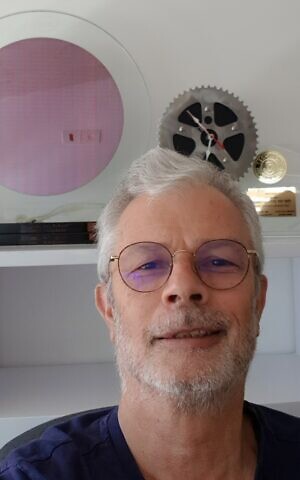
David Perlmutter, a former senior executive at
Intel
Corp (Courtesy).

Even before the pandemic, many tech firms were beginning to design and manufacture their own chips, rather than farming out the job to subcontractors like TSMC, Intel and Samsung. Custom-made chips can better serve their different products as competition grows. Custom-made chips also better meet the complex requirements of artificial intelligence computations as they handle machine learning algorithms and process images.

“The complexity of each of these chips grew in an unprecedented manner,” Perlmutter said. “When I joined Intel in 1980 the number of components, called transistors, in the most advanced processor chip was around 30,000-40,000. Today there are 50 billion transistors in an advanced processor chip.”

Israel’s prowess in not in the manufacturing of chips but mostly in their design, he said. “R&D development of a chip is likely the most complicated task in the world. The level of complexity is huge, and these are projects of hundreds of people who use computing tools to program them and giant computers to do simulations.”

With chips, “you touch at the underbelly and the most important nerves of the digital world,” Perlmutter added.

An illustrative image of a connected car (File).

The shift to cloud-based computing and the increased use of artificial intelligence is giving a new push to this field, as new chips need to be designed and developed to speed up the processing of huge amounts of data involved.

Training engineers takes many years, and even after they get their degrees, it takes years until they “fully understand the complexity” of chip design, Perlmutter said.

The tech giants understand that all of their AI and cloud activities are based on chips. They also believe that “they will find the best talent in Israel,” Perlmutter said.

The new 10th Gen Intel Core processors of Intel Corp. on a motherboard. (Courtesy)

Aside from Google, several other major firms have made moves toward giving Israel a bigger role in their chip design strategy.

Pat Gelsinger, the newly appointed CEO of Intel, said during a visit to Israel this year that the US tech giant is expanding local operations, setting up a new $200 million campus in Israel to develop the “chips of the future,” and will be recruiting 1,000 new employees locally.

Nvidia, a leading US chipmaker, said in March it plans to recruit 600 engineers locally to boost its activities in Israel, with a focus on artificial intelligence.

Microsoft is also increasing its chip-design activities in Israel, and Facebook is reportedly seeking to set up an R&D center in Israel focusing on the development of chips.

Amazon in 2015 bought Israel’s Annapurna Labs, which is now the US firm’s chip unit and is behind many of its most advanced custom chip projects.

‘We have the knowledge’

Until 1974, chips were only made in California’s Silicon Valley, which got its name from the material used to make the tech. That year, Intel opened a research and development center in Israel, just as the industry started taking off.

Some of the Intel’s fastest processors were developed by its Haifa team, which is the firm’s largest R&D center outside the US.

National Semiconductor, the US chip manufacturer, AMD and Motorola all followed Intel’s lead in setting up chip design facilities in Israel, fueling Israel’s eventual transition into Startup Nation.

Tech firms are expanding their activities in Israel because they know “know the complex abilities that exist here in Israel to design complex chips,” Perlmutter said.

According to data compiled by IVC Research Center, a data firm that tracks the local high-tech industry, there were a total of 37 multinational firms operating in Israel in the semiconductor segment in the first half of 2021, with a similar number in 2020 and 33 in 2017.
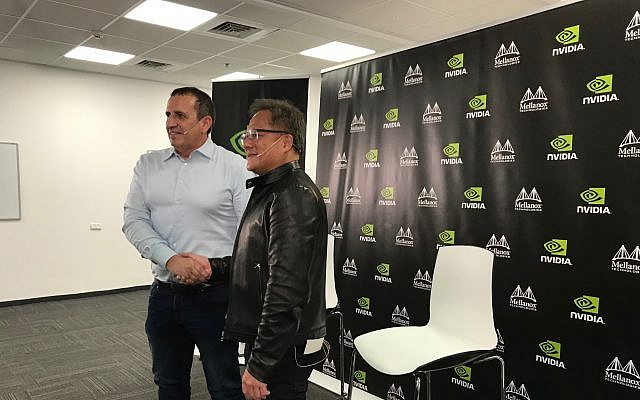
Eyal Waldman, left, founder and CEO of Mellanox, and Jensen Huang, the founder and CEO of Nvidia Corp., at a press conference in Yokne’am, Israel, on March 25, 2019 (Shoshanna Solomon/Times of Israel)

As demand grows for faster speeds, greater processing and storage power, there are huge technological challenges that need to be solved, said Waldman, the Mellanox founder. “We have the knowledge and the ability and we are among the most advanced countries in this field in the world.”

Other semiconductor design hubs, including Europe, which is starting to take off, are also good at chip design, Perlmutter said, but not at Israel’s level. China and India “are getting closer,” he said. “But Israel still has the advantage.”

‘Just the tip of the iceberg’

Microsoft employs more than 2,000 workers at its R&D center in Herzliya and the in-house development of chips is seen as a “strategically important and significant” part of its activities, said Ohad Jassin, who manages Azure Edge & Platform at  Microsoft Israel R&D. Even so, he said, many of the chips the US firm uses in its products still come from the firm’s partners, including Intel, ARM and AMD.

The chips designed by Microsoft’s Israel team are used for computing, edge appliances and cloud data centers, Jassin said in an interview. “There is experience here in Israel, as it is a veteran in the field, and there is talent that stems from the universities.”
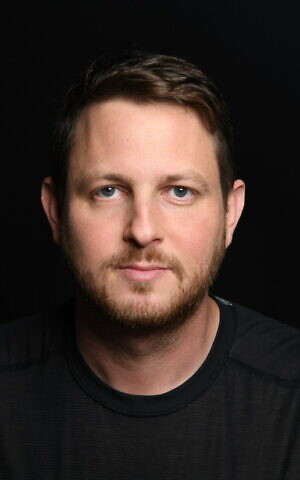
Ohad Jassin manages Azure Edge & Platform at
Microsoft
Israel R&D (Ronen Ackerman)

Microsoft also sees Israeli startups operating in the field as possible investment and acquisition targets, he said.

Locally, there are several semiconductor startups that develop chips, memory cards and processors, and it’s not uncommon for multinationals to acquire local companies or work with them as they expand chip-making activities here.

“There is an ecosystem here that is very interesting, that can interact with the larger companies,” said Perlmutter. They invest in these firms, sometimes buy them, and the engineers “move from one place to another. That is part of the tech ecosystem that is very important.”

Venture capital firms and corporations are pushing more funds into the semiconductor sector, which for years they largely turned a blind eye to, lured instead by the easier appeal of the software and social app industries. While the amount being invested in Israeli firms pales in comparison to those in the US, there is a clear trendline.

The nation’s largest tech exit ever was the 2017 sale of Mobileye, a maker of self-driving technologies and chips, to US giant Intel for a whopping $15.3 billion.

Other notable acquisitions have been US firm KLA-Tencor’s purchase of Orbotech for $3.4 billion in 2018. In 2019, chip manufacturer Nvidia snapped up Israel’s Mellanox Technologies for some $7 billion. Intel also acquired Habana Labs for $2 billion in 2019.

“Six, seven years ago it was hard to raise money for chip technologies. Big money went to software development, because investment in chip development is a longer process. But all of that has changed with the rise of AI and fast data communications,” said Perlmutter. Even so, he added, the number of corporations and VC firms that invest in semiconductors is still way smaller than the overall investment in tech firms.

In the first half of 2021, Israeli semiconductor startups raised a total of $588 million, in 13 deals, $141 million shy of the amount raised in the whole of 2020 in 24 deals, according to data compiled by IVC. Israeli tech firms raised a whopping $11.9 billion in the first half of 2021.

“There is a renaissance of the sector and there is a lot of investor money going into the field, including in Israel. This is giving a boost to the Israeli economy and also to the startup ecosystem, as it will lead to exits,” said Perlmutter.

IVC numbers show that the first half of 2021 saw three semiconductor firms make deals to raise at least $100 million. That’s compared to three such deals in all of 2020 and zero in 2019.
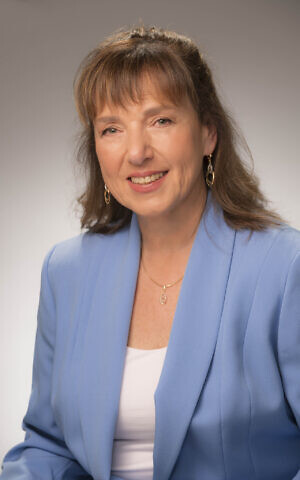
Shlomit Weiss has been appointed as co-general
manager
of Intel Corp.’s chip development and
design process.
(Shlomo Shoham).

The amounts raised per funding round are also much higher, with an average of $45 million raised per round in the first half of the year, compared to an average of $30 million in 2020, and an average of $15 million per round in 2019, when when $449 million was raised in 29 funding rounds.

What we have seen till now, both in terms of funding and exits, is “just the tip of the iceberg.” said Perlmutter.

“Overall, in Israel it is a very good time for hardware silicon engineering,” said Shlomit Weiss, who earlier this month was appointed co-general manager of Intel’s design engineering group, where she will be responsible for the entire chip development and design process of the US tech giant, including for computers, laptops and servers.

Intel is the most active investor in the national semiconductor scene, according to IVC, having                                                                 made 15 investments in the period between
2017 and the first half of 2021.

Operating in Israel “is good for the companies, because there are very good and innovative engineers” locally, she said in a recent interview. It is also good for Israel as “it helps the economy, and it also is good for the engineers, as it gives them more opportunities and more competition.”

Wanted: Engineers and startups

There are many challenges ahead, however, with the main ones being a shortage of engineers and programmers and a huge hike in salaries caused by competition between the multinationals and local startups for talent. The average monthly salary for a software engineer in Tel Aviv is some NIS 24,000 ($7,300), versus an average salary of some NIS 13,000 ($4,000) for the rest of the economy.

According to data compiled by the Israel Innovation Authority and Start-Up Nation Central, Israel’s tech industry suffered from a shortage of some 13,000 skilled workers at the end of 2020.

“Universities are not churning out enough engineers and there needs to be a strategic move of the industry and the government to increase the number of engineers in the shorter term and for the longer term,” said Perlmutter.

Another emerging trend, which is also being felt in the rest of Israel’s tech ecosystem, is a decline in the number of startups being set up, as would-be-entrepreneurs shun the risk of setting up their own firms in favor of the fat salaries offered by the local multinationals or the recently formed unicorn tech firms.

According to IVC, in the first half of the year there were no new startups set up in the semiconductor sector, as opposed to three new ones last year, and 12 in 2017.

“This is a major danger to the growth of our industry,” said Perlmutter. “The energy of innovation must continue. An ecosystem without new startups is not a healthy one.”

(Times of Israel).

 

Rabbi Jonathan Gewirtz – Spotted

0

Operation Inspiration


I’m not sure if it’s a widespread practice or not, but in my family, when we see someone or something familiar in an unusual or unexpected place, we’ll take a picture and send it to each other, with the caption: “Spotted!”

For example, if we’re driving on the highway and we see a cousin in another car, we’ll snap the picture and send it to the family, appropriately marked. This way, they know how cute it was that we happened to see our cousin. Or when my daughter was in Yerushalayim and saw one of my books at a seforim store, she sent me a pic of it on the shelf and said, “spotted!”

I’m not sure the origins of the ritual, but if I had to venture a guess, I’d think it was a recognition of Hashgacha Pratis, or as my daughter calls it (and I’ve told you this before) – HP.

I think it’s based on the understanding that Hashem orchestrated events so that this meeting occurred. Whether it was the traffic patterns and similar destinations or the fact that the booksellers bought the book and my daughter “happened” to be in that section so she saw it and let me know, we recognize that Hashem set these things in motion.

Recently at shul, I had another insight into this phenomenon and I thought, “Hey, that would make a great article!” So I used some memory triggers so I didn’t forget the idea, and now I’m writing it.

It was a Shabbos when the shul was extremely crowded. There was a simcha so there were guests both local and from out of town. There were also a number of people whose married children were visiting, some regulars had their parents-in-law with them, and seats were at a premium. Ok, who am I kidding? It was standing room only.

Anyway, I had arrived on time and took my regular seat, with my shtender right in front of me. A visiting father and son came in and I motioned them to two empty seats next to me. I don’t think they were sold on the idea, but they did take those seats, and I think they were glad they did. As the morning wore on, more people arrived and the crush was on. People kept looking for a place to sit or stand. They’d walk in, look left and right, and try to spot a place for themselves. But not me. Though chaos ensued around me, I was in a place of calm. It struck me how this was such a metaphor for life.

Often, we find ourselves in situations we’re not so sure of. They may be difficult places, with challenges and hardships, or they may be calm places where things just seem to be going smoothly. We may not have planned those circumstances, but Hashem did.

Hashem has a specific place for each of us at every moment. Let’s call it “Hashem’s Place,” or HP.  It’s where we are supposed to wind up and we don’t need to be running around trying to find another place. He’s already assigned it to us, even if it’s at the back, sharing half a chair with someone else. As they say, “Wherever you go, there you are!”

I’m not sure that that means either, but I take it to mean that you will always find yourself right where He wants you. Whether it’s a physical location or a station in life, you are right where you need to be. It may not be the most comfortable place, like my seat in shul that day, but it is the right place for you.

The posuk says, “Haboteach BaShem, Chesed Yesovevenhu,” One who trusts in Hashem is surrounded by kindness. That doesn’t mean nothing “bad” will ever happen to him, but rather that one who understands that everything comes from Hashem for a purpose will see whatever happens to him as kindness. It may encircle him like a shiver of sharks (nope, they’re not called a school, maybe because that’s what happens when someone is surrounded by sharks – he gets a shiver) but it’s kindness surrounding him. Maybe because he needs to be scared for some reason at that moment in time.

So the next time you’re wondering, “How did I get myself into this mess?” remind yourself that you may have had less to do with it than you might think. It could very well be that this is where Hashem put you and said, “Wait here for Me.”

© 2021 – All Rights Reserved

Did you enjoy this column? Feedback is welcome and appreciated. E-mail info@JewishSpeechWriter.com to share your thoughts. You never know when you may be the lamp that enlightens someone else.

Rabbi Lord Jonathan Sacks zt”l – To Lead is to Listen (Eikev 5781)

“If only you would listen to these laws…” (Deut. 7:12). These words with which our parsha begins contain a verb that is a fundamental motif of the book of Devarim. The verb is sh-m-a. It occurred in last week’s parsha in the most famous line of the whole of Judaism, Shema Yisrael. It occurs later in this week’s parsha in the second paragraph of the Shema, “It shall be if you surely listen [shamoa tishme’u]” (Deut. 11:13). In fact, this verb appears no less than 92 times in Devarim as a whole.

We often miss the significance of this word because of what I call the fallacy of translatability: the assumption that one language is fully translatable into another. We hear a word translated from one language to another and assume that it means the same in both. But often it doesn’t. Languages are only partially translatable into one another.[1] The key terms of one civilisation are often not fully reproducible in another. The Greek word megalopsychos, for example, Aristotle’s “great-souled man” who is great and knows he is, and carries himself with aristocratic pride, is untranslatable into a moral system like Judaism in which humility is a virtue. The English word “tact” has no precise equivalent in Hebrew. And so on.

This is particularly so in the case of the Hebrew verb sh-m-a. Listen, for example, to the various ways the opening words of this week’s parsha have been translated into English:

If you hearken to these precepts…

If you completely obey these laws…

If you pay attention to these laws…

If you heed these ordinances…

Because ye hear these judgments…

There is no single English word that means to hear, to listen, to heed, to pay attention to, and to obey. Sh-m-a also means “to understand,” as in the story of the tower of Babel, when God says, “Come, let us go down and confuse their language so they will not understand [yishme’u] each other” (Gen. 11:7).

As I have argued elsewhere, one of the most striking facts about the Torah is that, although it contains 613 commands, it does not contain a word that means “to obey.” When such a word was needed in modern Hebrew, the verb le-tzayet was borrowed from Aramaic. The verb used by the Torah in place of “to obey” is sh-m-a. This is of the highest possible significance. It means that blind obedience is not a virtue in Judaism. God wants us to understand the laws He has commanded us. He wants us to reflect on why this law, not that. He wants us to listen, to reflect, to seek to understand, to internalise and to respond. He wants us to become a listening people.

Ancient Greece was a visual culture, a culture of art, architecture, theatre and spectacle. For the Greeks generally, and Plato specifically, knowing was a form of seeing. Judaism, as Freud pointed out in Moses and Monotheism,[2] is a non-visual culture. We worship a God who cannot be seen; and making sacred images, icons, is absolutely forbidden. In Judaism we do not see God; we hear God. Knowing is a form of listening. Ironically, Freud himself, deeply ambivalent though he was about Judaism, invented the listening cure in psychoanalysis: listening as therapy.[3]

It follows that in Judaism listening is a deeply spiritual act. To listen to God is to be open to God. That is what Moses is saying throughout Devarim: “If only you would listen.” So it is with leadership – indeed with all forms of interpersonal relationship. Often the greatest gift we can give someone is to listen to them.

Viktor Frankl, who survived Auschwitz and went on to create a new form of psychotherapy based on “man’s search for meaning,” once told the story of a patient of his who phoned him in the middle of the night to tell him, calmly, that she was about to commit suicide. He kept her on the phone for two hours, giving her every conceivable reason to live. Eventually she said that she had changed her mind and would not end her life. When he next saw the woman he asked her which of his many reasons had persuaded her to change her mind. “None,” she replied. “Why then did you decide not to commit suicide?” She replied that the fact that someone was prepared to listen to her for two hours in the middle of the night convinced her that life was worth living after all.[4]

As Chief Rabbi I was involved in resolving a number of highly intractable agunah cases, situations in which a husband was unwilling to give his wife a get so that she could remarry. We resolved all these cases not by legal devices but by the simple act of listening: deep listening, in which we were able to convince both sides that we had heard their pain and their sense of injustice. This took many hours of total concentration and a principled absence of judgment and direction. Eventually our listening absorbed the acrimony and the two sides were able to resolve their differences together. Listening is intensely therapeutic.

Before I became Chief Rabbi, I was head of our rabbinical training seminary, Jews’ College. There in the 1980s we ran one of the most advanced practical rabbinics programmes ever devised. It included a three-year programme in counselling. The professionals we recruited to run the course told us that they had one precondition. We had to agree to take all the participants away to an enclosed location for two days. Only those who were willing to do this would be admitted to the course. We did not know in advance what the counsellors were planning to do, but we soon discovered. They planned to teach us the method pioneered by Carl Rogers known as ‘non-directive’ or ‘person-centred’ therapy. This involves active listening and reflective questioning, but no guidance on the part of the therapist.

As the nature of the method became clear, the Rabbis began to object. It seemed to oppose everything they stood for. To be a Rabbi is to teach, to direct, to tell people what to do. The tension between the counsellors and the Rabbis grew almost to the point of crisis, so much so that we had to stop the course for an hour while we sought some way of reconciling what the counsellors were doing with what the Torah seemed to be saying. That is when we began to reflect, for the first time as a group, on the spiritual dimension of listening, of Shema Yisrael.

The deep truth behind person-centred therapy is that listening is the key virtue of the religious life. That is what Moses was saying throughout Devarim. If we want God to listen to us, we have to be prepared to listen to Him. And if we learn to listen to Him, then we eventually learn to listen to our fellow humans: the silent cry of the lonely, the poor, the weak, the vulnerable, the people in existential pain.

When God appeared to King Solomon in a dream and asked him what he would like to be given, Solomon replied: lev shome’a, literally “a listening heart” to judge the people (1 Kings 3:9). The choice of words is significant. Solomon’s wisdom lay, at least in part, in his ability to listen, to hear the emotion behind the words, to sense what was being left unsaid as well as what was said. It is common to find leaders who speak, very rare to find leaders who listen. But listening often makes the difference.

Listening matters in a moral environment as insistent on human dignity as Judaism. The very act of listening is a form of respect. To illustrate this, I would like to share a story with you. The royal family in Britain is known always to arrive on time and depart on time. I will never forget the occasion ­– her aides told me that they had never witnessed it before – when the Queen stayed for two hours longer than her scheduled departure time. The day was 27 January 2005, the occasion, the sixtieth anniversary of the liberation of Auschwitz. The Queen had invited survivors to a reception at St James’ Palace. Each had a story to tell, and the Queen took the time to listen to every one of them. One after another came up to me and said, “Sixty years ago I did not know whether tomorrow I would be alive, and here I am talking to the Queen.” That act of listening was one of the most royal acts of graciousness I have ever witnessed. Listening is a profound affirmation of the humanity of the other.

In the encounter at the Burning Bush, when God summoned Moses to be a leader, Moses replied, “I am not a man of words, not yesterday, not the day before, not from the first time You spoke to Your servant. I am slow of speech and tongue” (Ex. 4:10). Why would God choose a man who found it difficult to speak to lead the Jewish people? Perhaps because one who cannot speak learns how to listen.

A leader is one who knows how to listen: to the unspoken cry of others and to the still, small voice of God.


[1] Robert Frost said: “Poetry is what gets lost in translation.” Cervantes compared translation to the other side of a tapestry. At best we see a rough outline of the pattern we know exists on the other side, but it lacks definition and is full of loose threads.

[2] Vintage, 1955

[3] Anna O. (Bertha Pappenheim) famously described Freudian psychoanalysis as “the talking cure,” but it is in fact a listening cure. Only through the active listening of the analyst can there be the therapeutic or cathartic talking of the patient.

[4] Anna Redsand, Viktor Frankl: A Life Worth Living, Houghton Mifflin Harcourt, 2006, 113-14.

For The First Time: IDF Is Drafting People On The Spectrum

By Gil Tanenbaum

Jerusalem, 28 July, 2021 (TPS) — The Israel Defense Forces have announced that it will now be drafting Israelis who are on the autism spectrum. This will be done under the auspices of a new program simply called “Progress.”

The IDF has always served to help the disabled integrate into Israeli society and move forward with careers after their service. It has also done the same for new immigrants. This has been somewhat of an unofficial additional mission of the IDF over the years.

The IDF even offers Hebrew language courses to new immigrants and has education personnel dedicated to aiding those people with disabilities in the service.

Over the years deaf and blind Israelis, even those confined to wheelchairs, have been able to perform military service in Israel. This is important in a country where serving in the IDF is part of the national culture.

Now people on the spectrum can be included in this important part of the Israeli identity as well.

There have been programs in the past which allowed autistic people to serve on a voluntary basis. They could perform simple tasks in the IDF for short periods of time. This allowed them to say that they did their civic duty and to feel included in society. But this is the first time that the IDF will induct such people for full terms of service. And they will serve in regular units integrated with everybody else.

The autistic people drafted to serve will be from the high-functioning end of the spectrum. They will be allowed to serve in regular units and go through training like any other Israeli.

Obviously, many cases of autism are too severe to allow for a person’s integration into what they call neuro-typical society. These are the ones whose autism leaves them unable to function and who need, in some cases, to be institutionalized.

Not all of the people on the spectrum, however, are like the Dustin Hoffman character in Rain Man or the Leonardo Dicaprio character in What’s Eating Gilbert Grape.

The people on the spectrum who are high functioning are those who you would not be able to tell are autistic just by meeting them. However, they have significant trouble integrating into society as they lack the almost instinctual social skills that the general population takes for granted.

They are the sorts of people who at one time in the past might have been called idiot-savants. Just think of the cliché of the nerdy computer geek with his pocket protector, or the Star Trek Nerd from school who went on to design advanced software systems or who became a rocket scientist.

You may have seen recent television programs and movies about people who are on the high functioning end of the autism spectrum. Netflix has one such show called Atypical. Even Ben Affleck recently starred in an action movie where he played a man on the spectrum who was brilliant with numbers and accounting.

Today, as more people become aware of the problem, it is getting easier for such people to integrate into society. Many who could contribute as employees in a company as trained professionals, whether accountants, programmers, engineers, or just about any field requiring higher education, are often rejected for jobs because of how they appear on the outside.

But as more people become aware of this type of disability and are seen more frequently working in private companies, then they will become more accepted by society. The decision to draft people on the spectrum into the IDF should help this process along.

Today, there are 53 new Israeli soldiers, sailors and airmen who are officially diagnosed as being on the spectrum. The IDF hopes that within the next few years as many as 500 new recruits per year will come from people on the spectrum.

The officers and sergeants who will be in command of the new recruits’ basic training underwent special additional training themselves. And specially trained soldiers who already work within the IDF – these are sort of the internal social workers of the Israeli military – will be assigned to supervise the service of those on the spectrum by looking in on them from time to time.

It should be noted, however, that these new recruits will go through the same specialty training courses as all IDF soldiers do after they complete basic training. So once in their active-duty units, the soldiers who are on the spectrum will serve alongside people who they already had a chance to get to know during training. Most importantly, though, their fellow soldiers will be apprised of their disability and special needs ahead of time.

Among the positions that the IDF will open for high functioning young people on the spectrum are those to be expected. They will work in cybersecurity, software testing, systems development, network manager, doing naval intelligence research in the navy, and even in the vaunted unit 8200 which protects the IDF’s secrets.

TRAGIC: Three Yeshiva Boys Amongst Dead In Small Plane Crash In Ukraine

0

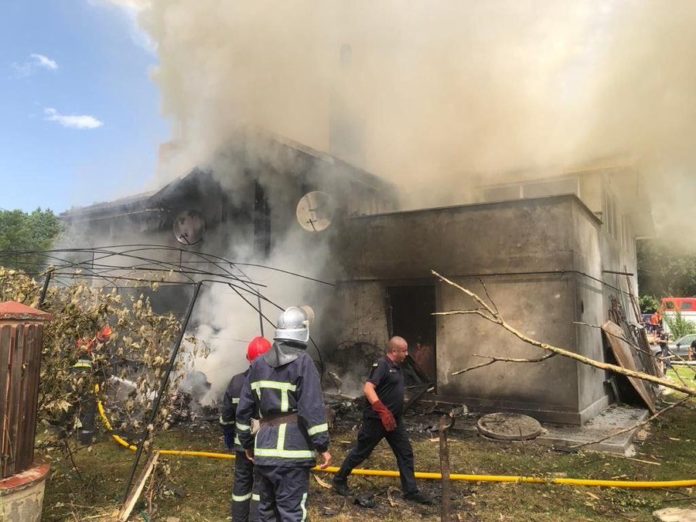
UKRAINE (VINnews) – At least four people died after a light aircraft crashed into the roof of a private villa in Prykarpattia in western Ukraine on Wednesday afternoon, the English Daily Express reported.The light aircraft crashed directly into the roof of a private villa in Prykarpattia in western Ukraine at around 1.40pm local time. Ten firefighters were called to the scene, and reportedly had the lethal blaze under control by 1.58pm.

Three of the victims were reported to have been young Yeshiva students.

Later, the three boys were identified as, Avrohom Fromowitz, Heshy Weiss, and Lazer Brill.

Reportedly, one of the Students was from the U.K., one was from Williamsburg, and the third was from Monsey.

Ukraine media is reporting that famous pilot Igor Tabanyuk was also killed. According to the regional department of the National Police, there were no people in the house that caught fire at the time of the accident.

The State Emergency Service of Ukraine said in a statement: “On July 28, at about 1:40 p.m., a light-powered sports plane crashed into a private house near the village of Sheparivtsi, Kolomyia district, with subsequent burning, killing four people.”

It is currently not known what caused the plane to go down or whether it was already on fire before it crashed into the villa.

Source: Vosizneias

Prominent actor puts black belt skills to use protecting fellow Jews in LA

0

“If you don’t don’t stand against all hate, you don’t stand against any,” says Jonathan Lipnicki.

Dubbed a “Shabbos angel,” actor Jonathan Lipnicki, a black belt in jiu jitsu, has been spending every weekend protecting Orthodox Jews in the Fairfax district of Los Angeles.

Lipnicki joined his friend, fellow actor and mixed martial artist Remi Franklin, to combat the ongoing anti-Semitic attacks outside an Orthodox synagogue in LA. The attacks intensified during Israel’s May 2021 Operation Guardian of the Walls against the Hamas terrorist group, which was targeting Israel’s civilian population with indiscriminate rocket fire.

“There have been a lot of anti-Semitic hate crimes and violence towards Jews,” explained Lipnicki, who got his break at age six in the 1996 film “Jerry McGuire” playing opposite Tom Cruise.

“Everyone should have the right to worship without being discriminated against,” he added, speaking to the entertainment site TMZ.

“They say in Judaism that there’s two angels — and I’m going to butcher this — one angel on either side of you when you walk to and from the synagogue,” Lipnicki explained to Spectrum News 1. “So a lot of people in the community kind of coined the phrase ‘Shabbat Angels.’”

Franklin started the volunteer group — mostly made of mixed martial artists — to make sure that Jewish families got to synagogues and back home safely. “Not all of us are Jewish, it’s just people wanting to help other people,” Franklin said.

“We had a bunch of people screaming horrible Nazi slurs up and down the street on a regular basis, and they do it specifically on Friday and Saturday when the Orthodox can’t carry their phones,” he added.

“A couple of people tried to run over some kids, there’s a rabbi that almost got run over in this parking lot, you name it. A kid was paintballed a couple weeks ago, multiple things … it just consistently keeps happening.”

Lipnicki said bullies and people who promote hate don’t like it when they see their presence in front of the synagogue.

“[It] is a huge deterrence, and I’m glad people’s eyes have been opened,” just like they have with other communities, including the Asians, who have been targeted, he said. “If you don’t don’t stand against all hate, you don’t stand against any.”

Other security groups have also formed in LA in response to the rising number of violent anti-Semitic incidents, including Magen Am, which means “nation’s shield” in Hebrew. Many of its volunteers are former Israeli soldiers.

The mission of the group, a registered nonprofit organization, is “to train and empower the community to secure itself from within.”

(World Israel News).

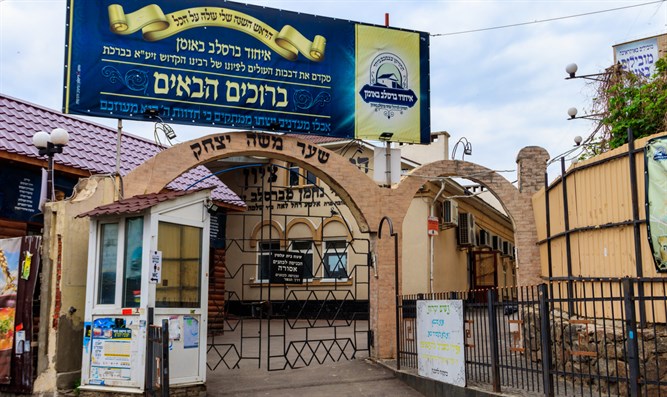
Uman outline: Special terminal for Hasidim, testing in Ukraine

0

Charter flights will be significantly reduced. As long as Ukraine is ‘green,’ travel there will be allowed.

Minister of Religions Matan Kahana and Minister of Health Nitzan Horowitz summarized the outline for the trips from Israel to Uman for Rosh Hashanah.

The outline that will be presented to the Corona Cabinet in the coming days has been formulated with broad agreement by Minister Kahana, in coordination with Breslov rabbis and activists and senior officials of the Ministry of Health.

Minister Kahana will meet tomorrow with the Ukrainian ambassador to Israel and introduce him to the principles of the outline.

The ministers’ guideline was that as long as Ukraine remains a green country, Hasidim would be allowed to travel to Uman, just like any trip to any other green country, according to the guidelines as they are today.

The ministers stressed that there would be no discrimination among travelers abroad.

As part of the outline, it was decided, however, to significantly reduce the number of special (charter) flights from Ben Gurion Airport to Ukraine.

In addition, the Hasidim’s flights will take off from Terminal 1 and the system of tests at Ben Gurion Airport will be reinforced in preparation for the Hasidim’s return after Rosh Hashanah.

In addition, a system for tests will be set up in Kiev and Uman ahead of the return flight, under the responsibility of Breslov organizations. Each passenger will have to undergo three tests like any other traveler abroad. Unvaccinated and children under the age of 12 will be required to isolate for 14 days or for seven days with two negative tests.


Source: Arutz Sheva


Swiss Jewish community slams Swiss Press Council’s pro-BDS stance

0

Swiss Jewish Federation outraged after country’s press council rules against magazine that printed article linking BDS to anti-Semitism.

The Swiss Federation of Jewish communities (SIG) has expressed outrage at what it called the Swiss Press Council’s biased stance toward the BDS movement.

After the Swiss Press Council harshly criticized an article in Prime News, a Swiss online magazine, for denouncing the BDS movement as anti-Semitic, the SIG reacted with shock, noting the Press Council’s “uncritical and almost partisan attitude toward BDS.”

The Press Council in its ruling accused Prime News of “improper reporting, of not taking expert opinions into account and even of using misleading definitions of anti-Semitism” for an article it published that described the BDS movement as “anti-Semitic,” “tinged with anti-Semitism,” or “considered by many experts to be anti-Semitic.”

“The Press Council has now sided with a complainant and reprimanded a journalist. In particular, the reasoning behind the ruling by the Press Council is disconcerting,” the SIG, the Swiss affiliate of the European Jewish Congress, said in a statement.

“BDS claims to only target the State of Israel and its representatives with its boycott calls and measures. In fact, it regularly targets individual Israeli citizens.”

The SIG questioned why the Press Council would adopt the “argumentation of the BDS movement verbatim.”

“The Press Council chose to ignore the IHRA working definition of anti-Semitism, recognized internationally and also recently adopted by Switzerland. Instead, it relied only pronouncements by the BDS itself and chose to suppress opinions to the contrary,” stated the SIG.

“Particularly offensive is the Press Council’s pronouncement that it is ‘disputed’ whether rejecting Israel’s right to exist is anti-Semitic.”

The SIG added, “The patterns of action and methods of the BDS movement have a clearly anti-Semitic tinge and may and should be described as such,” the SIG concluded.

(Arutz 7).

US bill demands reform of UNRWA in return for funding

0

The UNRWA Accountability and Transparency Act was introduced simultaneously in the Senate and the House by Republican legislators.

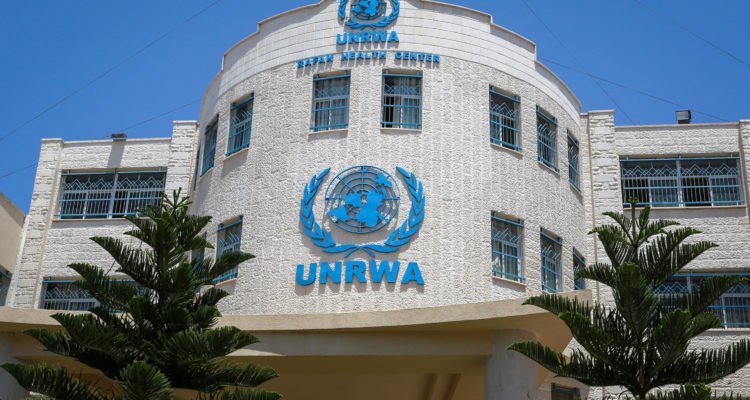
A new law was proposed Tuesday by Republicans in the House of Representatives and the Senate that would ban funding the UN organization for Palestinian refugees and their descendants unless a string of reforms is carried out.

Senator James Risch (R-ID) and Congressman Chip Roy (R-TX) gave several reasons for introducing their UNRWA Accountability and Transparency Act.

“When UNRWA was created, its specific purpose was to provide relief for refugees of the 1948 Arab-Israeli Conflict,” said Sen. Jim Risch. “More than 70 years later, the organization has employed individuals affiliated with Hamas, a U.S. designated foreign terrorist organization (FTO), and its schools have been used to promote anti-Semitism and store Hamas weapons.”

“It is unacceptable that U.S. taxpayer dollars are being used to fund this agency, which is why I’ve introduced legislation to cease U.S. contributions to UNRWA unless the administration can certify without a doubt that the agency has no affiliation with U.S. designation FTOs and does not support anti-Semitic rhetoric.

“The American people deserve better, and I look forward to working with my colleagues on holding both the administration and UNRWA accountable until meaningful reforms are made.”

Israel has long held that the UN agency should be disbanded, in the belief that it only helps to perpetuate the Arab-Israeli conflict.

The bill demands that the Secretary of State certify in writing that no UNRWA employee or recipient of its funds supports or has ties to terrorist organizations “like Hamas or Hezbollah.”

A full financial audit and vetting system must also be put in place to prevent any UNRWA funds being diverted to such organizations.

In addition, neither its employees or its educational material can promote anti-American, anti-Israel, or anti-Semitic rhetoric without the body losing its American funding.

Congressman Roy also cited UNRWA’s ties to Hamas and its “long track record of using educational materials that promote anti-Semitism, violence, and terrorism,” which makes the organization “an obstacle to peace” with a “flawed mandate [that] perpetuates the Palestinian ‘refugee crisis’ by using a nonsensical definition of a refugee.”

The Palestinians are the only group in the world that is also allowed to call descendants of those who fled war “refugees,” thus swelling their numbers from several hundred thousand in 1948 to several million today. A State Department report from 2018 stated that by now there are only some 20,000 refugees left from Israel’s War of Independence.

“I am proud to partner with Senator Jim Risch to put an end to the Biden Administration’s reckless decision to funnel hundreds of millions of dollars to UNRWA,” Roy added, “which has failed to meet previous commitments to stop its hostility towards Israel. If we truly desire peace, we must chart a new course that phases out UNRWA.”

The bill, which has 12 Senate and 28 Congressional co-sponsors, was brought in response to the Biden administration’s April decision to restore aid – to the tune of $150 million – that had been cut off by the Trump administration due to the issues cited by the legislators.

An additional $75 million was allocated at the same time for economic and development assistance to the Palestinians themselves.

As the ranking member on the Senate Foreign Relations Committee, Risch had put an “information hold” on the additional funds, blocking the aid by preventing notification of its reinstatement from reaching the committee.

At the time, he had stated that there should first be “increased oversight of Palestinian assistance to ensure compliance with anti-terrorism policies,” such as the cancellation of the Palestinian Authority’s financial support of jailed terrorists that flies in the face of American law.

(World Israel News).

WP Twitter Auto Publish Powered By : XYZScripts.com