After Mossad was pegged as responsible for latest attack on Islamic Republic’s nuclear sites, Ehud Ya’ari says Tehran unlikely to continue exercising restraint.
Channel 12 defense analyst Ehud Ya’ari says that, with the Mossad’s apparent leaks to Hebrew media taking responsibility for the latest attack on an Iranian nuclear site, “we’re getting close to the moment” where Tehran will have no choice but to respond with a military strike of its own.
Ya’ari notes that Iran has been restrained until now, despite the November 2020 assassination of its former nuclear chief Mohsen Fakhrizadeh and successive Israeli strikes in Syria.
Moreover, Ya’ari says that, despite the various setbacks attributed to Israel, Iran has continued making progress with its nuclear program.
If they call it “terror… there must be damage, otherwise they wouldn’t call it nuclear terror,” Ya’ari says of the power outage at the Natanz nuclear facility earlier today.
For his part, former CIA director James Woolsey writes that the Iranians already have all the components needed for a nuclear weapon.
Nearly 25% of Americans report that they have ZERO dollars saved for an emergency.¹
If something unexpected were to happen, do you have enough savings to get you and your family through it and back to solid ground again?
If you’re not sure you have enough set aside, being blindsided with an emergency might leave you in the awkward position of asking family or friends for a loan to tide you over. Or would you need to rack up credit card debt to get through a crisis? Dealing with a financial emergency can be stressful enough – like an unexpected hospital visit, car repairs, or even a sudden loss of employment. But having an established Emergency Fund in place before something happens can help you focus on what you need to do to get on the other side of it.
As you begin to save money to build your Emergency Fund, use these 5 rules to grow and protect your “I did not see THAT coming” stash:
1) Separate your Emergency Fund from your primary spending account. How often does the amount of money in your primary spending account fluctuate? Trips to the grocery store, direct deposit, automatic withdrawals, spontaneous splurges – the ebb and flow in your main household account can make it hard to keep track of the actual emergency money you have available. Open a separate account for your Emergency Fund so you can avoid any doubt about whether or not you can replace the water heater that decided to break right before your in-laws are scheduled to arrive.
2) Do NOT touch this account. Even though this is listed here as Rule #2, it’s really Rule #1. Once you begin setting aside money in your Emergency Fund, “fugettaboutit”… unless there actually is an emergency! Best case scenario, that money is going to sit and wait for a long time until it’s needed. However, just because it’s an “out of sight, out of mind” situation, doesn’t mean that there aren’t some important features that need to be considered for your Emergency Fund account:
You must be able to liquidate these funds easily (i.e., not incur penalties if you make too many withdrawals)
Funds should be stable (not subject to market shifts)
You definitely don’t want this money to be locked up and/or potentially lose value over time. Although these two qualities might prevent any significant gain to your account, that’s not the goal with these funds. Pressure’s off!
3) Know your number. You may hear a lot about making sure you’re saving enough for retirement and that you should never miss a life insurance premium. Solid advice. But don’t pause either of these important pieces of your financial plan to build your Emergency Fund. Instead, tack building your Emergency Fund onto your existing plan. The same way you know what amount you need to save each month for your retirement and the premium you need to pay for your life insurance policy, know how much you need to set aside regularly so you can build a comfortable Emergency Fund. A goal of at least $1,000 to three months of your income or more is recommended. Three months worth of your salary may sound high, but if you were to lose your job, you’d have at least three full months of breathing room to get back on track.
4) Avoid bank fees. These are Emergency Fund Public Enemy No. 1. Putting extra money aside can be challenging – maybe you’ve finally come to terms with giving up the daily latte from your local coffee shop. But if that precious money you’re sacrificing to save is being whittled away by bank fees – that’s downright tragic! Avoid feeling like you’re paying twice for an emergency (once for the emergency itself and second for the fees) by using an account that doesn’t charge fees and preferably doesn’t have a minimum account balance requirement or has a low one that’s easy to maintain. You should be able to find out what you’re in for on your bank’s website or by talking to an employee.
5) Get started immediately. There’s no better way to grow your Emergency Fund than to get started!
There’s always going to be something. That’s just life. You can avoid that dreaded phone call to your parents (or your children). There’s no need to apply for another credit card (or two). Start growing and protecting your own Emergency Fund today, and give yourself the gift of being prepared for the unexpected.
By It’s kind of cliché, but often we don’t want to get into discussions about what we don’t like about someone else so instead of explaining what’s happening, we give excuses.
Shidduchim is a perfect example. A girl goes out on a date with a boy and while they’re driving, someone cuts him off in traffic. He starts yelling at the guy and speeds up to cut off the other driver in spite.
While some girls may like this behavior, (and they probably ought to get their heads examined, if so) the hypothetical girl of our example does not. For the rest of the evening, throughout the conversation, she can’t put it out of her mind. When she speaks to the shadchan, she doesn’t want to hurt the guy’s chances of other Shidduchim so she just says it wasn’t right for her.
Essentially, she’s said, “It’s not you; it’s me.” There is nothing wrong with you, but the reason I’m not going forward is because of an issue that I have. It’s a way to be nice, but then again, it’s not necessarily the best way to handle things. What if nobody ever told this fellow that road rage isn’t attractive? What if he went through life making the same mistake because nobody pointed out the error of his ways? Sadly, he would continue to alienate people and not know what he did wrong.
It’s like the guy I’ve written about in the past who, when he went to pick up a girl, honked the horn and waited for her to come out. When my friend’s cousin was the recipient of such a tootling, she refused to go out with a guy who wouldn’t come get her from the door. When my friend relayed the message that his cousin said she wasn’t going to go out with him, the guy smacked the wheel and cluelessly said, “They ALWAYS say that!” Maybe letting him know what was wrong would be better.
Or consider someone going for a job interview, who had an everything bagel for lunch. Their teeth are now sparkling white with a few noticeable black dots, and that’s all an interviewer would see. A true friend would point out what was wrong. I recall a salesman making a presentation and I didn’t hear a word he said because his bottom shirt button was open and one string of his tzitzis was popping through and hanging down by itself. It distracted me but I couldn’t tell him about it then.
However, I was thinking that sometimes “It’s not you; it’s me” is very appropriate.
While driving with my daughter, I was doing a good speed on an unusually empty highway and she asked, “Why are you going so fast when you have to get off in half a mile?” I quickly glanced at my GPS and realized she was right. Though I could have continued on that highway, Google Maps thought I should take a different route. Not having time to compare routes, I exited. Sure enough, as luck would have it, we hit traffic. Not only that, but the exit we were supposed to take was closed and we had an 8-mile detour! We ended up arriving half an hour later than if we’d stayed on the first highway.
My daughter apologized for saying anything but I assured her she’d done nothing wrong. She was bringing the GPS route to my attention and I knew it was bashert anyway. In effect I said, “It’s not you; it’s me.” It was not she who had made us get stuck, even though I might have stayed the other way had I not noticed the GPS. There was no reason to blame her, and I wanted to make sure she didn’t feel guilty. That was a good time for that sentiment.
Another time to use this technique, though somewhat more difficult, is when someone did something to harm you. You should tell yourself that it wasn’t their doing, but rather a decree from Hashem, like Dovid HaMelech said about the curse of Shimi ben Geira. “Hashem said, “Curse Dovid!”” He rationalized. He was therefore not hurt or upset by it, or at least he didn’t take it personally as an affront from Shimi and he understood that Hashem was behind it. If we tell ourselves this when people hurt or insult us, we’ll be better able to handle it and we won’t blame or hold onto hard feelings.
Finally, there’s another time when it’s great to say “It’s not you, it’s me” even when it isn’t true.
Remember that case we mentioned about five seconds ago where someone did something bad to you? Remember how I said you should say, “It was meant to be”? That only works when you’re the one who was wronged. However, if you’re the one someone feels did something to hurt them, even if it was clearly bashert like my daughter and the GPS, you should not tell them, “why are you blaming me? It was Hashem!”
That’s because if they are hurting they won’t be able to see things as calmly as you are. They need the kindness that you can give them by taking responsibility and apologizing. The upside is that since you really didn’t do anything wrong, it’s easier to “take responsibility” for your actions and the problem, and make them feel better at the same time.
In other words, now would be an excellent time to say, “It’s not you; it’s me” to avoid hurting their feelings, and hopefully at some point later on they’ll take a good look in the mirror and realize you were just being nice.
Did you enjoy this column? Feedback is welcome and appreciated. E-mail info@JewishSpeechWriter.com to share your thoughts. You never know when you may be the lamp that enlightens someone else
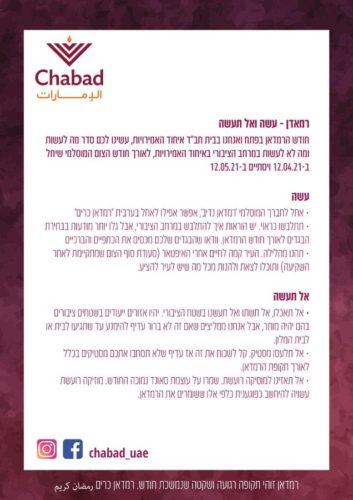
The friendly reminder was issued to the UAE Hebrew Twitter page in cooperation with the local Chabad branch.
Earlier today (Sunday), and in preparation for the month long Ramadan during which Muslims are expected to put more effort into following the teachings of Islam, the United Arab Emirates has issued guidelines specifically meant for Israeli tourists visiting the region during this time span.
The guidelines, written in Hebrew via the Hebrew language UAE Twitter page, features a Chabad graphic design showcasing do’s and don’ts to be acknowledged and followed closely.
The post calls to greet Muslim encounters between April 12th and May 12th with ‘Ramadan Kareem’ or ‘Ramadan Nadiv’. It also calls to dress in modest clothes covering ones knees and shoulders. Lastly, the post invites all visitors to enjoy the night coming to life with the traditional end of fast feasts.
The post warns to refrain from drinking and eating in public unless located in designated areas. In order to avoid confusion they recommend eating meals at the hotels. It is requested not to chew gum in public during the entire Ramadan. Lastly, it is requested visitors not listen to loud music, as it may be interpreted as hurtful towards those observing the holiday.
The end of the post features a subtle warning, explaining the Ramadan is a calm and quiet period of time. The post is cross-shared with the page of the Alliance Rabbis Islamic States.
Former Democrat Senator Harry Reid (NV) warned during a CNN interview on Saturday that Democrats need to be very careful when it comes to trying to alter the Supreme Court, including packing the court with leftist judges or trying to subject the justices to term limits.
CNN’s Jim Acosta asked Reid about whether he thought it was a good idea to pack the court, a push being made by the far-Left.
“I think it’s — we should be very, very careful in doing so. I have no problem with the commission, but I think that the commission is going to come back and disappoint a lot of people because I think they’re going to come back and say, we should just kind of leave it alone,” Reid said.
“I think it would be inappropriate at this time after that long history we’ve had in the country [to] have term limits for judges. I think that we better be very, very careful in saying that we need to expand the Supreme Court. I think we better be very, very, careful.”
Reid’s remarks come after President Joe Biden announced on Friday that he created a commission to study expanding the Supreme Court.
The New York Times reported that Biden did so because he was “under pressure from activists.”
The commission, which is being led by two former Obama officials, is comprised of members who are overwhelmingly on the political Left. This led George Washington University law professor Jonathan Turley to warn that it was “not a good sign” for how things are likely to go.
Reid’s push for Democrats to exercise caution before doing anything radical to the court system comes after Reid eliminated the filibuster for judicial nominees under former President Barack Obama, a move that then-Senate Minority Leader Mitch McConnell (R-KY) warned Democrats would come to regret.
Just a few short years later, they did regret it after President Donald Trump got to select three Supreme Court justices and got to reshape the federal judiciary with scores of conservative judges.
Court-packing is politically controversial, and the majority of Americans oppose it, including socialist Sen. Bernie Sanders (I-VT), leftist Supreme Court Justice Stephen Breyer, and even former leftist Supreme Court Justice Ruth Bader Ginsburg.
Mike Davis, founder and president of the Article III Project (A3P), warned that Biden’s move was “alarming” and must “be met with the harshest of denunciations from both sides of the aisle” because packing the Supreme Court would lead to “irreversible damage.”
“Packing the Supreme Court would destroy centuries of hard work from Democrat- and Republican-appointed justices to insulate the high court from partisan politics,” Davis warned.
“It also raises serious red flags as to what unconstitutional actions President Biden is planning that a more favorable Supreme Court might tolerate.”
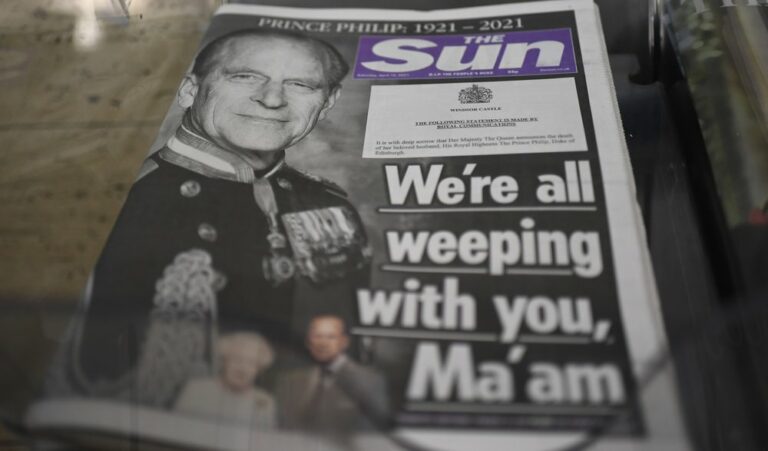
Britain’s Prince Charles offered a heartfelt tribute to his “dear Papa,? on Saturday as Buckingham Palace offered the broad outlines of a royal funeral that will be attended by the family and broadcast to the world.
As Queen Elizabeth II and other relatives mourned, Charles offered a deeply personal video message saying the royal family was “deeply grateful” for the outpouring of support they’ve received following the death Friday of his 99-year-old father, Prince Philip.
The heir to the throne said he was touched by the number of people around the world who have shared his family’s loss and sorrow.
“My dear Papa was a very special person who I think, above all else, would have been amazed by the reaction and the touching things that have been said about him,? Charles said, speaking from his southwestern England home of Highgrove. “And from that point of view we are, my family, deeply grateful for all that. It will sustain us in this particular loss and at this particularly sad time.”
Philip’s royal ceremonial funeral will take place April 17 at Windsor Castle — a slimmed-down service amid the COVID-19 pandemic that will be entirely closed to the public.
The palace insisted the royals would strictly adhere to national virus guidelines, measures that in theory would entail mask wearing in an enclosed space and social distancing. The palace declined to comment on specifics.
Philip, the queen’s husband of 73 years who was also known as the Duke of Edinburgh, took part in planning his own funeral and its focus on family was in accordance with his wishes. The duke also took part in designing the modified Land Rover that will carry his coffin.
“Although the ceremonial arrangements are reduced, the occasion will still celebrate and recognize the duke’s life and his more than 70 years of service to the Queen, the UK and the Commonwealth,” a palace spokesman said Saturday while speaking on condition of anonymity in line with policy.
Prince Harry, Philip’s grandson who stepped away from royal duties last year and now lives in California, will attend the service at Windsor along with other members of the royal family. His wife Meghan, the Duchess of Sussex, who is pregnant, has been advised by her doctor not to make the long journey.
The palace appealed to the public not to gather in Windsor and for those who wished to pay their respects to Philips to stay at home instead.
The announcement came after military teams across the U.K. and on ships at sea fired 41-gun salutes Saturday to mark Philip’s death, honoring the former naval officer whom they considered one of their own.
Batteries in London, Edinburgh, Cardiff and Belfast — the capitals of the four nations that make up the United Kingdom — as well as other cities around the U.K. and the Mediterranean outpost of Gibraltar fired the volleys at one-minute intervals beginning at midday.
Ships including the HMS Montrose, a frigate patrolling the Persian Gulf, offered their own salutes.
“The Duke of Edinburgh served among us during the Second World War, and he remained devoted to the Royal Navy and the Armed Forces as a whole,” Gen. Nick Carter, chief of the defense staff, said in a statement. “A life well-lived. His Royal Highness leaves us with a legacy of indomitable spirit, steadfastness and an unshakeable sense of duty.”
Members of the Commonwealth, a group of 54 countries headed by the monarch, were also invited to honor Philip. The Australian Defense Force began its salute at 5 p.m. local time outside Parliament House in Canberra, and New Zealand planned to offer its own tribute on Sunday.
Philip joined the Royal Navy as a cadet in 1939 and once had a promising military career. In 1941, he was honored for his service during the battle of Cape Matapan off the coast of Greece, when his control of searchlights aboard the HMS Valiant allowed the battleship to pinpoint enemy vessels in the dark. Philip rose to the rank of commander before he retired from active duty.
Two years after the war ended, Philip married Elizabeth at Westminster Abbey when she was 21 and he was 26. Philip’s naval career came to an abrupt end when King George VI died in 1952 and his wife became queen.
At the queen’s coronation in 1953, Philip swore to be his wife’s “liege man of life and limb” and settled into a life supporting the monarch. The couple had four children — Charles, the heir to the throne, Anne, Andrew and Edward.
Before he retired from official duties in 2017, the prince carried out more than 22,000 solo public engagements and supported over 780 organizations, including the Duke of Edinburgh’s Award for young people.
Members of the public continued to honor Philip’s life of service on Saturday, leaving flowers outside Buckingham Palace and Windsor Castle despite appeals from authorities and the royal family not to gather.
“I think everyone would like to pay their respects,” Maureen Field, 67, said outside Windsor Castle. “Because of the virus, a lot of people have to stay away. He didn’t want a big funeral. He wanted a very private time with his family to say their goodbyes. So, we’ve all got to respect that.”
Mike Williams, 50, traveled from his home in Surrey, southwest of London, to Buckingham Palace to honor the prince.
“He’s a massive loss to the country and to the world, I think, so we wanted to come and pay respects,” Williams said. “I don’t know what it achieves, but it just felt like the right thing to do.”
The screenplay focuses on the challenges that the 1973 war presented to Israel’s “Iron Lady.”
Oscar-winning British actress Helen Mirren will play the role of iconic Israeli Prime Minister Golda Meir in an upcoming biographical film Golda.
The movie will be directed by Oscar-winning Israeli director Guy Nattiv. Production is to begin in October.
The screenplay, which was written by world-renowned writer and producer Nicholas Martin, focuses on the 1973 Yom Kippur War and the challenges it presented Meir, also known as the “Iron Lady” of Israeli politics.
“As someone who was born during the Yom Kippur War, I am honored to tell this fascinating story about the first and only woman to ever lead Israel,” Nattiv said.
“Nicholas Martin’s brilliant script dives into Golda’s final chapter as the country faces a deadly surprise attack during the holiest day of the year, a core of delusional generals undermining Golda’s judgment, all the while undergoing secret treatments for her illness,” he added.
Golda Meir died of lymphoma in 1978, four years after resigning from office.
Mossad head Yossi Cohen is traveling to Washington on an official visit within the next few days and will meet with senior White House and intelligence officials, Channel 13 News reported on Wednesday night.
Cohen will present intelligence materials proving that the Islamic Republic is lying to the world and hiding information about its nuclear program in a bid to prevent the US from reentering the 2015 nuclear deal.
Israel is making efforts to arrange a private meeting between Cohen and Biden during the visit, the first high-level visit by an Israeli official since Biden entered office in January.
On Wednesday night, in a speech marking Yom HaShoah, Prime Minister Binyamin Netanyahu said that Israel is not obligated to respect a return to the Iran deal.
“History has taught us that deals like this, with extremist regimes like this, are worth nothing,” Netanyahu said.
“An agreement with Iran that will pave the way for nuclear weapons — weapons that threaten us with destruction — we will not be obligated to such an agreement in any way. We have only one obligation: to prevent anyone who seeks to destroy us from carrying out his plot.”
New unit merges ground and air forces that will employ new tactics against a changing enemy.
As part of the IDF’s long-term plan to adapt its military capabilities to new realities in the field, the military has created a new “multi-dimensional” fighting unit, the Jerusalem Post reported Thursday.
The move is part of IDF Chief of Staff Lt.-Gen. Aviv Kohavi’s new long-term plan according to which military strategists looked at the new threats facing the IDF and came up with changes to existing military doctrine to address the challenges.
Nicknamed “Ghost,” the new fighting force, under the IDF’s “Matkal” central command, will be comprised of groups selected from the IDF’s elite combat and artillery units and grouped with specialized units from the Israel Air Force.
Over the past year, the IDF conducted experiments that proved the new techniques are now ready to be put into practice. The result is a combined, or “multi-dimensional” force that will multiply the strength of the individual ground and air units.
One of the new tactical skills for the force is “expose and destroy.” As opposed to previous wars when the IDF engaged its enemies in the open and both sides used similar equipment, like tanks and armored personnel carriers, today’s enemies – i.e. Hamas in Gaza and Hezbollah in Lebanon – employ guerrilla tactics that the military calls “the disappearing enemy.”
Instead of warfare on open ground, both Hamas and Hezbollah exploit urban warfare according to which terrorists use tunnels and the civilian infrastructure to attack and then hide.
To counter this, the IDF added a special force with the capability to expose and destroy the enemy, the report said.
“The purpose of the exposure-attack company is to increase the lethality of the maneuvering force – whether it is a unit or a combined force – by exposing the enemy with advanced technologies, and then immediately categorizing it and destroying it,” Brig.-Gen. Dan Goldfus, Head of the Infantry and Paratroopers Corps, told the Post.
“This ability will allow the units to step up their ability to carry out more operations, and destroy more enemy forces,” he said.
Goldfus called the change in strategy “a revolution” in the way Israel’s military operates.
“The army is considered a conservative organization when comes to making changes, and here were are changing the way the maneuvering forces are working,” Goldfus said. “We will hear a lot about this change in the future.”
LONDON (AP) — Prince Philip, the irascible and tough-minded husband of Queen Elizabeth II who spent more than seven decades supporting his wife in a role that both defined and constricted his life, has died, Buckingham Palace said Friday. He was 99.
His life spanned nearly a century of European history, starting with his birth as a member of the Greek royal family and ending as Britain’s longest serving consort during a turbulent reign in which the thousand-year-old monarchy was forced to reinvent itself for the 21st century.
He was known for his occasionally racist and sexist remarks — and for gamely fulfilling more than 20,000 royal engagements to boost British interests at home and abroad. He headed hundreds of charities, founded programs that helped British schoolchildren participate in challenging outdoor adventures, and played a prominent part in raising his four children, including his eldest son, Prince Charles, the heir to the throne.
Prince Philip of Greece, during a naval visit to Melbourne, Australia in 1945. (AP Photo/File) Philip spent a month in hospital earlier this year before being released on March 16 to return to Windsor Castle.
“It is with deep sorrow that Her Majesty The Queen has announced the death of her beloved husband, His Royal Highness The Prince Philip, Duke of Edinburgh,” the palace said. “His Royal Highness passed away peacefully this morning at Windsor Castle.”
Philip saw his sole role as providing support for his wife, who began her reign as Britain retreated from empire and steered the monarchy through decades of declining social deference and U.K. power into a modern world where people demand intimacy from their icons.
In the 1970s, Michael Parker, an old navy friend and former private secretary of the prince, said of him: “He told me the first day he offered me my job, that his job — first, second and last — was never to let her down.”
Speaking outside 10 Downing St., Prime Minister Boris Johnson noted the support Philip provided to the queen, saying he “helped to steer the royal family and the monarchy so that it remains an institution indisputably vital to the balance and happiness of our national life.”
The queen, a very private person not given to extravagant displays of affection, once called him “her rock” in public.
This photo dated July 10, 1947 shows Britain’s Princess Elizabeth and her fiance, Lieut. Philip Mountbatten. (AP Photo/File) In private, Philip called his wife Lilibet; but he referred to her in conversation with others as “The Queen.”
Over the decades, Philip’s image changed from that of handsome, dashing athlete to arrogant and insensitive curmudgeon. In his later years, the image finally settled into that of droll and philosophical observer of the times, an elderly, craggy-faced man who maintained his military bearing despite ailments.
The popular Netflix series “The Crown” gave Philip a central role, with a slightly racy, swashbuckling image. He never commented on it in public, but the portrayal struck a chord with many Britons, including younger viewers who had only known him as an elderly man.
Philip’s position was a challenging one — there is no official role for the husband of a sovereign queen — and his life was marked by extraordinary contradictions between his public and private duties. He always walked three paces behind his wife in public, in a show of deference to the monarch, but he was the head of the family in private. Still, his son Charles, as heir to the throne, had a larger income, as well as access to the high-level government papers Philip was not permitted to see.
Philip often took a wry approach to his unusual place at the royal table.
“Constitutionally, I don’t exist,” said Philip, who in 2009 became the longest-serving consort in British history, surpassing Queen Charlotte, who married King George III in the18th century.
He frequently struggled to find his place — a friction that would later be echoed in his grandson Prince Harry’s decision to give up royal duties.
“There was no precedent,” he said in a rare interview with the BBC to mark his 90th birthday. “If I asked somebody, ‘What do you expect me to do?’ they all looked blank.”
But having given up a promising naval career to become consort when Elizabeth became queen at age 25, Philip was not content to stay on the sidelines and enjoy a life of ease and wealth. He promoted British industry and science, espoused environmental preservation long before it became fashionable, and traveled widely and frequently in support of his many charities.
In those frequent public appearances, Philip developed a reputation for being impatient and demanding and was sometimes blunt to the point of rudeness.
Many Britons appreciated what they saw as his propensity to speak his mind, while others criticized behavior they labeled offensive and out of touch.
In 1995, for example, he asked a Scottish driving instructor, “How do you keep the natives off the booze long enough to pass the test?” Seven years later in Australia, when visiting Aboriginal people with the queen, he asked: “Do you still throw spears at each other?”
Britain’s Queen Elizabeth II with Prince Philip in 2011. (AP Photo/Alastair Grant, File) Many believe his propensity to speak his mind meant he provided needed, unvarnished advice to the queen.
“The way that he survived in the British monarchy system was to be his own man, and that was a source of support to the queen,” said royal historian Robert Lacey. “All her life she was surrounded by men who said, ‘yes ma’am’ and he was one man who always told her how it really was, or at least how he saw it.”
Lacey said at the time of the royal family’s difficult relations with Princess Diana after her marriage to Charles broke down, Philip spoke for the family with authority, showing that he did not automatically defer to the queen.
Philip’s relationship with Diana became complicated as her separation from Charles and their eventual divorce played out in a series of public battles that damaged the monarchy’s standing.
It was widely assumed that he was critical of Diana’s use of broadcast interviews, including one in which she accused Charles of infidelity. But letters between Philip and Diana released after her death showed that the older man was at times supportive of his daughter-in-law.
After Diana’s death in a car crash in Paris in 1997, Philip had to endure allegations by former Harrods owner Mohamed Al Fayed that he had plotted the princess’s death. Al Fayed’s son, Dodi, also died in the crash.
During a lengthy inquest into their deaths, a senior judge acting as coroner instructed the jury that there was no evidence to support the allegations against Philip, who did not publicly respond to Al Fayed’s charges.
Philip’s final years were clouded by controversy and fissures in the royal family.
His third child, Prince Andrew, was embroiled in scandal over his friendship with Jeffrey Epstein, an American financier who died in a New York prison in 2019 while awaiting trial on sex trafficking charges.
U.S. authorities accused Andrew of rebuffing their request to interview him as a witness, and Andrew faced accusations from a woman who said that she had several sexual encounters with the prince at Epstein’s behest. He denied the claim but withdrew from public royal duties amid the scandal.
At the start of 2020, Philip’s grandson Harry and his wife, the American former actress Meghan Markle, announced they were quitting royal duties and moving to North America to escape intense media scrutiny that they found unbearable.
Born June 10, 1921, on the dining room table at his parents’ home on the Greek island of Corfu, Philip was the fifth child and only son of Prince Andrew, younger brother of the king of Greece. His grandfather had come from Denmark during the 1860s to be adopted by Greece as the country’s monarch.
Philip’s mother was Princess Alice of Battenberg, a descendent of German princes. Like his future wife, Elizabeth, Philip was also a great-great-grandchild of Queen Victoria.
When Philip was 18 months old, his parents fled to France. His father, an army commander, had been tried after a devastating military defeat by the Turks. After British intervention, the Greek junta agreed not to sentence Andrew to death if he left the country.
The family was not exactly poor but, Philip said: “We weren’t well off” — and they got by with help from relatives. He later brought only his navy pay to a marriage with one of the world’s richest women.
Philip’s parents drifted apart when he was a child, and Andrew died in Monte Carlo in 1944. Alice founded a religious order that did not succeed and spent her old age at Buckingham Palace. A reclusive figure, often dressed in a nun’s habit, she was little seen by the British public. She died in 1969 and was posthumously honored by Britain and Israel for sheltering a Jewish family in Nazi-occupied Athens during the war.
Philip went to school in Britain and entered Britannia Royal Naval College Dartmouth as a cadet in 1939. He got his first posting in 1940 but was not allowed near the main war zone because he was a foreign prince of a neutral nation. When the Italian invasion of Greece ended that neutrality, he joined the war, serving on battleships in the Indian Ocean, the Mediterranean and the Pacific.
Britain’s Prince Philip pulls his mount up sharp during a polo match at Windsor, England in 1965. (AP Photo/File)
On leave in Britain, he visited his royal cousins, and, by the end of war, it was clear he was courting Princess Elizabeth, eldest child and heir of King George VI. Their engagement was announced July 10, 1947, and they were married on Nov. 20.
After an initial flurry of disapproval that Elizabeth was marrying a foreigner, Philip’s athletic skills, good looks and straight talk lent a distinct glamour to the royal family.
Elizabeth beamed in his presence, and they had a son and daughter while she was still free of the obligations of serving as monarch.
But King George VI died of cancer in 1952 at age 56.
Philip had to give up his naval career, and his subservient status was formally sealed at the coronation, when he knelt before his wife and pledged to become “her liege man of life and limb, and of earthly worship.”
The change in Philip’s life was dramatic.
“Within the house, and whatever we did, it was together,” Philip told biographer Basil Boothroyd of the years before Elizabeth became queen. “People used to come to me and ask me what to do. In 1952, the whole thing changed, very, very considerably.”
Said Boothroyd: “He had a choice between just tagging along, the second handshake in the receiving line, or finding other outlets for his bursting energies.”
So Philip took over management of the royal estates and expanded his travels to all corners of the world, building a role for himself.
From 1956, he was Patron and Chairman of Trustees for the largest youth activity program in Britain, the Duke of Edinburgh’s Award, a program of practical, cultural and adventurous activities for young people that exists in over 100 countries. Millions of British children have had some contact with the award and its famous camping expeditions.
He painted, collected modern art, was interested in industrial design and planned a garden at Windsor Castle. But, he once said, “the arts world thinks of me as an uncultured, polo-playing clot.”
In time, the famous blond hair thinned and the long, fine-boned face acquired a few lines. He gave up polo but remained trim and vigorous.
To a friend’s suggestion that he ease up a bit, the prince is said to have replied, “Well, what would I do? Sit around and knit?”
But when he turned 90 in 2011, Philip told the BBC he was “winding down” his workload and he reckoned he had “done my bit.”
The next few years saw occasional hospital stays as Philip’s health flagged.
He announced in May 2017 that he planned to step back from royal duties, and he stopped scheduling new commitments — after roughly 22,000 royal engagements since his wife’s coronation. In 2019, he gave up his driver’s license after a serious car crash.
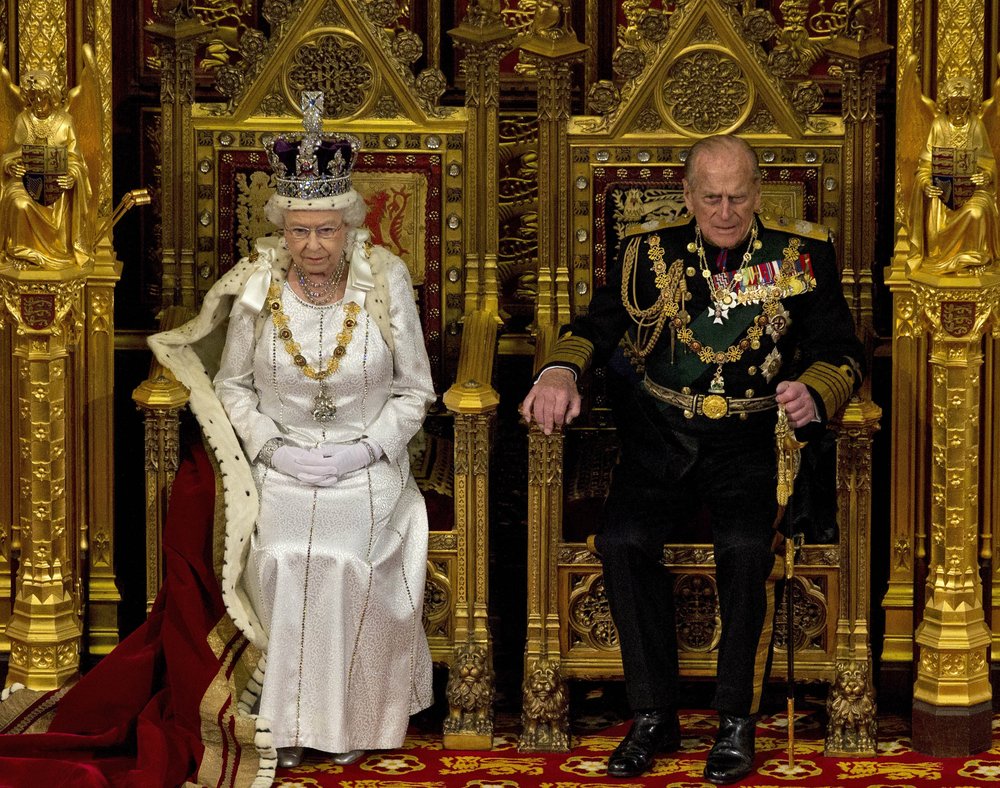
Britain’s Queen Elizabeth II sits next to Prince Philip in the House of Lords in 2012. (AP Photo/Alastair Grant, File)
Philip is survived by the queen and their four children — Prince Charles, Princess Anne, Prince Andrew and Prince Edward — as well as eight grandchildren and 10 great-grandchildren.
The grandchildren are Charles’ sons, Prince William and Prince Harry; Anne’s children, Peter and Zara Phillips; Andrew’s daughters, Princess Beatrice and Princess Eugenie; and Edward’s children, Lady Louise and Viscount Severn.
The great-grandchildren are William and Kate’s children, Prince George, Princess Charlotte and Prince Louis; Harry and Meghan’s son, Archie; Savannah and Isla, the daughters of Peter Phillips and his wife, Autumn; Mia, Lena and Lucas, the children of Zara Phillips and her husband, Mike Tindall; and Eugenie’s son, August, with her husband, Jack Brooksbank.
___
This story has been corrected to show that the queen and Philip have 10 great-grandchildren, not nine. It has also been corrected to show that the queen and he are great-great-grandchildren of Queen Victoria, not great-grandchildren.
___
Katz and Associated Press writer Robert Barr contributed to this report before their deaths.