Home Blog Page 699

US threatens to veto UN peacekeeper mandate in southern Lebanon — Report

0

Backing Israeli demands, Washington said to push for reduction in troop numbers and other reforms, warning it could shut down force if rest of Security Council refuses.

The United States is warning it may veto a United Nations resolution extending the mandate of UN peacekeepers in southern Lebanon and dissolve the force, unless changes are made before an August 31 vote, according to a Wednesday report.

Israel has for years complained that the contingent of Blue Helmets deployed along the ceasefire line between Israel and Lebanon is ineffective at keeping the Hezbollah terror group from maintaining an armed presence on its doorstep, claims that Washington is now reportedly backing.

However, the rest of the Security Council seemingly backs a simple renewal of the existing mandate without changes, especially with Lebanon currently wracked by instability following the Beirut port explosion and the fall of its government.

Washington wants all restrictions on UNIFIL peacekeepers’ movements lifted, to better monitor the activities of Hezbollah, an Iran-backed Shiite terror group, according to the report in Axios, which cited US and Israeli officials.

The US is also demanding that the maximum number of UNIFIL troops be reduced from 15,000 to 11,000, with more of them moved to the border area where they can have the biggest impact.

Other demands include having the mandate be extended every six months, rather than a year, and for the force’s weapons and technology to be immediately upgraded, in accordance with recommendations by UN Secretary-General Antonio Guterres.

“Both us and the Americans stress that in the current reality Hezbollah is just too comfortable with UNIFIL, and this is unacceptable,” a senior Israeli official was quoted
as saying. The State Department told the outlet the US wants UNIFIL to “fully implement its mandate, consider and pursue revisions which reinforce success and recognize any shortcomings.”

“We are deeply concerned about Hezbollah’s challenges to UNIFIL’s freedom of movement and this is unacceptable,” a spokesperson said.

In New York, US representatives have held talks with China, France, Russia, the UK, the other permanent members of the UN Security Council, in the past few days to lay out its demands, the report said. American diplomats have reportedly told their French counterparts they will veto the resolution if UNIFIL’s mandate is not revised.

A veto would shut down the peacekeeping mission, 42 years after it was created to ostensibly bring peace to the restive border region.

Washington is ultimately seeking to make changes, and not fully disband the force, but sees the veto as its strongest bargaining chip, the report said.

On Wednesday, France circulated a draft resolution that diplomats said would extend the current UNIFIL mandate for a year. The diplomats, speaking on condition of anonymity because discussions have been private, predicted tough negotiations before the mandate expires on Aug. 31.

“Veto and then what? They will deploy 10,000 marines to replace UNIFIL?” a senior French diplomat was quoted saying by Axios. “I believe the mandate will be renewed before the end of the month without too much trouble,” the diplomat added.

UNIFIL was created to oversee the withdrawal of Israeli troops after a 1978 invasion. The mission was expanded after a 2006 war between Israel and Hezbollah fighters so that peacekeepers could deploy along the Lebanon-Israel border to help Lebanese troops extend their authority into their country’s south for the first time in decades.
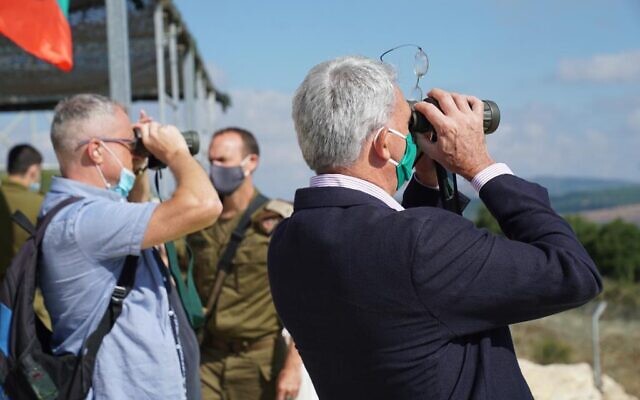
Foreign diplomats tour Israel’s northern border with Lebanon amid calls from Israel to beef up the mandate of the UN peacekeeping force UNIFIL, July 10, 2020 (IDF Spokesperson)

At a closed council meeting Tuesday on the mission, US Ambassador Kelly Craft stressed the need for a new mandate.

“The US has long reiterated publicly and privately that the status quo in Lebanon is unacceptable,” Craft said in a statement to The Associated Press after the meeting.
“Now is the time to empower UNIFIL, end the long complacency, and enable the mission
to fully achieve what it was set out to accomplish.”

But Craft faces an uphill struggle because most of the council backs a continuation of the current UNIFIL mandate.

Germany’s deputy UN ambassador Günter Sautter told the council in remarks circulated by the country’s UN mission that “recent tensions and the danger of escalation only underline the importance of UNIFIL presence on the ground.” He said “the new political reality” since last week’s devastating explosion at Beirut’s port made it “more important than ever.”

“UNIFIL’s mandate continues to be of utmost importance,” Sautter said. “It is clear that UNIFIL will not be able to do more with less. We therefore fully support UNIFIL in its current mandate and strength, and we hope that the council will once more show unanimous support to this important mission.”
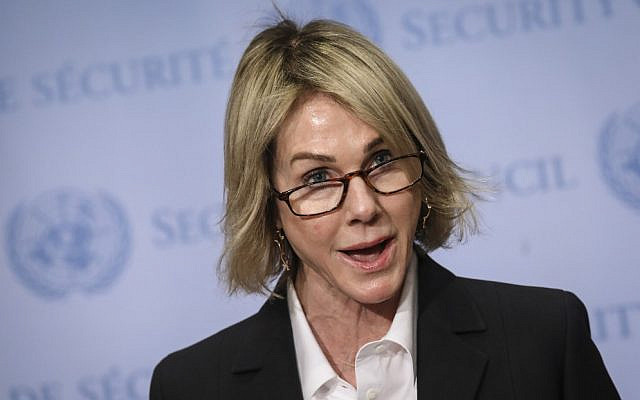
US Ambassador to the United Nations Kelly Craft delivers a statement to the press after a Security Council meeting on October 16, 2019, in New York City (Drew Angerer/Getty Images/AFP)

Guterres has written to the council calling for a 12-month renewal of UNIFIL’s mandate, stressing the importance of maintaining high troop strength.

Israel has repeatedly accused Hezbollah fighters of impeding the peacekeepers from carrying out their mandate.

Israel’s former ambassador Danny Danon said in May that Israel will insist that peacekeepers have access to all sites, that they have freedom of movement and that any time they are being blocked the UN Security Council must be immediately informed.

Craft said at that time that UNIFIL was being “prevented from fulfilling its mandate” and Hezbollah had “been able to arm itself and expand operations, putting the Lebanese people at risk.”

She said the Security Council “must either pursue serious change to empower UNIFIL or realign its staffing and resources with tasks it can actually accomplish.”

As of June 15, UNIFIL comprised 10,275 military personnel from 45 troop-contributing countries, 238 international civilian staff, and 580 national civilian staff.
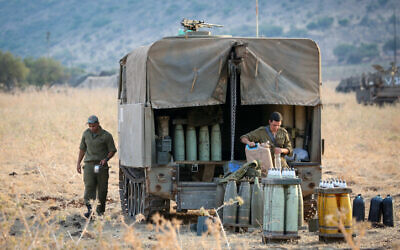
Israeli army forces seen stationed near the border between Israel and
Lebanon in the Golan Heights on July 27, 2020. (David Cohen/Flash90)

Its Maritime Task Force comprised six vessels, two helicopters and 864 of the force’s military personnel. However, one vessel was damaged in last week’s deadly explosion and over 20 naval personnel were injured, two critically.

Israel has pointed to the six underground passages built by Hezbollah and destroyed by Israel during a month-long operation in December 2018 as proof that UNIFIL does not have the tools to effectively maintain peace along the border. It has urged the Security Council to demand access to all sites and freedom of movement in Southern Lebanon to allow it to ensure that Resolution 1701 that ended the 2006 Second Lebanon War, and which calls for all armed groups outside the Lebanese military to be removed from southern Lebanon, is enforced.

(Times of Israel).

New Jersey’s Top Court: Defendant Must Share Phone Passcodes

0

The Supreme Court of New Jersey ruled a defendant must turn over the passcodes for his two phones in response to a search warrant, opening the way for law enforcement to compel other defendants in the state to do the same.

The court’s majority decision on Monday was supported by four justices with three dissenting in the case of a former Essex County sheriff’s officer who is suspected of helping a man charged with trafficking drugs, NJ Advance Media reported.

Robert Andrews was charged in 2016 for official misconduct, hindering and obstruction for passing on information about an ongoing law enforcement investigation to the suspect, who was in the same motorcycle club as him.

Andrews had appealed an order from a lower court to turn over the passcodes to his phones so authorities could execute a search warrant on phone calls and texts between the two men.

“It’s time to rethink whether you should keep anything simply private or personal on a personal electronic device because if the government wants it they can now get it,” said Charles J. Sciarra, Andrews’ attorney in a statement.

Sciarra argued, in part, that Andrews did not have to turn over the passcodes because the Fifth Amendment protected him from self-incrimination. But the court found the passcodes were not “testimonial” and noted Andrews did not challenge the search warrants, which give the state “the right to the cellphones’ purportedly incriminating contents,” the majority decision said.

Justice Jaynee LaVecchia, who authored the dissenting opinion, said the law had reached a crossroads.

“Will we allow law enforcement — and our courts as their collaborators — to compel a defendant to disgorge undisclosed private thoughts — presumably memorized numbers or letters — so that the government can obtain access to encrypted smartphones?” she wrote.

Andrews’ attorney did not respond to the newspaper’s questions about whether he would appeal the case to the U.S. Supreme Court or turn over his passcodes.

In October, an Oregon court of appeals ruled in a similar case that a defendant there must enter the passcode into a phone found in her purse in response to a search warrant. She entered in the wrong code twice and was ordered to be held for 30 days in jail in contempt of court.

In another case in Louisiana, the FBI said it managed to unlock a defendant’s phone before an appeals court issued a decision over whether the law compels him to disclose the password to his phone in response to a search warrant.

(Vosizneias / AP).

Elli Schwarcz – Re’eh

0

In this week’s Torah reading, Moshe Rabbeinu continues to implore the nation to live correctly. He opens with a statement that leaves no room for doubt: following Hashem brings blessing, and disobeying Him brings devastation. Here is the ‘headline’ that Moshe begins with, before he elaborates on his point.

See, I put before you today blessing and curse.
-Re’eh, 11:26

Aside from the powerful lesson this verse contains concerning the consequences of our choices, it includes another, more subtle message as well.
The wording of this verse is difficult. For starters, the introductory expression, “See” (re’eh), seems unnecessary for the point being made- no more than a dramatic turn of phrase. Furthermore, the grammar of this verse seems inconsistent; the verse begins with a singular directive, “See”, and continues in the plural form, “before you (plural).”

The Chasam Sofer (Rav Moshe Schreiber, 1762-1839; Germany, Slovakia) answers these questions in light of a Talmudic teaching:

One should always view himself as if the world in its entirety, half of it is innocent and half of it is culpable; if he would do one Mitzvah he would tip the whole world to merit, and if he would do one sin he would tip the whole world to culpability…
-Gemara Kiddushin 40

A person with such a perspective is looking at the world’s very existence as hanging in the balance- and therefore sees what he does in the next moment as what will swing the balance- either saving everyone with a good deed, or, Heaven forbid, condemning everyone with a bad one. Says the Chasam Sofer: this is what our verse is hinting at; a single person should see his action as affecting the public…

The Kotzker Rebbe (Rav Menachem Mendel Morgensztern, Poland; 1787-1859) provides a different approach to the shift from singular to plural, in his trademark incisive style: when it comes to giving– as in Hashem “giving” B’nei Israel the options of blessing and curse- everyone is given equallyYet when we speak of seeing, the perspective and approach we take with what he has been presented to us, each person is different. Each person sees according to who he is. 

We know that every person has his own personality, strengths and weaknesses, and circumstances. The unique package that each person possesses is actually the very reason he or she is in this world; one is given challenges and tests that only this soul is meant to overcome.

Our Rabbis put it succinctly:

Just as their faces are not similar, so too are their makeups not similar.
-Gemara Berachot 58a

Here is the Mesilat Yesharim’s famous opening line:

The foundation of righteousness and the root of complete service is that a person should clarify and verify what his obligation is in his world…
-Mesilat Yesharim, Ch.1

The Mussar masters (those who learn and teach the Torah’s ethics) observe a nuance in the above sentence: one is charged to know his obligation in his world. Of course, we are all obligated to keep the Torah (and non-Jews must keep the Seven Mitzvot B’nei Noach), and this never changes. However, within that, and as a way of striving for and ensuring that these principles are adhered to, we must all know our personal paths.

Additionally, the more a person works on himself, the more his or her viewpoint changes. One may begin his life’s journey as selfish, or jealous, or egotistical, but grow and evolve along as he studies and follows the Torah. Concerted efforts to mitigate negative personality traits and characteristics, or to channel them in the proper direction, will yield results that last a lifetime. Thus, we are charged to choose life and blessing, knowing that the more we make correct decisions, the more elevated will be our view- of this world and the next.

Have a great Shabbat!

Elli Schwarcz

Elli is an alumnus of the Toras Moshe, Ner Israel, and Carteret Yeshivos, and has been involved in Jewish outreach for almost 15 years. He is a Hebrew School and English Language Arts teacher, and has a Master’s Degree in Counseling from Johns Hopkins University. Of all his pursuits, Elli most enjoys teaching high-level Jewish thought and Talmud to teenage boys, exposing them to the beauty and wisdom of their heritage while highlighting their own ability to engage in advanced Torah learning. Elli lives in Lakewood, New Jersey, with his wife and children.


Rabbi Jonathan Sacks – The Good Society (Re’eh 5780)

Moses, having set out the prologue and preamble to the covenant and its broad guiding principles, now turns to the details, which occupy the greater part of the book of Devarim, from chapter 12 to chapter 26. But before he begins with the details, he states a proposition that is the most fundamental one in the book, and one that would be echoed endlessly by Israel’s Prophets:

See, this day I set before you blessing and curse: blessing, if you obey the commandments of the Lord your God that I enjoin upon you this day; and curse, if you do not obey the commandments of the Lord your God, but turn away from the path that I enjoin upon you this day and follow other gods, whom you have not experienced. (Deut. 11:26-28)

If you behave well, things will go well. If you act badly, things will turn out badly. Behaving well means honouring our covenant with God, being faithful to Him, heeding His words and acting in accordance with His commands. That was the foundation of the nation. Uniquely it had God as its liberator and lawgiver, its sovereign, judge and defender. Other nations had their gods, but none had a covenant with any of them, let alone with the Creator of heaven and earth.

And yes, as we saw last week, there are times when God acts out of chessed, performing kindness to us even though we do not deserve it. But do not depend on that. There are things Israel must do in order to survive. Therefore, warned Moses, beware of any temptation to act like the nations around you, adopting their gods, worship or practices. Their way is not yours. If you behave like them, you will perish like them. To survive, let alone thrive, stay true to your faith, history and destiny, your mission, calling and task as “a Kingdom of Priests and a holy nation.”

As you act, so shall you fare. As I put it in my book Morality, a free society is a moral achievement. The paradoxical truth is that a society is strong when it cares for the weak, rich when it cares for the poor, and invulnerable when it takes care of the vulnerable. Historically, the only ultimate guarantor of this is a belief in Someone greater than this time and place, greater than all time and place, who guides us in the path of righteousness, seeing all we do, urging us to see the world as His work, and humans as His image, and therefore to care for both. Bein adam le-Makom and bein adam le-chavero – the duties we have to God and those we owe our fellow humans –  are inseparable. Without a belief in God we would pursue our own interests, and eventually those at the social margins, with little power and less wealth, would lose. That is not the kind of society Jews are supposed to build.

The good society does not just happen. Nor is it created by the market or the state. It is made from the moral choices of each of us. That is the basic message of Deuteronomy: will we choose the blessing or the curse? As Moses says at the end of the book:

This day I call the heavens and the earth as witnesses against you that I have set before you life and death, blessings and curses. Now choose life, so that you and your children may live. (30:15, 19)

The test of a society is not military, political, economic or demographic. It is moral and spiritual. That is what is revolutionary about the biblical message. But is it really so? Did not ancient Egypt have the concept of ma’at, order, balance, harmony with the universe, social stability, justice and truth? Did not the Greeks and Romans, Aristotle especially, give a central place to virtue? Did not the Stoics create an influential moral system, set out in the writings of Seneca and Marcus Aurelius? What is different about the way of Torah?

Those ancient systems were essentially ways of worshipping the state, which was given cosmic significance in Pharaonic Egypt and heroic significance in Greece and Rome. In Judaism we do not serve the state; we serve God alone. The unique ethic of the covenant, whose key text is the book of Devarim, places on each of us an immense dual responsibility, both individual and collective.

I am responsible for what I do. But I am also responsible for what you do. That is one meaning of the command in Kedoshim: “You shall surely remonstrate with your neighbour and not bear sin because of him.” As Maimonides wrote in his Sefer ha-Mitzvot, “It is not right for any of us to say, ‘I will not sin, and if someone else sins, that is a matter between him and his God’. This is the opposite of the Torah.”[1] In other words, it is not the state, the government, the army or the police that is the primary guardian of the law, though these may be necessary (as indicated at the beginning of next week’s parsha: “You shall appoint magistrates and officials for your tribes”). It is each of us and all of us together. That is what makes the ethic of the covenant unique.

We see this in a phrase that is central to American politics and does not exist at all in British politics: “We, the people.” These are the opening words of the preamble to the American constitution. Britain is not ruled by “We, the people.” It is ruled by Her Majesty the Queen whose loyal subjects we are. The difference is that Britain is not a covenant society whereas America is: its earliest key texts, the Mayflower Compact of 1620 and John Winthrop’s address on board the Arbella in 1630, were both covenants, built on the Deuteronomy model.[2] Covenant means we cannot delegate moral responsibility away to either the market or the state. We – each of us, separately and together – make or break society.

Stoicism is an ethic of endurance, and it has some kinship with Judaism’s wisdom literature. Aristotle’s ethic is about virtue, and much of what he has to say is of permanent value. Rambam had enormous respect for it. But embedded in his outlook was a hierarchical mindset. His portrait of the “great-souled man” is of a person of aristocratic bearing, independent wealth and high social status. Aristotle would not have understood Abraham Lincoln’s statement about a new nation, “dedicated to the proposition that all men are created equal.”

The Greeks were fascinated by structures.  Virtually all the terms we use today – democracy, aristocracy, oligarchy, tyranny – are Greek in origin. The message of Sefer Devarim is, yes, create structures – courts, judges, officers, priests, kings – but what really matters is how each of you behaves. Are you faithful to our collective mission in such a way that “All the peoples on earth will see that you are called by the name of the Lord, and they will be in awe of you” (Deut. 28:10)? A free society is made less by structures than by personal responsibility for the moral-spiritual order.

This was once fully understood by the key figures associated with the emergence (in their different ways) of the free societies of England and America. In England Locke distinguished between liberty, the freedom to do what you may, and licence, the freedom to do what you want.[3] Alexis de Tocqueville, in Democracy in America, wrote that “Liberty cannot be established without morality, nor morality without faith.”[4] In his Farewell Address, George Washington wrote, “Of all the dispositions and habits which lead to political prosperity, religion, and morality are indispensable supports.”

Why so? What is the connection between morality and freedom? The answer was given by Edmund Burke:

“Men are qualified for civil liberty in exact proportion to their disposition to put moral chains upon their own appetites… Society cannot exist, unless a controlling power upon will and appetite be placed somewhere; and the less of it there is within, the more there must be without. It is ordained in the eternal constitution of things, that men of intemperate minds cannot be free. Their passions forge their fetters.”[5]

In other words, the less law enforcement depends on surveillance or the police, and the more on internalised habits of law-abidingness, the freer the society. That is why Moses, and later Ezra, and later still the rabbis, put so much emphasis on learning the law so that it became natural to keep the law.

What is sad is that this entire constellation of beliefs – the biblical foundations of a free society – has been almost completely lost to the liberal democracies of the West. Today it is assumed that morality is a private affair. It has nothing to do with the fate of the nation. Even the concept of a nation has become questionable in a global age. National cultures are now multi-cultures. Elites no longer belong “somewhere”; they are at home “anywhere.”[6] A nation’s strength is now measured by the size and growth of its economy. The West has reverted to the Hellenistic idea that freedom has to do with structures – nowadays, democratically elected governments – rather than the internalised morality of “We, the people.”

I believe Moses was right when he taught us otherwise: that the great choice is between the blessing and the curse, between following the voice of God or the seductive call of instinct and desire. Freedom is sustained only when a nation becomes a moral community. And any moral community achieves a greatness far beyond its numbers, as we lift others and they lift us.

Shabbat Shalom


[1] Rambam, Sefer ha-Mitzvot, positive command 205.

[2] See the recent survey: Meir Soloveichik, Matthew Holbreich, Jonathan Silver and Stuart Halpern, Proclaim liberty throughout the land: the Hebrew Bible in the United States, a sourcebook, 2019.

[3] John Locke, The Second Treatise of Civil Government (1690), chapter 2.

[4] Alexis de Tocqueville, Democracy in America, Introduction.

[5] Edmund Burke, Letter to a Member of the National Assembly (1791).

[6] David Goodhart, The Road to Somewhere, Penguin, 2017.


Earthquake Swarm Continues In SoCal, Larger Quakes Possible

0

“During this earthquake swarm, the probability of larger earthquakes in this region is significantly greater than usual,” the USGS said.


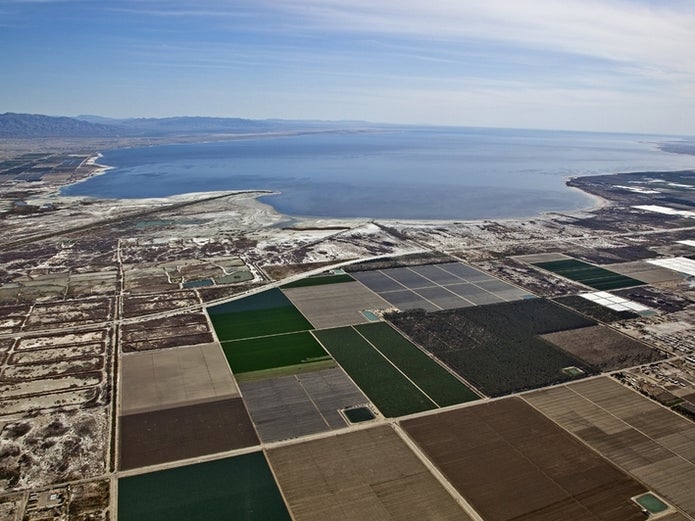
RIVERSIDE COUNTY, CA — This week’s earthquake swarm, at the southern end of the San Andreas Fault near the Salton Sea, is a stark reminder that California residents and businesses are at risk, officials are warning.

“Earthquakes can happen at any time,” said Bruce Barton, director of the Riverside County Emergency Management Department. “It is important to remember that Southern California is earthquake country and Riverside County has active fault lines running through it. The time to prepare for earthquakes is now.”

The earthquake swarm began at 6:33 a.m. Monday in the Salton Sea region, and dozens of temblors have been reported since. Most are centered near Bombay Beach, along the Salton Sea’s eastern edge. The largest quake struck at 8:56 a.m. Monday and measured a magnitude 4.6, according to the U.S. Geological Society. Many of the quakes have registered well above 3.0.

The Salton Sea stretches across Riverside and Imperial counties, with the San Andreas Fault’s southern reach running along the water’s northwest shore.

The USGS issued a public statement in response to the earthquake swarm, noting that there is an 80 percent probability that earthquakes will continue over the next seven days and some may be moderate in size — magnitude 4.5 to 5.4.

There is approximately a 19 percent chance that a larger earthquake between magnitude 5.5 to 6.9 could occur within seven days, which could cause damage around the Salton Sea, as well as aftershocks. There is a 1 percent probability that a much larger earthquake — of magnitude 7 or higher — can occur within seven days, according to the statement.

“During this earthquake swarm, the probability of larger earthquakes in this region is significantly greater than usual,” the USGS statement read. “The southernmost section of the San Andreas Fault is capable of rupturing in large magnitude earthquakes (magnitude 7+), but the last earthquake that strong was more than 300 years ago.

“In a typical week, there is approximately a 1 in 10,000 chance of a magnitude 7+ earthquake on the southernmost San Andreas Fault. That probability is significantly elevated while swarm activity remains high,” the agency’s statement continued. “While this is a very small probability, if such an earthquake were to occur, it would have serious impacts on communities nearby and would be followed by aftershocks that would increase the number of smaller earthquakes per day.”

Scientists were looking at how far away from the San Andreas Fault the swarm was in determining how likely it is that a “big one” will hit. The quake sequence has been about 7.5 miles away from the San Andreas Fault’s southern reach, seismologist Lucy Jones told the Los Angeles Times. “So this is probably too far away,” she said, for the swarm to trigger a large one on the San Andreas. “It’s not so much too far away that you say it’s impossible. But probably too far away.”

Riverside County officials are advising residents, business owners and visitors to plan ahead for any scenario. They advise:

Now: Create an emergency kit with water, food and other essential items that will sustain your family for three to seven days.

During: Drop, cover and hold on during the shaking. If driving, pull to the side of road and stop until shaking stops. Do not take cover under overpasses or bridges.

After: Prepare for aftershocks. Do not handle or drive over downed power lines. If you smell gas, leave the area.

“This latest swarm of earthquakes reminds me of words from my former UC Riverside geography professor. He told us students, ‘This is earthquake country. It is only a matter of time for a major earthquake.’ We should always be prepared,” said Riverside County Board Chair V. Manuel Perez, Fourth District Supervisor.

Riverside County residents are urged to register cell phone numbers with the county’s mass notification system, called Alert RivCo, which will notify residents of an earthquake. Most California county’s have a similar system.

Additionally, California has an early warning system called “MyShake,” the nation’s first statewide Earthquake Early Warning System. On Monday, Gov. Gavin Newsom announced in partnership with Google, that the forthcoming update to the company’s Android operating system will incorporate the technology into all Android phones.

Last October, on the 30th anniversary of the deadly Loma Prieta earthquake in Northern California, Newsom unveiled MyShake. The technology provides advance warning before the ground starts to shake from a nearby quake — enough time to drop, cover and hold on to help prevent injury.

Warnings delivered through the system are based on ShakeAlert technology operated by the Governor’s Office of Emergency Services and the USGS. The system analyzes data from seismic networks in California, calculates preliminary magnitudes, and then estimates which areas will feel shaking.

To download the MyShake application, visit: www.earthquake.ca.gov.


Source: Los Angeles Patch

Biden taps Kamala Harris as running mate, setting aside tensions from primary

0

She makes history as the first woman of color to serve as a major political party’s VP pick.

Kamala Harris, the politically shrewd California senator with a law enforcement background that has caused some tensions with the progressive left, was announced Tuesday as Joe Biden’s running mate.

“I’ve decided that Kamala Harris is the best person to help me take this fight to Donald Trump and Mike Pence and then to lead this nation starting in January 2021,” Biden said in an email to supporters.

She makes history as the first black woman to serve as a major political party’s VP pick.

“I’m honored to join him as our party’s nominee for Vice President, and do what it takes to make him our Commander-in-Chief,” Harris tweeted.

The Biden campaign said Biden and Harris will deliver remarks together on Wednesday in Wilmington, Delaware.

Biden tweeted on Tuesday, “Back when Kamala was Attorney General, she worked closely with Beau. I watched as they took on the big banks, lifted up working people, and protected women and kids from abuse. I was proud then, and I’m proud now to have her as my partner in this campaign.”

The decision, following months of secret meetings and closely held deliberations, would indicate the former vice president is setting aside their friction from the primary campaign. Harris memorably drew sharp contrasts with Biden when she challenged him on the debate stage over his past resistance to federally mandated desegregation busing.

Signaling the campaign’s line of attack against Harris, President Trump responded by tweeting out an attack ad soon after the announcement that called her “phony Kamala Harris.”

The Trump campaign also released a statement from Katrina Pierson, a Trump 2020 senior adviser, that said: “In her failed attempt at running for president, Kamala Harris gleefully embraced the left’s radical manifesto, calling for trillions of dollars in new taxes and backing Bernie Sanders’ government takeover of health care. She is proof that Joe Biden is an empty shell being filled with the extreme agenda of the radicals on the left.”

The now-presumptive Democratic presidential nominee’s selection amounts to a vote of confidence in the senator’s political ability and her background, and a willingness to move past the bad blood. The decision may have been tipped days earlier, when he was photographed with talking points saying of Harris that he does “not hold grudges” and has “great respect for her.”

The choice also fulfills a commitment the former vice president made in March to name a woman as running mate. Naming a black woman at a time when issues of racial inequality are front-and-center also responds to signals from some circles in the party that such a choice could help build bridges with the black community.

The timing gives Biden space to re-introduce her to voters ahead of this month’s scaled-back Democratic National Convention.

Former President Obama praised the pick.

“Joe Biden nailed this decision,” Obama said in a statement. “By choosing Senator Kamala Harris as America’s next vice president, he’s underscored his own judgment and character.”

Biden’s naming of 55-year-old Harris as his running mate comes 13 months after she flattened him on the debate stage in Miami at the first Democratic presidential primary showdown.

During the debate, Harris criticized comments by the former vice president spotlighting his ability to find common ground during the 1970s with segregationist senators with whom he disagreed, and his opposition decades ago to federally mandated school busing.

“Do you agree today that you were wrong to oppose busing in America?” Harris asked Biden during the debate.

And in a line that went viral, she spotlighted that “there was a little girl in California who was a part of the second class to integrate her public schools, and she was bused to school every day. And that little girl was me.”

Biden, who served eight years as vice president to Barack Obama, the first Black president in U.S. history, and who’s enjoyed strong support from African-American voters as he makes his third bid for president, angrily said the senator’s comments were “a mischaracterization” of his position.

Biden’s poll numbers briefly edged down after the debate – and Harris enjoyed a short-lived surge in the polls. But her campaign faltered later in the year, and Harris ended her White House bid last December.

By the time she suspended her campaign, the relationship between Harris and Biden had improved. Biden has publicly praised Harris numerous times – and has repeatedly pointed out that he’s thought highly of her since she became close to his late son, Beau Biden, when they both served as attorney general of their respective states.

Harris ended up endorsing Biden and appeared on stage with him – along with another former rival, Sen. Cory Booker of New Jersey – at a rally in Michigan on the eve of that state’s March 10 primary, which the former vice president ended up winning decisively as he moved closer to locking up the Democratic nomination.

“I believe in Joe. I believe in Joe,” Harris said at the rally. “I know Joe. And that’s why I’m supporting him.”

The rally was Biden’s last before the coronavirus pandemic swept across the country, shutting down in-person campaigning. Since then, Harris has campaigned virtually for Biden, headlining online events and fundraisers.

While the Harris-Biden feud now seems like ancient history, what may still be relevant is her prosecutorial record as San Francisco district attorney and later as California attorney general.

Even before she announced her White House bid in January of last year, Harris’ record as a “progressive prosecutor” was being scrutinized and criticized by some on the left.

And that record was in the spotlight at last summer’s second Democratic primary debate in Detroit, as the senator faced withering attacks from Biden and another rival, Rep. Tulsi Gabbard of Hawaii.

The former vice president accused Harris of keeping nonviolent prisoners behind bars during her tenure as California attorney general because they were a source of cheap labor for the state.

“What happened? Along came a federal judge and said enough is enough and he freed 1,000 of these people,” Biden said as he argued that Harris was forced by a judge to release the prisoners.

Gabbard also jumped in to land heavy blows – accusing Harris of keeping “people in prison beyond their sentences to use them as cheap labor for the state of California.”

While the intra-party rifts from 2019 appear to have healed long ago, the attacks from past primary debates could be used as ammunition by President’s Trump’s campaign and allied groups to target Biden and Harris. And it remains unclear whether the progressive flank of the party will embrace her.

Harris, who was elected to the Senate in 2016, grabbed plenty of attention two years later for her grilling of Supreme Court justice Brett Kavanaugh during his contentious confirmation hearings.

Harris was a co-sponsor last year of The Green New Deal.

As a presidential candidate, she announced her support for the federal legalization of marijuana. The senator was an original co-sponsor of Sen. Bernie Sanders’ single-payer “Medicare-for-all” bill, which if enacted would essentially eliminate private insurance. But she moderated her stance during her nearly year-long White House bid. Harris took a political hit last summer when she introduced a health care plan that allowed for private insurance to co-exist with a government run system.

The senator has called for a national moratorium on the death penalty. And on gun violence, Harris has proposed a ban on importing AR-15-style assault weapons and supported a national buyback program for such weapons. She also said on the campaign trail that if elected president, she would sign executive orders requiring enhanced background checks for weapons purchases if Congress failed to act.

Choosing a running mate is arguably the most consequential decision a presidential candidate can make.

Biden announced in March during a one-on-one Democratic primary debate with Sen. Bernie Sanders that if he won the nomination, he’d name a woman as his running mate.

And the former vice president emphasized for months that he needed to choose a running mate who’s “simpatico with where I am,” pointing to his own strong relationship with former President Obama during their eight years together steering the country.

Starting in late May, after the outbreak of protests in cities nationwide over systemic racism sparked by the death of George Floyd, a Black man who died while in police custody, the volume was turned up on calls for Biden to name a black woman as the Democratic Party’s vice presidential nominee.

Biden told reporters during a rare news conference at the beginning of July that he had prepared a list of “women of color” for consideration – but he wouldn’t announce a decision until August.

Three weeks later he acknowledged that of those he was considering for this running mate, “among them there are four Black women.” The former vice president made his comments during an MSNBC interview.

Among the other Black candidates Biden was thought to be considering were Rep. Val Demings of Florida, who is a former Orlando police chief; Atlanta Mayor Keisha Lance Bottoms; former Georgia House leader and 2018 gubernatorial nominee Stacey Abrams, former U.S. ambassador to the U.N. under President Obama Susan Rice; and Rep. Karen Bass of California.

Biden was also thought to be considering progressive Sens. Elizabeth Warren of Massachusetts, who was a Biden rival during the Democratic nomination race; Tammy Baldwin of Wisconsin; and Tammy Duckworth of Illinois, the first Thai-born woman elected to Congress and an Iraq war veteran who lost both of her legs piloting helicopters in combat. Also believed to be on his list were Govs. Gretchen Whitmer of Michigan and Michelle Lujan Grisham of New Mexico.

Many of the other contenders congratulated Harris on Twitter after the announcement was made.

Biden’s naming of his running mate came just several days before the Democratic National Convention is scheduled to kick off on Aug. 17.

Then-Sen. Barack Obama named Biden as his running mate just three days before the 2008 Democratic convention. And Donald Trump named then-Indiana Gov. Mike Pence as his running mate three days before the 2016 Republican convention.

(Fox News).

Coronavirus: LA County trials further delayed

0

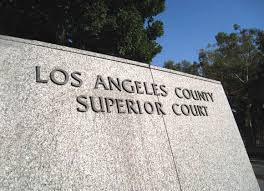
Trial dates for cases pending in Los Angeles Superior Court will
be further delayed under an order issued by the presiding judge.

Courthouses, the judge said, are not designed for social distancing required due to the
coronavirus.

Some criminal trials may start as early as September, but civil jury trials will be postponed until January, and civil non-jury trials – other than small claims and traffic trials – may not commence before Nov. 16, based on Presiding Judge Kevin C. Brazile’s order.

Some cases that can be heard by a judge without a jury may begin as early as Oct. 5 in compliance with social-distancing protocols.

“The Los Angeles County Department of Public Health has expressed concerns to the court about commencing jury trials and bringing jurors into county courthouses given the current COVID-19 numbers and trends,” Brazile said in a statement. “Courthouses are not designed to facilitate social distancing given their fixed configuration.”

The court will allow judges to hold remote hearings. However, remote appearances cannot be mandated in all cases for legal and ethical reasons. In criminal proceedings, the defendant’s consent is typically required, and civil cases can pose their own obstacles.

“The court cannot mandate remote appearances in civil trials due to logistical and evidentiary issues,” Brazile said.

Most dependency proceedings have been held virtually since the dependency courts reopened June 22. However, the number of cases heard is limited because of the social-distancing mandates. Monday’s order prioritizes those cases so that they can be heard as quickly as circumstances allow.

All non-jury trials scheduled from Monday to Sept. 8 – other than small claims and traffic trials and any case statutorily required to proceed – are continued until further notice.

Family law evidentiary proceedings, other than restraining order hearings, that can be completed within two court days may be held. Otherwise, such proceedings cannot commence before Nov. 20, except as authorized by the supervising judge.

To safeguard court users and enforce social distancing, scheduled appointments are required for in-person services from the clerk’s office, court support services and self-help centers. Appointments may be made the same day for persons seeking restraining orders who have completed paperwork and arrive at the courthouse no later than 3 p.m.

Judicial officers retain the discretion to require in-person appearances. Everyone must wear face coverings while in a courthouse, unless disabilities preclude them from doing so.

(LA Daily News).

The quiet race between Israel’s Navy and Gaza’s armed terror factions

0

IDF source tells JNS of “dizzying rate of change” in naval capabilities, but also about how Hamas and Palestinian Islamic Jihad are looking
to upgrade their attack capabilities “in every domain.”

As it conducts its mission to defend southern Israeli communities and vital strategic sites, the Israel Navy is also engaged in a quiet arms race with Israel’s adversaries in the Gaza Strip—namely, Hamas and Palestinian Islamic Jihad.

A senior IDF source told JNS about the ongoing activities of the Ashdod Naval Base, which is responsible for a substantial part of Israel’s coastal waters, stretching from central Israel to southern Gaza.

This area of jurisdiction, known as the Ashdod Arena, sees naval vessels securing Israel’s borders and keeping a watchful eyes on developing threats, explained the source. “We also guard our strategic assets, such as the [offshore] gas rigs and natural-gas production facilities—the whole complex coastal area.”

The ways in which the Israel Navy conducts its daily security missions is changing at a “dizzying pace,” stated the source, due to technological improvements in the IDF and advances made by the enemy.

“Each side is very dynamic,” said the source. “Hence, we always have to think a few steps ahead.”

On the Israeli side, the navy is developing new combat systems, while activating its force in quickly changing ways as part of its broad mission of finding answers to the range of threats.

One of the changes includes closer-than-ever cooperation between the navy and the ground forces of the Israel Defense Forces, particularly the Northern Gaza Brigade, which is active on land to protect Israel from the same adversaries, Hamas and Palestinian Islamic Jihad.

This cooperation is a “force multiplier,” said the source. “We analyze the territory and threats together. A threat that in the past was only the responsibility of the Northern Gaza Brigade is a threat that interests us as well today. We can assist in many ways, and they can help us. It’s a joint challenge.”

This cooperation has seen naval and ground forces share resources and means while activating a joint command network. Training and inquiries are also held together on a regular basis to create a common language. “Each side has to learn much about the other, about the other side’s platforms and capabilities,” said the source.

Addressing the activities of Hamas and Palestinian Islamic Jihad, the source said that “they are trying to build up their force in every sphere—the air, on the surface and underwater. We, of course, are providing an answer to this in every domain.”

As part of this effort, the navy is upgrading its air defenses, its ability to protect itself on the surface, and its underwater threat detection and response capability. It’s also working on new ways of striking targets in Gaza. “We are preparing for these in a massive way,” said the source.

As the option of smuggling weapons via tunnels is vanishing for Gaza’s terror factions, they increasingly turn to sea-trafficking attempts—as an interception of a weapons ship in February, traveling from the Sinai Peninsula to Gaza—illustrates.

“When one thing closes off, they try somewhere else. And we foil these attempts,” said the source. “Our border defense is highly dynamic. We conduct daily situation assessments.”

‘Vigilant at all times’

Meanwhile, the navy conducts ongoing, daily patrols off the Gazan coastline under all weather conditions.

It often detects Palestinian fishing vessels that violate Israel’s naval restrictions on where they can operate, which are designed to prevent bomb boats and other threats from approaching the coasts.

In such cases, the navy must be able to distinguish between vessels simply seeking to catch more fish from those gathering hostile intelligence or attempting an armed attack.

“That’s the million-dollar question,” said the source. The navy changes its procedures and drills to find out what the intent behind those operating the vessels are. “We have many sensors, and we produce data before approaching the vessel,” he said.

Hamas often seeks to disguise its activities and uses civilian guises to do so. “They try to improve their existing capability and to create new ones. We must always think like them and breakthrough our own conceptions,” insisted the source.

In recent months, the navy has also had to tackle a new and prolonged challenge in the form of the coronavirus pandemic. It has learned to operate under new restrictions. Commanders have had to conduct a “daily battle” with the new situation and ensure that the Navy remains “vigilant at all times, and that our operational forces are strong,” noted the source.

That readiness includes the personnel’s mental resilience.

Many sailors have had stay on base for lengthy periods to prevent the risk infection, and the navy has communicated these needs to their families. As the source said, control-room operators have had to work in smaller teams, and the navy was forced to “reinvent ourselves from scratch as we deal with the pandemic.”

(JNS).


Israel threatens ‘forceful’ response as over 60 fires sparked by arson balloons

0

Israel closed the Kerem Shalom Gaza border crossing except for vital humanitarian aid and fuel due to the launching of dozens of incendiary and explosive balloons into Israel over the past week. Over a dozen fires were sparked in southern communities on Monday as a result of the balloons.

Gantz says Israel could follow up closure of crossing with harsher measures; PM blames Iran, says Israel will exact ‘heavy price’ if attacks persist.

Israeli leaders on Tuesday threatened Gaza’s Hamas rulers that Israel would take “forceful” action if a rash of airborne arson attacks is not brought under control, as incendiary balloons continued to fly following Israel’s shuttering of a key crossing into the Palestinian territory.

Balloon-borne incendiary devices launched from the Gaza Strip sparked at least 60 fires in southern Israel throughout the day, according to firefighters. Officials said most were small fires, but some caused damage.

Tensions on the Gaza border have intensified in recent days, with balloon-borne incendiary devices igniting a number of fires across southern Israel. The Hamas terror group, which rules the Strip, has also threatened to renew rocket fire and there have been a number of small fire exchanges. No injuries have been reported.

“In the south, Hamas is allowing the continued launching arson and explosive-carrying balloons into Israel,” Defense Minister Benny Gantz said during a tour of a Home Front command center. “We are not prepared to accept that and we closed the Kerem Shalom crossing as a result. They would do well to stop disturbing the security and quiet in Israel. If that doesn’t happen, we will need to respond, and forcefully.”

Prime Minister Benjamin Netanyahu also took a threatening tone as he toured the Hazor air force base in the center of the country, accusing Iran of being behind the Gaza balloon attacks.

“I want to say to all of Iran’s forces, including in Gaza, there will be a very heavy price for the balloon terror,” Netanyahu said. “We will not suffer this, we will act and exact a heavy price. We have done it in the past and we will do it now.”

The comment appeared to be a reference to the Iran-backed Islamic Jihad terror group. While Israel holds Hamas responsible for all attacks emanating from the Strip, it has also increasingly targeted Islamic Jihad over the last year.

Authorities said they were battling a large blaze in the Eshkol region, near the Gaza border, forcing the evacuation of a number of Bedouin families living in the area.

A number of smaller fires were also reported in the area Tuesday morning, and Monday saw over a dozen blazes ignited by suspected Gazan balloons, as well as reports of possible balloon-borne bombs exploding over the city of Sderot.

In response to the fires, Israel announced Monday it was shutting the Kerem Shalom commercial crossing into Gaza, halting all goods but fuel, humanitarian products and food.

On Tuesday Hamas called the closure of the commercial crossing an aggressive action and a crime for which the Jewish state “bears all consequences and repercussions.”

Hamas spokesperson Fawzi Barhoun said the “use of tools and forms of struggle to express a state of anger” is a natural result of Israel’s blockade of the Gaza Strip.

The practice of launching balloon-borne incendiary and explosive devices from the Gaza Strip toward Israel has waxed and waned over the past two years, with an uptick since the end of last week.

Gantz, who is also alternate prime minister and was IDF chief of staff during the 2014 Gaza war, has previously urged taking a sterner hand to deter balloon and other attacks from Gaza, though without specifying what action he recommends.

Gantz was reviewing work to set up a command center to oversee the army’s efforts in combating the ongoing coronavirus outbreak. The military is to be given responsibility for epidemiological tracing and contacting those who may have been exposed to virus carriers. The center is to come online in the coming days.

Also on Tuesday evening, the IDF issued a denial of Palestinian media reports that claimed Israeli soldiers fired toward a group of young Palestinian men in the al-Bureij camp in the central Gaza Strip.

Hamas-linked Safa News published undated footage of the incident, showing the balloon launchers crouching on the ground as gunshots could be heard in the background.

The Kan public broadcaster later aired footage of a laser system to intercept the balloons that was deployed near the Gaza border. It was unclear whether the system would be immediately operational.

Leaders of communities near the Palestinian enclave have demanded the government and military take action to stem the launches.

“We have no deterrence against Gaza. A Palestinian who wants to launch a balloon ought to think 100 times before doing so but he does not think even once because he knows there won’t be a firm reaction,” said Ofer Lieberman, the agriculture director at Kibbutz Nir Am near the Gaza frontier.

Israel has in the past launched air strikes against suspected balloon launchers, though the military, already dealing with a threat on the northern border, appears to be wary of allowing violence on the Gaza border to snowball.

While the Israeli government has said that it holds Hamas responsible for any and all violence from the Gaza Strip, rights groups call Israel’s practice of shutting border crossings with Gaza a form of collective punishment.

Rights group Gisha released a statement Tuesday calling the closure “inappropriate and illegal,” while also condemning the balloon attacks.

Kerem Shalom is the only commercial crossing between Israel and the Gaza Strip.

Tensions along the Gaza border have risen over the past week, reportedly due to delays in the implementation of an ongoing ceasefire agreement between the Gaza-ruling Hamas terror group and the Israeli government.

(Times of Israel).


WP Twitter Auto Publish Powered By : XYZScripts.com