Home Blog Page 931

Arab-Israeli ISIS fighter tells BBC that Israel is just, unlike Syria’s Bashar Assad

Captured fighter Sayyaf Sharif Daoud: Israel isn’t nearly as bad as Assad’s regime; Israel treats Arabs justly, equally to Jews.

(July 24, 2019 / MEMRI) Sayyaf Sharif Daoud, a captured Islamic State fighter who holds Israeli citizenship, told BBC correspondent Feras Kilani on BBC Arabic (UK) earlier this month that he had joined ISIS instead of the Palestinian resistance because his experience of having lived through the Second Intifada, and living in the West Bank and in Israel had taught him that Israel “has not done 1 percent of what [Syrian President] Bashar al-Assad has done.”

He explained that despite the fighting between Israel and the Palestinians, Israelis have never raped women or killed people brutally like those affiliated with the Assad regime.

Daoud also said that his father had warned him against joining Hamas and Fatah, and expressed regret at having joined ISIS. He said he hopes that Israel will take him back so that his life can return to normal.

He added that Israel is a democracy in which he has not seen injustice, and in which Arabs and Jews live together and are treated equally.

Israel Foils Iranian Plot to Recruit Spies on Facebook

0

By Arye Green/TPS • 24 July, 2019

Israeli security forces have exposed an Iranian intelligence plot to recruit people from across Israel through fake Facebook profiles, the Shin Bet (Israel Security Agency) revealed Wednesday.

The network, based in Syria under Iranian guidance, attempted to recruit people through the use of fictitious Facebook profiles and messaging apps to establish contact. The network was led by a Syrian operative nicknamed ‘Abu Jihad’.

The objective of the network was to gather intelligence necessary for the preparation of terror attacks against Israel. The individuals who have been recruited were asked to gather information on military bases, sensitive security facilities, police stations, hospitals and other targets.

Most of the network’s efforts failed, according to the Shin Bet. The fake profiles aroused suspicion and were ignored for the most part. The Iranians ultimately failed to collect meaningful intelligence on Israel.

This is not the first time Israeli counter-intelligence has uncovered such plots. The use of social networks to recruit people is a well-known method to the Israeli intelligence community and has been used by governments and terrorist organizations alike.

The Iranian network was identified and monitored by Israeli intelligence early on. Both handlers abroad and recruits in Israel were closely and continuously examined to uncover the full scope of the network.

The counter-operation aimed at shutting down the network began in April 2019.

The police arrested several citizens who are suspected of having been in contact with Iranian operatives.

The Shin Bet emphasizes that “any Israeli who is contacted over the Internet by an element that he or she suspects is linked to a hostile body or terrorist organization should inform the Israel Police and sever contacts with the element.”

Israeli Envoy Reveals Iran-Hezbollah Weapons Smuggling Routes into Lebanon At UN Security Council Meeting

0

July 23, 2019 8:45 pm

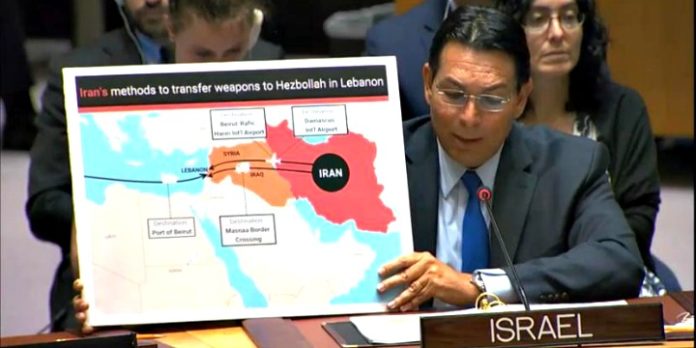
Israel’s Ambassador to the United Nations on Tuesday shared Israeli intelligence information with the UN Security Council showing Iran funneling weapons to the Hezbollah terrorist organization, highlighting the continuing threat posed by the Tehran regime and its Lebanese proxy along Israel’s northern border.

“In the years 2018-2019, Israel found that dual-use items are smuggled into Lebanon to advance Hezbollah’s rocket and missile capabilities,” Danny Danon — Israel’s envoy to the UN — revealed to the Security Council.

Danon said that the Quds Force of the Islamic Revolutionary Guards Corps (IRGC), which directs Iranian interventions abroad, had begun “to advance the exploitation of the civilian maritime channels, and specifically the Port of Beirut.”

Said Danon: “The Port of Beirut has become the Port of Hezbollah.”

Danon disclosed that Iran and Hezbollah were aided by Syrian agents who purchased the dual-use equipment — meaning it can be used for both civilian and military purposes — from foreign civilian companies and transferred it to Lebanon. These agents misled the companies when they officially unloaded the equipment at the Port of Beirut, Danon said, which was then transported to Hezbollah’s missile production facilities.

Danon said that Hezbollah regularly uses civilian centers in Lebanon to illegally transport arms, in “flagrant violation” of UN Security Council Resolution 1701, which calls for the disarming of the terrorist organization. Danon also presented the Security Council with a map of various weapons transfer routes.

The Israeli envoy urged UN member states to take extra precautions with regard to the sale of dual-use equipment.

“Are you absolutely sure your companies are not the ones selling dual-use equipment to the hands of Hezbollah?” Danon asked. “Are you sure your citizens know the end-users of these dual-use items?”

The Algemeiner   (c) 2019 .        

{Matzav.com}

Could Canada’s election day change?

Canada’s Federal Court orders review of election date which coincides with Jewish holiday of Shmini Atzeret.

Elad Benari,  24/07/19 04:38

Canada’s Federal Court on Tuesday ordered the chief electoral officer to review his decision to not recommend a change in the scheduled federal election date, October 21, which coincides with the Jewish holiday of Shmini Atzeret, the CBC reported.

Orthodox Jewish candidate Chani Aryeh-Bain, who is running for the Conservatives in the Toronto-area riding of Eglinton-Lawrence, and Ira Walfish, an Orthodox Jewish political activist, said Elections Canada’s Stéphane Perrault did not properly consider their rights under the Charter of Rights and Freedoms.

“… This judicial review is granted as the overall decision of the CEO does not demonstrate the hallmarks of transparency, intelligibility and justification, as it is not possible to determine if he undertook the necessary proportionate balancing between the applicant’s charter rights and the exercise of his statutory duty,” says the Federal Court ruling.

Shemini Atzeret begins on October 20 and ends on October 22. Aryeh-Bain argued that during the holiday, observant Orthodox Jews must refrain from a number of activities — including voting and campaigning — and cannot ask others to work for them.

According to the judgment, the October 12 advance polling day conflicts with the Sabbath, while the October 14 advance polling day coincides with the holiday of Sukkot.

Aryeh-Bain said that, aside from preventing her from participating on voting day itself, the current federal election date will negatively affect her campaign. Eglinton-Lawrence has about 5,000 Orthodox Jewish voters and in the last three federal elections it was decided by 2,000 to 4,000 votes, noted the CBC.

The chief electoral officer does not choose the election date and cannot change it once it has been set, but can recommend to cabinet that the election date be moved.

Perrault wrote to Aryeh-Bain in May saying that he was made aware of the issue through the Centre for Israel and Jewish Affairs (CIJA) as early as August 2018 and assured it that steps were being taken to ensure voter accessibility.ADVERTISING

The CEO’s efforts were focused on advance polling and special ballot options. No consideration appears to have been given to recommending a date change.

B’nai Brith Canada, which was an intervener in the case, argued that holding a federal election on a religious holiday infringes on the democratic rights of Canadians and undermines the democratic process.

Tuesday’s judgment supported those claims and criticized Perrault’s decision, saying he did not adequately consider how the election date affected a date of religious significance and how that might infringe upon voters’ and candidates’ rights under the Charter of Rights.

The judgment says Perrault must reconsider his decision in a way that “reflects a proportionate balancing of the Charter rights with the statutory mandate.” According to the Canada Elections Act, Perrault has until August 1 to make a date change recommendation to cabinet in order to leave enough time for the election date to be moved.

Shimon Koffler Fogel, president of CIJA, said he respects Perrault’s decision but would keep working to ensure “every Jewish voter can cast their ballot.”

“We respect the democratic and judicial process that has led to today’s ruling. Changing the date at this stage entails considerable logistical and financial implications,” Fogel said.

“We will respect the chief electoral officer’s decision and will continue working closely with Elections Canada to support its efforts to maximize voter participation and inclusion of the Jewish community – which is a cornerstone of democracy,” he added.

Michael Mostyn, chief executive officer of B’nai Brith Canada, called the decision “a massive victory for the Canadian Jewish community and the cause of human rights.”

“The right to vote and run for office is one of the most fundamental rights in Canadian society, and the court was right to find that Elections Canada must give them proper consideration,” he said in a statement.

Ukraine President’s Party Gets Solid Parliament Majority

0

Tuesday, July 23, 2019 at 2:22 pm

KIEV (AP) – The anti-corruption party of Ukraine’s new president has won a commanding majority of seats in the national parliament, near-complete election results showed Tuesday, giving him leverage to try to enact his promised reforms.

The national election commission reported Tuesday that with 98% of ballots counted, President Volodymyr Zelenskiy’s Servant of the People party had 43% of the vote for the 225 seats in parliament that are allocated proportionally. Party candidates also led in races for 176 of the 199 parliament seats being chosen in individual constituencies.

The election commission said a Russia-friendly party led by tycoon Viktor Medvedchuk, a close ally of Russian President Vladimir Putin, was in second place in Sunday’s nationwide vote with 13% support, and picked up 19 individual seats.

Zelenskiy, who took office in May, has promised to tackle Ukraine’s entrenched corruption. He also faces the challenges of trying to end the five-year-old war with Russia-backed separatists in eastern Ukraine that has killed more than 13,000 people and of trying to raise Ukrainians’ poor living standards.

The head of the president’s party, Dmytro Razumkov, said key measures to be taken up when the new Verkhovna Rada parliament convenes will include removing national lawmakers’ immunity from prosecution, establishing procedures for presidential impeachment and creating anti-corruption agencies that are independent from both the president and parliament.

Zelenskiy, a comedian with no prior political experience but a strong anti-corruption agenda, won office in a landslide against former President Petro Poroshenko.

His election victory and the parliament election results reflect Ukrainians’ frustration with their political establishment as the country has endured war, disorder, the loss of Crimea to Russia and an economic decline.

With Zelenskiy having a parliamentary majority, Ukrainians will be expecting quick action, said analyst Volodymyr Fesenko of the Ukrainian think-tank Penta.

“Zelenskiy’s honeymoon with the voters will quickly come to an end and many questions stand before the new team,” he told The Associated Press. “How do you find the optimal balance between the new impulse for liberal economic reforms and solving social problems and poverty?”

Source: Hamodia

New Pentagon leader Esper faces steadily rising tensions with Iran

0

U.S. Secretary of Defense Mark Esper “understands the strategic relationship with Israel, and also understands that the alternative is no alternative,” said former Pentagon official Michael Rubin.

BY JACKSON RICHMAN

(July 23, 2019 / JNS) After more than six months without a permanent U.S. Secretary of Defense, Mark Esper, who previously served as acting U.S. Defense Secretary and U.S. Secretary of the Army, was confirmed on Tuesday to lead the Pentagon on a full-time basis.

Before arriving at the Pentagon, Esper, 55, served in the U.S. Army during the 1991 Gulf War, and held roles on and off Capitol Hill. He and his wife, Leah, have three kids.

Esper replaced Patrick Shanahan in June as acting Secretary of Defense after Shanahan withdrew his nomination to serve in the position permanently. The decision came after USA TODAY published an explosive report about alleged domestic violence between him and his former wife, Kimberly Johnson.

“Mark Esper makes a fine choice for Defense Secretary, and he has a full plate coming in to the role,” Security Studies Group senior fellow Matthew Brodsky told JNS. “The immediate challenges are what the intelligence community refers to as ‘The Big Four’: China, Russia, North Korea and Iran. The first two pose great power challenges requiring a long-term strategy while the latter two pose emerging nuclear power challenges that require near-term solutions.”

Moreover, he said, “Syria is another challenge where I think the U.S. will be better served now by someone who fully appreciates how Iran and Russia are intimately linked to the problem there.”

As defense secretary, Esper’s most immediate challenge will be dealing with the increasing tensions with Iran since the United States withdrew in May 2018 from the 2015 nuclear deal, reimposing sanctions lifted under it and enacting new financial penalties against the regime.

More recently, Iran shot down a U.S. drone—a RQ-4A Global Hawk that was flying in international airspace above the Strait of Hormuz, though claimed that it was flying above its own airspace. In doing so, Iran’s Islamic Revolutionary Guards Corps’ top commander, Gen. Hossein Salami, said his country is “completely ready for war.”

Trump called off retaliatory strikes against Iran for that action, saying that such a response was “not proportionate to shooting down an unmanned drone.”

Nonetheless, the United States conducted a cyber-attack against Iran.

Last week, Trump confirmed that the USS Boxer, a U.S. Navy ship, “immediately destroyed” an Iranian drone in the Strait of Hormuz. (CENTCOM Commander Gen. Kenneth McKenzie told CBS News on Tuesday that the ship may have shot down two drones.)

“I agree we do not want war with Iran, we are not seeking war with Iran, we need to get back on the diplomatic channel,” said Esper during his confirmation hearing last week in front of the Senate Armed Services Committee.

Esper told reporters after a closed-door meeting at NATO last month, “I discussed the need to internationalize this issue by encouraging NATO allies and regional partners to voice their opposition to Iran’s bad behavior and to help us deter further provocative acts by improving maritime security.”

“The department’s mission remains clear: to deter conflict and, if necessary, fight and win on the battlefield,” he added.

Additionally, at his confirmation hearing, Esper said that Turkey acquiring the S-400 missile-defense system last week was “disappointing.”

“Acquisition of the S-400 fundamentally undermines the capabilities of the F-35,” he stated. “They are a NATO ally, a longstanding and capable ally. It is very disheartening to see how they have drifted over the past several years.”

In response, the United States cut off Turkey last week as an F-35 recipient.

Regarding Turkey, Brodsky said, “I think Esper understands that Turkey, at least under [President Recep Tayyip] Erdo?an, is much closer to irredeemable than those who came before him. This will, incidentally, make Jordan even more important as an ally for basing and training and other roles. That should be seen as a positive development from Israel’s standpoint given the premium they tend to place on Jordan’s security and stability, and also a positive from the standpoint of our Gulf allies.

“Someone needs to play hardball with Turkey, and I think Esper will be more willing to do so,” he said.

Brodsky added that with Israel, “I don’t see much changing because the relationship is more solid than it has ever been, and that’s because President Trump loves Israel. It’s a kishka issue for President Trump. He gets Israel.”

‘Knows the risks and range of options’

Former Pentagon official Michael Rubin agreed, saying that Esper appears to have strong pro-Israel credentials.

“On a scale of Chuck Hagel to 10, with 10 being the most pro-Israel, Esper is probably an eight or nine,” Rubin told JNS, referring to the former defense secretary under President Barack Obama, who faced some opposition from within the pro-Israel community.

Rubin said that Esper “understands the strategic relationship with Israel and also understands that the alternative is no alternative.”

“It’s hard to say a defense secretary should be more ‘pro-Arab’ when even the moderate Arab states are generally now allied with Israel. Esper is cautious on Iran, but then again, so is most of the Pentagon,” he continued. “That said, if given the order to utilize the military against Iran, Esper is someone who knows both the risks and the full range of options, and will do what’s needed for victory.”

Along with Iran, according to Rubin, Esper’s biggest challenges will come from somewhere outside the Middle East.

“China, China and China. That will be the biggest issue for every defense secretary for the next 50 years—whether China is rising or, equally likely, declining,” he said. “That is why the Israelis
Saudi blogger attacked by Palestinians sings in Hebrew at meeting with Netanyahu

PM hosts Arab media group day after one of them, Mohammed Saud, was harassed at Temple Mt.; Israeli spokesman: ‘He took it harshly but understood this is real face of Palestinians’

By RAPHAEL AHREN 23 July 2019, 3:48 pm

Prime Minister Benjamin Netanyahu on Tuesday hosted in his office a delegation of journalists and bloggers from Arab countries, including a Saudi Arabian national, Mohammed Saud, who was harassed and attacked by Palestinians on Monday as he was touring Jerusalem’s Old City.

During a lengthy meeting, Netanyahu apologized to Saud on Israel’s behalf for the incident. Saud, for his part, underlined his support for Israel by singing a song, in Hebrew, by poet Leah Goldberg, the Foreign Ministry’s spokesperson for the Arabic media, Hassan Caabia, told The Times of Israel.

Later on Tuesday, the delegation of six Arab journalists and bloggers also had an hour-long meeting with Foreign Minister Israel Katz.

“He took it somewhat harshly, but he understood that this is the real face of the Palestinians,” Caabia said, referring to the insults and attacks to which Saud was subjected Monday when he toured the Temple Mount and walked through Jerusalem’s Old City.

Three suspects in the harassment of Saud were arrested Tuesday.

In the wake of the incident, a scheduled meeting of the visiting group with Israeli journalists was canceled.

“They talk about how so many in the Arab world want to have peace with Israel, normalization with Israel, want to come to Israel,” Netanyahu said later, referring to the group he hosted. “They’re not always free to express it, and there’s always opposition… but they expressed that desire.”

The prime minister said he told the delegation that Israel is “the irreplaceable power” in the Middle East because without it, “I would say the region would collapse.

“Without Israel, without the things that we do and the things that we stand for and the things that we protect, I think the entire Middle East would collapse to the forces of Islamic radicalism, whether Shiite led by Iran or Sunni radicalism led by Islamic State.”

Netanyahu made those remarks during a meeting with US Secretary of Energy Rick Perry, which took place immediately after his sit-down with the Arab journalists and bloggers. The Prime Minister’s Office released no photos and no separate readout of his meeting with the Arab delegation, members of which have thus far refused to have their names and photographs made public. Only Saud’s name has been published.

The delegation is touring Israel at the invitation of the Foreign Ministry, which has billed the visit as a milestone in Jerusalem’s effort to foster closer ties with the Arab world. No representatives of the media were invited to the meeting.

Saud is one of six Arab journalists and bloggers, including representatives from Jordan and Iraq, brought to Israel by the Foreign Ministry.

Video of the incident shows a child spitting on Saud as he visited the holy site, while others yell at him to leave. In another clip, chairs and other objects are thrown at Saud as he walks through one of the Old City’s alleys.

One man is heard shouting at Saud, “Go to a synagogue.” Others are heard calling him an “animal” and “Zionist trash.”

A Foreign Ministry spokesman condemned Saud’s harassment.

“We strongly condemn the cruel and immoral behavior of some Palestinians near the Al-Aqsa Mosque toward a Saudi media personality who came to Jerusalem to be a bridge to peace and understanding between peoples,” Nizar Amer wrote on Twitter on Monday.

Another Foreign Ministry spokesperson called it a “disgusting welcome.”

Said the Foreign Ministry’s Caabia: “It was barbaric and brazen; the Palestinians think [the Temple Mount] is only theirs, and doesn’t belong to the Israelis… This young man came here to promote peace between the nations. Israel gave him a warm welcome, but the Palestinians wanted to humiliate him.”

Saud, who speaks some Hebrew, is an unabashed fan of Netanyahu and his Likud party. The username on  his Twitter feed is written in Hebrew as well as in Arabic, and his description includes an Israeli flag emoji and the words “Only Bibi!” using Netanyahu’s nickname.

The group of journalists and bloggers were slated to visit Jerusalem’s Yad Vashem Holocaust memorial, the Knesset and holy sites, and to meet with members of Israeli academia during the trip.

The ministry has said the visit has “the aim of exposing the journalists — some of whom come from countries that do not have diplomatic relations with Israel — to Israeli positions on diplomatic and geopolitical issues.”

Times of Israel staff and AFP contributed to this report.

Washington – House Opposes Israel Boycott In Bipartisan Vote

0

Washington – The House overwhelmingly approved a resolution Tuesday opposing an international effort to boycott Israel, a rare bipartisan vote as Democrats try to tamp down increasingly heated political rhetoric over differences with the longtime U.S. ally.

Democrats have been wrestling with the issue all year. Liberal lawmakers, most notably Reps. Ilhan Omar, D-Minn., and Rashida Tlaib, D-Mich., two newly elected Muslim Americans, have spoken out about the Boycott, Divest and Sanctions movement, known as BDS, as they criticize Israel’s treatment of Palestinians, particularly in the occupied territories. Republicans have amplified the views of the left flank to portray Democrats as deeply divided and at odds with Israel.

Ahead of voting, the bill’s chief backers warned against the stark framing as dangerous for both countries.

“This issue has been politicized in a way that I find ugly and ultimately harmful to the U.S.-Israel relationship,” said Rep. Eliot Engel, D-N.Y., the chairman of the Foreign Affairs Committee.

The resolution passed on a vote of 398-17.

House Democrats have been eager to vote to show support for Israel and, for those lawmakers from more conservative areas, to resist having the party be defined by its most liberal members.Advertisement:

Rep. Steny Hoyer, D-Md., the majority leader, had promised lawmakers the bill would come up for a vote before the August recess. It’s a way to shield House Democrats from continued Republican efforts to attack them around the issue of Israel, according to a Hoyer aide who spoke on condition of anonymity to discuss the private conversations.

Omar, a member of the Foreign Affairs Committee, was among the only lawmakers to voice objection when the bill was included in a package the panel approved last week.

“What are we doing to bring peace? I believe that simple question should guide every vote we take in this committee,” said the freshman lawmaker, who came to the U.S. as a refugee from Somalia when she was a child and became a U.S. citizen.

Omar has been outspoken against Israel, once tweeting that lawmakers were supportive of the Jewish state because they were essentially being paid to do so. It was widely considered a slur that relied on a trope against Jewish people, and she later “unequivocally” apologized.

Trump called her apology “lame” and Republicans have continued to stoke opposition to her views as part of the “squad” of liberal freshmen lawmakers. Trump stood by last week at a campaign rally as the crowd chanted about Omar, “Send her back.”

Omar, who was among a handful of Democrats who voted against the bill Tuesday, said she supports the long-held U.S. goal of a “two-state solution,” one for Israel and one for Palestine. But she said during the committee hearing last week that “truly achieving peace” means “ending this occupation” of Israeli settlements.

The House has struggled with the issue since the start of the year, after an earlier version passed the Senate. Senate Majority Leader Mitch McConnell, R-Ky., had introduced it as the first bill of the new Congress, and brought it forward repeatedly for votes until it ultimately passed, also with robust bipartisan support. But the Senate bill, which was part of a broader foreign policy package, stalled in the House amid concerns over First Amendment rights and the ability of Americans to protest Israel’s policies.

The resolution puts the House on record opposing the BDS movement and its efforts to target U.S. companies that do business with Israel. The movement has grown in recent years, and Israel sees it as a threat. Supporters of Israel view it as an attempt to delegitimize the Jewish state.

“We must reject the blatant anti-Semitics injected throughout BDS,” said Rep. Lee Zeldin, R-N.Y., a sponsor of the measure.

The resolution has been pushed by AIPAC, the influential Israel lobby in Washington. J Street, a more liberal group in the progressive Jewish community, had opposed an earlier Senate version but supported the House’s approach.

To win over those in the House who had panned the Senate effort, the resolution beefed up First Amendment protections over the boycott. While the Senate bill affirmed the legal authority of state and local governments to restrict contracts or take other actions against entities that boycott Israel, the House bill affirms the constitutional right of Americans to engage in “free speech, including the right to protest or criticize the policies of the United States or foreign governments.”

WP Twitter Auto Publish Powered By : XYZScripts.com