Home Blog Page 1124

Two Arabs Arrested After Pipe-Bomb Attack on Kever Rochel

0

Two Arabs Arrested After Pipe-Bomb Attack on Kever Rochel

YERUSHALAYIM –

Two 25-year-old residents of the Al-Aida refugee camp in the Beit Lechem area have been arrested on suspicion of throwing a pipe bomb at Kever Rochel, on Wednesday evening.

Late Wednesday, IDF and Border Police forces launched widespread searches in the nearby refugee camp. Two 25-year-old suspects were arrested, one of them carrying a knife. Police said that one of the men is suspected of belonging to the Hamas terror group.

Equipment suspected of being used to make pipe bombs, found in the home of a
Palestinian in the Al-Aida refugee camp, Thursday. (Police Spokesman)

Forces later raided the home of one of the suspects and seized equipment used to produce the homemade explosive devices.

Source: Hamodia

IDF Beefs Up Gaza Border Presence In Wake Of Security Assessment

0

IDF Beefs Up Gaza Border Presence In Wake Of Security Assessment

By Yona Schnitzer/TPS • 4 October, 2018


IDF Chief of Staff Lt. Gen. Gadi Eizenkot ordered reinforcements to be sent to the Gaza border Thursday and remain there for the coming days following a security situation assessment which included commanders from the IDF and the Israeli Security Agency (Shin Bet).

“The Chief of the General Staff, Lt. Gen. Gadi Eisenkot and senior IDF & ISA (Israel Security Agency) officials decided to implement wide-scale reinforcements in the Southern Command and to continue acting to thwart terror and infiltrations from Gaza,” the IDF Spokesperson said in a statement, adding that it holds Hamas as “responsible for Gaza and all that emanates from it.”

Last Friday, seven Palestinians were killed in clashes with IDF troops as 20,000 people held violent demonstrations along the border. The incident followed two months of relative quiet and the breakdown of Egyptian mediated efforts to reach a understanding between Israel and Hamas on the rehabilitation of Gaza and a long-term ceasefire.

Earlier on Thursday, Energy and Water Minister Yuval Steinitz accused Palestinian Authority Chairman Mahmoud Abbas (Abu Mazen) of attempting to drag both sides in Gaza into war by perpetuating the humanitarian crisis in the Strip.

“The objective of Abu Mazen and the Palestinian Authority is clear,” Steinitz told Army Radio, “Abu Mazen is trying to instigate a war in Gaza and and is stopping the flow of electricity and water in order to make everything blow up in Israel’s face,” he said.

“We must put an effort into preventing Abu Mazen from maneuvering us into a war,” Steinitz continued, “if Abu Mazen on one side and the Iranians on the other side are interested in causing an escalation in Gaza, we must act in order to prevent that.”

On Thursday morning, Israel’s Yedioth Ahronoth daily published an interview with Hamas military leader Yahya Sinwar, in which he said that Hamas is not interested in another war with Israel.

“A new war is in no one’s interest,” said Sinwar, “who has the will to challenge a nuclear superpower with four slingshots? War will not achieve anything,” he stated, adding that while he has no plans to lay down his arms, ending the blockade on Gaza is his top priority.

Responding to Sinwar’s statements, Steinitz said: “I would take his words, by which he is no longer interested in war, with a grain of salt. His objective is still to destroy the State of Israel.”

Merkel At Yad Vashem” Holocaust Was “A Crime That Has No Equal”

0

Merkel At Yad Vashem” Holocaust Was “A Crime That Has No Equal”

By Mara Vigevani/TPS • 4 October, 2018

The Holocaust was a crime that “has no equal” German Chancellor Angela Merkel said Thursday morning as she visited the Yad Vashem -World Holocaust Remembrance Center.

After touring the Hall of Names, she placed a wreath in the Hall of Remembrance, in memory of the six million Jews that perished in the Holocaust. Before leaving, Merkel wrote in the Yad Vashem guestbook: “80 years ago, on Kristallnacht, the Jews in Germany suffered from hatred and violence that the world did not know was possible. What came later is a crime that has no equal – the teardown of civilization – the Holocaust. Since then, Germany has the responsibility to remember that crime, and to combat Anti-Semitism, Xenophobia, violence and hatred,” she wrote.

After arriving in Israel Wedesday night, Merkel had dinner with Prime Minister Binyamin Netanyahu at the Prime Minister’s residence in Jerusalem.

The chancellor will also visit the Israel Museum, where she will be awarded an honorary doctorate by the University of Haifa, and where she will review an exhibition of innovation at the museum, where a “roundtable” will be held with Israeli businessmen and Prime Minister Netanyahu.

At 12:30, Merkel will arrive for lunch at the residence of President Reuven Rivlin, and at 14:00 she will meet again with Netanyahu. After the meeting, the two will hold a joint press conference, and at 19:00 Merkel will leave for Germany.

During the visit, the chancellor and 13 German government ministers will hold an intergovernmental meeting (G2G) with their Israeli counterparts. This will be the seventh such meeting in the last decade.

The intergovernmental consultations will focus on cultural, economic, security, scientific, and cyber cooperation. There will be signed a series of MOUs with the goal to strengthen bilateral relations.


1 officer killed, 4 others wounded in South Carolina shooting; suspect in custody

0

1 officer killed, 4 others wounded in South Carolina shooting; suspect in custody


Five law enforcement officers were shot Wednesday in Florence, South Carolina, CBS affiliate WBTW-TV reports, and a suspect is in custody. One of the officers has died, according to Florence County Coroner Keith von Lutcken. A total of three Florence County deputies and two city officers were wounded, Florence County Sheriff’s Office Chief Deputy Glen Kirby said.

The suspect surrendered to deputies after talking with a negotiator, according to Kirby. Florence Mayor Stephen Wukela said that some of the officers are in “serious condition.”

Officials held an emotional press briefing Wednesday night saying that officers were issuing a search warrant at a residence around 4 p.m. local time when the shooting unfolded. A 2-hour standoff ensued and the suspect opened fire.

The Florence County Emergency Management Department tweeted earlier that the “active shooting situation is over and the suspect is in custody.” Officials urged people to stay away from the area.

President Trump took to Twitter shortly after the evening press conference to say “we are forever grateful for what our law enforcement officers do 24/7/365.”

Donald J. Trump

Gov. Henry McMaster

Governor candidate, SC
This is simply devastating news from Florence. The selfless acts of bravery from the men and women in law enforcement is real, just like the power of prayer is real. (1/2)
South Carolina Gov. Henry McMaster posted on Twitter that Wednesday’s incident is “simply devastating” and called out the “selfless acts of bravery from the men and women in law enforcement.”

Gov. Henry McMaster

Governor candidate, SC
This is simply devastating news from Florence. The selfless acts of bravery from the men and women in law enforcement is real, just like the power of prayer is real. (1/2)
The Bureau of Alcohol, Tobacco, Firearms and Explosives said special agents are assisting in the incident.

Authorities said the shooting took place in Vintage Place, an upscale neighborhood in the western part of the city. Florence is about 70 miles northwest of Myrtle Beach. The Associated Press reports that it’s home to roughly 37,000 people, sitting at the convergence of Interstates 95 and 20. It’s the largest region known as the Pee Dee, an area recently affected by heavy flooding in the wake of Hurricane Florence.


Source: CBS Evening News

JEWISH COMMUNITY IN CHICAGO IN SHOCK, FEAR AFTER MURDER OF LOCAL LEADER

0

JEWISH COMMUNITY IN CHICAGO IN SHOCK, FEAR AFTER MURDER OF LOCAL LEADER

“We went from extreme happiness to mourning, it’s unbearable.

BY JEREMY SHARON


 OCTOBER 3, 2018 20:55

he Jewish community in Chicago is in shock and mourning, a local rabbi has said, after Eliyahu Moscowitz, 24, was shot and killed close to the West Roger’s Park neighborhood which has a large Jewish community.

Moscowitz was out taking a walk in a nearby park some 25 minutes walking distance from the neighborhood when he was murdered on Monday night during the Simchat Torah holiday, apparently by a masked gunman who is also suspected of killing an elderly man the previous day.

Rabbi David Kotlarsky, who heads the nearby Chabad community of East Lakeview, was good friends with Moscowitz and studied with him at yeshiva.

He said that the pain of his death was “unimaginable” and that the entire community was in shock.

Kotlarsky said the police believe at present that the murder was not a hate crime, but that community members are nevertheless fearful for their safety, especially given the fact that the suspect is believed to have committed another random murder less than 48 hours earlier.

“We’re in total shock, it’s unreal that it could happen here,” Kotlarsky told The Jerusalem Post.

“The community is feeling hurt and we’re all in mourning. For it to happen on Simchas Torah, to such a special soul – that Hashem took him on such a day – was very challenging,” he said.

“We went from extreme happiness to mourning: it’s unbearable.”

Kotlarsky, who spoke regularly with Moscowitz, described him as someone who always had a smile on his face, was always willing to help others, and was a generous person.

He said that Moscowitz had served as a prayer leader three years ago in his community on Yom Kippur, and had helped Jewish inmates at a local prison over Rosh Hashanah that year as well.

“He was a very sincere person. He always had thoughtful questions, he cared about people. He always wanted to have meaningful conversation, engage with the person he was talking with,” said the rabbi.

Moscowitz comes from a prominent Chabad family in Illinois, and worked as a kashrut supervisor at a local kosher grocery store.

His uncle, Rabbi Daniel Moscowitz, was the head of Chabad in Illinois until 2014 when he died suddenly, while his first cousin, Rabbi Meir Moscowitz, serves as the current regional director of Lubavitch Chabad of Illinois.

A spokesman for the Israeli consulate in Chicago, Moran Birman, said that the consulate has been deeply saddened by the murder, and described the Chabad movement in Illinois as “good friends and allies.”

Source: The Jerusalem Post

Phyllis Shallman -How inflation can affect your savings

0

Even before we leave childhood behind, we become aware of a decrease in buying power. It seems like that candy bar in the check-out lane has doubled in price without doubling in size.

Unlike the value of stocks, real estate, or similar assets, candy doesn’t appreciate in value. What has happened is that your money has depreciated in value. Inflation has a sneaky way of eating away our money over time, forcing us to either find a way to earn more – or to get by with less. Even for the youngest of Generation Z, now in their early teens, consumer prices have increased about 30% since they were born.[i]

In 2018, the average new car costs $35,285 – up $703 since the previous year, or about 2%.[ii] While a $703 increase in a single year might seem high, the inflation rate (as a percentage) is lower than for many other items. And some other items may not have gone up as much as you would expect. For example, in 1913, a gallon of milk cost about 36 cents. One hundred years later in 2013, the average cost was about $3.53.[iii] But if milk had followed the average rate of inflation, the price for a gallon would be nearly $10.00 by now. Supply, demand, and more efficient production and distribution all contribute to a lower price than expected with the milk example. The U.S. government uses what is called a Consumer Price Index (CPI) to measure inflation, which unfortunately does not include food and fuel – both essentials and daily expenses for households – making the true rate of inflation more difficult to determine.

Inflation is due to several reasons, all with complex relationships to each other. At the heart of the matter is money supply. If there is more money in circulation, prices go up. Under the current monetary system, which utilizes a Central Bank to govern monetary policy, inflation rates have been as low as about 1.3% annually in 1964 to 13.5% in 1980.[iv] That means something that cost $10 in 1979 cost $11.35 just a year later. That may not seem like a big increase on $10, but if you’re like most people, your pay probably doesn’t go up 13.5% in a year for doing the same work!

How does inflation affect my savings strategy? It’s a good idea to always keep the current rate of inflation in the back of your mind. As of August, 2018, it was about 2.7%.[v] Interest rates paid by banks and CDs are usually lower than the inflation rate, which might mean you’ll lose money if you leave most of it in these types of accounts. Saving, of course, is essential – but try to find accounts for your cash that work a bit harder to outrun inflation.


1) https://www.bls.gov/data/inflation_calculator.htm
2) https://mediaroom.kbb.com/average-new-car-prices-jump-2-percent-march-2018-suv-sales-strength-according-to-kelley-blue-book
3) https://inflationdata.com/articles/2013/03/21/food-price-inflation-1913/
4 & 5) https://www.usinflationcalculator.com/inflation/historical-inflation-rates/


Rabbi Lord Jonathan Sacks – The Three Stages of Creation (Bereishit 5779)

0

“And God said, let there be… And there was… and God saw that it was good.”


Thus unfolds the most revolutionary as well as the most influential account of creation in the history of the human spirit.

In Rashi’s commentary, he quotes Rabbi Isaac who questioned why the Torah should start with the story of creation at all.[1] Given that it is a book of law – the commandments that bind the children of Israel as a nation – it should have started with the first law given to the Israelites, which does not appear until the twelfth chapter of Exodus.

Rabbi Isaac’s own answer was that the Torah opens with the birth of the universe to justify the gift of the Land of Israel to the People of Israel. The Creator of the world is ipso facto owner and ruler of the world. His gift confers title. The claim of the Jewish people to the land is unlike that of any other nation. It does not flow from arbitrary facts of settlement, historical association, conquest or international agreement (though in the case of the present state of Israel, all four apply). It follows from something more profound: the word of God Himself – the God acknowledged, as it happens, by all three monotheisms: Judaism, Christianity and Islam. This is a political reading of the chapter. Let me suggest another (not incompatible, but additional) interpretation.

One of the most striking propositions of the Torah is that we are called on, as God’s image, to imitate God. “Be holy, for I, the Lord your God, am holy” (Leviticus 19:2):

 The sages taught: “Just as God is called gracious, so you be gracious. Just as He is called merciful, so you be merciful. Just as He is called holy, so you be holy.” So too the prophets described the Almighty by all the various a tributes: long-suffering, abounding in kindness, righteous, upright, perfect, mighty and powerful and so on – to teach us that these qualities are good and right and that a human being should cultivate them, and thus imitate God as far as we can.[2]

Implicit in the first chapter of Genesis is thus a momentous challenge: Just as God is creative, so you be creative. In making man, God endowed one creature – the only one thus far known to science – with the capacity not merely to adapt to his environment, but to adapt his environment to him; to shape the world; to be active, not merely passive, in relation to the influences and circumstances that surround him:

The brute’s existence is an undignified one because it is a helpless existence. Human existence is a dignified one because it is a glorious, majestic, powerful existence…Man of old who could not fight disease and succumbed in multitudes to yellow fever or any other plague with degrading helplessness could not lay claim to dignity. Only the man who builds hospitals, discovers therapeutic techniques, and saves lives is blessed with dignity…Civilised man has gained limited control of nature and has become, in certain respects, her master, and with his mastery he has attained dignity as well. His mastery has made it possible for him to act in accordance with his responsibility.[3]

The first chapter of Genesis therefore contains a teaching. It tells us how to be creative – namely in three stages. The first is the stage of saying “Let there be.” The second is the stage of “and there was.” The third is the stage of seeing “that it is good.”

Even a cursory look at this model of creativity teaches us something profound and counter-intuitive: What is truly creative is not science or technology per se, but the word. That is what forms all being.

Indeed, what singles out Homo sapiens among other animals is the ability to speak. Targum Onkelos translates the last phrase of Genesis 2:7, “God formed man out of dust of the ground, and breathed into his nostrils the breath of life, and man became a living creature,” as “and man became ruah? memallelah, a speaking spirit.” Because we can speak, we can think, and therefore imagine a world different from the one that currently exists.

Creation begins with the creative word, the idea, the vision, the dream. Language – and with it the ability to remember a distant past and conceptualise a distant future – lies at the heart of our uniqueness as the image of God. Just as God makes the natural world by words (“And God said…and there was”) so we make the human world by words, which is why Judaism takes words so seriously: “Life and death are in the power of the tongue,” says the book of Proverbs (18:21). Already at the opening of the Torah, at the very beginning of creation, is foreshadowed the Jewish doctrine of revelation: that God reveals Himself to humanity not in the sun, the stars, the wind or the storm but in and through words – sacred words that make us co-partners with God in the work of redemption.

“And God said, let there be…and there was” – is, the second stage of creation, is for us the most difficult. It is one thing to conceive an idea, another to execute it. “Between the imagination and the act falls the shadow.”[4] Between the intention and the fact, the dream and the reality, lies struggle, opposition, and the fallibility of the human will. It is all too easy, having tried and failed, to conclude that nothing ultimately can be achieved, that the world is as it is, and that all human endeavour is destined to end in failure.

This, however, is a Greek idea, not a Jewish one: that hubris ends in nemesis, that fate is inexorable and we must resign ourselves to it. Judaism holds the opposite, that though creation is difficult, laborious and fraught with setbacks, we are summoned to it as our essential human vocation: “It is not for you to complete the work,” said Rabbi Tarfon, “but neither are you free to desist from it.”[5] There is a lovely rabbinic phrase: mah?ashva tova HaKadosh barukh Hu meztarfah lema’aseh.[6]

This is usually translated as “God considers a good intention as if it were the deed.” I translate it differently: “When a human being has a good intention, God joins in helping it become a deed,” meaning – He gives us the strength, if not now, then eventually, to turn it into achievement.

If the first stage in creation is imagination, the second is will. The sanctity of the human will is one of the most distinctive features of the Torah. There have been many philosophies – the generic name for them is determinisms – that maintain that the human will is an illusion. We are determined by other factors – genetically encoded instinct, economic or social forces, conditioned reflexes – and the idea that we are what we choose to be is a myth. Judaism is a protest in the name of human freedom and responsibility against determinism. We are not pre-programmed machines; we are persons, endowed with will. Just as God is free, so we are free, and the entire Torah is a call to humanity to exercise responsible freedom in creating a social world which honours the freedom of others. Will is the bridge from “Let there be” to “and there was.”

What, though, of the third stage: “And God saw that it was good”? This is the hardest of the three stages to understand. What does it mean to say that “God saw that it was good”? Surely, this is redundant. What does God make that is not good? Judaism is not Gnosticism, nor is it an Eastern mysticism. We do not believe that this created world of the senses is evil. To the contrary, we believe that it is the arena of blessing and good.

Perhaps this is what the phrase comes to teach us: that the religious life is not to be sought in retreat from the world and its conflicts into mystic rapture or nirvana. God wants us to be part of the world, fighting its battles, tasting its joy, celebrating its splendour. But there is more.

In the course of my work, I have visited prisons and centres for young offenders. Many of the people I met there were potentially good. They, like you and me, had dreams, hopes, ambitions, aspirations. They did not want to become criminals. Their tragedy was that often they came from dysfunctional families in difficult conditions. No one took the time to care for them, support them, teach them how to negotiate the world, how to achieve what they wanted through hard work and persuasion rather than violence and lawbreaking. They lacked a basic self-respect, a sense of their own worth. No one ever told them that they were good.

To see that someone is good and to say so is a creative act – one of the great creative acts. ere may be some few individuals who are inescapably evil, but they are few. Within almost all of us is something positive and unique, but which is all too easily injured, and which only grows when exposed to the sunlight of someone else’s recognition and praise. To see the good in others and let them see themselves in the mirror of our regard is to help someone grow to become the best they can be. “Greater,” says the Talmud, “is one who causes others to do good than one who does good himself.”[7] To help others become what they can be is to give birth to creativity in someone else’s soul. This is done not by criticism or negativity but by searching out the good in others, and helping them see it, recognise it, own it, and live it.

“And God saw that it was good” – this too is part of the work of creation, the subtlest and most beautiful of all. When we recognise the goodness in someone, we do more than create it, we help it to become creative. This is what God does for us, and what He calls us to do for others.

Shabbat Shalom,


[1] Rashi 1:1

[2] Maimonides, Mishneh Torah, Hilkhot De’ot 1:6.

[3] Joseph B. Soloveitchik, The Lonely Man of Faith (New York: Doubleday, 1992), 16–17.

[4] T.S. Eliot, “The Hollow Men”, in T.S. Eliot, Collected Poems 1909–1962 (London: Faber and Faber, 1963), p92.

[5] Mishna, Avot 2:16.

[6] Tosefta, Pe’ah 1:4.

[7] Bava Batra 9a.


Source:  Covenant and Conversation

An international religious leader, philosopher, award-winning author and respected moral voice, Rabbi Lord Jonathan Sacks was awarded the 2016 Templeton Prize in recognition of his “exceptional contributions to affirming life’s spiritual dimension.” Described by H.R.H. The Prince of Wales as “a light unto this nation” and by former British Prime Minister Tony Blair as “an intellectual giant”, Rabbi Sacks is a frequent and sought-after contributor to radio, television and the press both in Britain and around the world.
Since stepping down as the Chief Rabbi of the United Hebrew Congregations of the Commonwealth – a position he served for 22 years between 1991 and 2013 – Rabbi Sacks has held a number of professorships at several academic institutions including Yeshiva University and King’s College London. In addition to his writing and lecturing, he currently serves as the Ingeborg and Ira Rennert Global Distinguished Professor at New York University. Rabbi Sacks has been awarded 17 honorary doctorates including a Doctor of Divinity conferred to mark his first ten years in office as Chief Rabbi, by the then Archbishop of Canterbury, Lord Carey.
Rabbi Sacks is the author of over 30 books. Among them, Rabbi Sacks has published a new English translation and commentary for the Koren Sacks Siddur, the first new Orthodox siddur in a generation, as well as powerful commentaries for the Rosh HaShana, Yom Kippur, Pesach, Shavuot and Sukkot Machzorim. His most recent work, Not in God’s Name: Confronting Religious Violence was awarded a 2015 National Jewish Book Award in America and was a top ten Sunday Times bestseller in the UK. Past works include: The Great Partnership: God, Science and the Search for Meaning; The Dignity of Difference: How to Avoid the Clash of Civilizations, winner of the Grawemeyer Prize for Religion in 2004 for its success in defining a framework for interfaith dialogue between people of all faith and of none; To Heal a Fractured World: The Ethics of Responsibility; and A Letter in the Scroll: On Being Jewish, winner of a National Jewish Book Awards in 2000. His Covenant & Conversationcommentaries on the weekly Torah portion are read in Jewish communities around the world.
In recognition of his work, Rabbi Sacks has received, among others, the Jerusalem Prize in 1995 for his contribution to diaspora Jewish life, The Ladislaus Laszt Ecumenical and Social Concern Award from Ben Gurion University in Israel in 2011, The Guardian of Zion Award from the Ingeborg Rennert Center for Jerusalem Studies at Bar-Ilan University in 2014, and The Katz Award in recognition of his contribution to the practical analysis and application of Halakha in modern life in Israel in 2014. He was named as The Becket Fund’s 2014 Canterbury Medalist for his role in the defence of religious liberty in the public square; won a Bradley Prize in 2016 in recognition of being “a leading moral voice in today’s world”; and in 2017, he was awarded the Irving Kristol Award from the American Enterprise Institute for his “remarkable contributions to philosophy, religion, and interfaith discourse… as one of the world’s greatest living public intellectuals.” In 2018, he was given the Lifetime Achievement Award by The London Jewish News in recognition of his services to the Jewish world and wider society.
Rabbi Sacks was knighted by Her Majesty The Queen in 2005 and made a Life Peer, taking his seat in the House of Lords in October 2009. Born in 1948 in London, he has been married to Elaine since 1970. They have three children and several grandchildren.




Paris – French Court Rules Pissarro Painting Belongs To Jewish Heirs

Paris – French Court Rules Pissarro Painting Belongs To Jewish Heirs


A Paris appeals court on Tuesday upheld a ruling ordering an American couple to return a Camille Pissarro painting to the descendants of a Jewish family that owned the art work before it was seized during World War II.

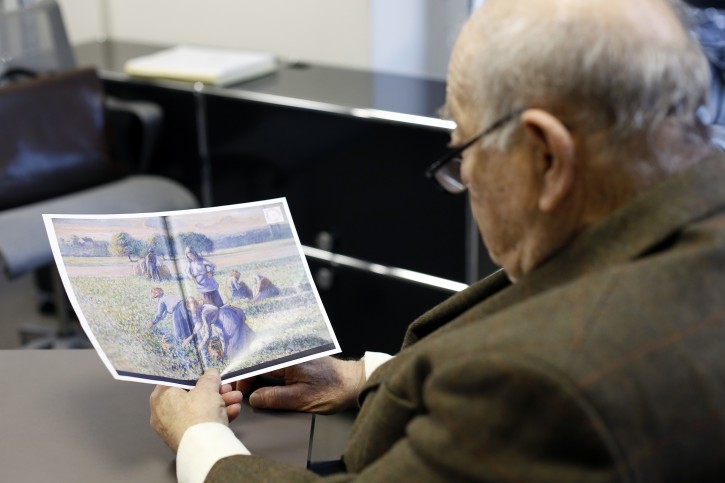
The couple, prominent Philadelphia collectors Bruce and Robbi Toll, loaned Pissarro’s “La Cueillette des Pois” (“Picking Peas”) to a Paris museum for an exhibition last year. But the painting from the impressionist master was placed in temporary escrow after one of the heirs of the Jewish family recognized it and sued to get it back.

The Tolls, who are also Jewish, said they did not know when they bought the Pissarro that it had been stolen by France’s war-era Vichy regime from Jewish collector Simon Bauer.

The lawyer representing Bauer’s descendants, Cedric Fischer, said Tuesday’s ruling “sanctions the right of the victims of acts of barbarity committed by the Vichy regime to recover, without limit of duration, the goods they have been disposed of.”

A civil court last year ruled that the Tolls didn’t act in bad faith when they bought the painting from Christie’s auction house more than two decades ago. But it said that sales of all goods looted from Jewish people by the French Vichy regime or its Nazi allies during the war were declared void by France’s post-war authorities in 1945.

Judges didn’t award any financial compensation for the couple, who purchased the painting for $800,000 in 1995.

The Bauer family had previously received 109,304 euros ($126.373) in compensation for losing the painting. Fischer told The Associated Press in a phone interview Tuesday that his clients have committed to return that money once they have the painting back.

Painted by Pissarro in 1887, the canvas was confiscated by French authorities after Bauer’s relatives found out it was on display in Paris as part of an exhibition and filed a lawsuit to have the work returned.

In his statement, Fischer said his clients now hope the Tolls will “respect the decision of the Paris Court of Appeal and not to keep going with the procedures which only aggravate the harm they have suffered.”

Messages left with Toll’s suburban Philadelphia office and an email seeking comment weren’t returned Tuesday.

Bauer’s collection of more than 90 paintings was confiscated in 1943 by the Vichy regime, which collaborated with the Nazis, and sold by a vendor designated by the General Commissariat for Jewish Questions.

After Simon Bauer’s death in 1947, his grandson Jean-Jacques began the search for the stolen art. He has recovered only a few pieces.

According to Fischer, the painting is now worth about $1.75 million, the price paid by the Tolls for its insurance. He said last year the painting was first bought by Theo van Gogh, the brother of Vincent van Gogh, who purchased it from Pissarro.

Source: VosIzNeias


Avromi Spitz – Harachaman/Rebuild (Official Music Video) – Feat. PUMPIDISA

Avromi Spitz – Harachaman/Rebuild (Official Music Video) – Feat. PUMPIDISA


96-year-old Jewish American wins Nobel Prize in Physics

96-year-old Jewish American wins Nobel Prize in Physics

Arthur Ashkin, who retired after 40 years in 1992 but remains active in his home laboratory, at 96 is oldest ever Nobel laureate.


Three researchers, including a Jewish American, won the 2018 Nobel Prize in Physics for inventions in the field of laser physics.

Arthur Ashkin, who retired after 40 years from Bell Labs in New Jersey in 1992, but remains active in his home laboratory, at 96 is the oldest ever Nobel laureate.

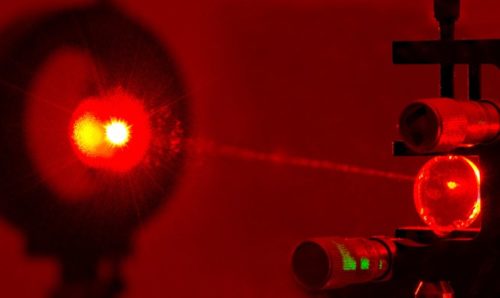
He started his work on manipulation of microparticles with laser light in the late 1960s which resulted in the invention of optical tweezers in 1986. Optical tweezers can grab particles, atoms, viruses and other living cells with their laser beam fingers and have resulted in the invention of advanced precision instruments used in corrective eye surgery and in industry.
Nobel Prize for Physics 2018 award winners

Ashkin won one half of the $1 million prize, with Gerard Mourou of France and Donna Strickland of Canada sharing the other half for together developing a method to generate ultra-short optical pulses, which also is used in corrective eye surgery.

Ashkin also is known for his studies in photorefraction, second harmonic generation, and non-linear optics in fibers. He holds 47 patents.

His parents were immigrants from the Ukraine who married and settled in Brooklyn, where Ashkin was born. He received a PhD in nuclear physics from Cornell University.


Laser physics study


Source: Arutz Sheva

WP Twitter Auto Publish Powered By : XYZScripts.com