
Home Blog Page 1131

Rabbi Lord Jonathan Sacks – Emotional Intelligence – Ha’azinu 5779

0


In March 2015 I had a public conversation at Yale with the University’s President Peter Salovey. The occasion was quite an emotional one. It celebrated the sixtieth anniversary of the Marshall Scholarships, created by the British parliament as a way of expressing thanks to the United States for the Marshall Plan, that helped Western Europe rebuild its economies after the Second World War. The scholarships fund outstanding young Americans to study at any university in the United Kingdom. So the gathering that evening was about the links between Britain and the United States, and the role of universities in cultivating that generosity of spirit, epitomised by the Marshall Plan, that understands the need to build peace, not just wage war.

But it had another emotional resonance. Yale is one the world’s great universities. Yet there was a time, between the 1920s and 1960s, when it had a reputation for being guarded about, even quietly hostile to, the presence of Jews among its students and staff.[1] Happily that has not been the case since 1960 when its President, A. Whitney Griswold, issued a directive that religion should play no role in the admissions process. Today it is warmly welcoming to people of all faiths and ethnicities. Noting that fact, the President pointed out that not only was Yale that afternoon hosting a rabbi, but he too –  Salovey – was Jewish and the descendant of a great rabbinic dynasty. Salovey is an Anglicisation of the name Soloveitchik.

Thinking back to that occasion, I wondered whether there was a more than merely family connection between the university president and his great distant relative, Rabbi Joseph Soloveitchik, the man known to generations of his students at Yeshiva University as simply, “The Rav.” Was there an intellectual and spiritual link also, however oblique?

There is, and it is significant. Peter Salovey’s great contribution to the thought of our time is the concept he formulated together with John Mayer in a landmark 1989 article,[2] namely emotional intelligence – popularised in 1995 by Daniel Goleman’s best-selling book of the same title.

For many decades, IQ, or intelligence quotient, focused attention on a set of cognitive and reasoning tests as the primary measure of intelligence, itself considered as the best indicator of ability as, for example, a military officer. It took another brilliant Jewish psychologist of our time, Howard Gardner (of Harvard), to break this paradigm and argue for the idea of multiple intelligences.[3] Solving puzzles is not the only skill that matters.

What Salovey and Mayer did was to show that our ability to understand and respond to not only our own emotions but also those of others is an essential element of success in many fields, indeed of human interaction in general. There are fundamental elements of our humanity that have to do with the way we feel, not just the way we think. Even more importantly, we need to understand how other people feel – the gift of empathy – if we are to form a meaningful bond with them. That is what the Torah is referring to when it says, “Do not oppress a stranger because you know what it feels like to be a stranger” (Ex. 23:9).

Emotions matter. They guide our choices. They move us to action. Intellect alone cannot do this. It has been a failing of intellectuals throughout history to believe that all we need to do is to think straight and we will act well. It isn’t so. Without a capacity for sympathy and empathy, we become more like a computer than a human being, and that is fraught with danger.

It was precisely this point – the need for emotional intelligence – about which Rabbi Soloveitchik spoke in one of his most moving addresses, ‘A Tribute to the Rebbetzin of Talne.’[4] People, he said, are mistaken when they think there is only one Mesorah, one Jewish tradition handed on through the generations. In fact, he said, there are two: one handed down by fathers, the other by mothers. He quoted the famous verse from Proverbs 1:8, “Listen, my son, to the instruction of your father (mussar avikha), and do not forsake the teaching of your mother (torat imekha).” These are two distinct but interwoven strands of the religious personality.

From a father, he said, we learn how to read a text, comprehend, analyse, conceptualise, classify, infer and apply. We also learn how to act: what to do and what not to do. The father-tradition is “an intellectual-moral one.” Turning to “the teaching of your mother,” Soloveitchik became personal, speaking of what he learned from his own mother. From her, he said:

I learned that Judaism expresses itself not only in formal compliance with the law but also in a living experience. She taught me that there is a flavour, a scent and warmth to mitzvot. I learned from her the most important thing in life – to feel the presence of the Almighty and the gentle pressure of His hand resting upon my frail shoulders. Without her teachings, which quite often were transmitted to me in silence, I would have grown up a soulless being, dry and insensitive.[5]

To put it in other words: Torat imekha is about emotional intelligence. I have long felt that alongside Rabbi Soloveitchik’s great essay, Halakhic Man, there was another one he might have written called Aggadic Woman. Halakhah is an intellectual-moral enterprise. But aggadah, the non-halakhic dimension of rabbinic Judaism, is directed to the broader aspects of what it is to be a Jew. It is written in narrative rather than law. It invites us to enter the minds and hearts of our spiritual forebears, their experiences and dilemmas, their achievements and their pain. It is the emotional dimension of the life of faith.

Speaking personally, I am disinclined to think of this in terms of a male-female dichotomy.[6] We are all called on to develop both sensibilities. But they are radically different. Halakhah is part of Torat Cohanim, Judaism’s priestly voice. In the Torah, its key verbs are le-havdil, to distinguish/analyse/categorise, and le-horot, to instruct/guide/issue a ruling. But in Judaism there is also a prophetic voice. The key words for the prophet are tzedek u-mishpat, righteousness and justice, and hessed ve-rahamim, kindness and compassion. These are about I-Thou relationships, between humans, and between us and God.

The priest thinks in terms of universal rules that are eternally valid. The prophet is attuned to the particularities of a given situation and the relationships between those involved. The prophet has emotional intelligence. He or she (there were, of course, women prophets: Sarah, Miriam, Deborah, Hannah, Abigail, Huldah and Esther) reads the mood of the moment and how it relates to longstanding relationships. The prophet hears the silent cry of the oppressed, and the incipient anger of Heaven. Without the law of the priest, Judaism would have no structure or continuity. But without the emotional intelligence of the prophet, it would become, as Rav Soloveitchik said, soulless, dry and insensitive.

Which brings us to our parsha. In Ha’azinu, Moses does the unexpected but necessary thing. He teaches the Israelites a song. He moves from prose to poetry, from speech to music, from law to literature, from plain speech to vivid metaphor:

Listen, heavens, and I will speak;
And let the earth hear the words of my mouth.
May my teaching fall like rain,
My speech flow down like dew;
Like gentle rain on tender plants,
Like showers on the grass. (Deut. 32:1-2)

Why? Because at the very end of his life, the greatest of all the prophets turned to emotional intelligence, knowing that unless he did so, his teachings might enter the minds of the Israelites but not their hearts, their passions, their emotive DNA. It is feelings that move us to act, give us the energy to aspire, and fuel our ability to hand on our commitments to those who come after us.

Without the prophetic passion of an Amos, a Hosea, an Isaiah, a Jeremiah, without the music of the Psalms and the songs of the Levites in the Temple, Judaism would have been a plant without water or sunlight; it would have withered and died. Intellect alone does not inspire in us the passion to change the world. To do that you have to take thought and turn it into song. That is Ha’azinu, Moses’ great hymn to God’s love for His people and his role in ensuring, as Martin Luther King put it, that “the arc of the moral universe is long but it bends towards justice.” In Ha’azinu, the man of intellect and moral courage becomes the figure of emotional intelligence, allowing himself to be, in Judah Halevi’s lovely image, the harp for God’s song.

This is a life-changing idea: If you want to change lives, speak to people’s feelings, not just to their minds. Enter their fears and calm them. Understand their anxieties and allay them. Kindle their hopes and instruct them. Raise their sights and enlarge them. Humans are more than algorithms. We are emotion-driven beings.

Speak from the heart to the heart, and mind and deed will follow.

Shabbat Shalom.



1] Dan A. Oren, Joining the Club: A History of Jews and Yale, Yale University Press, 1988.

[2] Salovey, P., & Mayer, J. D. (1989). Emotional intelligence. Imagination, Cognition and Personality, 9(3), 185-211.

[3] Howard Gardner, Frames of Mind: the theory of multiple intelligences, New York, Basic Books, 1983.

[4] Joseph B. Soloveitchik, ‘A Tribute to the Rebbetzin of Talne,’ Tradition, 17:2, 1978, 73-83.

[5] Ibid. 77.

[6] There are, to be sure, serious thinkers who have made just this claim, about the superior emotional intelligence of women. See Steven Pinker, The Blank Slate, Allen Lane, 2002; Simon Baron Cohen, The Essential Difference, Penguin, 2004. See also Carol Gilligan’s classic, In A Different Voice, Harvard University Press, 1982.



Mahwah and NJ Attorney General’s Office settle eruv, parks discrimination lawsuit

0

Mahwah and NJ Attorney General’s Office settle eruv, parks discrimination lawsuit


Mahwah has agreed to repeal one ordinance called “discriminatory” against Orthodox Jews, and not enact another, to settle a civil lawsuit filed by the New Jersey Attorney General’s Office last October.

Mahwah had already repealed the ordinance passed last June that prohibited out-of-state residents from using its parks. For the settlement agreement, township officials agreed that the repeal from December 2017 would remain in effect, according to the Attorney General’s Office.

The “Mahwah parks ordinance at issue unlawfully discriminated by banning non-New-Jersey-residents from using Mahwah’s public parks and also violated the terms of Green Acres grant funding provided to the Township for many years,” the Attorney General’s Office said.

The township also agreed not to adopt a second ordinance, introduced last year, that would have expanded a ban to prohibit the posting of signs on utility poles to include lechis, or plastic pipe attached to mark the borders of an Orthodox Jewish religious border known as an eruv.

Last July, Mahwah officials asked that a New York Jewish group take down the eruv pipe from utility poles around town. Within an eruv, Orthodox Jews can do tasks and activities forbidden on the Sabbath.

As part of the settlement, the township must advise Attorney General Gurbir Grewal in writing of any new ordinance proposals affecting use of parks, or signage on utility poles, for the next four years.

The township also has agreed to investigate all incidents of damage to lechis placed on utility poles as “potential criminal acts of vandalism” unless there is good cause to blame the “weather or accidental contact.”

In addition, the settlement requires the mayor and Township Council to issue a joint public statement affirming that its park and recreational facilities laws as well as solicitation laws will be enforced in “an even-handed and non-discriminatory manner.”

A proposed $350,000 fine has been suspended, but the township will be liable for the fine, in addition to legal fees and other costs, if it violates the terms of the agreement during the next four years.

Yehudah Buchweitz, attorney for the Bergen Rockland Eruv Association, which sued the town in August, said, “We commend the New Jersey attorney general for standing up for religious freedom,” and congratulated his office on the settlement.

“The people of the Bergen Rockland Eruv Association have been enjoying religious freedom for over a year now in part because of the great efforts of people like the New Jersey attorney general,” Buchweitz wrote in an email.

Council clash

Mahwah Mayor William Laforet and council President Robert Hermansen blame each other for the lawsuit.

Laforet said the council should have sought guidance before introducing the two ordinances. Hermansen countered that the ordinance was passed “with the support of the mayor.”

The attorney general filed the nine-count lawsuit against Mahwah and its council last October. The council withdrew the parks ordinance on Dec. 15.

“They [council members] have asserted for the better part of a year and a half that they were never told not to proceed,” Laforet wrote in an email. “This statement is blatantly false.”

“While the Attorney General’s Office or Mayor Laforet may characterize this settlement agreement as an admission by the council that we previously did something wrong, in fact it provides for something we requested before we even passed the ordinance that the state found so offensive: a dialogue,” Hermansen said Monday.

Hermansen said “a phone call and a meeting, either before or after the subpoena was served, would have been welcome.”

“Instead, they sued us,” he said.

Complaint filed

The attorney general filed a Superior Court complaint against Mahwah and its council last October alleging that in an effort to stave off a “feared influx of Orthodox Jewish persons from outside New Jersey,” it had passed or proposed two unlawful ordinances.

“Influenced largely by vocal anti-Orthodox-Jewish sentiment expressed by some residents at public meetings and on social media,” Mahwah engaged in unlawful discrimination, the complaint said.

Source: North Jersey Record

Rabbi Lord Sacks ‘honoured’ to be featured in art exhibition with faith leaders

0

Rabbi Lord Sacks ‘honoured’ to be featured in art exhibition with faith leaders

Former chief rabbi one of several religious leaders in Nicola Green’s new ‘Encounters’ display launched at St Martin-in-the-Fields in Trafalgar Square

Former Chief Rabbi Lord Sacks has paid tribute to an artist whose London exhibition opened this week with images that capture today’s unprecedented levels of inter-religious dialogue.

Sacks, who is one of several religious leaders featured in Nicola Green’s new ‘Encounters’ exhibition, said it was “an honour” to be involved, after the launch at St Martin-in-the-Fields in Trafalgar Square on 17 September.


Alongside Sacks, other notable figures who sat for the project include the Dalai Lama, Pope Francis, the former Grand Mufti of Egypt Ali Gomaa and former archbishops Desmond Tutu and Rowan Williams.

The exhibition, which runs for two months, includes images of Jewish, Christian, Muslim, Hindu, Zoroastrian, Sikh, Baha’i, Jain, African, Confucian, Humanist, Shinto and indigenous leaders, and is intended as a comment of dialogue and identity.

In the book Green argues that we are entering a new era of inter-religious relationships… formed by faith leaders across historically deep divides.

She says: “Often for the first time in history, these religious leaders have begun to sit down together and consider possibilities for cooperation, dialogue, and friendship. Together, they are leading the way towards a dialogue which respects and honours other religions, without compromising the truth of their own traditions.”

Commenting on the initiative, the Dalai Lama said: “I, too, believe that today’s leaders of various religious traditions are becoming more aware of the need for peaceful coexistence. I am confident that with more religious leaders actively involved in promoting religious harmony, we can all help in making this world a better place for everyone.”

Religious leaders depicted in Nicola Green’s new ‘Encounters’ exhibition


Source: Jewish News


Multiple people killed in Maryland shooting, officials say

0

Multiple people killed in Maryland shooting, officials say


At least three people were dead Thursday after a “horrific shooting” at a Maryland distribution center, a law enforcement official told The Associated Press.

Police initially reported there were “multiple victims,” and the Harford County Sheriff’s Office confirmed the shooting near Spesutia and Perryman roads in Aberdeen. The first shots were reported just after 9 a.m. at the “Liberty Support Facility,” which is a portion of the Rite Aid distribution center, FOX Baltimore reported.

It wasn’t known if officials had taken anyone into custody in connection with the incident. A news conference was set for 11:45 a.m.

“We are closely monitoring the horrific shooting in Aberdeen. Our prayers are with all those impacted, including our first responders. The State stands ready to offer any support,” Hogan said.

“We can confirm there was a shooting in the area of Spesutia Road and Perryman Road. Multiple victims. The situation is still fluid. Please avoid the area,” the sheriff’s office tweeted.

FBI Baltimore said it was responding to the scene, and a spokesperson told Fox News one of the bureau’s crisis specialist teams was en route.

“FBI Baltimore is responding & assisting @Harford_Sheriff with an Active Shooter situation. For updates please follow @Harford_Sheriff,” the agency tweeted.

Aberdeen is located about 30 miles northeast of Baltimore.

The Associated Press contributed to this report. 


Delta joins United, JetBlue in hiking U.S. baggage fees to $30

0

Delta joins United, JetBlue in hiking U.S. baggage fees to $30

WASHINGTON (Reuters) – Delta Airlines Inc, the second-largest U.S. airline, on Wednesday joined other major airlines in hiking domestic flight baggage fees by $5 per bag to $30.


The price hike follows similar moves by United Continental Holdings Inc and JetBlue Airways Corp in August and comes as Congress is considering whether to require the U.S. Transportation Department to assess whether airline baggage and ticket change fees are “reasonable and proportional.”

Delta, United and JetBlue are now charging $30 for the first checked bag on domestic routes, up from $25 previously, and $40 for the second bag, up from $35.

U.S. airlines’ revenues from baggage and reservation change fees increased from $5.7 billion in 2010 to $7.5 billion in 2017. Other fees are not reported to regulators.

United Chief Executive Oscar Munoz defended the price hikes last week, saying they were the first increases in eight years. Munoz said the airline would use some of the added fees to reinvest in operations.

Southwest Airlines Co, the No. 4 U.S. airline, has said it would continue to allow passengers to check two bags and does not charge reservation change fees.

In May, the U.S. Transportation Department opposed provisions in a bill approved by the Senate Commerce Committee that would require new rules prohibiting unreasonable airline fees, arguing it would mark a return to the pre-1978 era before airline deregulation.

American Airlines Group Inc Chief Executive Doug Parker told reporters last week that if Congress moved to regulate change fees, the No.1 U.S. airline would likely stop selling nonrefundable tickets that could be changed to a new flight. “That’s where I think we would end up,” he said.

American has not followed its competitors in raising baggage fees.

Airlines for America, an airline trade group, has said the fee provision would result in “government-mandated price controls” and should be rejected.

A Senate aide involved in the talks predicted the fee provision would not be included in the compromise bill but would include other consumer protections such as requiring the Transportation Department to set minimum standards for seat size.


Israel Fortifying its Nuclear Facilities Amidst Iranian Threats

0

Israel Fortifying its Nuclear Facilities Amidst Iranian Threats

By Yona Schnitzer/TPS • 20 September, 2018

Israel is upgrading the security around its nuclear facilities in light of Iranian threats against the country, Israel Atomic Energy Commission Director General Zeev Snir said at the annual meeting of the International Atomic Energy Agency (IAEA) in Vienna on Tuesday.

“We cannot ignore the repeated and explicit threats, made by Iran and its proxies, to attack Israel’s nuclear sites. These outrageous threats, require Israel to take action and continue to protect and defend its nuclear facilities,” said Snir, “These facilities are constantly upgraded and reinforced, in line with IAEA safety guidelines, in order to withstand any attack,” he added.

Snir also called on the IAEA to look further into Iran’s secret nuclear activities, citing the fact that Syria has managed to construct a near operational nuclear reactor concealed from the eyes of the world, before Israel destroyed it in September 2007.

“Syria built an undeclared, secretive military nuclear reactor at Dir Alzour. Such concealment of illicit activities, is a clear violation of the Non Proliferation Treaty and Syria’s safeguards obligations. The IAEA and the international community should have taken action ten years ago, and must take action now,” Snir said, “The IAEA must conduct a robust verification of Iran’s clandestine activities. The covert Iranian nuclear weapons program is a documented fact.”

Liberman on Russian Plane Incident: ‘Syria is to blame, Israel acted without error’

0

Liberman on Russian Plane Incident: ‘Syria is to blame, Israel acted without error’

By Yona Schnitzer/TPS • 20 September, 2018


Israel acted without error in the events that lead to the Syrian downing of a Russian military plane on Monday, Israeli Defense Minister Avigdor Liberman said Thursday morning.

Speaking to Army Radio, Liberman said: “We don’t usually comment on airforce activities, [but] as we have clarified more than once, we will do everything needed in order to prevent the Iranian entrenchment and the transfer of advanced weapons from Syria to Hezbollah, and as part of that constant activity, we have acted as we do all the time.”

According to Liberman, the Syrian downing of the Russian plane is not the result of Israeli malfeasance, but rather of Syrian incompetence, and that the Syrians only triggered their defense systems after the Israeli planes were back in Israeli airspace. “It’s important to understand that there is a military with missile defense, [consisting of] irresponsible and unprofessional people, who acted when the IAF planes were already in Israeli airspace… they fired indiscriminately.”

Just before dispatching IAF Commander Maj. Gen. Amiram Norkin to Moscow in order to present the IDF’s findings, Liberman said:

“We are prepared to present Russia with the findings of the IDF investigation, we have nothing to hide. We have acted like we have always acted. [This is a result of] the overconfidence of the Syrian Army.”

On Monday, while responding to an Israeli airstrike, Syrian missile defense systems shot down a Russian plane carrying 15 Russian soldiers over the Mediterranean sea. Moscow blamed Israel for the incident, claiming that they were not briefed in time about the planned strike.

On Tuesday, Israeli Prime Minister Binyamin Netanyahu spoke to Russian President Vladimir Putin, where he expressed his regret over the loss of the 15 Russian soldiers, but insisted that the blame rests with Syria, offering Israel’s full cooperation to Russia in investigating the incident and offering to dispatch IAF Commander maj. gen. Amiram Norkin to Moscow in order to assist with investigating the issue.

On Wednesday, Moscow announced that it will be sealing all Syrian airspace from September 19th to the 26th, citing a training exercise.


18 Uplifting Contemplations for Yom Kippur

0

18 Uplifting Contemplations for Yom Kippur

Take a different view of what this day is about

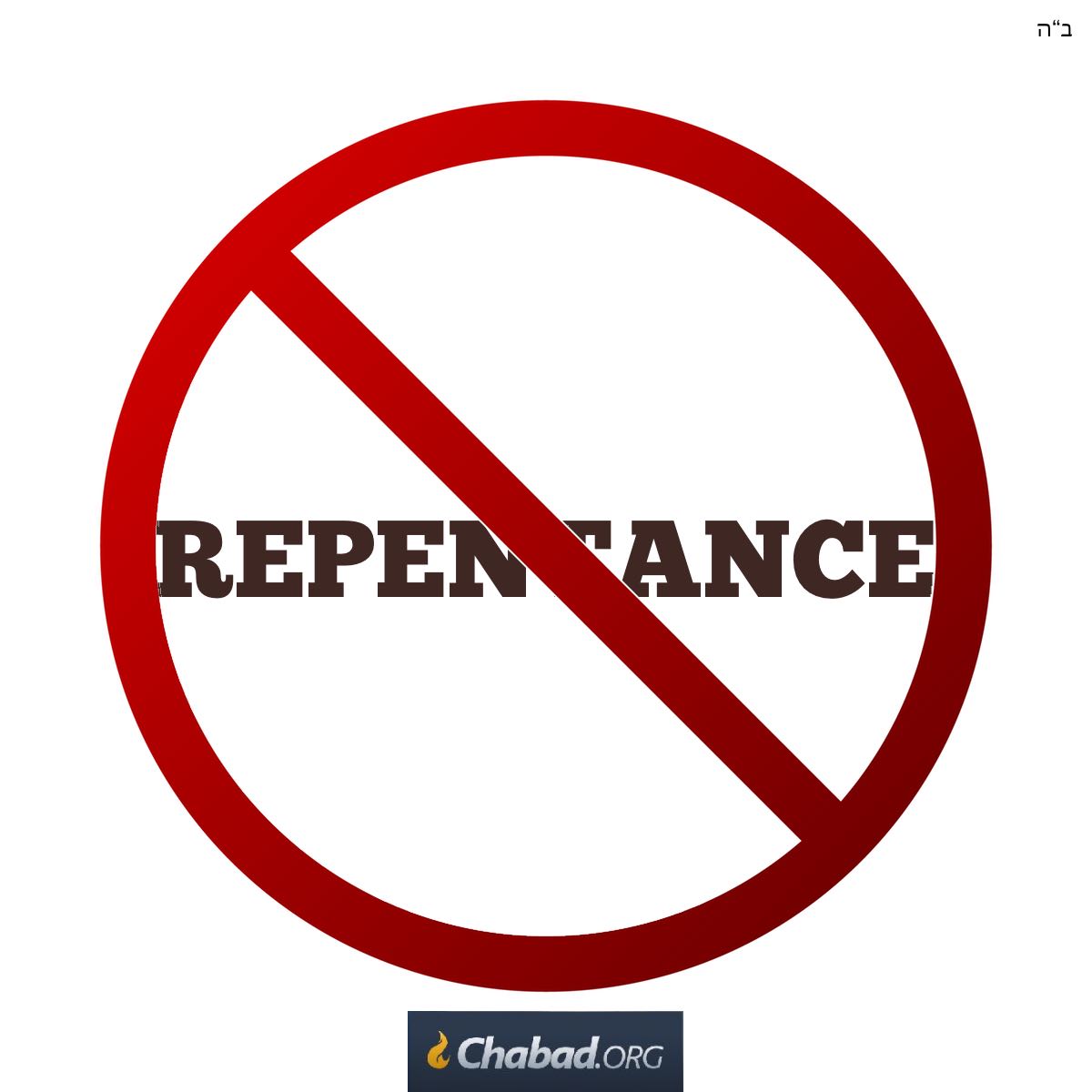
1. Unrepenting


Do not repent.

Repentance means to stop being bad and to become good.

But your essential being is always good. The bad is only on the outside.

So instead of repenting, return. Return to the essential self and to what is rightfully yours.


2. Recovery


Teshuvah doesn’t mean repentance. Repentance means regretting who you’ve become. Teshuvah means returning to who you truly are.

Teshuvah, in English, is recovery. Recovering a lost inner self.

On Yom Kippur, we are all in recovery.


3. Take the High Road


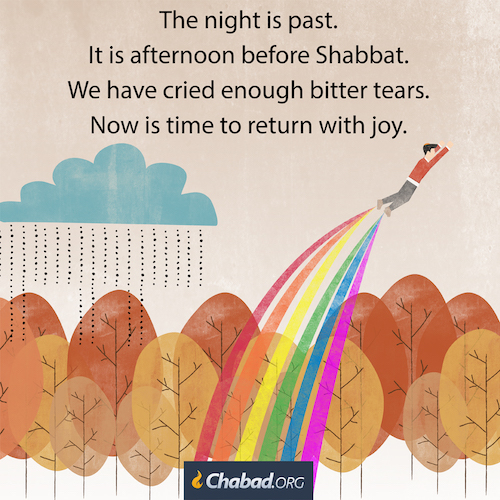
Two rivers take you home: One flows with bitter tears of remorse,
the other with sweet tears of joy.

For most of time, the principal path of travel was the bitter one. Only once soaked in those bitter waters could you rise to embrace your G?d with joy.

But now we have experienced more than our fill of pain. That which our people suffered in lands across the ocean has purged every stain, bleached every garment of our souls, refined us and lifted us high.

We have cried enough bitter tears. Now is time to return with joy.

Maamar Margalia B’Fuma D’Rabba 5746. Blessing on Erev Yom Kippur 5750.

4. Self Pity


Self-pity is nothing less than an impulse to self-destruction. And this is its script:

“This is the way you were made. These are the facts of your situation. It’s bad. In fact, it’s so bad, it’s impossible to do anything about it. And therefore, you are free from any responsibility to clean it up. Nobody can blame you for anything.”

Self-pity is a liar and a thief.

A liar, because everyone is granted the power to clean up their own mess. A thief, because as long as it sits inside you, it is stealing away the days of your life.


5. Even Better


Every soul begins its journey as pure, lucid light. But once she enters this world, she may fall.

Even had the soul remained pure, the descent would still have been worthwhile. All the more so now that she has fallen.

True, she was meant to confine herself to the permissible; she would have enlightened that realm of the world, healed it and carried it upward.

But now that she has fallen, let her return to her true, inner self, and in doing so she will transform to light that which a pure soul would never have touched.


6. Bouncing Up


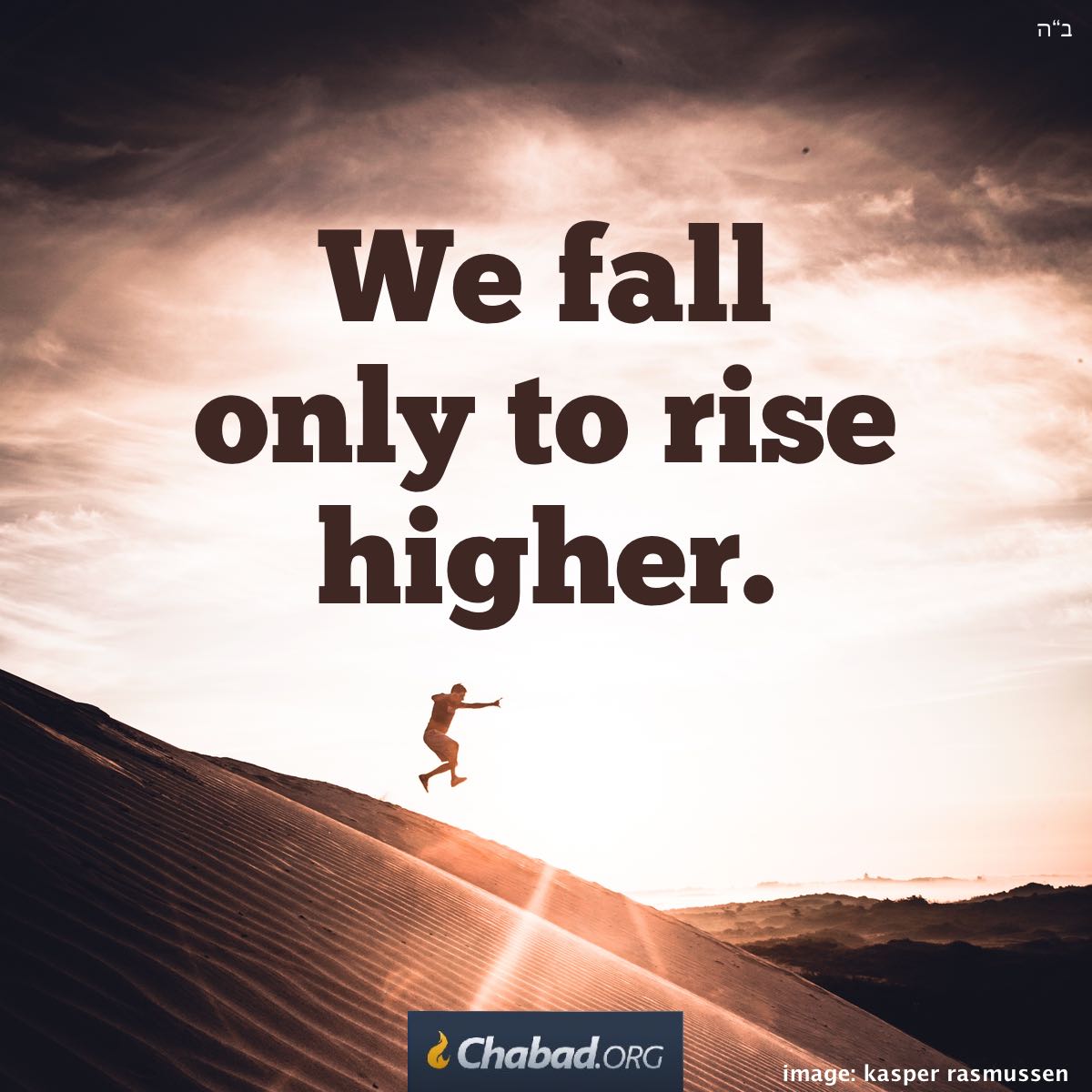
Night comes before day, pain before pleasure, confusion before wisdom. So too, the way this world was made, there is no journey forward without first a step backward.

So it is with all creatures. But we human beings, we strive not only to move forward, but to leap beyond our own nature, beyond any nature at all.

We, too, must first step back before we can leap upward. But since our leap is beyond nature, we fall, too, beneath our nature.

That is sin—a fall beneath your own nature, as one who crouches before he leaps.

And that is the power of return
—to leap beyond any bounds at all.


7. A Leap of Failure


Everything in life is a step forward; everything has meaning. It’s just that there are two ways to move forward: walking and leaping.

When you walk, you leave one foot in its place as the other moves ahead. You’re secure, you’re stable—and you never leave your comfort zone.

So sometimes you need to leap. But to do that, you need to first crouch down.

That’s the true meaning of failure: It is the crouch before the jump, the breakaway from the past so that you can leap into the future, an opportunity to do something totally unexpected.

Failure lets you go where your footsteps could never take you.


8. Time Travel


To change the past, there is no need to travel in a time machine. Everything can be done by remote control.

Here’s how it works: From beyond the continuum of time, its Creator looks at where your spaceship is heading right now. From that point, He creates all its trajectory—through the future and through the past.

Switch the direction your past is sending you. Soon enough, it becomes a different past.

Maamar Padah B’Shalom 5738.

9. Time Machine


If you could travel back in time, what would you change?

Perhaps you could revisit some crucial scenes and distance yourself from the mess that occurred. Perhaps you could jump in as a hero and grab credit for some of the good.

But for that, you don’t need a time machine. All you need is to stand right where you are and say, “I messed up. I dropped the ball. But I learned my lesson and now I will do things differently.”

You will change yourself. You will change your past. You will say, “I am no longer that person who lived in that past.”

In fact, you do have a time machine.


10. G?d’s Fishing Net


The soul emerges from her intimate bond with G?d and invests herself within a human form, wrapped up in the transient concerns and pain of the flesh. Yet the imprint of that bond is never erased.

It is that bond that pulls her incessantly to return, like a magnet pulled towards its lost other half. All the searching of the human soul is an outward expression of this dynamic, this thirst to return.

Yet, as innate as this yearning may be, it must nevertheless be awakened. To thirst for closeness, the soul must first realize she is distant.

That is why return in all its strength and passion is found in the soul which has wandered far from her true self—and then awakened to recognize she is lost.

There is great bounty to be found in this journey. For the soul is G?d’s fishing net. In her desperation to reunite with Him, she finds G?d in every corner of His world. And so, these too are pulled in.

And the deeper the descent, the greater the treasure.


11. Hit the Road


Getting to where you need to be is an important step.

But nothing is as important as getting out of where you’re at right now.


12. The Ultimate Delight


What is G?d’s ultimate delight?

That a human soul will build portals of light so that the Creator’s presence may shine into His creation.

That a breath from His essence will pull herself out from the mud and turn to Him in love.

That a child of His being, exiled to the shadows of a physical world, will discover that the darkness is nothing more than Father hiding, waiting for His child to discover Him there.

But none of these can reach to the essence of all delights, the origin of all things, the hidden pleasure beyond all pleasures: The delight that this breath, this soul, this child did it all on its own.


13. Getting Personal


When does a relationship become real? Once it has broken down.

As long as each fulfills the other’s expectations, there is no relationship, only a contract and its transactions. Once trust is breached, a new depth must enter: The depth of the human being.

If there is truly a relationship—if it is the person inside that matters—then there is a search for forgiveness, for return, and for healing.

So it was that within forty days of entering into a contract with the One Above, the children of Israel broke the deal. And the soul below and the One Above discovered they could not part from one another.


14. Dance With the Other


As a parent and a child, as siblings who remain bonded, as two young people in love, as in any marriage that stays alive—so we are with the One Above.

One chases, the other runs away. One runs away, the other chases in longing pursuit. One initiates, the other responds. The other initiates, the one responds.

It is a dance, a game, a duet, and it plays as surely as the pulse of life.

Until one falls away. Until it seems the game is over, that all is lost and it is time to move on.

That’s when the other looks and says, “This is not an other. We are one.” And so, they return to each other’s arms.

It is a great mystery, but in that falling apart, there is found the deepest bond.


15. The Fair Maiden’s Hero

“He found her in the field. The maiden cried out, but there was no one to hear.”—Deuteronomy 22:27

Rabbi Menachem Mendel of Lubavitch explained:

He does not want to be in that place. He feels himself a captive of his own desires, now a prisoner incapable of escape. Deep within him a voice screams—the scream of an innocent maiden under assault, yet hopeless that anyone can save her..

And no one hears.

No one. Nothingness. The Nothingness from which everything begins. Not just the Source of All Being, but the core essence of G?d, beyond all being. There, her cry is heard.

The screams of a fair maiden stir her hero to overcome mighty armies and slay awesome giants; so too, the cries of the soul from her captivity reach to the core of the Infinite Above.

Out of Nothingness, anything could happen.


16. Kosher Yearnings


He sits and yearns for a thing he should not have. For something beneath himself.

The yearning itself is good—to live is to yearn. If there’s nothing for which you yearn, you can hardly be said to be alive.

It’s the form this yearning has taken that is death itself. To yearn for that which is beneath you is to destroy yourself.

So the form must be crushed. Extinguished like the embers of an abandoned campfire in a dry forest.

And then that yearning can be freed, the flame of life that burns inside. That was always good. The yearning—that is life.


17. Beyond the Script


What do we bring to the table?

Our brains, our power, our beauty, are all from Him.

We can decide with our own free will to do good and to restrain ourselves from the opposite. Yet even then, we are only playing our role in the script for which we were formed.

But when we mess up, we can call out to the Infinite Light and say, “Dad, I still love you. Do you still love me?” and ask forgiveness.

That is not in the script. That is from beyond. Way beyond.


18. Divine Delights


G?d has many delights:

The delight that comes from a pure and simple act of love.

Greater than that, the delight that comes from an act of beauty sparkling in the darkness.

Greater than that, the delight when a child who has run away from Him returns with all her heart.

All the world was formed from G?d’s delight. There is nothing else.


Source: Chabad.org

WP Twitter Auto Publish Powered By : XYZScripts.com