A 3,300 year old coffin was exposed by the Israel Antiquities Authority (IAA) containing the personal belongings of a wealthy Canaanite, possibly an official of the Egyptian Army. Among the items discovered is a gold signet ring bearing the name of the Egyptian Pharaoh Seti I.
The rare artifacts were uncovered during salvage excavations by the Israel Antiquities Authority near Tel Shadud, prior to the installation of a natural gas pipeline to Ramat Gavriel by the Israel Natural Gas Lines Company (INGL), during which the fascinating and exceptional discovery was made.
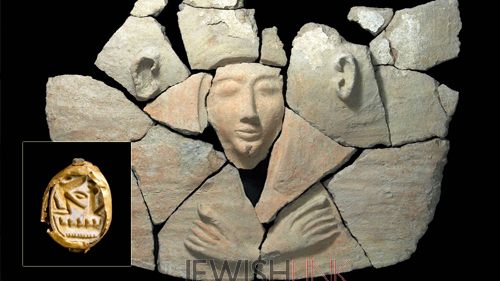
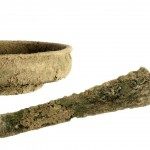
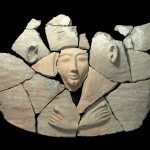
Part of a burial site dating to the Late Bronze Age (thirteenth century BCE) was exposed in an excavation at the foot of Tel Shadud. According to the excavation directors, Dr. Edwin van den Brink, Dan Kirzner and Dr. Ron Be’eri of the IAA, “During the excavation we discovered a unique and rare find: a cylindrical clay coffin with an anthropoidal lid (a cover fashioned in the image of a person) surrounded by a variety of pottery consisting mainly of storage vessels for food, tableware, cultic vessels and animal bones. As was the custom, it seems these were used as offerings for the gods, and were also meant to provide the dead with sustenance in the afterlife.” The skeleton of an adult was found inside the clay coffin and next to it were buried pottery, a bronze dagger, bronze bowl and hammered pieces of bronze. “Since the vessels interred with the individual were produced locally”, the researchers say, “We assume the deceased was an official of Canaanite origin who was engaged in the service of the Egyptian government”. Another possibility is that the coffin belonged to a wealthy individual who imitated Egyptian funerary customs. The researchers add that so far only several anthropoidal coffins have been uncovered in the country. The last ones discovered were found at Deir el-Balah some fifty years ago. According to the archaeologists, “An ordinary person could not afford the purchase of such a coffin. It is obvious the deceased was a member of the local elite”.
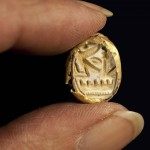
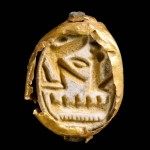
The graves of two men and two women who may have been members of his family were also located near the coffin. The discovery of the coffin at Tel Shadud is evidence of Egyptian control of the Jezreel Valley in the Late Bronze Age (thirteenth century BCE). During the period when the pharaohs governed the country, Egyptian culture greatly influenced the local Canaanite upper class. Signs of Egyptian influence are occasionally discovered in different regions and this time they were revealed at Tel Shadud and in the special tomb of the wealthy Canaanite. A rare artifact that was found next to the skeleton is an Egyptian scarab seal, encased in gold and affixed to a ring. The scarab was used to seal documents and objects.
The name of the crown of Pharaoh Seti I, who ruled ancient Egypt in the thirteenth century BCE, appears on the seal. Seti I was the father of Ramses II, identified by some scholars as the pharaoh mentioned in the biblical story of the Israelites’ exodus from Egypt. Already in the first year of his reign (1294 BCE) a revolt broke out against Seti I in the Bet Shean Valley. Seti conquered that region and established Egyptian rule in Canaan. Seti’s name on the seal symbolizes power and protection, or the strength of the god Ra – the Sun God – one of the most important deities in the Egyptian pantheon. The winged Uraeus (cobra), protector of the pharaoh’s name or of the sovereign himself, is clearly visible on the seal. The reference to the pharaoh Seti on the scarab found in the coffin aided the archaeologists in dating the time of the burial to the thirteenth century BCE – similar to the burials that were exposed at Deir el-Balah and Bet She‘an, which were Egyptian administrative centers.
A cemetery dating to the reign of Seti I was previously discovered at Bet Shean, the center of the Egyptian rule in the Land of Israel, and similar clay coffins were exposed. Evidence of an Egyptian presence was detected in archaeological surveys conducted in the Jezreel Valley in the past but the discovery of the impressive anthropoid at Tel Shadud surprised the archaeologists. Tel Shadud preserves the biblical name ‘Sarid’ and the mound is often referred to as Tel Sarid. The Tell is situated in the northern part of the Jezreel Valley, close to Kibbutz Sarid. The city is mentioned in the Bible in the context of the settlement of the Tribes of Israel. Sarid was included in the territory of the tribe of Zevulun and became a border city, as written in the Book of Joshua
Tel Shadud is strategically and economically significant because of its location alongside important roads from the biblical period.
The Israel Antiquities Authority is currently looking into the possibility of sampling the DNA from inside the coffin to see if the deceased was originally a Canaanite or an Egyptian who was buried in Canaan.
By Aryeh Savir
Tazpit News Agency
The gold scarab. Photograph: Clara Amit, courtesy of the Israel Antiquities Authority.
A picture of the bronze dagger and bowl. Photograph: Clara Amit, courtesy of the Israel Antiquities Authority.
The gold scarab. Photograph: Clara Amit, courtesy of the Israel Antiquities Authority.
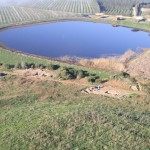
A general view of the excavation area. Photograph: Skyview Company, courtesy of the Israel Antiquities Authority.
Parts of the coffin’s lid after an initial cleaning. Photograph: Clara Amit, courtesy of the Israel Antiquities Authority.
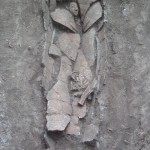
The clay coffin at the time of its discovery in the field. Photograph: Dan Kirzner, courtesy of the Israel Antiquities Authority.
It is with great sadness that we inform the community of the passing of Moshe Yechezkel, Moshe Yechezkel Ben Rebbe, Beloved father of Ofrah Haridim, Father in law of Yosef Haridim,Beloved grandfather of Renana, Shimon, Chananya ,Shira, Hadar, Benyamin ,Shalom and Moshe. Great grandfather to Yaakov, Aaron Haridim in LA.
SHIVA:
Ofrah is sitting Shiva at her house 1500 Oakhurst Dr.
Today Wednesday April 9th until Sunday April April 13th.
Shiva 9:00-11:30 and 1:30-4:30
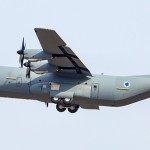
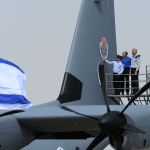
BE’ER SHEVA – The new “Samson” Squadron, a military transport plane purchased from the United States, was inaugurated into the Israel Air Force (IAF) today in the Nevatim airbase near Be’er Sheva. The modern aircraft, with a range of flight of nearly 4,000 km, will greatly strengthen the IAF aircraft fleet.
Known abroad as the “Super Hercules,” or C-130J-30, the IAF purchase of the Samson from Lockheed Martin, will replace the IAF’s aging Hercules C-130/H transport models.
Some of the Hercules aircraft have been in use by Israel for more than 40 years. The Lockheed Martin-made planes played a significant role in the Yom Kippur War as well as the Entebbe Operation to free hostages in 1976 and Operation Solomon to airlift Ethiopian Jews to Israel in 1991.
The current “Samson” aircraft is able to fly at faster speeds, higher altitudes and carry more weight. It allows for an improved carrying capacity, holding 94 paratroopers instead of the 64 paratroopers that the former version carried, and their equipment. Alternatively, the cargo hold can accommodate four military SUV’s instead of three, or transport 128 soldiers, according to the IAF website.
“The more cargo a plane is able to take, the fewer trips that are necessary to accumulate power on the battlefield,” explained Lieutenant Colonel Uri on the IAF website.
In addition, Israeli-made computer systems will be added to the plane, providing it with exclusive capabilities and making it stand out from other Hercules planes around the world.
According to the IAF, the new plane will work closely with ground forces. “The plan will mostly work with ground forces and to their benefit: it will transport forces, rescue them and know how to execute transport and supply missions for them with a degree of efficiency and safety,” said Lieutenant Colonel Uri on the IAF website.
Once the “Samson” undergoes test flights, the air crews of the IAF’s Elephants squadron will begin training on it, integrating the plane into the IAF aircraft fleet.
“For several months now, the future pilots of these massive planes have been training in flight simulators in the U.S. and Italy in order to familiarize themselves with its technological and operational innovations,” said Colonel A, the deputy commander of the IDF unit in charge of the “Samson” in a report on the official IDF blog.
The Hebrew name for the plane, Shimshon, is named after the biblical hero, Samson, the counterpart to its foreign name Hercules.
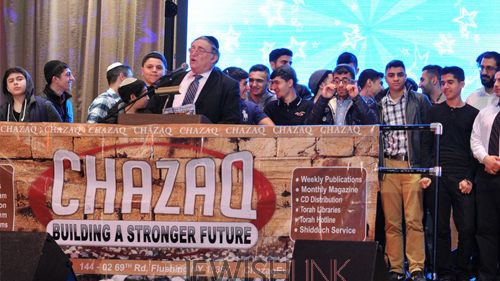
This year’s “Big Event” by the renowned Jewish outreach group CHAZAQ certainly lived up to its name, as well over a thousand people flooded into the auditorium of Forest Hills High School on Sunday night, March 30, for an evening of inspiration and entertainment.
Founded in 2006 by Rabbi Ilan and Yaniv Meirov, CHAZAQ’s offerings include educational programs (classes and one-on-one learning) for men and women of all ages, youth groups, a variety of family-oriented publications, even a shidduch service—just to name a few. And under the dynamic leadership of the Meirov brothers and their colleagues, CHAZAQ has quickly become a household name among the Queens Jewish community.
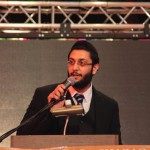
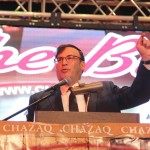
CHAZAQ’s motto is “To Build a Stronger Future,” and it was clearly with this ethos in mind that the Big Event was created. A sea of fresh, young faces could be seen, enjoying equally the words of mussar offered by a distinguished line-up of lecturers, and the entertainment, which included master illusionist Marc Garfinkel, and frum music sensation The Chevra. But it wasn’t just the leaders of tomorrow who were in the house. Also in attendance to show their support were BP Melinda Katz (who issued a government proclamation declaring March 30th “Chazaq Day” in the Borough of Queens), Congresswoman Grace Meng, and New York City Councilman Rory Lancman.
The dignitaries attending the Big Event came from both near and far. We caught up with Israeli Knesset Member R’ Nissim Ze’ev, a CHAZAQ supporter and personal friend of the Meirovs. Ze’ev spoke of the significance of so many people coming together to support a Torah cause on the eve of Rosh Chodesh Nissan, the month of Passover. “This is the first month of the year, that we have to bring the Torah and the geulah of Am Yisrael this month. … And that’s why we are here; we are coming to accept the geulah, be’ezrat Hashem.”
At the heart of the evening’s proceedings were presentations by respected Jewish figures such as investor-turned-motivational speaker and media personality Charlie Harary, and a highly-esteemed procession of rabbanim, including crowd favorites Rabbi Zecharia Wallerstein and Rabbi Paysach Krohn, along with Rabbi Yitzchak Oelboum who chaired the event. The theme of Freedom, central to the Pesach holiday, was a popular one throughout the evening. Mr. Harary exhorted audience that if one wants to be free from those weaknesses and personal obstacles keeping them from personal fulfillment, one need simply “act free.”
“Our holidays are not commemorative,” declared Harary, noting that each holiday is intended to be a transformative personal experience – which is why, he explains, the first Passover seder took place prior to the Exodus from Egypt, rather than on the first anniversary thereof.
Though presented with a tough act to follow, the rabbis whose speeches came after Harary’s were certainly up to the task. Regaling the audience with a variety of parables and personal anecdotes, the evening served as one big call to action, both in attendees’ own spiritual lives, and in support of the vital work of CHAZAQ.
“A thousand Jewish kids come to this [public] school every day!” Rabbi Krohn lamented. “And if we don’t get involved in kiruv, and we don’t help CHAZAQ help these kids come back, we are not only losing a thousand kids—we’re losing tens of thousands, because we’re losing their children, and their grandchildren, and their great grandchildren.” Still, the overall tone of the event was emphatically positive, with Rabbi Krohn—in awe of CHAZAQ’s accomplishments—remarking later that same evening: “If someone told me that Moshiach was coming tomorrow, I would believe it.”
Divrei bracha by the famed Rav Noach Isaac Oelboum were read to the audience by Mr. Boruch Singer and a dramatic video presentation served to underscore the significance of the Big Event in terms of making the ongoing work of CHAZAQ possible. Fresh from their success with last year’s sefer Torahcampaign (whereby the organization was able to create a Torah scroll with letters filled in by numerous gedolei hador), CHAZAQ is currently promoting its “A Teen for Eighteen” initiative, whereby community members may partner with CHAZAQ’s highly-successful after school programs for local teenagers by sponsoring a teen for only eighteen dollars a month. The Big Event was a fundraiser for that program, but efforts are ongoing.
To learn more about how CHAZAQ is building a stronger future for the Jewish community or to join their efforts, visit their website atchazaq.org or call 917-617-3636.
Daniel Perez is a freelance journalist and PR consultant based in New York City. His work has appeared in dozens of Jewish publications and media outlets. Mr. Perez can be reached at Daniel@PerezConsulting.org.
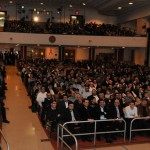
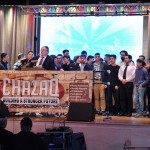
Partial View of the crowd (Amity Studios)
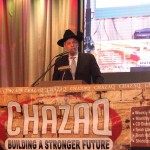
Rabbi Krohn introducing Chazaq’s Teen for Eighteen campaign (Amity Studio) (2)
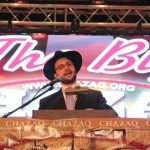
Opening remarks by R’ Yitzchak Oelbaum (Yaakov Katz Studios)
Reb Baruch Singer relaying Divrei Bracha from HaRav Noach Isaac Oelbaum (Yaakov Katz Studios)
R’ Zecharia Wallerstein speaking at the Big CHAZAQ Event II (Yaakov Katz Studios)
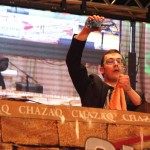
Marc Garfinkel entertaining the audience (Yaakov Katz Studios)
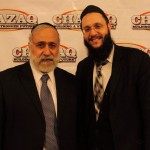
Knesset member R’ Nissim Ne’ev with CHAZAQ Director Rabbi Ilan Meirov (Yaakov Katz Studios)
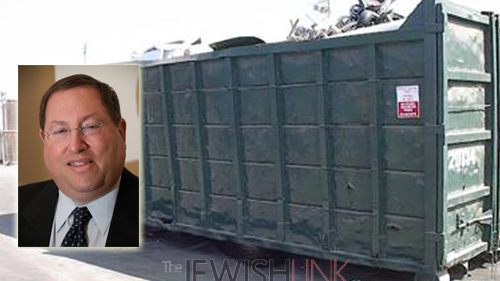
Councilmember Paul Koretz is pleased to announce the availability of refuse roll-off dumpsters at three locations on the Westside for the disposal of Chometz prior to the start of the Pesach holiday. These containers, in cooperation with the Bureau of Sanitation of the City Department of Public Works, will be available for the convenience of the community prior to the commencement of the holiday beginning by the late afternoon of Thursday, April 10 and will be available through Monday, April 14. The locations are the following:
1. The rear alley side of the City parking lot adjacent to B’nai David-Judea Congregation at 8906 W. Pico Blvd., one block west of Robertson Blvd. and east of Livonia Ave.
2. The Ralphs parking lot, 260 S. La Brea Ave., the northeast corner at Third St.
3. Pan Pacific Park at 7600 Beverly Blvd. in the east side of the parking lot west of Gardner St.
These containers may fill over the weekend and will be replaced with empty ones on the morning of April 14. Please help the City to keep the areas around the containers clean if those containers are already filled to capacity. Please do not leave your household garbage cans out throughout the holiday as it violates Los Angeles Municipal Code and could be subject to citation by the Bureau of Street Services. If you have any questions please call the Westside district office of Councilmember Koretz at (310) 289-0353.
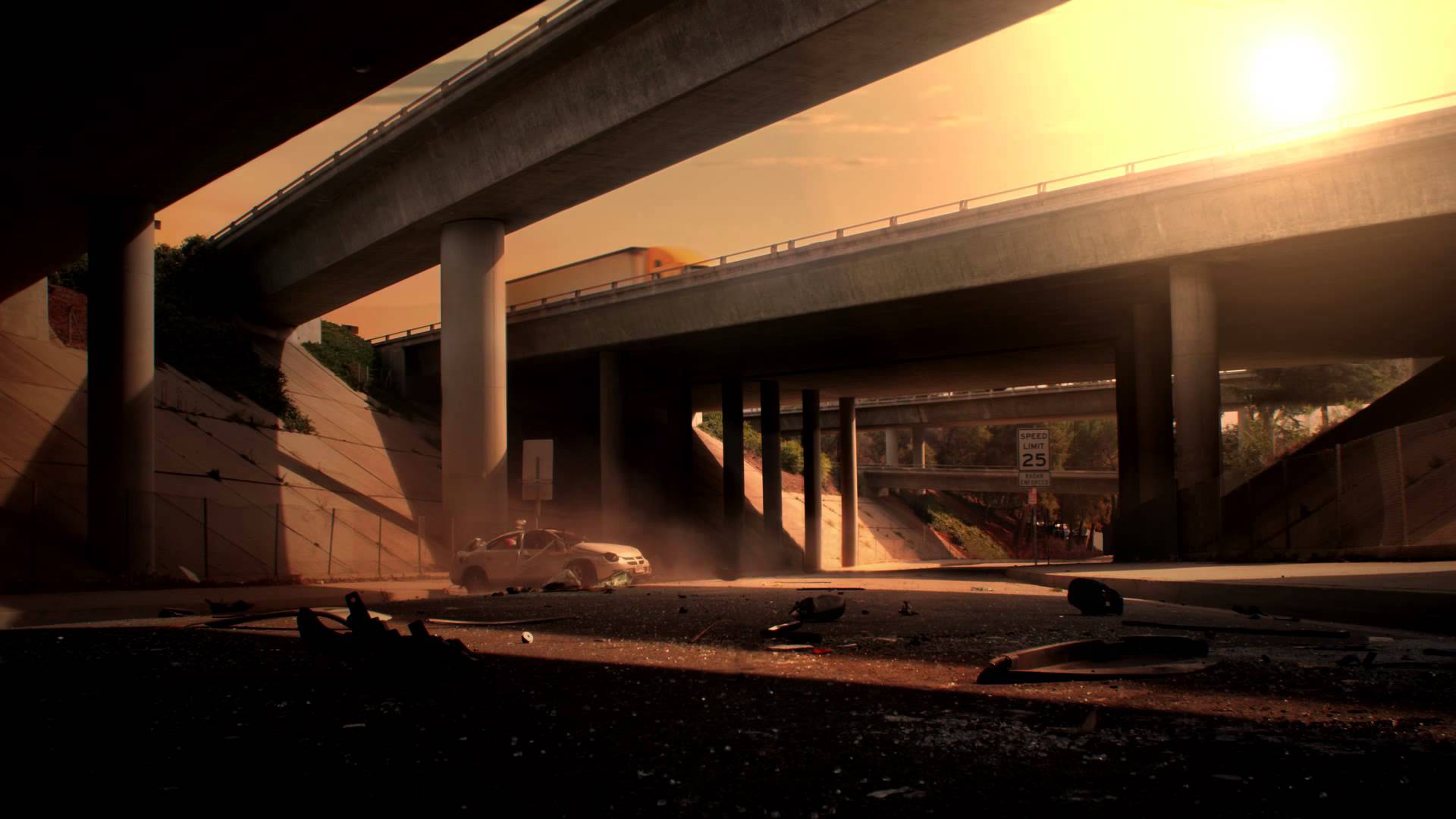
Ushering in National Distracted Driving Awareness Month, the The US Department of Transportation’s National Highway Traffic Safety Administration has launched a new ad campaign. according to reports by adweek.com the ad is aimed at teens, it’s incredibly straightforward, simulating an everyday scene cut short by a distracted driver. The theme is “U drive. U text. U pay.”
According to the new site distraction.gov, more than 70 percent of teens and young adults have sent or read a text while driving. The campaign aims to get teen drivers to take a pledge to refrain from texting and driving, as well as give them the tools to help raise awareness. Thousands of people die every year in crashes related to distracted driving.
It’s certainly a step in the right direction. The Jewish Link would like to reminds our readers. Please do not text and drive!
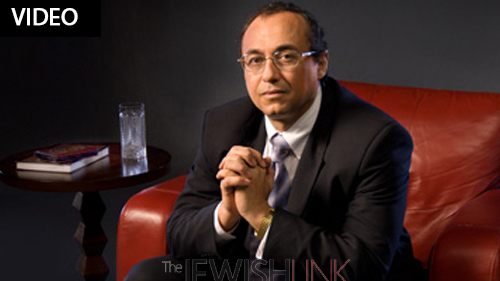
Dr. Tawfik Hamid is a unique and solitary voice in the Islamic world. A self-described former terrorist, he was a member of the militant al-Gama’a al-Islamiyya with Dr. Ayman Al-Zawaherri who later on became the second in command of Al-Qaeda and now heads it. He stresses he has never actually committed an act of violence.
Dr. Hamid is currently a Senior Fellow and Chair for the Study of Islamic Radicalism at the Potomac Institute for Policy Studies. Dr. Hamid has a medical degree in internal medicine and a master’s degree in cognitive psychology and educational techniques. He writes that some twenty-five years ago, he recognized the threat of radical Islam and the need for a reformation based upon peaceful interpretations of classical Islamic texts. Hamid believes the real message of Islam has been hijacked by many people throughout history. Those people defamed Islam and portrayed it incorrectly. He says he started to preach in mosques to promote his message of and, as a result, became a target of Islamic militants, who threatened his life.
Expressing his opinion on the peace accords between Israel and the Palestinian Authority, Dr. Hamid places the blame for their failure on the Palestinian leadership. He states that the Arabs’ suffering must be acknowledged, but the source of their suffering is their own leadership. The PA leaders and Hamas are cynically and immorally using the Arabs’ plight for political and religious gain. “One million Arabs live in Israel with the Jews and they are not suffering like the Arabs who are actually controlled by the Arabs. To be honest you have to say that the Palestinian suffering is because of their leadership, not because of Israel,” says Dr. Hamid.
“The solution is in the hands of the Palestinians”, he says, “They have to take the decision to stop the suffering of their people.” he believes the key to peace is for the Arabs to change their attitude towards Israel. If they truly extend their hand in peace, all will be resolved.