
New Engagement~
Dovid Leider – San Diego, CA to Mimi Shallman – Los Angeles, CA!!!

Jewish Students Kicked Off Flight

An entire class of students from Yeshivah of Flatbush were booted off an AirTran flight because they were “noncompliant passengers.
Shloime Gertner Releases All New Single – Hear My Prayer
Shloime Gertner, who just this past year released the hit album “Vehiskin” has just is now out with a brand new single. This beautiful all new song, titled “Hear My Prayer” was recorded and composed in the honor of the wedding of Stage and Johana Presence.
Philanthropist donates $250,000 to Mount Zion cemetery repair | Los Angeles | Jewish Journal
BY JARED SICHEL www.jewishjournal.com
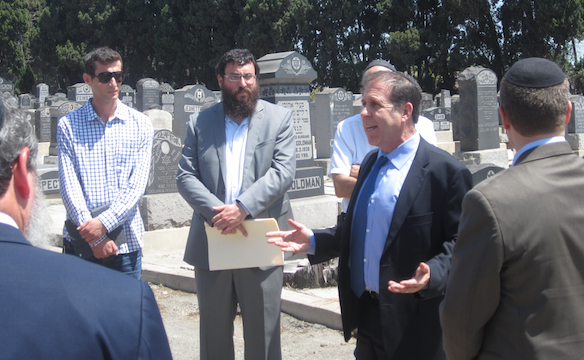
Shlomo Rechnitz, a Los Angeles businessman and philanthropist, has donated $250,000 to restore the badly vandalized Mount Zion Cemetery in East Los Angeles. In addition, two other donors, real estate developer Izek Shomof and businessman Adi McAbian, each donated $25,000, and another real estate developer, Michael Fallas, gave $10,000, making possible some major initial repairs to the site, which has been damaged by intruders in recent years, including knocking over gravestones. The century-old cemetery is the gravesite for about 7,000 Jews.
Following these gifts and a site visit on May 30 by key community leaders, the first stage of the crumbling cemetery’s restoration is expected to begin in June.
Articles in the Jewish Journal and Los Angeles Times have raised awareness about the issue in recent weeks. Rabbi Moshe Greenwald, co-director of Chabad of Downtown Los Angeles, is leading the effort to restore the cemetery.
The Jewish Federation of Greater Los Angeles assumed responsibility for Mount Zion Cemetery in 1969 after its original owner, Chevra Chesed Shel Emeth, was no longer able to maintain it. In the past decade, Federation has provided annual support of about $25,000.
To donate to Friends of Mt. Zion Cemetery, send checks, payable to “Friends of Mt. Zion Cemetery,” to 219 W Seventh St., Suite 206, Los Angeles, CA 90014.
For full article please visit:

North America’s First-Ever Jewish Entrepreneur Conference
World-Renowned Speakers; Best Selling Authors; Shark Tank-Like Event to Highlight LTB 2013
(Brooklyn, NY) — On June 11, 2013, history will be made at the Dyker Beach Golf Course in Brooklyn with the premiering of LTB 2013.
Being hailed as the nation’s first-ever, large-scale Jewish business and entrepreneur conference, LTB 2013 will provide serious-minded business people in the Jewish community with the necessary tools to learn grow and succeed in the world of business.
“This is North America’s very first business conference that’s been created specifically for the Jewish business community,” says LTB 2013 founder Meny Hoffman. “By bringing together a wide array of knowledge, resources and opportunities under one roof, LTB 2013 will provide the Jewish business owner, entrepreneur or employee with an amazing platform for achieving sustained business growth.
The underlying acronym of LTB 2013 is “Let’s Talk Business” – and that’s precisely what will be happening at this revolutionary event created in collaboration with venerated community personalities, including Kosherfest founder Menachem Lubinsky and inspirational orator Charlie Harary, Esq.
Touting a lineup of world-famous keynote speakers including New York Times bestselling business author Gary Vaynerchuk and the internationally-recognized “Authority on Approachability” Scott Ginsberg, LTB 2013 will provide attendees with a powerful array of fresh business concepts, ground-breaking takeaways and proven industry strategies.
The full-day business conference will also feature interactive breakaway sessions on topics like leadership, sales, marketing and social media; one-on-one networking opportunities with some of the Jewish community’s most successful entrepreneurs; and a CEO Roundtable Session where five corporate executives take to the stage and share their personal business challenges, ideas and solutions.
But the crowning moment of LTB 2013 will be an exclusive, never-before-seen program: The Launch Pad™. This live, reality show-based competition is being modeled after the popular Shark Tank series and will feature unscripted business pitches from aspiring Jewish entrepreneurs to a panel of wealthy investors sitting on-stage. Eligible entrepreneurs will have the opportunity of landing an investment of $100,000 or more.
According to Menachem Lubinsky, this event is nothing short of extraordinary: “Rarely is the Jewish business community given the opportunity to network and be educated by such a high-level roster of speakers at a professionally organized conference,” he says. “This is an unprecedented opportunity for both employers and employees looking to get out-of-the-box and into-the-mode.”
LTB 2013 is being presented by Ptex Group, an award-winning marketing and business services agency headquartered in Brooklyn, NY. As the Title Sponsor of LTB 2013, Fidelity Payment Services – renowned as one of the largest electronic payment providers in North America – has partnered with this event, along with other prominent companies, to transform LTB 2013 into a reality.
Admission for LTB 2013 is being limited to only 500 attendees; between sponsor-reserved passes and pre-sale registrants, nearly half of the available registration passes have already been reserved.
“Many businesspeople in the community have expressed their excitement about attending LTB 2013,” notes Meny Hoffman. “They’ve come to realize that to succeed, you need to dedicate time for working on your business instead of in your business. And that’s exactly what will be happening at LTB 2013.”
For more information about LTB 2013 and for registration details, call 718-513-2222 or visit www.ltbsummit.com.
About LTB 2013:
Created as the North American Jewish community’s first-ever business conference fusing knowledge, resources and opportunities, LTB 2013 will take place on June 11, 2013, with the goal of helping Jewish business people learn, grow and succeed more in the world of business. LTB 2013 is being presented by Ptex Group, an Inc. 500/5000-ranked marketing and business services agency headquartered in Brooklyn, NY, specializing in helping businesses flourish amidst a rapidly evolving marketplace.
Action Kippah – Levelling The Field For Jewish Athletes
We’ve solved an age-old problem in a Clever, Cool, and Comfortable way.
Can you help us introduce a new idea to an ancient group of people?
I am proud to have been raised an observant Jew; doing my part to perpetuate the heritage of my forefathers. Part of that commitment involves adhering to certain traditions.
And while styles of dress amongst observant Jews are all over the map, it is part of our law that Jewish males must keep their heads covered at all times
(as a reminder that G-d is always above us)
This is typically done using a KIPPAH (aka a yarmulke)

And kippahs fall off
A lot.
Usually, this is no more than an occasional distraction in the life of a Jew, but there are also situations where it can be a major pain in the tuchis.
Take Sports, for example.
The need to move freely and quickly is challenged by the need to keep a small piece of cloth balanced on top of the head.
Look what happened to Jewish basketball legend Tamir Goodman
http://youtu.be/VeZRgiQAW1M
THAT wouldn’t have happened if he had been wearing an Action Kippah!
So what is the Action Kippah?
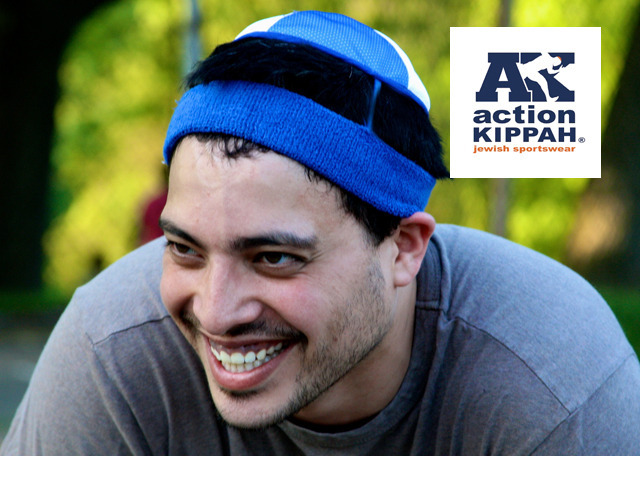
It’s the easiest, most simple, practical and and by far the COOLEST way of preventing a kippah from falling off.
By attaching a stretchable sports headband (the kind worn by athletes at all levels of competition) to a traditional kippah made out of state-of-the-art sweat-wicking mesh fabric, we have developed the perfect solution.
And once we had a few Action Kippahs of our own, we found out it was great for more than just sports. We’ve used them for
- Downhill skiing
- Changing ceiling lightbulbs
- In motor boats
- On roller coasters
- In convertibles
- Dancing at weddings
PROJECT PROGRESS TO DATE
Here’s what we’ve accomplished over the past year:
- Filed for and received a Provisional US Utility Patent
- Experimented with and decided upon an appropriate fabric out of which we will be making the Action Kippahs
- Enlisted and worked with a professional seamstress to finalize the size of the kippahs, including placement and length of the elastic holding bands
- Contracted a professional design studio that has already designed our logo, and will be overseeing our packaging prototype, as well as our product web page
- Experimented with and developed a collection of Action Kippah PROTOTYPES, in different sizes and colors.
- Tested the product for comfort and reliability, on the court and in the field
- Located and received a commitment from a factory overseas to manufacture our first, and future production runs of the Action Kippah. This factory will procure all materials necessary for the production of the kippah, and deliver it to us, fully packaged and retail ready
- Decided on the sizes and colors of our initial run of 6,000 Action Kippahs
Here’s what we have still to do:
- Take print-ready photographs to use on our packaging and website
- Design our retail packaging
- Design our product website
- Place our initial factory order for 6,000 Action Kippahs (pending funding)
When our initial order arrives
- We will fill our Kickstarter contributor’s rewards
- Place packaged Action Kippahs in over 50 Judaica stores Worldwide
- Begin an online marketing campaign
- Ship orders for the Action Kippah that come into our website
- Expand our marketing efforts into high schools and colleges
- Carefully monitor sales trends and prepare for our next run of Action Kippahs, based on data received from sales of the first run
Ber Cohen’s background and experience:
I grew up in an observant, Jewish household. It is this intimate familiarity with the Jewish lifestyle, and frustrations over wearing a precarious kippah that brought about the creation of the Action Kippah.
I have spent a good deal of time over the past year bringing the Action Kippah to the point it is now; ready to go into production overseas and then distributed to stores. So I have learned a lot in the last year doing that.
Since I just recently turned 20, though, I can’t claim to have extensive business experience.
But this is where my group of advisors and business experts come in. My grandfather, David Cohen, owned and operated MISTER COATS, INC. a wholesale clothing business for over 30 years. He is helping me find production sourcing, determine pricing, etc.
My father, Leibel Cohen, has over ten years experience creating product for the observant Jewish market (AGENT EMES), and distributing said product to both stores and end users.
These two very important people are enough to get this business off the ground successfully, but I have also enlisted legal and accounting professionals as well.
Why 6,000?
We think that’s an ambitious, yet reachable sales goal for our first year on the market; one that will allow us to try out different combinations, slowly build our business, and leave us with enough in stock in the event that they hit it big during the holiday season.
Risks and challengesLearn about accountability on Kickstarter
Normally, in order to produce clothing overseas (for the better price), it would require us to place an upfront order of several thousand yards of fabric. However we think it is prudent to make our initial run a conservative one, to get a better feel for the market potential of the Action Kippah.
Fortunately we have selected a particular style of mesh, wicking fabric that is currently being used by an NBA-licensed company to produce a totally different line of sportswear (we don’t even know what).
Because we have access to something that is already being produced, this will allow us to order smaller quantities of fabric for our first run.
However, it also means that we will be at the mercy of another company’s schedule and color choices. These could change at any time, which could potentially affect our delivery dates and ultimate color selections. The faster we raise the needed funding to place our order, the more certain we can be of maintaining the status quo.
Fortunately, my family has been in the wholesale clothing business for over 40 years, so there isn’t much we haven’t seen in the world of wholesale manufacturing and distribution.
The manufacturer’s rep we are using to take on this project has over 30 years experience producing products overseas.
We are also using local legal and accounting professionals to make sure that all our ‘i’s are dotted and ‘t’s crossed.
The Jewish market also has some unique peculiarities, mainly related to a small selection of Judaica stores from which our customers purchase their Jewish products.
Working in our favor here is my father’s ten year experience producing and distributing the Agent Emes DVD series for Jewish children.
Agent Emes has become a household name in the Jewish world due, in large part, to its being distributed worldwide through the Judaica store network.
But we also know that if we want to reach the widest possible customer-base for the Action Kippah, we will have to promote it on the Web, through social media, and even through a few strategically placed, on the ground, independent sales reps.
It will take us time to do all these things. We won’t have much of an advertising budget**, so it may take a while for market awareness to spread.
Ultimately, we believe the Action Kippah itself will be its own best marketing tool.
When a kid sees his friend wearing one out on the playground, he’ll want one as well.
** Unless our KickStarter campaign is wildly successful 🙂
To be a part of this great project click on the link: http://www.kickstarter.com/projects/bercohen/action-kippah-always-on-top-of-your-game
On the Bright Side
By Jessica Hanewinckel of the San Diego Jewish Journal
http://sdjewishjournal.com
Rabbi Yitzi Hurwitz doesn’t speak so much these days, but he says a lot with the look in his eyes and the expression on his face. When the topic of how he met his wife, Dina, comes up, for example, a wide, open smile spreads across his face and his warm, brown eyes grow come alive with delight. (She was 14, and her cousin, whom she was staying with while attending high school in Brooklyn, was his best friend and neighbor; she says she knew she would marry him one day.) It’s as if he’s no longer a 41-year-old man married 17 years, but a newlywed in adoration of his bride. Dina returns his happy gaze with her own smile. “It was wooooonderful,” the rabbi says slowly of their courtship. “The best decision…” His voice trails off, but that smile returns, and he doesn’t need to say more.
Later, when Dina wipes tears from her eyes and pauses to collect herself, saying she sometimes feels scared about the future — mostly at night, when their seven children, ages 16-6, are tucked in and she can’t sleep — Rabbi Hurwitz looks past her into the distance, somber, lost in his own thoughts, lips tucked tightly together, as if he can’t bear to see her in pain.
That’s the thing about Rabbi Hurwitz, the 14-year Chabad emissary in Temecula. He lives for God, and for doing kind things for his fellow people. True to the Chabad spirit, the rabbi exudes uninhibited joy, gratitude and gentle kindness and concern for those around him. Never mind the circumstances, and never mind himself; he thrives on blessing others with the gift of a mitzvah.
Now, though, it’s the rabbi and his family, so accustomed to always being on the giving end of mitzvot, who have had to learn to be the recipients. Their lives changed on Rabbi Hurwitz’s 41st Hebrew birthday just four months ago (2 Adar, this year Feb. 12), when he received a diagnosis they’d suspected, but hadn’t confirmed: the rabbi has ALS, or amyotrophic lateral sclerosis, more commonly known as Lou Gehrig’s disease.
The ALS Association describes ALS as a progressive neurodegenerative disease that affects nerve cells in the brain and spinal cord. Motor neurons connect the brain to the spinal cord, and the spinal cord to all the body’s muscles. The progressive degeneration of the motor neurons eventually leads to their death, which means muscles cease functioning. Paralysis eventually comes as the patient gradually loses the use of more and more muscles, and most victims usually die of respiratory failure in a handful of years. There is no cure. The rabbi’s prognosis: five years.
“I am truly humbled by how good people are,” Dina says of the outpouring of love they’ve received, “because I have never been on the receiving end like I am now. When we first heard, I thought, ‘I have a monopoly on pain,’ but it affects so many people.” She begins crying. “I didn’t realize how… I’m not the only one who loves him. We’re hiding in Temecula, so I forgot. I’ve long forgotten who [many of those people] are, because they were just passing through, or whatever it was. Apparently he makes a big impact on a lot of people.”
Rabbi Hurwitz has been diagnosed with a particularly cruel form of ALS, known as bulbar onset. While about 75 percent of ALS patients first experience limb onset, meaning their symptoms start with trouble controlling the muscles in the arms and legs, the rabbi is one of 25 percent to first experience what, to that other 75 percent, only comes at the end: trouble speaking, swallowing and controlling their tongue. For the rabbi, a man who says he loves singing Chasidic niggunim (his brother is the authority on them in the Chabad world), teaching (he says teaching is giving your love to people, connecting with them and making a difference in their lives) and just being around others, he suddenly found his words starting to come out awkwardly. Back in July and August 2012, the rabbi says, he knew something was wrong.
“When I would speak or when I would pray, my tongue wouldn’t move,” he says slowly, deliberately. It’s sometimes hard to make out his words, and the more he talks, the more difficult it becomes. The effort is clearly tiring, so he tries to convey his thoughts as simply as possible. Dina, who says she used to be the one who was less of a talker, intercedes often so he doesn’t tire as quickly.
“I couldn’t get the words out at the normal rate,” he continues. “And then slowly I wasn’t able to whistle. I used to like whistling. My voice started to sound a bit hoarse.”
With the High Holy Days fast approaching, he went to his doctor. He wanted to be in tip-top shape in time to perform his duties for Rosh Hashanah and Yom Kippur. A severe sinus infection was diagnosed, but after two rounds of antibiotics and no change, the Hurwitzes saw a neurologist. Since the only way to diagnose ALS is to exclude all other possibilities, they (Dina never refers to this battle as her husband’s alone) endured months of testing. They even explored the option of lyme disease (they knew the rabbi had been bitten by a tick, and lyme symptoms can present similarly) and administered a month’s worth of lyme medication through a PICC line. No change.
It wasn’t until seven months had passed that the news they had been expecting came.
“That day was not the hardest day,” says Dina, choking up. “The hardest day was the day we told the children. But that day was hard, too. … One person comes in and says, you know, ‘Here’s a brochure for wheelchairs when he can’t walk anymore.’ And the next person comes in and says, ‘Here’s a brochure for feeding tubes,’ and the next person comes in and says, ‘Here’s a brochure for a breathing apparatus.’ Then the next one says, ‘When you can’t talk anymore, there are computers that can help you.’ It was very shocking with this barrage of, ‘Go home and wait it out.’ And I said, ‘You know what? I am not taking any of that stuff home. We have time. Whatever it is, it’s not going to happen overnight. That stuff is not going to be in my house right now.’”
The birthday party that night, had it been in honor of so many other people, might have taken a decidedly depressing turn, or might not have happened at all. Instead, 65 of the rabbi’s closest friends, all of whom knew the results, showed up to celebrate regardless.
“It was wonderful,” the rabbi says, “because … I’m not the disease. So they had a wonderful time with me. They celebrated with me. They told me stories of encouragement. It was positive.”
And positive is how the rabbi prefers to keep things. It helps that he and his family have been flooded by support and love from their closest friends, from the Chabad community locally and around the world, from people who had come in and out of their lives briefly but remembered them for their kindness, from the rabbi’s former students when he served as a schoolteacher many years ago, and from total strangers. He receives text messages asking after his wellbeing every day from people. Many of those numbers he doesn’t recognize, but he responds to them all anyway. Another time, the family was driving in Temecula, and a car pulled up beside them. The driver, unknown to them, rolled down her window and told Rabbi Hurwitz she was praying for him.
And that’s just the beginning. A group of L.A.-area rabbis who are friends of the Hurwitz family (the Hurwitz family calls these men “The Fabulous Five,” took the initiative to help the Hurwitzes in every possible way. One became the chief medical researcher of the group, whose sleuthing led them to their current physician, Dr. Merit Cudkowicz of Massachusetts General Hospital, who is considered the leading authority in the country on ALS. If a clinical trial is being conducted, it most certainly is going through her office, with her patients. Dina says they’re excited and hopeful they’ll be selected for an upcoming trial out of Israel, among others. They’re also trying lots of supplements, vitamins and some alternative medicine.
“With God’s help, soon we’ll be cured,” the rabbi says slowly. “Or, if God wants, I don’t mind.” He lifts his arms in the air, palms up, and looks to the sky, smiling. “He can figure out another way.”
Other friends of theirs have helped with housing and visiting their four oldest kids, who attend school in L.A. and are home only on weekends to rejoin their family. The Fabulous Five also established a fund for the Hurwitz family to help with medical and living expenses.
“They make sure I have nothing to worry about except how he’s doing today,” Dina says, “so that’s unbelievable.”
Since being diagnosed, the rabbi has had to quit two of his three jobs (one as a kosher supervisor at a dairy plant in San Jacinto, which required him to sometimes work nights, and as a chaplain at a hospital in San Bernardino), putting an obvious financial strain on his large family. He’s cut back on his rabbinical duties somewhat and has been sent an assistant from Chabad headquarters to pick up some of the slack, though he still teaches a class and gives a sermon on Shabbat. (Dina has stepped in to help when the rabbi had trouble controlling his laughter and crying while cracking a joke or telling a sad story during a sermon, a symptom that presents with ALS when the person feels overwhelmed with emotion.)
“There are many things to do [as a congregational rabbi],” Rabbi Hurwitz says. “Some of them require that I speak, some of them don’t. So as much as I can do for the community, I do. I still have my heart.”
To say times are stressful is an understatement, but, Dina says, there is a silver lining. For one, they spend a lot more time together. They also have begun to appreciate life in new ways.
“I think it’s changed people,” Dina says, choking up. “Obviously it’s changed our family. [We’re] realizing how life is important. Whenever you meet somebody who has a life-changing experience, you check out your own life. And I think a lot of people have stepped up in their own life because of it. … I’ve seen people who would not talk to each other work together to do something good. I’ve seen the positivity that’s come out of it. And I think there has to be a greater purpose.”
Adds her husband, “It’s wonderful how many people are doing positive things, mitzvot, in my merit. It means a lot.”
This community outpouring of mitzvot has helped the Hurwitzes to find some bit of consolation.
“I can wrap my head around, why him,” Dina says. “Thousands of people have changed their lives because of him. If it would have been a different person, I don’t know if that would have happened. If it would have been me, I don’t think so. I’m not that positive person who is still positive no matter what. We get messages from around the world about people who are changing their lives because of how they see him react to this. So as to why him, I could kind of get it. I don’t maybe appreciate it whole-heartedly, but I could understand.”
More than a dozen Jewish men in their community who never wore tefillin before have bought new pairs in the rabbi’s merit. Explains Dina, the mitzvah of tefillin is close to her husband’s heart, because his primary loss of function so far has been in his head and his left arm, which is where tefillin are worn. Another family wakes up each morning and says the Modeh Ani prayer, thanking God for returning their souls to them upon waking.
“There must be a good reason, right?” the rabbi says of his diagnosis. “There has to be. So maybe to make a change in our lives. For some, life has changed to the positive. That’s wonderful.”
Though Rabbi Hurwitz is not technically part of the San Diego Chabad network (Temecula is in Riverside County), he says he feels close to its rabbis and attends their meetings occasionally (three of the seven Hurwitz kids currently attend Chabad Hebrew Academy in Scripps Ranch, too). When the San Diego Chabad rabbis got together with Rabbi Hurwitz and asked what they could do to help, he didn’t think of himself.
“All of our families have done meals each day for him and for their whole family, we have carpooled for their kids, had their kids over at our houses and things like that,” says Rabbi Josef Fradkin, head of school at Chabad Hebrew Academy. “But we said, ‘What is his thing?’ [Yitzi] said, ‘If you guys want to do something for me, I really want people to do mitzvot.’ What was so impressive was it wasn’t, ‘Maybe you can take over my synagogue for a week, or maybe you can help me out by giving my classes.’ He didn’t say anything like that. He said the opposite. He said, ‘Let’s get people to do more mitzvot. That will really give me strength.’”
Rabbi Hurwitz’s request sparked a formal mitzvah campaign in his honor, organized by the San Diego Chabad rabbis. Those who want to support the rabbi simply log on to the Web site created for the campaign (www.amitzvahforyitzi.org) and select from one of 12 suggested mitzvot, after which a letter is sent to the rabbi telling him the person has done a mitzvah in his honor.
“We believe that as the Jewish people, we can affect great change by our own actions, and we’re hoping to have a spiritual effect on his illness,” Rabbi Fradkin says.
Chabad of San Diego is also organizing a night of celebration and inspiration in honor of the rabbi at 7 p.m. June 10 (the Lubavitcher Rebbe’s yartzeit) at Chabad of Scripps Ranch. The event, which is open to the community, is for teens and adults only and will celebrate the rabbi with cocktails, dinner, highlights of the mitzvah campaign thus far, special guest speaker Rabbi Yehushua Gordon and a special video presentation.
“Yitzi is out in a little desert town where it’s hard to get a few Jews together, but he’s there out of a love and for the mission the Rebbe sent him on, so this is a very appropriate day that he get his energy,” Rabbi Fradkin says. “What better way to do it than celebrate that day together with him? The whole community is with him, and that’s important to see. Not just people sending him cards and emails, but the people in the room, even if they don’t know him, just simply giving a fellow Jew or just a fellow human being a charge of energy saying, ‘Yitzi, go fight that battle.’”
• To RSVP for “A Night to Remember” honoring Rabbi Yitzi Hurwitz, or to do a mitzvah in his merit, go to www.amitzvahforyitzi.org. For information on the Hurwitz Family Fund, established by five rabbis who are friends of the Hurwitz family to assist them with medical and living expenses, visit www.hurwitzfamilyfund.com.