

Yamina leader Naftali Bennett addressed criticism against Israel from iconic pop culture figures Bella Hadid, Trevor Noah and John Oliver in a YouTube video Thursday.
Oliver, Noah and Hadid had been among many celebrities in recent days to heavily criticize Israel for its conduct in Gaza during Operation Guardian of the Walls. Many of these criticisms stemmed from the idea that there is a significant disparity in casualties, with Hamas suffering far more casualties than Israel, due in part to the Iron Dome defense system.
This was criticized by National Jewish Advocacy Center Mark Goldfeder as being “logically flawed and incredibly dangerous.”
Writing in an op-ed in The Jerusalem Post, Goldfeder explained that it is unfair to fault Israel for technological advantage or disparity in casualties due to Hamas’s use of human shields, with this type of methodology essentially rewarding Hamas for doing so. And regardless, Goldfeder explains,” as Noah ironically notes, Israel has the ability to completely destroy the other side, but they have shown great restraint in not doing so.
Hannah Brown contributed to this report.
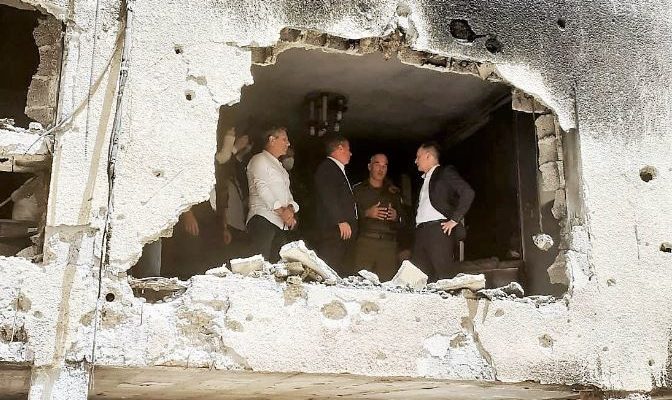
Czech Foreign Minister Kulhanek said his visit is “first and foremost, a demonstration of the Czech Republic’s unwavering support for Israel in these difficult times.”
By Aryeh Savir, TPS
Czech Foreign Minister Jakub Kulhanek, Slovak Foreign Minister Ivan Korcok, and German Foreign Minister Heiko Mass arrived in Israel on Thursday at the invitation of Israeli Foreign Minister Gabi Ashkenazi and as the IDF is in the midst of Operation Guardian of the Walls against Hamas in the Gaza Strip
Czech Foreign Minister Kulhanek said his visit is “first and foremost, a demonstration of the Czech Republic’s unwavering support for Israel in these difficult times. Israel has every right to defend its citizens against indiscriminate terror.”
Slovak Foreign Minister Korcok stated that “while we recognize Israel’s right to protect its citizens against attacks of Hamas and other militant groups, Slovakia wants to contribute through active diplomacy to de-escalation in order to avoid further innocent victims.”
German Foreign Minister Mass said his visit to Israel was a show of solidarity “with the people on both sides who fear for their lives day and night as Israel must defend itself against Hamas’ rocket terror.”
“The Middle East is experiencing the worst violence in years these days. That’s why I’m going to Israel and the Palestinian territories. I will hold talks there about the current escalation and about our international efforts to end the violence,” he stated.
In a meeting with Maas, Ashkenazi thanked Germany for condemning Hamas’ terrorist activities.
“With every rocket fired, Hamas is committing a double war crime. They fire at Israeli citizens from within population centers in Gaza, using the entire population of Gaza as human shields,” he noted.
“No country in the world would accept acts of terrorism and aggression towards its citizens. Israel uses proportionate force while doing all it can to avoid harming civilians,” he stated.
Maas said that “as long as there are states and groups that threaten Israel with annihilation, it must be able to protect its people. Germany will continue to make its contribution to ensuring that it stays that way. Our solidarity is not limited to words.
”Germany “supports the international efforts to reach a ceasefire and are convinced that the violence must end as soon as possible in the interests of the people,” he said.
His country also “wants to broaden our view beyond the current situation. We are convinced that a life of security and peace will only be possible in the long term if Israelis and Palestinians can live independently, on both sides.”
Rocket attacks from Gaza on Israel continued throughout the visit.
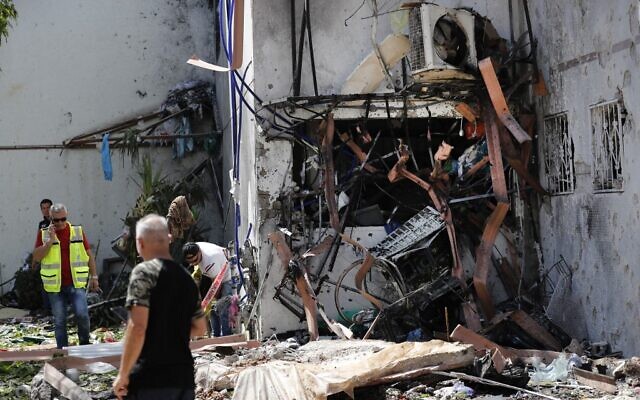
Ashkenazi hosted a tour for the three top diplomats at a site where rockets fell in Petah Tikvah in the center of the country to see “the reality for residents of Israel in the center of the country this last week and for residents of the south for much longer.”
Defense Minister Benny Gantz met with Maas and the two “affirmed the deep ties of friendship between the two countries and underscored the shared goal of weakening extremist elements and strengthening moderate forces in Gaza and in the region at large, to the end of securing long-term peace and stability.”
On Wednesday, Prime Minister Benjamin Netanyahu and Ashkenazi briefed over 70 foreign ambassadors and diplomatic representatives on the situation in Israel, including EU and U.S. representatives and the ambassadors from Russia, China, India, Germany, Austria, Australia, Japan, Brazil, Canada and Italy.
During the briefing, Netanyahu presented the ambassadors with documentation of IDF attacks in the Gaza Strip against Hamas and the Islamic Jihad, as well as the location of stockpiles of missiles, rockets, terrorist buildings, command centers and many terrorist infrastructures.
He explained that rather than cowering to terrorism or leveling entire cities, Israel is targeting “those who target us with great precision. That is not a surgical operation as it is. Even in a surgical room in a hospital, you don’t have the ability to prevent collateral damage around an infected tissue. Certainly, in a military operation, you cannot.”
“There is no army in the world that does more than the Israeli army to prevent collateral damage. To have Israel criticized for that is absurd. Not only is absurd and unjust and untrue, it does enormous damage to democracies that are fighting this kind of evil,” he underscored.
“Instead of having the perpetrators who commit double war crimes, who are hiding behind civilians and firing on civilians, not having them criticized but having you criticized is the height of hypocrisy and stupidity. What that does is in fact encourage the terrorists,” he charged.
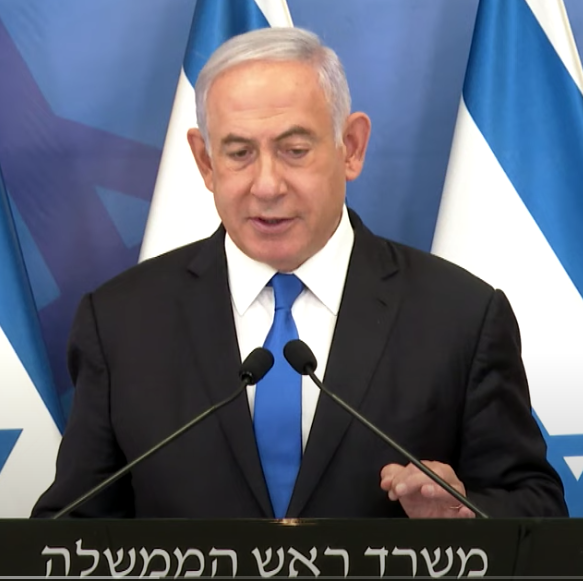

PM Netanyahu’s Remarks at the Defense Ministry in Tel Aviv
(Communicated by the Prime Minister’s Media Adviser)
Prime Minister Benjamin Netanyahu, today (Friday, 21 May 2021), at the Defense Ministry in Tel Aviv, made the following remarks:
https://www.youtube.com/watch?
“Israel didn’t initiate this conflict. We were attacked in an unprovoked manner by the Hamas terrorist organization that fired four thousand rockets into our capital and into our cities. No country will sit aside when it’s attacked in such a criminal fashion. Israel is no different.
But we did do something different. We were fighting terrorists who are hiding among civilians in one of the most densely populated places on earth. They were firing rockets on our civilians while using their civilians as human shields. We did everything in our power to prevent civilian casualties, unnecessary casualties of non-combatants, while trying to attack the combatants who are trying to murder our citizens. We regret every loss of life, but I can tell you categorically, there is no army in the world that acts in a more moral fashion than the army of Israel.
I want to thank President Joe Biden, a friend of many years, who stood by Israel throughout this conflict. He expressed clearly, unreservedly, America’s support for Israel’s right of self-defense. And I am also grateful to President Biden for offering to help replenish our stocks of missile interceptors. That’s so important to saving Israeli lives, and coincidentally, Palestinian lives. Without Iron Dome, we would have had to have a ground invasion of Gaza to stop them firing their missiles and the casualty list would have soared to stratospheric heights.
So thank you, President Biden, and thank you too for the many leaders around the world who have stood by Israel. They know how to distinguish so clearly between a democracy that cherishes life and a terrorist organization that glorifies death. I think that distinction and that support is crucial for our common future. Thank you”.

Journalists are expressing their outrage that the 12-story Al-Jalaa building housing the Gaza headquarters of Associated Press and Al Jazeera was targeted during retaliatory Israeli airstrikes on Saturday.
Al Jazeera Jerusalem bureau chief Walid al-Omari said that by striking the building, Israel was acting “not only to sow destruction and killing, but also to silence those who broadcast it.”
Not exactly an objective assessment.
AP CEO Gary Pruitt released a statement expressing that the world’s largest news syndication service was “shocked and horrified” by the strike.
Meanwhile, Hamas was using the building as an intelligence and operations center.
“This is an incredibly disturbing development. We narrowly avoided a terrible loss of life,” Pruitt’s statement added. “A dozen AP journalists and freelancers were inside the building, and thankfully we were able to evacuate them in time. The world will know less about what is happening in Gaza because of what happened today.”
Aaron Klein, senior adviser to Israeli Prime Minister Benjamin Netanyahu, told JNS that “it is Hamas that must be condemned for housing its terrorist infrastructure in the same complex as the international media. This is far from the first time that Hamas has used journalists as human shields.”
Klein added that the building was utilized by Hamas “for waging a terror war on Israeli civilians and was only targeted after the Israel Defense Forces warned civilians at the site and waited enough time for them to evacuate. Hamas provides no such warning when it daily commits the double war crimes of firing rockets indiscriminately into Israeli cities and launching those rockets from Palestinian civilian zones.”
The reason that AP was able to evacuate its journalists is because the IDF alerted every person inside that the building was about to be targeted by an airstrike. And aside from phone calls and text messages, the IDF clips the rooftops of such targets with a drone strike—meant not to cause significant damage, but to further warn civilians inside the building that they are risking their lives by staying inside.
The IDF has taken these same measures with nearly every carefully selected target, as it works with surgical precision to hit terrorist infrastructure while limiting the possibility of civilian casualties.
It is a procedure that no other army in the world would dare undertake, as it gives additional time to the enemy to escape and thus continue firing rockets at population centers.
It is also a practice that is not featured prominently in mainstream media coverage.
In a statement, Netanyahu said, that, “as always, Israel is doing everything possible to protect our civilians and keep Palestinian civilians out of harm’s way. We demonstrated this yet again [yesterday] when we warned civilians to vacate the building used by the Hamas terror intelligence.”
“They vacated the premises before the target was destroyed and that’s why you don’t hear of casualties from these collapsing terror towers because we take special care to avoid these civilian casualties, exactly the opposite of Hamas.”
As reported by Palestinian Media Watch, even the Palestinian press has acknowledged that buildings are evacuated before they are hit.
PMW director Itamar Marcus noted that “Israel’s care for civilians is unique, especially in the history of warfare against terror organizations that use civilians as human shields. Moreover, the international community’s questioning of Israel about civilian casualties exposes its great hypocrisy.”
“Hypocrisy” is an overly kind word. A better term would be “narrative warfare.”
In the current conflict being waged between Israeli forces and Palestinians in Gaza, Judea and Samaria—and even within fully Israeli-controlled cities, including Lod, Akko, Haifa, Jaffa, Jerusalem and others—the media has been intentionally painting pictures of the war designed to paint Palestinians as innocent victims.
Indeed, it has been purposefully mis-framing the events that led up to the ongoing full-scale hostilities.
According to the media, this war started initially because the Israel Police employed crowd-control measures near a gate outside the Old City of Jerusalem, where innocent Muslim penitents were gathering after their daily Ramadan fast. Reports to this effect made little mention, if at all, of the rioting taking place there, night in and night out.
Next, the media made it sound as though Arabs had no choice but to riot when Israeli courts were moving to evict Palestinians from homes in eastern Jerusalem and handing those houses over to hardline Israeli settlers.
The media are ignoring that the neighborhood in question, Sheikh Jarrah, is the site of the tomb of the ancient Jewish high priest, Simon the Righteous; that the homes in question were owned by Jews for generations; that the Arabs living in them are squatters; and that the case had been in court for more than 30 years.
The straw that clearly broke the Palestinians’ back, however—and led to an all-out war—was when Israeli law enforcement ostensibly “stormed” the Al-Aqsa mosque compound.
It didn’t matter to the media that Israeli police officers entered the compound to dispel a violent Arab riot, which included the throwing of rocks and hurling of Molotov cocktails at defenseless Jewish worshipers in the Western Wall plaza some 70 feet below.
Suddenly, an annual parade by Israelis on “Jerusalem Day” was portrayed as an act of aggressive nationalism. And when Arabs rioting on the Temple Mount—Judaism’s holiest site beyond any dispute, even among Muslims—set a tree ablaze with fireworks illegally lit while Jews were having a concert at the Western Wall, many media outlets spread images of Jews “celebrating the burning of Al-Aqsa.”
Worse, these outlets have been attempting to disingenuously link up the Palestinian cause with the sentiments that have fueled the Black Lives Matter movement—a movement that similarly justified rioting in urban centers.
This is done with careful coordination across media outlets and employs talking points tested in focus groups, with the specific goal of eliciting emotional responses from viewers sitting in front of their televisions and phones.
To see this phony media campaign in action, one can watch various Israeli spokespersons across different networks being bombarded with the exact same accusations and questions about civilian casualties in Gaza.
Aside from its strike on the building housing AP and Al Jazeera, the IDF actually used an unwitting mainstream media to achieve a well-designed strategic objective. A day prior to the hit, the Israeli military reportedly alerted various outlets to its supposed upcoming ground incursion into Gaza.
At the time, the IDF tweeted that its “ground troops are currently attacking in the Gaza Strip,” a post that promptly went viral as evidence that the said incursion had begun.
In response to the messages being broadcast by media outlets, Hamas ordered its operatives to enter the network of tunnels—built with funds and materials that could otherwise be used to better the lives of Gaza’s residents—in preparation for infiltrations into Israel. At that very moment, Israel bombed the tunnel network, killing dozens of terrorists.
This isn’t the first time that Israel has “played” the mainstream media, which deserves it.
Israel is a democracy, charged with protecting its citizens from attacks by well-funded terror organizations. It neither seeks conflict nor prefers fighting. Yet a “free press” is clearly working for—and even in the same building as—a terrorist organization.
The reason that Israel struck the building that houses the AP and Al Jazeera offices in Gaza had nothing to do with the media’s agenda of painting Israel as the aggressor, in its brazen and dangerous attempt to drain international support for the Jewish state.
But, if Israel had targeted media outlets that openly and intentionally support its enemies, it may have been justified on those grounds alone. Sadly, but not surprisingly, it is unlikely that outlets like AP and Al Jazeera will learn their lesson.
(JNS).
Alex Traiman is managing director and Jerusalem bureau chief of Jewish News Syndicate.

Israeli startup XTEND, a provider of tactical drones for defense, national security, public safety, and industrial inspection markets, has contracted with the US Department of Defense on a small Unmanned Aircraft System (sUAS) called SKYLORD XTENDER, the company announced Tuesday.
According to XTNED, its SKYLORD XTENDER provides a “unique, human-centric ‘machine interface technology’ that enables operators and first responders to remotely intervene in dangerous situations, from a safe distance, via drone by virtually ‘sitting inside’ the small sUAS.”
The technology is designed to reduce human interaction with dangerous environments.
The SKYLORD XTENDER platform allows any operator with little or no flight experience to perform specific remote tasks in complex environments.
In addition, the company reports that its sUAS is capable of approaching a target site from any location, performing recon and data collection tasks with extreme accuracy, and seamlessly exit the danger zones, agnostic of any indoor-outdoor transition limitations.
Aviv Shapira, XTEND co-founder and CEO, explained that “Hyper enabled drones are the future of engagement for dangerous situation worldwide. The IDF has recognized XTEND’s family of products called SKYLORD as one of the most effective technologies for urban warfare missions, specifically indoor and close-quarters combat.
“The SKYLORD XTENDER is one of our most advanced drone platforms and harnessing it under this initiative will help the US Department of Defense save lives and ensure mission success in any combat scenario,” Shapira added.
Company co-founder Matteo Shapira said that the SKYLORD XTENDER platform was “so intuitive” that users could be trained to operate it in under an hour.
“Whether it’s a soldier scanning a building for enemy fighters, locating snipers, or providing ISR on a suspected enemy stronghold, our goal in developing this technology was to minimize the danger to human life,” Matteo said.
“No matter the operator or situation, when you use our extended VR technology, you can rest assured that even the most dangerous missions are as safe as possible.”
The US Assistant Secretary of Defense for Special Operations / Low Intensity Conflict (ASD SO/LIC) and Irregular Warfare Technical Support Directorate (IWTSD) has partnered with Israel’s Defense Minister and Directorate of Defense Research & Development.
The goal is to contract with XTEND to deliver multiple, tactical sUAS platform prototypes to the tactical units for Operational Testing and Evaluation (OT&E) starting this year.
(Israel Hayom).

The Vermont senator introduced a resolution on Thursday to block the weapons transfer. A similar measure in the House was introduced Rep. Alexandria Ocasio-Cortez, a Democrat from New York, and liberal lawmakers on Wednesday.
Sanders says that Congress needs to “take a hard look at whether the sale of these weapons is actually helping, or whether it is simply fueling conflict.”
Supporters of this effort are unlikely to have the votes needed to reverse the sale, but they’re racing the clock to register opposition under a review period that expires this week.
The opposition to what had been a routine transfer of arms shows the increasing unrest on Capitol Hill from some Democrats over Israel’s allegedly “disproportionate” handling of the conflict with Hamas in Gaza.
(Vosizneias).

Few things in the Torah are more revolutionary than its conception of leadership.
Ancient societies were hierarchical. The masses were poor and prone to hunger and disease. They were usually illiterate. They were exploited by rulers as a means to wealth and power rather than treated as people with individual rights – a concept born only in the seventeenth century. At times they formed a corvée, a vast conscripted labour force, often used to construct monumental buildings intended to glorify kings. At others they were dragooned into the army to further the ruler’s imperial designs.
Rulers often had absolute power of life and death over their subjects. Not only were kings and pharaohs heads of state; they also held the highest religious rank, as they were considered children of the gods or even demigods themselves. Their power had nothing to do with the consent of the governed. It was seen as written into the fabric of the universe. Just as the sun ruled the sky and the lion ruled the animal realm, so kings ruled their populations. That was how things were in nature, and nature itself was sacrosanct.
The Torah is a sustained polemic against this way of seeing things. Not just kings but all of us, regardless of colour, culture, class or creed, are in the image and likeness of God. In the Torah, God summons His special people, Israel, to take the first steps towards what might eventually become a truly egalitarian society – or to put it more precisely, a society in which dignity, kavod, does not depend on power or wealth or an accident of birth.
Hence the concept, which we will explore more fully in parshat Korach, of leadership as service. The highest title accorded to Moses in the Torah is that of eved Hashem, “a servant of God” (Deut. 34:5). His highest praise is that he was “very humble, more so than anyone else on earth” (Num. 12:3). To lead is to serve. Greatness is humility. As the book of Proverbs puts it, “A man’s pride will bring him low, but the humble in spirit will retain honour” (Prov. 29:23).
The Torah points us in the direction of an ideal world, but it does not assume that we have reached it yet or even that we are within striking distance. The people Moses led, like many of us today, were still prone to fixate on ambition, aspiration, vanity, and self-indulgence. They still had the human desire for honour and status. And Moses had to recognise that fact. It would be a major source of conflict in the months and years ahead. It is one of the primary themes of the book of Bamidbar.
Of whom were the Israelites jealous? Most of them did not aspire to be Moses. He was, after all, the man who spoke to God and to whom God spoke. He performed miracles, brought plagues against the Egyptians, divided the Red Sea, and gave the people water from a rock and manna from heaven. Few would have had the hubris to believe they could do any of these things.
But they did have reason to resent the fact that religious leadership seemed to be confined to only one tribe, Levi, and one family within that tribe, the Kohanim, male descendants of Aaron. Now that the Tabernacle was to be consecrated and the people were about to begin the second half of their journey, from Sinai to the Promised Land, there was a real risk of envy and animosity.
That is a constant throughout history. We desire, said Shakespeare, “this man’s gift and that man’s scope.” Aeschylus said, “It is in the character of very few men to honour without envy a friend who has prospered.”[1] Goethe warned that although “hatred is active, and envy passive dislike; there is but one step from envy to hate.” Jews should know this in their very bones. We have often been envied, and all too frequently has that envy turned to hate, with tragic consequences.
Leaders need to be aware of the perils of envy, especially within the people they lead. This is one of the unifying themes of the long and apparently disconnected parsha of Naso. In it we see Moses confronting three potential sources of envy. The first lay within the tribe of Levi. Its members had reason to resent the fact that priesthood had gone to just one man and his descendants: Aaron, Moses’ brother.
The second had to do with individuals who were neither of the tribe of Levi nor of the family of Aaron but who felt that they had the right to be holy in the sense of having a special, intense relationship with God in the way that the priests had. The third had to do with the leadership of the other tribes who might have felt left out of the service of the Tabernacle. We see Moses dealing sequentially with all these potential dangers.
First, he gives each Levitical clan a special role in carrying the vessels, furnishings, and framework of the Tabernacle whenever the people journeyed from place to place. The most sacred objects were to be carried by the clan of Kohath. The Gershonites were to carry the cloths, coverings, and drapes. The Merarites were to carry the planks, bars, posts, and sockets that made up the Tabernacle’s framework. Each clan was, in other words, to have a special role and place in the solemn procession as the house of God was carried through the desert.
Next, Moses deals with individuals who aspire to a higher level of holiness. This, it seems, is the underlying logic of the Nazirite, the individual who vows to set himself apart for the Lord (Numbers 6:2). He was not to drink wine or any other grape product; he was not to have his hair cut; and he was not defile himself through contact with the dead. Becoming a Nazarite was, it seems, a way of temporarily assuming the kind of set-apartness associated with the priesthood, a voluntary extra degree of holiness.[2]
Lastly, Moses turns to the leadership of the tribes. The highly repetitive chapter 7 of our parsha itemises the offerings of each of the tribes on the occasion of the dedication of the altar. Their offerings were identical, and the Torah could have abbreviated its account by describing the gifts brought by one tribe and stating that each of the other tribes did likewise. Yet the sheer repetition has the effect of emphasising the fact that each tribe had its moment of glory. Each, by giving to the house of God, acquired its own share of honour.
These episodes are not the whole of Naso but they consist of enough of it to signal a principle that every leader and every group needs to take seriously. Even when people accept, in theory, the equal dignity of all, and even when they see leadership as service, the old dysfunctional passions die hard. People still resent the success of others. They still feel that honour has gone to others when it should have gone to them. Rabbi Elazar HaKappar said: “Envy, lust and the pursuit of honour drive a person out of the world.”[3]
The fact that these are destructive emotions does not stop some people – perhaps most of us – feeling them from time to time, and nothing does more to put at risk the harmony of the group. That is one reason why a leader must be humble. They should feel none of these things. But a leader must also be aware that not everyone is humble. Every Moses has a Korach, every Julius Caesar a Cassius, every Duncan a Macbeth, every Othello an Iago. In many groups there is a potential troublemaker driven by a sense of injury to their self-esteem. These are often a leader’s deadliest enemies and they can do great damage to the group.
There is no way of eliminating the danger entirely, but Moses in this week’s parsha tells us how to behave. Honour everyone equally. Pay special attention to potentially disaffected groups. Make each feel valued. Give everyone a moment in the limelight if only in a ceremonial way. Set a personal example of humility. Make it clear to all that leadership is service, not a form of status. Find ways in which those with a particular passion can express it, and ensure that everyone has a chance to contribute.
There is no failsafe way to avoid the politics of envy but there are ways of minimising it, and our parsha is an object lesson in how to do so.
[1] Aeschylus, Agamemnon l.832.
[2] See Maimonides, Hilchot Shemittah ve-Yovel 13:13.
The Israel Defense Forces believes that Hamas is “trying to have a major success,” such as a cross-border attack or other major assault, which it can hold up as a victory over Israel as the current round of fighting appears to be drawing to a close, a senior officer in the military’s Southern Command told reporters on Wednesday.
The senior officer said he believed the military’s intelligence capabilities would prevent the terror group from conducting a large invasion into Israel, but acknowledged that a smaller operation was possible.
“I don’t think Hamas can do a major surprise ground operation, but it could do a raid,” he said, speaking on condition of anonymity.
The officer said Hamas may try to conduct a large-scale barrage on the Tel Aviv metropolitan area, having refrained from firing rockets at the city in recent days.
According to IDF Military Intelligence, the terror group has at least enough long-range munitions to conduct several more barrages of dozens of rockets at Tel Aviv.
(Times of Israel).