Home Blog Page 522

Kerry’s reported leaks to Iran about Israel lead to calls for his dismissal

0

“John Kerry needs to go. He should resign, or he should get fired by the president of the United States,” said Sen. Dan Sullivan.

Sen. Dan Sullivan (R-Alaska) on Monday called for the resignation of Special Presidential Envoy for Climate John Kerry, a member of President Biden’s National Security Council, due to reports that Kerry revealed sensitive information about Israel’s covert activities in Syria to Iranian officials.

Sullivan, speaking on the Senate floor, said, “Today I’ve heard such disturbing news that if true, it should absolutely result in the call of John Kerry either being fired or resigning. Enough is enough.”

According to Sullivan, the disturbing news came by way of “a tape that was leaked of an interview with Iran’s Foreign Minister Mohammad Zarif.”

“The most disturbing part of the interview that was leaked was when Zarif said that John Kerry told him, the Iranian foreign minister, about covert Israeli actions against Iranian interests in Syria,” Sullivan said.

Zarif said that, “to his astonishment,” then-Secretary of State Kerry informed him that Israel had attacked Iranian interests in Syria at least 200 times, the New York Times reported Sunday.

“When I read this today, I was astonished as well,” said Sullivan.

“If John Kerry told the leaders of Iran about issues relating to our most critical ally in the region, Israel, who Iran has repeatedly said they want to wipe off the face of the earth, if he did this, he needs to resign,” he said.

Sullivan said that Kerry has a record of working against American national security interests, but the latest news represents “a red line that was crossed” and “the straw that broke the camel’s back.”

“John Kerry needs to go. He should resign, or he should get fired by the president of the United States,” he said.

According to the New York Times, Iranian Foreign Ministry Spokesperson Saeed Khatibzadeh did not dispute the authenticity of the recording but called the leak “unethical politics.”

Kerry denied the allegations.

Meanwhile, in parallel news, former US Ambassador to the UN Nikki Haley called John Kerry’s actions “disgusting” and called for him to resign.

When asked for Biden’s reaction to the report on Monday, White House Press Secretary Jen Psaki said, “We’re not going to comment on leaked tapes.”

As secretary of state under the Obama administration, Kerry was America’s lead negotiator of the JCPOA, the Iran nuclear deal.

After President Donald Trump pulled out of the JCPOA, Kerry admitted to meeting on his own with Zarif in 2018 in an effort to salvage the deal.

According to reports, he advised Zarif to hang tough during the Trump years in the hopes that the 2020 elections would lead to a Democratic administration.

According to many of his accusers, Kerry has thereby contravened the Logan Act.

Before entering a long career in politics, Kerry served in the U.S. Navy during the Vietnam War. Upon his return, he accused his fellow soldiers of committing war crimes before Congress.

His actions later came back to haunt him during his 2014 run for the presidency as a group, “Swift Boat Veterans for Truth,” formed against him and successfully attacked him on grounds of character as unfit for the White House.

(World Israel News)

Israeli-Made Robots Are Powering the E-Commerce Revolution

Three Israeli companies are making huge strides in the automated fulfillment landscape, providing a glimpse into the future of retail.

One of the first things that strike you when you enter eGold’s fulfillment center in the port city of Ashdod is how quiet things are. The 20,000-square-meter facility, that handles thousands of items a day, taking them from the container ship they arrived on and prepping them for delivery to customers’ homes, is eerily silent.

Where you would expect to hear the grumbling of engines, the whizzing and burring of conveyor belts, the shouting of instructions between workers, and the shrill warning of forklifts backing up, all you can hear is the hum of electric motors working in perfect sync.

The company’s state-of-the-art facility is one of the first of its kind in Israel and it is operated almost entirely by a robot, or rather an algorithm that manages the work of scores of individual robots.

The facility, which was launched last February, is primarily used by solopreneurs and small enterprise e-tailers, enabling them to manage their whole logistics operation — import, storage, picking, sorting, and preparing for delivery — in one spot. The advantages: it’s fast, it makes almost no mistakes, and it provides a mix of human and machine quality assurance.

Following the flow of a single item through the entire process showcases an astounding amount of different technologies at play – from a sorting system in which a mounted light pointer indicates to a human employee in which bin to place a scanned item depending on its weight and size; to the mini-forklift robots that maneuver around the center carrying shelves full of products of every kind to their predetermined destination for picking or longer-term storage; to the mindbogglingly complex Warehouse Management System (WMS) that knows where every item is at every moment, knows how to line up the shelves, bins, and robots so that they arrive where they’re needed at the precise time that they’re needed in the most efficient way possible.

“It’ll blow your mind even more, when you realize that it is also a self-learning system that as soon as a new client is onboarded or a new type of product is introduced, adjusts itself in order to attain the highest efficiency and can anticipate things like shipment peaks and other fluctuations in activity,” said Yevgeniy Trakhtman, eGold’s business development manager.

Trakhtman said that the volume of items that the new center can handle is seven or eight times that of a traditional human-operated fulfillment center – with a fraction of the manpower and a micro fraction of the errors and mistakes. “Three centers like this could handle all of the e-commerce activity in Israel,” he noted.

Yotam Ben Ari, who manages eGold’s e-commerce operations said that it took the company more than six months to design and build the center, from making sure the storage floor was perfectly level with QR codes positioned on it precisely to help the robots navigate around the facility; to training the human pickers and packers to meet their strict quality control guidelines; to programming the WMS to operate in complete synchronization.

“The next center we build won’t take quite as long because we have the expertise already. Nowadays, other companies that want to design similar solutions come to us in order to learn how we did it,” he said.

Ben Ari stressed that what distinguishes eGold from other fulfillment center operations is that they work in complete unison with its clients. “We share with them in real-time the status of every shipment and parcel, so they can pass the information on to their customers. We even make the lives of the distributors easier, sparing them the process of sorting the delivery into routes. A driver can pull up to our depot and their deliveries will be waiting for them, sorted by location, making last-mile service as efficient as can be.”

“Our goal is to enable every small e-tailer to compete with the giants of the sector. Our next step will be to set up a marketplace. We want to give our customers end-to-end services by helping them connect to producers in China and other places, integrating solutions, connecting them with local marketers, in short: enabling them to focus only on sales,” Ben Ari concluded.

Another Israeli company that is making strides in the fulfillment industry is Caja Robotics. The company, which was founded in 2014, develops advanced cloud-based software which controls the entire operation, two types of robots that work in sync, and two types of picking stations.

Unlike eGold, which offers services to e-commerce clients out of its own facility employing robots and a management system that were developed overseas, Caja Robotics developed its own technology and provides it to its clients, adapting it to their specific needs.

“We offer our clients a very simple solution, even though the technology behind it is extremely complicated,” Ilan Cohen, Caja Robotics’ CEO said in an interview with CTech. “The prevailing sensibility in the market these days is that fulfillment work is no longer suitable for human beings. The work which is physically demanding and mentally tedious is perfectly suited to robots and now that the technology enables it, everyone is searching for automated solutions.“

“Our solutions are integrated into our clients’ existing warehouse. The AI is adaptive enough to adjust to existing infrastructure and doesn’t require the company to remodel its own facilities for our robots to work in them,” noted Hanna Yanovsky Caja’s EVP and Chief Revenue Officer.

“Choosing to go fully automated is a big decision for companies. We make it a bit easier by developing a system that is adaptive and scalable. It is flexible enough to handle peaks in demands by stretching the robots to increase their working hours and/or add more robots to the fleet when needed. As our clients’ needs grow or change, so do our solutions. This is attractive to clients because it ensures that our technology works in the most efficient way possible, increasing their ROI.”

Caja Robotics’ target market in the U.S. where it already provides fulfillment services for 3rd party logistics provider Bergen Logistics in New Jersey and just this month signed a partnership agreement with Advanced Handling Solutions (AHS), a full-service systems integrator located in Kentucky. And in August, the company is launching a new local center for a popular Israeli retail chain.

Cohen noted that as markets change and the demand for e-commerce rises, particularly over the past year of lockdowns and the widespread adoption of online shopping, many B2B companies are adopting practices from the online B2C world.

“Even a company like Nike doesn’t want to keep a large amount of stock in their stores. They prefer to have a flexible warehouse that can deliver orders to their stores quickly and on-demand.”

Caja Robotics’ primary emphasis nowadays is on advancing its software solutions and it prides itself on being made in Israel. “We are blue-and-white and proud of it. We have shown that it is possible to manufacture in Israel and at prices that are attractive even compared to China or India,” Cohen said.

“Israeli technology is highly respected in our field,” Yanovsky added. “And during the pandemic, we proved that we are capable of remote installations too. Necessity showed us that our solution is nearly plug-and-play.”

One Israeli company that is geared towards meeting the demands of the changing market in a big way is Fabric. Formerly known as CommonSense Robotics, the company changed its name and shifted its headquarters to the U.S. in anticipation of the upcoming revolution in the fulfillment center industry.

The company garnered banner headlines with its announcement last year that it was partnering with retail giant Walmart, providing the household brand and industry leader with warehouse automation services as part of a pilot the company is trying out in its effort to compete with the likes of Amazon.

Fabric operates on two fronts. The first is in the grocery sector, where it provides retailers the option to convert part of their stores into micro-fulfillment centers, receiving customer’s online orders, picking and packing their selections in a robot-human collaboration depending on the type of product, scheduling the orders so that they are ready for delivery at the required time, and packaging them in convenient boxes for delivery to clients’ homes, all within minutes and with near-zero mistakes.

One of the company’s biggest clients is Fresh Direct, which now enables two-hour on-demand delivery in many of its locations.

Its second niche is creating relatively small multi-tenant centers in urban centers that make on-demand fulfillment profitable for ecommerce sellers by locating automation physically close to end customers. Fabric provides the robots, the WMS, and the algorithm that combines the complex services to offer its clients the utmost flexibility and responsiveness.

“The supply chain world used to be dependent on centralization, but the model is changing from economies of scale to economies of demand,” Fabric co-founder CEO Elram Goren said in an interview from New York. “Technology allows us to shift the balance between consolidation and distribution.”

Amazon Makes Up Only 5% of Retail

When asked whether it is still possible for the rest of the market to compete with an industry powerhouse like Amazon, Goren conceded that while Amazon is indeed a monster, there is plenty of room for other players.

“Amazon may control 50% of the ecommerce market, but it still makes up only 5% of retail, so it’s important to keep things in perspective. That leaves ample room both for competition and for uniqueness,” Goren said.

“Nowadays most retailers realize that e-commerce is the wave of the future. If you were to speak to them two years ago, they might have considered it as a side business, but today, we’re talking about 50% of business eventually going online. I think that in the grocery space, we will hit 20% over the next five years, but it won’t stop there. Once things reach critical mass, there will be no turning back.

All the people Ctech spoke with are convinced that Covid-19 was a game changer when it comes to the retail industry. The consensus seems to be that while volumes have dropped since their peak at the height of lockdowns last year, the baseline has gone up and that it’s a one way journey.

“On the seller side there was a huge shift to digital stores. People who own brick and mortar shops, quickly turned to e-commerce and many new entrepreneurs found out that they could rake in profits from importing unique products,” said eGold’s Ben Ari.

“What we experienced over the past year was a defining moment for the industry, it accelerated processes that would have otherwise taken years and offered us a glimpse into the future,” Goren said. “Companies need to decide if they want to compete or give up. We offer them the best tools to remain in the race.”

When it comes to disrupting massive traditional markets, you can be sure that the silent robots made and used by Israeli companies will be there to make a lot of noise.

(United with Israel).

ABC, CBS, NBC, MSNBC all skip John Kerry controversy over alleged leaking of Israeli intel to Iran

0

There’s been a widespread blackout in media coverage of the growing controversy surrounding Presidential Envoy for Climate John Kerry over his alleged sharing of Israeli intel with Iran.

There has been intense backlash after the New York Times reported that Iranian Foreign Minister Mohammad Javad Zarif alleged in audiotape that Kerry told him that Israel had struck around 200 Iranian targets in Syria.

The Iranian leader admitted he was shocked by the purported admission, as reported by The New York Times.

While Kerry has alleged that the reports are “unequivocally false” and such a conversation “never” occurred during or since his tenure as Secretary of State, GOP lawmakers are calling for investigations and for his resignation from the Biden administration if the allegations turn out to be true.

Kerry was already embroiled in serious controversy in 2018 when he admitted to have given advice to Iran after the Trump administration withdrew from the nuclear deal. This,
too, may well have been illegal under US Law, specifically the Logan Axt.

former Secretary of State Mike Pompeo:
“While I was briefing Trump,
Kerry was briefing Iran”.

Apparently, none of this was newsworthy to ABC, CBS, and NBC, which dedicated zero coverage to the controversy on Monday and Tuesday during their morning and evening news programs.

And despite being a 24-hour news network, MSNBC also skipped any mention of Kerry’s alleged chat with Iran.

CNN only addressed the Kerry controversy twice on Tuesday, once during its “Early Start” program and a brief mention by Jake Tapper during his interview with Sec. of State Antony Blinken.

Neither CNN nor MSNBC made any mention of Kerry on their most-watched shows in primetime.

(Fox News).


IDF adopts new tactics against Gaza threat

0

Fewer attacks but more forceful ones is the new approach, according to a report.

Israel is changing tactics vis a vis Gaza rockets, Israel Hayom reports on Monday.

In the past, Israel responded swiftly to rocket attacks. It did so on Saturday morning after enduring a barrage of at least 36 rockets the night before. Israel also struck the week prior on April 17 after a smaller Gaza attack, hitting two terrorist training sites.

However, Israel Hayom says that in a decision taken in the last months, the IDF is moving away from an eye-for-an-eye retaliatory approach in favor of fewer, but more forceful, attacks.

“The new policy is a policy of an open ledger, in which every violent event is written down in a ‘ledger’ and Israel chooses the time and the place comfortable for the appropriate response,” Israel Hayom reports.

The new policy, the Israeli daily says, is due to an assessment of past rounds of violence by the IDF in which Israel didn’t come out as successful as it would have liked. It attributed the cause to the fact that Hamas and its satellite terror groups were the initiators, putting Israel in the position of reacting.

After the rocket barrage on Saturday morning, Israel’s reaction was restrained. It didn’t respond at all to another attack on Saturday evening.

However, on Monday the Security Cabinet gave the go-ahead to the IDF to respond with significant force against Hamas if rocket fire continued.

For three nights in a row starting Friday, terrorists from the Gaza Strip fired rockets indiscriminately into Israel’s southern region.

Of the 36 rockets launched on Friday night, six were deemed dangerous and intercepted by the Iron Dome anti-missile system. Three more were fired Saturday night, with one being shot down by the system, and another six came Sunday night. The Iron Dome took out two, as they had been headed to the city of Sderot.

Several people were lightly hurt when running to shelter. No serious casualties or damage have been reported, even though two rockets evaded the Iron Dome and landed inside Israeli communities.

Israel also passed a message to Hamas through the UN earlier Monday saying that if more rockets are launched, Israel would respond immediately with a wide-ranging and intense attack in the Gaza Strip.

A Hamas spokesman said “Occupation threats do not scare the Palestinian people.” However, no fire came from Gaza Monday night, possibly indicating the message was received.

A senior IDF officer reports that Hamas had sent quiet messages through the UN, Egypt and other Arab countries that it was trying to stop the rocket fire and had no interest in a further escalation with Israel.

Its public messaging is quite different. Hamas leader Ismail Haniyeh threatened on the organization’s website Sunday that there would be “no calm if the Zionist entity continues this aggressive policy in Jerusalem … We will only accept that this uprising continues.”

(World Israel News).

Vienna communal report: Anti-Semitic incidents in Austria hit record in 2020

0

Abusive behavior was responsible for 62 percent of incidents with physical attacks accounting for 11 incidents, up from six in 2019.

 The number of anti-Semitic incidents in Austria last year reached the highest level since the Jewish community began its official records 19 years ago, according to a report published on Monday and cited by Reuters.

The number of incidents increased by 6.4 percent in 2020 to 585, as stated in an annual study by the Anti-Semitism Reporting Office of the Jewish Community of Vienna, the official body that represents Austria’s Jews.

Abusive behavior, including online abuse, was responsible for 62 percent of incidents with physical attacks accounting for 11 incidents, up from six in 2019. The only category that did not increase was regarding property damage.

When dividing all incidents by associated ideology, the largest category was right-wing (229 incidents), followed by “not possible to assign” (195 incidents).

The report noted that some protesters wore yellow Stars of David, like the ones Jews were forced to wear by the Nazis, as a way of suggesting that citizens who opposed coronavirus restrictions were being persecuted like Jews during the Holocaust.


Quebec’s top court rules to uphold ban on religious symbols in workplace

Bill 21 prohibits “certain persons from wearing religious symbols while exercising their functions” and says “under the bill, personnel members of a body must exercise their functions with their face uncovered.”

 The Quebec Superior Court ruled last week to uphold a controversial bill that restricts most civil servants from wearing religious symbols, including such as yarmulkes, crucifixes and hijabs, while at work.

Bill 21 prohibits “certain persons from wearing religious symbols while exercising their functions” and says “under the bill, personnel members of a body must exercise their functions with their face uncovered.”

“It is important that the paramountcy of state laicity be enshrined in Québec’s legal order,” the legislation also states, adding that “a stricter duty of restraint regarding religious matters should be established for persons exercising certain functions, resulting in their being prohibited from wearing religious symbols in the exercise of their functions.”

The law, passed by the province’s Coalition Avenir Québec government in June 2019, does not apply to educators in Quebec’s English-language school boards since they hold special rights over education under the Canadian Charter of Rights and Freedoms, reported ReutersQuebec Justice Minister Simon Jolin-Barrette said the court’s ruling will be appealed to ensure that the restrictions apply to all.

Elli Schwarcz – Parshat Emor – Duties and Expectations

0

This week’s Torah reading begins with laws given especially to the Kohanim, the group among our people that serve in the Beit Hamikdash, and who have more obligations and restrictions than the rest of the nation. They were informed of their obligation to stay away from death and impurity, and of their responsibility to be especially careful to sanctify Hashem’s Name:

And Hashem said to Moshe, “Say to the Kohanim, the children of Aharon, and you shall say to them: ‘He shall not become impure to another person in his nation.'”
-Emor, 21:1

Our Rabbis notes that the verse contains an extra word:

Say… and you shall say to them…

They answer that two sayings are being alluded to here: Moshe told the Kohanim that they should tell the younger Kohanim, their children, about the laws of purity.

Although minors are not generally obligated in the laws on a Torah level (but are rather rabbinically obligated, in conjunction with the father’s duty to train them), their parents were nevertheless instructed to teach them about Kohanim’s unique set of laws.
(See Gemara Yevamot, 114a)

The Midrash also seems to highlight the usage of “Say” in the verse. They link this word to a verse in Tehilim:

The sayings of Hashem are pure sayings. How so? For Hashem warned B’nei Israel for the sake of their holiness and purity.
-Midrash Tanchuma

What exactly does this Midrash mean?

Divrei Sha’arei Chayim (Rav Chaim Sofer, 1821 –1886, Hungary) explains: because B’nei Israel are holy and pure, they must therefore take special care of themselves. This is comparable to a prince who grows up eating the most refined foods. If he were to eat coarse, cheap food, he would get sick. A peasant, on the other hand, eats these foods in abundance but is unaffected. B’nei Israel’s souls are more spiritually sensitive, and so Hashem gives us prohibitions and safeguards to ensure that we do not damage our special inborn quality. Thus, for example, we are forbidden to eat many types of food. We may not enter the Beit Hamikdash or eat holy foods in a state of impurity, and must therefore pay attention to the issues they impurity yields. Kohanim, elevated above the rest of the nation, are actually prohibited altogether from becoming impure. In short, it is because we are already holy that Hashem helps us remain so.

This thought reminds us of the words of the Midrash:

And even the soul is not full…

-Kohelet, 6:7

This is comparable to a villager who marries a princess. If he brings her everything in the world, they’re not worth anything to her, for she is a princess. So is the soul: if you bring her everything all the luxuries in the world they are nothing to her. Why? Because she is from the upper worlds.
-Kohelet Rabbah

-In this same way, the Jewish soul is holier than the non-Jewish one. We must therefore be more aware of our duty to keep it clean and pristine, remembering that it derives pleasure and benefit from spiritual pursuits.

The Toras Gavriel (Rav Gavriel Ze’ev Wolf Margoliyos; Lithuania, United States; 1847-1935) interprets the double language of the verse differently- reading it into the simple meaning of the verse. If a father trains and educates all of his children with the same standards, but is more exacting and demanding of one particular son, the boy will obviously wonder why he is being singled out for this treatment. It behooves the father to first pull his son aside and explain his reason for doing so: “I see that you are especially capable and talented, and so I can expect more of you.” So, too, are the Kohanim addressed. Before they are taught the restrictions that they will face, they are told that they are uniquely suited to keeping extra prohibitions.

As such, the verse reads:
“Say to the Kohanim that they are the sons of Aharon,” meaning that they come from the special lineage of Aharon, “and (then) you shall tell them” not to become impure.

Amazing. Only after establishing the strength of their roots should they be informed of their additional responsibilities.

May we always remember the proper way to educate our children- and ourselves- being conscious of our innate holiness, and recognizing Torah law not as a burden but a privilege.


Have a great Shabbat!

Elli

Elli Schwarcz is an alumnus of the Toras Moshe, Ner Israel, and Carteret Yeshivos, and has been involved in Jewish outreach for almost 15 years. He is a Hebrew School and English Language Arts teacher, and has a Master’s Degree in Counseling from Johns Hopkins University. Of all his pursuits, Elli most enjoys teaching high-level Jewish thought and Talmud to teenage boys, exposing them to the beauty and wisdom of their heritage while highlighting their own ability to engage in advanced Torah learning. Elli lives in Lakewood, New Jersey, with his wife and children.

Newsom recall officially triggered as verified signature threshold is met

0

The campaign to recall the California governor collected more
than 1.6 million signatures

The effort to recall California Gov. Gavin Newsom has received the necessary number of verified signatures to trigger a recall election later this year.

The California Secretary of State said on Monday that the threshold of verified signatures reported by counties, which was set at 1,495,709, had been met.

The campaign collected more than 1.6 million verified signatures, according to the secretary of state’s office.

“This now triggers the next phase of the recall process, a 30-business-day period in which voters may submit written requests to county Registrars of Voters to remove their names from the recall petition,” Secretary Weber said in a statement. “A recall election will be held unless a sufficient number of signatures are withdrawn.”

If after those 30 days the effort retains enough signatories, the Department of Finance will be given 30 days to estimate the cost of the recall election, and after that a budget committee will have 30 calendar days to review those estimates before the Lieutenant Governor sets the date for the election.

The recall ballot would ask voters to choose “yes” or “no” on the question of removing Newsom from office, followed by a selection of replacement candidates. More than 50% of voters would be required to “yes” to remove him. Then, the candidate with the most votes is elected governor.

A spokesperson for Newsom’s office did not return Fox News’ request for comment.

Gold medal Olympian and reality show star Caitlyn Jenner threw her name into the ring to run as a Republican to replace Newsom. Jenner’s team includes several operatives that helped on President Donald Trump’s 2016 and 2020 campaigns.

placeholderOther individuals who are running include businessman John Cox, former San Diego Mayor Kevin Faulconer and former Rep. Doug Ose.



In a statement on Monday, Faulconer pointed to Newsom’s policies as a reason Californians are being “forced to leave their home state in droves” after the state lost a seat in the House of Representatives based on the updated 2020 Census data.

According to data from the California Secretary of State’s office, there have been 54 previous attempts to recall governors. Only one was successful – the recall of Gov. Gray Davis in 2003. Former bodybuilder and actor Arnold Schwarzenegger was selected as his replacement.

(Fox News).

Israel’s National Security Adviser to fly to DC with sensitive information on Iran

0

The meeting will take place in person due to the sensitive nature
of the information that Israel wishes to convey.

Meir Ben-Shabbat, Israel’s national security adviser, will leave for the U.S. this week for an extremely brief meeting with his American counterpart, Jack Sullivan, Israel Hayom reports on Monday.

The meeting between Ben-Shabbat and U.S. National Security Adviser Jack Sullivan will only last a few hours and will take place at the Israel Embassy in Washington, D.C. Israel Hayom reports the reason for this is that Ben-Shabbat intends to provide sensitive information that can only be exchanged between in a physical meeting.

Ben-Shabbat and Sullivan have met virtually as part of a bilateral strategic group set up by the U.S. and Israel designed mainly to prevent surprises and misunderstandings between the two sides as the U.S. negotiates its way back into the 2015 Iran nuclear accords.

“Apart from Ben Shabbat, the head of the Mossad, Yossi Cohen, will also travel to the U.S. capital this week. He is expected to meet with the head of the CIA and other senior members of the American intelligence community,” a source told the Israel daily.

IDF Chief of Staff Aviv Kochavi was also reportedly to travel to the U.S. to discuss the Iran deal. However, he put those plans on hold due to the escalating situation in the south of the country.

Israel opposes America’s return to the deal, whose provisions it views not only as ineffective in preventing Iran from obtaining a nuclear bomb, but actually providing a pathway to a bomb due to its ‘sunset’ clauses.

After a strategy session on Iran held by Prime Minister Benjamin Netanyahu last Thursday, it was decided that Israel’s representatives visiting the States would express opposition to the deal but wouldn’t go into any further details about Israel’s position.

Israel Hayom‘s source says that if there are talks about an improved deal, then Israel will express its views on what provisions should be included.

However, at the same time the source says that Israel’s representatives will make suggestions, such as not removing all the sanctions and insisting that for each sanction cancelled, Iran will cancel one of its violations.

Israel will also reportedly ask for a tougher inspection process. Under the 2015 deal, Iran had three weeks to prepare for an inspection, enough time to clean up any weapons site. Israel wants inspectors to have the ability to visit without warning.

(World Israel News).

Deep thought in deep blue: 5 Israelis in pioneering project to decode whale talk

The aim is to provide first blueprint of another animal’s language,
using robot fish to record sperm whale talk, and cutting-edge machine learning and linguistics methods to decode it.

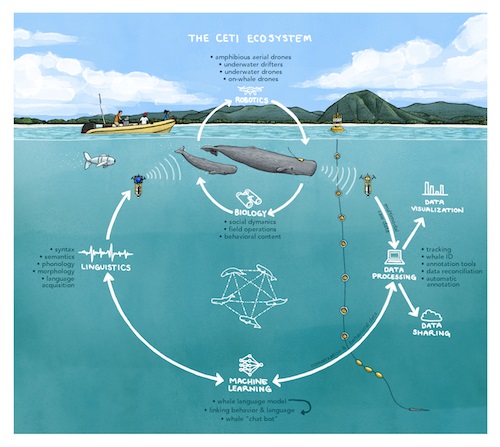
Five Israelis have been invited to join a pioneering global research project aimed at listening into and understanding the language of sperm whales, the animals with the biggest brains on the planet.

Project CETI — Cetacean Translation Initiative — forms part of TED’s Audacious Project program, which annually selects what it calls “big, bold solutions to the world’s most urgent challenges.”


In the Mediterranean, they are generally not found further east than western Turkey. However, in February there was an unusual sighting of a young sperm whale off the coast of Nahariya, in northern Israel.

A juvenile sperm whale spotted off the coast of Nahariya in northern Israel, February 25, 2021. (Channel 12 News screen grab)

Now, scientists are aiming to decode their language.

“These mammals make a clicking sound at varying frequencies when they are in the company of other whales,” said one of the leaders of the project, Prof. Dan Tchernov of University of Haifa’s Leon H. Charney School of Marine Sciences, the scientific director of the Morris Kahn Marine Research Station.

“The question is, is this just a simple code or a true language? Right now, our database is not comprehensive enough to know the answer to this question.”

“However, with the advancement of machine learning, and advanced linguistics, we realized that if we gathered enough data about their voices, the context in which these sounds are employed, and understood their behavior and motivation behind these sounds, we can then develop an algorithm which will determine whether they have an authentic language.”

Leading the international project is Prof. David Gruber, presidential professor of Biology and Environmental Science at City University of New York, who is also an explorer for National Geographic. Gruber discovered the first biofluorescent sea turtle, and developed a “shark-eye” camera to gain a shark’s perspective of the underwater world.

According to the project’s website, Gruber’s team has already applied deep machine learning techniques to sperm whale clicks, with 99.5% accuracy in pulling sperm whale clicks out of more general noise, 97.5% accuracy in categorizing 23 types of click patterns, and 95.3% accuracy in recognizing whale dialects.

“These results demonstrate AI’s capability to recognize patterns in this aquatic Morse code,” the website says.

CETI scientists will combine these insights with findings from The Dominica Sperm Whale Project, off the coast of the Caribbean island country Dominica, where Dr. Shane Gero, CETI’s whale biology leader, has been gathering data on the sounds, dialects, social lives, relationships and behaviors of 30 families of sperm whales.

The first step is to develop “delicate” robot technologies. These will include sensors on the seabed, robotic fish that will swim alongside the whales to record their conversations, and sea surface drones equipped with dropdown hydrophones.

Once the information and data have been collected, scientists will decode using cutting-edge machine learning, and linguistics methodologies. “Project CETI will also launch a public portal, and through partners like the National Geographic Society will engage a global community in the deep wonder of our attempt of meaningful dialogue with a non-human species,” the website says.

The technology planned for listening into the communication of sperm whales, off the coast of Dominica. (Alex Boersma, CETI project)

Also joining the project from University of Haifa are Dr. Roee Diamant of the Marine Sciences Department, who will be the project’s lead acoustic adviser in charge of placing the world’s most advanced marine mammal listening and localization equipment, and Dr. Bracha Nir, head of the university’s Department of Communication Disorders, who will investigate mother and calf communication themes.

Among other key recruits are Israeli American Prof. Shafi Goldwasser, professor of Electrical Engineering and Computer Science at the Massachusetts Institute of Technology and a member of the Department of Computer Sciences and Applied Mathematics at Weizmann Institute of Science in Rehovot. She is a leading figure in the science of cryptography (encrypting and decrypting data).

Prof. Michael Bronstein is an expert in deep machine learning and Director of Graph Learning Research at Twitter, who received his PhD from the Technion Israel Institute of Technology and is currently chair in Machine Learning and Pattern Recognition at the Faculty of Engineering, Department of Computing, at Imperial College, London.

Whales help to regulate the atmosphere

Like all great whales, sperm whales, which can be found in all oceans from the poles to the equator, have been found to be key actors in the regulation of the atmosphere.

Accumulating massive amounts of carbon in their bodies while they live, they take an average of 33 tons of CO? to the bottom of the ocean when they die. This compares with 22 kilograms (48 pounds) absorbed by an average tree in one year.

Furthermore, where there are whales, there are also vast populations of phytoplankton, which feed off the nitrogen and iron found in whale excreta. These nutrients are dispersed vertically, as the whales move up to the sea’s surface to breathe, and back down again — they will dive 3,280 feet in search of squid — and horizontally, as they migrate.

A female sperm whale. (Amanda Cotton)

Phytoplankton contribute at least 50 percent of all oxygen to the atmosphere and absorb about 37 billion metric tons of CO?, an estimated 40 percent of all marine CO? produced, in the process of photosynthesis. This has been equated with the amount of carbon dioxide captured by four Amazon forests.

Whaling has reportedly reduced world sperm whale populations from 1.1 million to around 360,000. Although hunting has more or less stopped, whales are still threatened by entanglement in fishing nets and disturbance or collision with ships.

In 2018, a dead sperm whale that washed ashore in Indonesia was found to contain nearly 6 kilograms (13 pounds) of plastic waste in its stomach. This included 15 drinking cups, four plastic bottles, 25 plastic bags and two flipflops, the BBC reported at the time.

Female sperm whales live in pods with their young while bulls live apart.

(Times of Israel).

WP Twitter Auto Publish Powered By : XYZScripts.com