Home Blog Page 545

Biden plans to ‘reset’ ties with PA

Internal draft memo shows Biden administration crafting a plan aimed at “resetting” US ties with the Palestinian Authority.

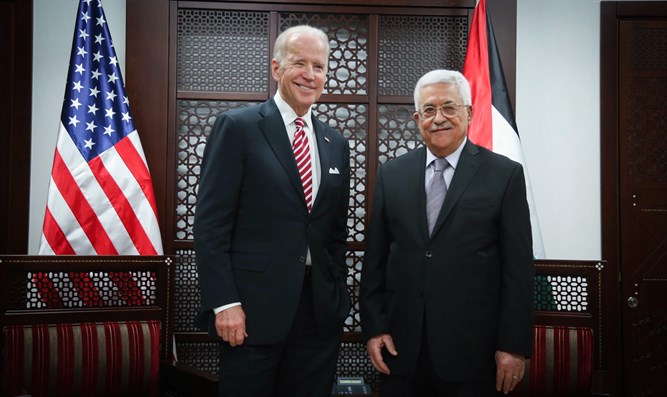
The Biden administration is crafting a plan aimed at “resetting” US ties with the Palestinian Authority, according to an internal draft memo quoted by Reuters on Wednesday.

Two people familiar with the State Department document, which was first reported by the United Arab Emirates-based newspaper The National, said it was still in an early “working stage” but could eventually form the basis for rolling back parts of Trump’s approach that Palestinian Arabs denounced as heavily biased in favor of Israel.

A portion of the draft memo said the US vision is “to advance freedom, security, and prosperity for both Israelis and Palestinians in the immediate term.”

The document was cited as saying $15 million in COVID-19 pandemic aid to the Palestinians could be announced by the end of March. It is also reported to take a tougher stance on Israeli settlement activities and mentions efforts “to obtain a Palestinian commitment to end payments to individuals imprisoned (by Israel) for acts of terrorism.”

One source, speaking on condition of anonymity, told Reuters the document was a preliminary draft subject to revision and any final version would require inter-agency review.

“We don’t have any comments on that specific memo,” US State Department spokeswoman Jalina Porter told reporters at a daily briefing on Wednesday.

Since taking office, the Biden administration has renewed ties with the PA that have been frozen since 2017.

The PA had been boycotting the US in protest of Trump’s recognition of Jerusalem as Israel’s capital and the relocation of the US embassy in Israel to the city.

However, the Biden administration is planning to roll back many of Trump’s policies related to Israel and the PA, including a resumption of aid to the PA and the reopening of the Palestine Liberation Organization (PLO) office in Washington, as well as the consulate in Jerusalem.

(Arutz 7).

California Republican Doug Ose enters Newsom recall election ahead of Wednesday’s petition deadline

0

Ose joins former San Diego Mayor Kevin Faulconer and businessman John Cox as Republicans who are hoping to replace Gov. Newsom.

A third California Republican has declared his candidacy for the recall election aimed at ousting incumbent Democrat Gov. Gavin Newsom.

Former U.S. Rep. Doug Ose made his intentions known Tuesday, one day ahead of Wednesday’s deadline for recall proponents to submit petition signatures to county election officials to get the recall effort put on the ballot later this year.

“Californians are tired of having a governor whose operating themes are hypocrisy, self-interest, half-truths and mediocrity,” Ose said in a statement, according to The Associated Press.

“Californians are tired of having a governor whose operating themes are hypocrisy, self-interest, half-truths and mediocrity.”

— Former U.S. Rep. Doug Ose

“Newsom sides with unions that close our schools while sending his own kids to private school,” Ose continued. “He dines in the state’s fanciest restaurants while telling everyone else to stay at home. He lives in a gated mansion while allowing the state’s homeless crisis to spin out of control. Enough is enough.”

Ose, 65, is a Sacramento native who represented the state’s 3rd Congressional District from 1999 to 2005. He joins former San Diego Mayor Kevin Faulconer and businessman John Cox as Republicans who are hoping to replace Newsom, 53, a former mayor of San Francisco and former lieutenant governor who has led the state since January 2019.

The recall election could ultimately draw scores of candidates, like the 135 who ran in 2003 when Republican Arnold Schwarzenegger eventually replaced Democrat Gov. Gray Davis.

Newsom has countered the recall effort this week with a media blitz that has included appearances on CNN, MSNBC and ABC’s “The View.”

“Am I worried about it? Of course I’m worried about it,” Newsom said on “The View” on Tuesday, according to The Mercury News of San Jose. “We’re taking it seriously.”

During an appearance Tuesday at an elementary school in Alameda County, Newsom told reporters that recall activists may have racist motives.

“Look at the petition, look at the actual reasons they themselves listed,” the governor said. “It has to do with immigration. The Browning of California.”

At the same event, he acknowledged that the recall vote was likely to proceed.

“The reality is it looks like it’s got on the ballot, so we’re ready to go,” Newsom told reporters. “We will fight it, we will defeat it.”

After petition signatures are submitted, county officials will have until April 29 to verify the signatures are valid and notify the secretary of state.

(Fox News).

Biden border officials say he’s wrong not to acknowledge migrant crisis

0

Border officials working under the Biden administration tell Fox News that the president and his surrogates are wrong not to call the border situation a “crisis.”

“A week ago I would not have called this a crisis. Today it meets the definition. We are overwhelmed.”

“We do not have the resources to stop the cartels from bringing in illegal aliens, from bringing in drugs, therefore we are in fact in a crisis,” Brandon Judd, president of the National Border Patrol Council, told Fox News.

A senior CBP official who spoke on condition of anonymity echoed Judd’s sentiment.

“The president understands it is a crisis, which is why he told migrants ‘don’t come over,'” the official told Fox News.

Meanwhile, President Biden said Tuesday he does not have any plans to travel to the southern border “at the moment” amid a migrant surge in migrants and overwhelmed facilities.

Republicans have laid blame on Biden for the surge after he rolled back a number of Trump-era immigration restrictions he deemed “inhumane”, including ending the “Remain-in-Mexico” policy and by reinstating “catch-and-release.”

Biden’s immigration agenda also includes a pathway to citizenship for 11 million undocumented immigrants.

Department of Homeland Security Secretary Alejandro Mayorkas on Tuesday described the border situation as “difficult,” but, just as the White House has, refrained from calling it a crisis.

“The situation at the southwest border is difficult,” Mayorkas said. “We are working around the clock to manage it and we will continue to do so. That is our job. We are making progress and we are executing on our plan. It will take time and we will not waver in our commitment to succeed.”

(Fox News).

United Arab Emirates reportedly furious at Netanyahu, feeling it has become campaign prop

Apparently, the feeling that it’s being used as part of Netanyahu’s political campaign has started to ruffle feathers in the UAE.

No one would accuse Prime Minister Benjamin Netanyahu of being a shy campaigner. Ferocious is more like it. He doesn’t hesitate to enlist all forces within reach to best his opponents, including some forces that may not want to be enlisted.

That appears to be the case with the United Arab Emirates.

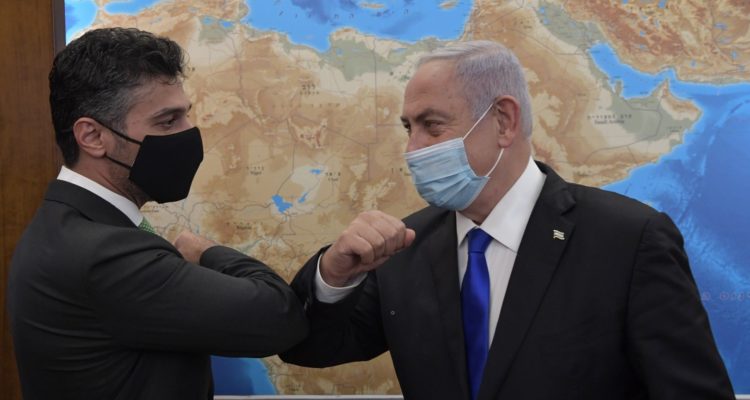
The UAE was the first to sign the Abraham Accords, but Hebrew media is reporting that Israel’s new ally is very unhappy with Netanyahu, who has been using the blossoming relations between the two countries for his reelection campaign.

Netanyahu had planned to visit the UAE last week, even though the UAE was reportedly reluctant about the timing as it didn’t want to appear to be interfering with the election. The trip ended up being canceled due to a small diplomatic kerfuffle with Jordan.

It’s not clear if Netanyahu will try to visit again. He told Army Radio he will not but a member of the Likud party said it’s still a possibility. It’s unlikely, however, given the UAE’s position that Netanyahu will be able to visit before the election.

Reports also say that after his trip was cancelled Netanyahu asked the UAE to publicize its decision to start a $10 billion investment fund targeting strategic sectors in Israel, which it agreed to do through its official news agency.

Apparently, the feeling that it’s being used as part of Netanyahu’s political campaign has started to ruffle feathers in the UAE.

Hebrew news site N12 reports that “sources in the Emirates are talking about anger and frustration” at Netanyahu. They’re particularly irked at his use of the Crown Prince’s name.

“The Emirates note that its ties are with the State of Israel and not with one politician or another, and that they do not want to be involved in Netanyahu’s election campaign,” N12 reports.

Anwar Gargash, until recently the UAE’s Minister of Foreign Affairs, tweeted: “From the UAE’s perspective, the purpose of the Abrahamic Accords is to provide a robust strategic foundation to foster peace and prosperity with the State of Israel and in the wider region. The UAE will not be a part in any internal electioneering in Israel, now or ever.”

Touting foreign endorsements is a relatively new tactic in Israeli elections. Netanyahu may have been the one to introduce it prior to the September 2019 elections.

Huge posters put up the Likud party featured Netanyahu shaking hands with then-President Donald Trump, Russian President Vladimir Putin and India’s Prime Minister Narendra Modi.

(World Israel News)

Israel’s Supreme Court opens airport, rules that limiting arrivals is illegal

0

The judges suggested that the decision to limit arrivals at 3,000 people was arbitrary, and that the number was not based on scientific data.

Israel’s Supreme Court ruled Wednesday that all restrictions on the number of arriving Israeli citizens at Ben Gurion Airport will be lifted, starting Saturday.

Citing the upcoming national election in six days, in which citizens can vote only if they’re physically present in the country, the Court said all Israelis must be free to enter the Jewish State.

Chief Justice Esther Hayut and judges Neal Hendel and Yitzhak Amit wrote that the arrival restrictions “violate the basic constitutional right to enter and exit Israel, and other rights at the core of the democratic fabric of life.”

The decision is a reversal of Israel’s most recent policy which limited arrivals to 3,000 people daily. Between late January and early March, Israel granted entry to citizens only on the basis of exceptional circumstances, effectively locking out tens of thousands of Israelis abroad.

The judges suggested that the decision to limit arrivals at 3,000 people was arbitrary, and that the number was not based on scientific data.

“The restrictions were set without the government having any data about the number of citizens abroad who want to return to the country… instead of investing efforts and resources in enforcing quarantine… the government preferred to impose a regime of entry quotas, which is more simple to implement but infringes much more on basic rights,” they wrote.

The decision was met with dismay by coronavirus czar Nachman Ash, who told Channel 12 News that the ruling is “worrying, because it will allow the entry of a lot of illness and dangerous [coronavirus] variants.”

In a statement, Knesset Speaker Yariv Levin blasted the decision, saying “judges come and say ‘We’ll endanger all your lives for a constitutional principle from a non-existent principle.”

Also on Wednesday, the Knesset approved a bill requiring travelers returning from abroad to quarantine with an electronic monitoring bracelet.

The device will serve as an alternative to state-run quarantine hotels.

(World Israel News).

Rabbi Lord Jonathan Sacks zt”l – The Sins of a Leader (Vayikra 5781)

Rabbi Sacks zt’’l had prepared a full year of Covenant & Conversation for 5781, based on his book Lessons in Leadership. The Rabbi Sacks Legacy Trust will continue to distribute these weekly essays, so that people all around the world can keep on learning and finding inspiration in his Torah.


As we have discussed so many times already this year, leaders make mistakes. That is inevitable. So, strikingly, our parsha of Vayikra implies. The real issue is how leaders respond to their mistakes.

The point is made by the Torah in a very subtle way. Our parsha deals with sin offerings to be brought when people have made mistakes. The technical term for this is sheggagah, meaning inadvertent wrongdoing (Lev. 4:1-35). You did something, not knowing it was forbidden, either because you forgot or did not know the law, or because you were unaware of certain facts. You may, for instance, have carried something in a public place on Shabbat, perhaps because you did not know it was forbidden to carry, or you forgot what was in your pocket, or because you forgot it was Shabbat.

The Torah prescribes different sin offerings depending on who made the mistake. It enumerates four categories. First is the High Priest, second is “the whole community” (understood to mean the Great Sanhedrin, the Supreme Court), a third is “the leader” (Nasi), and the fourth is an ordinary individual.

In three of the four cases, the law is introduced by the word im, “if” – if such a person commits a sin. In the case of the leader, however, the law is prefaced by the word asher, “when” (Lev. 4:22). It is possible that a High Priest, the Supreme Court or an individual may err. But in the case of a leader, it is probable or even certain. Leaders make mistakes. It is unavoidable, the occupational hazard of their role. Talking about the sin of a Nasi, the Torah uses the word “when,” not “if.”

Nasi is the generic word for a leader: a ruler, king, judge, elder or prince. Usually it refers to the holder of political power. In Mishnaic times, the Nasi, the most famous of whom were leaders from the family of Hillel, had a quasi-governmental role as representative of the Jewish people to the Roman government. Rabbi Moses Sofer (Bratislava, 1762-1839) in one of his responsa[1] examines the question of why, when positions of Torah leadership are never dynastic (never passed from father to son), the role of Nasi was an exception. Often this role did pass from father to son. The answer he gives, and it is historically insightful, is that with the decline of monarchy in the Second Temple period and thereafter, the Nasi took on many of the responsibilities of a king. His role, internally and externally, was as much political and diplomatic as religious. That in general is what is meant by the word Nasi.

Why does the Torah consider this type of leadership particularly prone to error? The commentators offer three possible explanations. R. Ovadiah Sforno (to Lev. 4:21–22) cites the phrase “But Yeshurun waxed fat, and kicked” (Deut. 32:15). Those who have advantages over others, whether of wealth or power, can lose their moral sense. Rabbeinu Bachya agrees, suggesting that rulers tend to become arrogant and haughty. Implicit in these comments – it is in fact a major theme of Tanach as a whole – is the idea later stated by Lord Acton in the aphorism, “Power tends to corrupt, and absolute power corrupts absolutely.”[2]

Elie Munk, citing the Zohar, offers a second explanation. The High Priest and the Sanhedrin were in constant contact with that which was holy. They lived in a world of ideals. The king or political ruler, by contrast, was involved in secular affairs: war and peace, the administration of government, and international relations. They were more likely to sin because their day-to-day concerns were not religious but pragmatic.[3]

Meir Simcha ha-Cohen of Dvinsk[4] points out that a King was especially vulnerable to being led astray by popular sentiment. Neither a Priest nor a Judge in the Sanhedrin were answerable to the people. The King, however, relied on popular support. Without that he could be deposed. But this is laden with risk. Doing what the people want is not always doing what God wants. That, R. Meir Simcha argues, is what led David to order a census (2 Sam. 24), and Zedekiah to ignore the advice of Jeremiah and rebel against the King of Babylon (2 Chr. 36). Thus, for a whole series of reasons, a political leader is more exposed to temptation and error than a Priest or Judge.

There are further reasons.[5] One is that politics is an arena of conflict. It deals in matters – specifically wealth and power – that are in the short-term, zero-sum games. ‘The more I have, the less you have. Seeking to maximise the benefits to myself or my group, I come into conflict with others who seek to maximise benefits to themselves or their group.’ The politics of free societies is always conflict-ridden. The only societies where there is no conflict are tyrannical or totalitarian ones in which dissenting voices are suppressed – and Judaism is a standing protest against tyranny. So in a free society, whatever course a politician takes will please some and anger others. From this, there is no escape.

Politics involves difficult judgements. A leader must balance competing claims and will sometimes get it wrong. One example – one of the most fateful in Jewish history – occurred after the death of King Solomon. People came to his son and successor, Rehoboam, complaining that Solomon had imposed unsustainable burdens on the population, particularly during the building of the Temple. Led by Jeroboam, they asked the new King to reduce the burden. Rehoboam asked his father’s counsellors for advice. They told him to concede to the people’s demand. Serve them, they said, and they will serve you. Rehoboam then turned to his own friends, who told him the opposite: Reject the request. Show the people you are a strong leader who cannot be intimidated (1 Kings 12:1-15).

It was disastrous advice, and the result was tragic. The kingdom split in two, the ten northern tribes following Jeroboam, leaving only the southern tribes, generically known as “Judah,” loyal to the king. For Israel as a people in its own land, it was the beginning of the end. Always a small people surrounded by large and powerful empires, it needed unity, high morale and a strong sense of destiny to survive. Divided, it was only a matter of time before both nations, Israel in the north, Judah in the south, fell to other powers.

The reason leaders – as opposed to Judges and Priests – cannot avoid making mistakes is that there is no textbook that infallibly teaches you how to lead. Priests and Judges follow laws. For leadership there are no laws because every situation is unique. As Isaiah Berlin put it in his essay, ‘Political Judgement,’[6] in the realm of political action, there are few laws and what is needed instead is skill in reading a situation. Successful statesmen “grasp the unique combination of characteristics that constitute this particular situation – this and no other.” Berlin compares this to the gift possessed by great novelists like Tolstoy and Proust.[7] Applying inflexible rules to a constantly shifting political landscape destroys societies. Communism was like that. In free societies, people change, culture changes, the world beyond a nation’s borders does not stand still. So a politician will find that what worked a decade or a century ago does not work now. In politics it is easy to get it wrong, hard to get it right.

There is one more reason why leadership is so challenging. It is alluded to by the Mishnaic Sage, R. Nechemiah, commenting on the verse, “My son, if you have put up security for your neighbour, if you have struck your hand in pledge for another” (Prov. 6:1):

So long as a man is an associate [i.e. concerned only with personal piety], he need not be concerned with the community and is not punished on account of it. But once a man has been placed at the head and has donned the cloak of office, he may not say: ‘I have to look after my welfare, I am not concerned with the community.’ Instead, the whole burden of communal affairs rests on him. If he sees a man doing violence to his fellow, or committing a transgression, and does not seek to prevent him, he is punished on account of him… you are responsible for him. You have entered the gladiatorial arena, and he who enters the arena is either conquered or conquers.[8]

A private individual is responsible only for their own sins. A leader is held responsible for the sins of the people they lead: at least those they might have prevented.[9] With power comes responsibility: the greater the power, the greater the responsibility.

There are no universal rules, there is no failsafe textbook, for leadership. Every situation is different and each age brings its own challenges. A ruler, in the best interests of their people, may sometimes have to take decisions that a conscientious individual would shrink from doing in private life. They may have to decide to wage a war, knowing that some will die. They may have to levy taxes, knowing that this will leave some impoverished. Only after the event will the leader know whether the decision was justified, and it may depend on factors beyond their control.

The Jewish approach to leadership is thus an unusual combination of realism and idealism – realism in its acknowledgement that leaders inevitably make mistakes, idealism in its constant subordination of politics to ethics, power to responsibility, pragmatism to the demands of conscience. What matters is not that leaders never get it wrong – that is inevitable, given the nature of leadership – but that they are always exposed to prophetic critique and that they constantly study Torah to remind themselves of transcendent standards and ultimate aims. The most important thing from a Torah perspective is that a leader is sufficiently honest to admit their mistakes. Hence the significance of the sin offering.

Rabban Yochanan ben Zakkai summed it up with a brilliant double-entendre on the word asher, meaning “when” in the phrase “when a leader sins.” He relates it to the word ashrei, “happy,” and says: Happy is the generation whose leader is willing to bring a sin offering for their mistakes.[10]

Leadership demands two kinds of courage: the strength to take a risk, and the humility to admit when a risk fails.


[1] Responsa Chatam Sofer, Orach Chayyim, 12.

[2] This famous phrase comes from a letter written by Lord Acton in 1887. See Martin H. Manser, and Rosalind Fergusson, The Facts on File Dictionary of Proverbs, New York: Facts on File, 2002, 225.

[3] Elie Munk, The Call of the Torah, Vayikra, New York, Mesorah Publications, 1992, 33.

[4] Meshech Chochmah to Lev. 4:21-22.

[5] This, needless to say, is not the plain sense of the text. The sins for which leaders brought an offering were spiritual offences, not errors of political judgment.

[6] Isaiah Berlin, The Sense of Reality, Chatto and Windus, 1996, 40-53.

[7] Incidentally, this answers the point made by political philosopher Michael Walzer in his book on the politics of the Bible, In God’s Shadow. He is undeniably right to point out that political theory, so significant in ancient Greece, is almost completely absent from the Hebrew Bible. I would argue, and so surely would Isaiah Berlin, that there is a reason for this. In politics there are few general laws, and the Hebrew Bible is interested in laws. But when it comes to politics – to Israel’s Kings for example – it does not give laws but instead tells stories.

[8] Exodus Rabbah, 27:9.

[9] “Whoever can prevent the members of his household from sinning and does not, is seized for the sins of his household. If he can prevent his fellow citizens and does not, he is seized for the sins of his fellow citizens. If he can prevent the whole world from sinning, and does not, he is seized for the sins of the whole world.” (Shabbat 54b)

[10] Tosefta Baba Kamma, 7:5.


IRS To Delay This Year’s Tax Filing Deadline To Mid-May

0

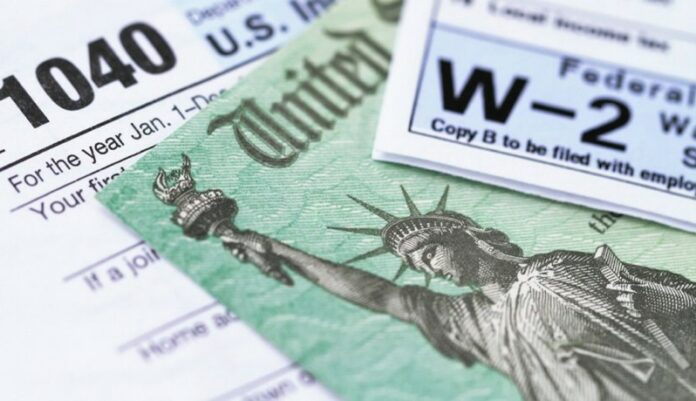
The Internal Revenue Service plans to delay this year’s tax filing deadline by roughly a month, to mid-May, according to an official familiar with the plans.

The official said the decision was made in order to allow filers more time to navigate tax situations complicated by the coronavirus pandemic.

The IRS is still figuring out what the final deadline will be. The agency is considering setting the filing deadline either on May 15 or May 17.

Last year, the IRS moved the deadline to July 15, giving Americans an additional three months to file their taxes amid the pandemic.

(YWN World Headquarters – NYC)

CNN hemorrhaging viewers since Trump left office, down nearly 50% in key measurables

0

Liberal network has lost 47% of primetime audience among the 25-to-54 demographic most important to advertisers


CNN has been hemorrhaging viewers since former President Trump left office, losing roughly half of its audience in key measurables since January following a brief post-Election Day spike.

CNN averaged 2.5 million primetime viewers from Nov. 4, the day following the presidential election, through Inauguration Day on Jan. 20. But viewers fled the liberal network once President Biden took office, and CNN has averaged only 1.6 million primetime viewers from Jan. 21 through March 15.

CNN’s viewership during the primetime hours of 8-11 p.m. ET dropped 36% since Biden took office after it spiked following Election Day. CNN’s primetime viewership decline was even sharper among the key demographic of adults age 25-to-54, plummeting 47% during the same period.

CNN has been hemorrhaging viewers since former President Trump left office, losing half of its audience in key measurables since Inauguration Day following a brief post-Election Day spike.

CNN’s viewership also suffered among the total day audience since Trump left office, leaving the liberal network without its bête noire.

CNN averaged 1.7 million viewers from Nov. 4 through Jan. 20, but it dropped to 1.1 million since Biden took office for a 34% fall. During the same period, CNN shed 44% of its total day viewers among the key demo, dropping from an average of 483,000 to only 272,000.

Longtime broadcaster Ted Koppel famously mocked CNN’s Brian Stelter to his face back in 2018, telling the network’s media pundit that “CNN’s ratings would be in the toilet without Donald Trump.”

Stelter shook his head in disagreement, but it turns out that Koppel was onto something.

CNN’s ratings’ nosedive is even worse when tossing out the weeks following Election Day.

CNN averaged 3.1 million primetime viewers from Dec. 28 through Jan 20, but it plummeted to 1.6 million from Inauguration Day to the present for a drop of 49%. When it comes to the key demo, CNN lost a staggering 58% of its viewers during the same time frames.

CNN also lost nearly half its viewers among the total day audience, too.

CNN averaged 2.2 million total day viewers from Dec. 28-Jan. 20, owed in part to viewers flocking to cable news for coverage of the Jan. 6 Capitol riot and its aftermath. However, the network has since averaged only 1.1 million viewers for a significant 48% decline.

In addition to the declining viewership, CNN has been embarrassed by its handling of multiple scandals surrounding New York Gov. Andrew Cuomo, a Democrat.

The network notoriously allowed his younger brother, Chris Cuomo, to conduct a series of playful interviews in 2020 while largely avoiding lingering questions about the nursing home crisis in New York. CNN was then mocked for imposing a ban on the “Cuomo Prime Time” host intervening his big brother once the governor became engulfed with sexual harassment allegations.

All data is courtesy of Nielsen Media research.


Source: Fox News

Still no crisis, Joe? Biden’s Border Explodes; Number Of Unaccompanied Children In Custody 300% Higher Than Previously Known

0

Democrat President Joe Biden’s border crisis is rapidly spiraling out of control as new reporting on Tuesday evening indicated that the number of unaccompanied children being held in detention facilities is more than 300 percent higher than previously known.

CBS News host Norah O’Donnell said Biden’s border crisis was “growing larger and more dire by the day.”

“Tonight, we have got the stunning new numbers,” O’Donnell said. “Sources tell CBS News more than 13,000 migrant children who entered the country without their parents are now in U.S. custody. The government says even more adults are being turned back every day.”

In a tweet, O’Donnell noted that the 13,000 unaccompanied minors, which is significantly higher than the roughly 4,200 that were reported in U.S. custody at the start of the week, “are being held in U.S. custody for an average of 120 hours, far longer than the 72 hours allowed by law.”

(Daily Wire).

Syria says Israel carried out air strikes in Damascus

0

Syrian media says air defense systems were activated due to
“Israeli aggression.”

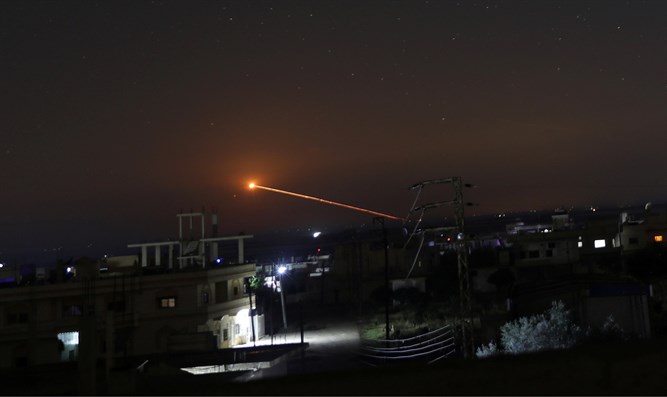
Syrian media reported on Tuesday evening that Israel had attacked targets in the Damascus area and in southern Syria.

According to the reports, the country’s air defense systems were activated due to “Israeli aggression.” Syria’s official SANA news agency claimed that several missiles were intercepted over the skies of the Syrian capital.

Several weeks ago, Syrian news outlets reported that Israeli warplanes attacked Iranian targets near Damascus.

The alleged attack appeared to be in response to the shelling of an Israeli-owned ship in the Gulf of Oman, which was attributed to Iran.

In mid-February, Syrian state television reported that the country’s air defense intercepted “Israeli aggression” over Damascus.

In late January, Syria reported that its air defense systems responded to an Israeli air strike in the Hama area.

A Syrian military source said the attack originated from the direction of the Lebanese city of Tripoli. He added that the Syrian air defense systems intercepted the missiles and “downed most of them”.

Two weeks earlier, Syrian TV reported that the country’s air defense systems responded to an Israeli air strike over southern Damascus.

A week before that, Syrian media reported that the country’s air defense systems were activated in the Damascus area and thwarted an Israeli air strike.

(Arutz 7).


WP Twitter Auto Publish Powered By : XYZScripts.com