Home Blog Page 6

House Panel Says China Subsidizes Fentanyl Production To Fuel Crisis In The United States

0

China is fueling the fentanyl crisis in the U.S. by directly subsidizing the manufacturing of materials that are used by traffickers to make the drug outside the country, according to a report released Tuesday by a special House committee focused on countering the Chinese government.

Committee investigators said they accessed a government website that revealed tax rebates for the production of specific fentanyl precursors as well as other synthetic drugs as long as those companies sell them outside of China.

“Through its actions, as our report has revealed, the Chinese Communist Party is telling us that it wants more fentanyl entering our country,” said Rep. Mike Gallagher, the Republican chairman of the special House committee. “It wants the chaos and devastation that has resulted from the epidemic.”

In November, President Joe Biden and Chinese President Xi Jinping announced a resumption of bilateral cooperation on counternarcotics with a focus on reducing the flow of precursor chemicals and synthetic drug trafficking. But the congressional report raises questions about whether China is following through.

The report’s findings were released Tuesday as part of a hearing examining China’s role in the fentanyl epidemic in the U.S. Most overdose deaths in the U.S. continue to be linked to fentanyl and other synthetic opioids. Inexpensive fentanyl is increasingly cut into other drugs, often without the buyers’ knowledge.

The Chinese government not only subsidizes the manufacturing of precursor chemicals, but the report says it has also thwarted investigations into illicit manufacturers by warning the targets of an investigation when U.S. law enforcement has sent a formal request for assistance. Investigators said multiple current and former federal agents have described the notification of targets, leading those targets to revamp operations and make it harder to detect their activities.

Former U.S. Attorney General William Barr told lawmakers in Tuesday’s hearing that it’s hard to believe that a country with the most pervasive surveillance system in the world is not fully aware of the massive drug trafficking taking place. He said the committee’s report “uncovered persuasive evidence” that China’s government is not just a bystander, but is “knee deep” in sponsoring and facilitating the export of fentanyl precursors.

Barr recommended the U.S. use its trade and economic power to seek greater enforcement from Chinese authorities. He also said victims should bring civil actions against companies and individuals involved in distributing the precursors and synthetic drugs.

“I don’t think we can count on their goodwill, as we have in the past,” Barr said.

The Chinese embassy in Washington did not respond immediately to a request for comment.

Rep. Raja Krishnamoorthi, the top Democrat on the committee, said Chinese companies are also currently selling synthetic opioids on their websites, and pointed to a screenshot of one such solicitation that committee staff found just Monday night in advance of the hearing. He said such posts have to be taken down immediately.

“There are hundreds of these website posts — hundreds” Krishnamoorthi said. “This is completely unacceptable.”

The chemical companies providing fentanyl precursors often have legitimate businesses with customers around the world. The report said fentanyl precursors and other synthetic narcotics are a “side hustle” designed to maximize profits.

Businesses that deal in fentanyl precursors and narcotics on the side are particularly vulnerable to U.S sanctions. The same goes for companies such as banks, online platforms and shipping companies that enable illicit fentanyl trade.

The report calls on Congress to clarify the power of the president to sanction those involved in drug trafficking, for the U.S. to impose financial sanctions on violators and for regular reports to Congress on how often sanctions have been undertaken.

It also calls for forming a task force that would place intelligence, economic and enforcement resources under one roof. The head of the group would report directly to the attorney general of the U.S. and serve as a special assistant to the president on the National Security Council with authority over the opioids portfolio.

(AP)

Source: The Yeshiva World

‘Don’t Know Why Anybody Would Think I Like Hoodies,’ Says Fetterman of New Yeshiva Sweatshirt

0

By Joseph Feldman

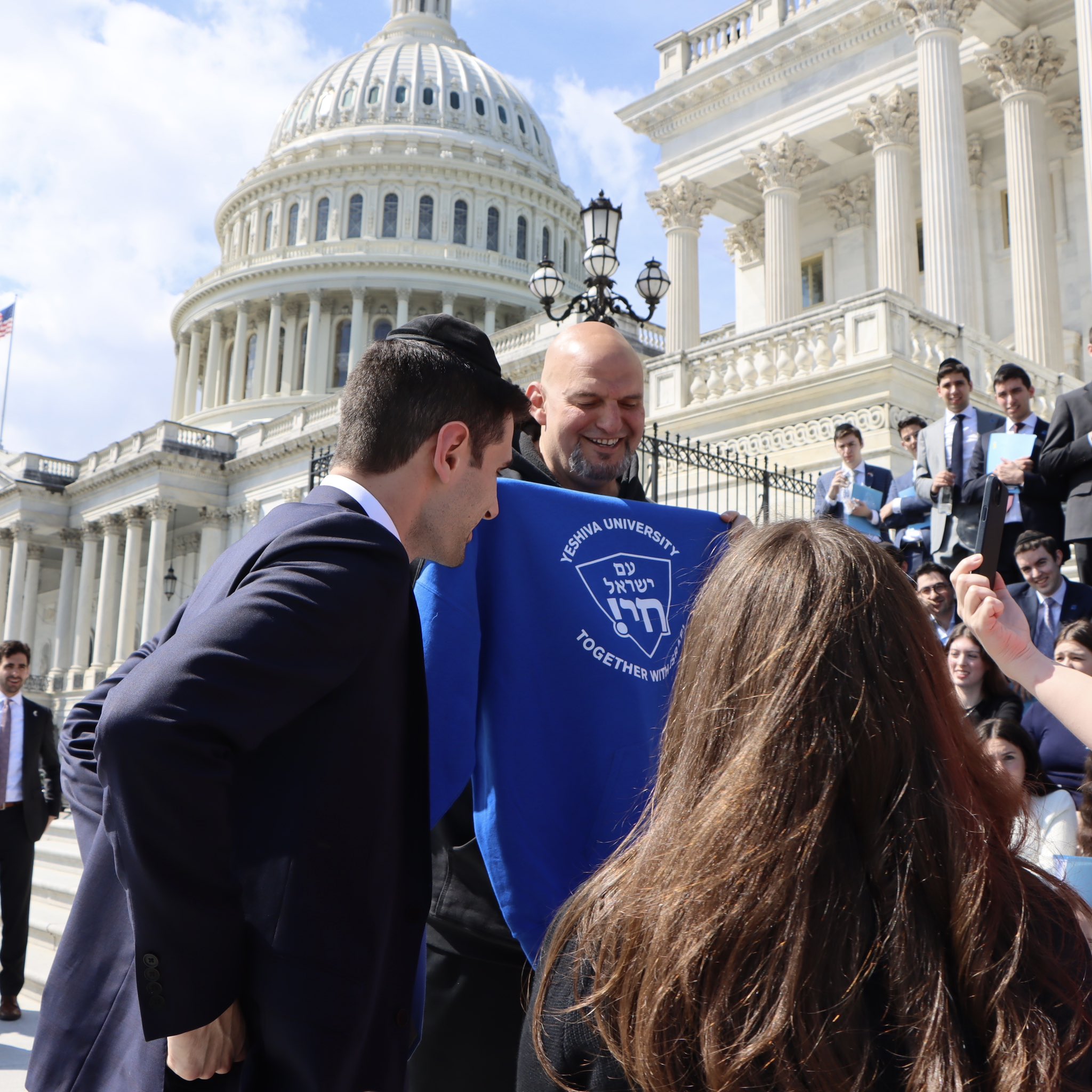
NEW YORK  (JNS) – More than 100 Yeshiva University students met last week in Washington with Sen. John Fetterman (D-Pa.), one of Israel’s most vocal supporters in the U.S. Congress.

The Pennsylvania Democrat posted photos on social media holding a blue Yeshiva sweatshirt that states “Yeshiva University. Am Yisrael chai. Together with Israel.” (The Hebrew phrase means, “The nation of Israel lives.”)


John Fetterman Yeshiva University
Sen. John Fetterman (D-Pa.) meets at the U.S. Capitol in Washington, D.C., with more than 100 Yeshiva University students in April 2024. Credit: Courtesy of the office of Sen. John Fetterman.

“I don’t know why anybody would think I like hoodies,” the senator, known for his hooded sweatshirts, joked on Friday.

“Thanks to the 100-plus students from Yeshiva University for stopping by the Senate,” he added. “You’re always welcome back to my office.”

Jon Greenfield, assistant vice president of government relations at Yeshiva University, told JNS that hundreds of students in Yeshiva’s Political Action Club travel annually to Washington to meet with members of Congress and their staffs to support Israel.

“This latest mission was the group’s second trip to Capitol Hill since Oct. 7 and comes at a time when pro-Israel voices are most needed in the halls of Congress,” Greenfield said. “We were proud to see our students engage such a broad, bipartisan cohort of lawmakers during their trip, including Senator Fetterman, and gain firsthand experience in grassroots civic engagement.”

“Their efforts truly represent the values of Yeshiva University as a top-tier academic institution and strong advocate for Israel,” he added.

“Hoodie with a backbone,” wrote Eli Lebowicz, a Jewish comedian.

Dov Hikind, a former New York state legislator and founder of Americans Against Antisemitism, expressed his appreciation for the senator’s post.

“Love that YU students got Sen. Fetterman a YU hoodie to add to his collection,” wrote the Jewish educator Dovid Bashevkin. “There’s no way they got the right size.”

“Beyond well deserved,” Bashevkin added. “Sen. Fetterman has been a beacon of hope and moral clarity. We appreciate you.”

“Thank you, Sen. Fetterman, for your unflinching support,” wrote Rabbi Tzvi Pittinsky, director of educational technology at the Frisch School, Yeshivat Frisch in Paramus, N.J. “You are a true friend of the State of Israel, the Jewish people and all people who love freedom throughout the world.”

Source:  VosIzNeias


House Approves: ‘From The River To The Sea’ Is Antisemitic

0

The US House of Representatives on Tuesday passed a resolution condemning the chant “From the River to the Sea, Palestine will be free” as antisemitic, Fox News reported.

This resolution, spearheaded by Rep. Anthony D’Esposito (R-NY) and supported by the House GOP, garnered an overwhelming vote of 377 to 44. 43 Democrats and one Republican dissented from the majority stance.

Among those opposing the resolution were members of the Progressive Democrats, the “Squad,” including Reps. Ilhan Omar, Rashida Tlaib, and Alexandria Ocasio-Cortez. Also included were Jamaal Bowman, Cori Bush, and House Progressive Caucus Chair Pramila Jayapal.

In an unexpected turn, Rep. Thomas Massie, a Republican, joined the dissenting ranks.

This resolution forms part of a series of 17 measures set forth by House Republican leaders for voting this week. These measures aim to reaffirm support for Israel and denounce Iran, particularly in the wake of recent air strikes launched by Iran over the weekend.

Tlaib, in defense of the controversial phrase, has previously argued that “From the river to the sea is an aspirational call for freedom, human rights, and peaceful coexistence, not death, destruction, or hate.”

However, this interpretation drew sharp criticism from fellow Democrat Rep. Debbie Wasserman Schultz, who directly addressed Tlaib, asserting, “This phrase means eradicating Israel and Jews. Period. Dressing it up in a new PR ploy won’t change that.”

Tlaib’s past employment of this phrase led to her censure in November, particularly due to her confrontational rhetoric towards Israel.

Later, White House press secretary Karine Jean-Pierre publicly condemned Tlaib for her use of the phrase, further emphasizing the contentious nature of the issue.

Source: {Matzav.com}

U.S. and Allies Plan New Sanctions on Iran; War Cabinet to Meet

0

The U.S. and its allies are preparing new sanctions against Iran following its unprecedented attack on Israel. These measures aim to deter Israel from a significant escalation as its War Cabinet is scheduled to meet for a third time later on Wednesday to formulate a response.

Although the attack resulted in no casualties and minimal damage, b’chasdei Shamayim, due to effective air defenses from Israel and its allies, it has heightened concerns of broader war. The incident underscores the potential for the six-month-old Gaza conflict to expand into a direct confrontation between Iran and Israel.

IDF Chief of Staff Herzi Halevi stated that Iran’s barrage of over 300 missiles, cruise missiles, and drones would not go unanswered, though specifics were not provided. A government source noted that Tuesday’s War Cabinet meeting was postponed to Wednesday, without further details.

In efforts to prevent a major Israeli retaliation, the U.S. and European nations have signaled a strengthening of economic and political sanctions against Iran. National Security Adviser Jake Sullivan announced that the U.S. would soon impose sanctions targeting Iran’s missile and drone capabilities, with similar actions expected from its allies. Treasury Secretary Janet Yellen also emphasized ongoing efforts to disrupt Iran’s destabilizing activities and mentioned that new measures targeting Iran’s terrorist financing were imminent.

EU’s foreign policy chief, Josep Borrell, after an emergency video conference with EU foreign ministers, reported that some member states had requested an expansion of sanctions against Iran. Plans include not only targeting Iranian drone supplies to Russia but also extending to missile provisions and possibly affecting Iranian proxies in the Middle East.

Meanwhile, Foreign Minister Yisrael Katz initiated a diplomatic offensive, urging 32 countries to sanction Iran’s missile program and designate its Revolutionary Guard Corps as a terrorist organization.

President Joe Biden assured Israeli Prime Minister Benjamin Netanyahu that the U.S., while a staunch ally of Israel, would not participate in any retaliatory strikes by Israel.


Source: Hamodia

ADL Reports 140% Surge in Antisemitic Incidents Across U.S

0

According to a survey by the Anti-Defamation League (ADL) released Tuesday, antisemitic incidents in the U.S. have surged by 140%, marking an unprecedented rise and the highest annual increase in the past 45 years. The ADL’s Audit of Antisemitic Incidents reported an average of 24 antisemitic acts per day, totaling 8,873 incidents throughout the year. This spike is largely attributed to the ongoing war in Gaza.

The audit revealed a significant rise in assaults, harassment, and vandalism, particularly after Oct. 7, with 5,204 incidents recorded in the latter part of the year. These acts of antisemitism occurred in various settings, including college campuses, public spaces, and during anti-Israel demonstrations, reflecting a global uptrend in antisemitic tensions.

In light of these findings, the ADL has urged governor’s offices nationwide to adopt state-level strategies akin to the White House’s National Strategy to Counter Antisemitism. This call to action aims to comprehensively address antisemitism across all political spectra. ADL CEO Jonathan Greenblatt emphasized the severity of the situation, describing antisemitism as a “national emergency” that requires immediate and widespread action.

The ADL’s survey also noted a disturbing increase in targeted attacks on Jewish institutions, with 1,987 incidents recorded — an increase of 237% from the previous year. This includes a sharp rise in bomb threats, predominantly targeting shuls during the fall. Shuls were the victims in 73% of all incidents affecting Jewish institutions.

Additionally, there was a 321% increase in antisemitic activity on college campuses and a 135% rise in incidents in non-Jewish K-12 schools. The report also highlighted an increase in activity by white supremacist groups, with 1,161 incidents of antisemitic propaganda distribution noted last year.

The states with the highest number of recorded incidents were California, New York, New Jersey, Florida, and Massachusetts, which together accounted for 48% of the total incidents.

Despite these challenges, Greenblatt encouraged American Jews not to succumb to fear but to remain proud of their Jewish identity and confident in their societal role. Oren Segal, Vice President of the ADL Center on Extremism, stressed the diverse nature of the incidents, which ranged from bomb threats to swatting campaigns, all intended to terrorize Jewish communities. The ADL’s tracking efforts have provided crucial intelligence to law enforcement, helping to mitigate potential harm and ensure perpetrator accountability.

Overall, the report found that 36% of the incidents in 2023 involved references to Israel, a significant increase from the previous year. This often included harmful rhetoric and the promotion of classic antisemitic tropes.

Source: Hamodia

Israeli-Led Researchers Discover the Milky Way’s Heaviest Black Hole

0
By Pesach Benson • 16 April, 2024

Jerusalem, 16 April, 2024 (TPS) — An international team of astronomers, led by Tel Aviv University Professor Tsevi Mazeh discovered a black hole more than three times heavier than the other known black holes in the Milky Way galaxy.

Situated approximately 1,500 light-years away from Earth, the black hole was revealed through data collected by the European Space Agency’s Gaia spacecraft. The researchers also found a star orbiting the black hole, also known as a “binary system.” The findings are due to be published in the peer-reviewed Astronomy & Astrophysics journal.

“This is an exciting discovery of the heaviest black hole in a binary system known today in the galaxy,” said Mazeh. “It is amazing how humankind manages to navigate the vast expanses of the universe and discover such mysterious objects. I am convinced that the discovery will lead to a new mode of thinking regarding the presence and prevalence of the black holes that cruise through the expanses of our galaxy.”

According to the accepted theory, when the fuel for the nuclear combustion process that takes place in the core of a star runs out, it collapses in on itself, towards its center. If the star is massive enough, all the remaining matter collapses into a single point of infinite density. It is possible, therefore, to see the black hole as the “corpse” of a star that has ended its life cycle and collapsed in on itself, the researchers explained.

Black holes are difficult to discover because even light cannot overcome their powerful gravitational forces. When a black hole is in a binary system with a normal star, the motion of the visible star is used to measure the mass of its invisible partner.

Astrophysicists are still trying to understand the extreme conditions that lead to the collapse of matter into the central point, so every discovery of a black hole is accompanied by enormous excitement among researchers.

Mazeh, along with Prof. Laurent Eyer from the University of Geneva, spearheaded the effort to identify black holes using Gaia’s data. Their collaboration brought together researchers from various countries, including Spain, France, Germany, Belgium, Poland, and Switzerland.

The team dubbed the new binary system Gaia BH3.

U.S. Details Pentagon’s Role In Defending Israel From Iranian Attack

0

As Iran launched its much-anticipated attack on Israel last night, the night sky was filled with deadly threats. More than 100 ballistic missiles were fired, senior U.S. officials said, complemented by about 30 cruise missiles and more than 150 explosive drones.

Israel’s vaunted missile defense systems ramped up to engage the munitions as they were launched from Iran, Iraq, Syria and Yemen. But they were flanked by U.S. and British fighter jets, a Patriot missile defense system manned by U.S. troops in Iraq and U.S. destroyers off the coast of Israel, each ready to assist.

The result, a senior Biden administration official said Sunday, was a “spectacular defeat” of Iran’s attack, even though it was larger than U.S. officials had anticipated.

“You can imagine those tense moments,” the official said, speaking to reporters Sunday on the condition of anonymity under ground rules set by the White House.

Among the U.S. forces that participated were the 494th Fighter Squadron, with headquarters in Britain; and the 335th Fighter Squadron, of Seymour Johnson Air Force Base in North Carolina. Combined, the two squadrons used their F-15E Strike Eagles to take down about 70 attack drones heading to Israel, and received a phone call after from President Biden. The jets are designed for both air-to-air combat and deep interdiction, the Air Force says.

A senior military official, speaking on the same call, said that the USS Carney and USS Arleigh Burke, destroyers in the eastern Mediterranean Sea, shot down between four and six ballistic missiles in the attack. U.S. troops manning the Patriot missile defense system in Irbil, Iraq, took down another missile that had violated Iraqi airspace on its vector to Israel, the official said.

All told, Israeli and U.S. officials said that 99 percent of the incoming munitions were intercepted, suggesting just a few may have struck their intended targets in the Jewish state. At least one ballistic missile readied by Houthis in Yemen was destroyed on the launch pad, officials said, pointing to the coalition presence that has surveilled militant activity in the region in the last few months.

“There’s virtually no infrastructure damage to Israel at all,” the senior administration official said. That, he said, was despite Iran’s intent to cause “significant damage and deaths in Israel.”

Iranian drones similar to those used in the attack have been deployed by Russian forces to target Ukrainian infrastructure, and a key strategy there is to exhaust Kyiv’s costly air defense with cheaper and plentiful weapons to make future attacks easier, said Samuel Bendett, a member of the Russia studies program at the Center for Naval Analyses, a policy institute based in Arlington, Va. Tehran has almost certainly taken note, Bendett said.

It was notable that some of the drones used are slower and less sophisticated than jet-powered drones they also have in their inventory, he said, and it was likely Iran knew those drones would be destroyed relatively easily.

But the attack still imposed new challenges on Israel, Bendett suggested. To achieve a 99 percent interception rate required defenses that are probably “much costlier than the total number of threats arrayed against Israel,” he said.

“In this case, the mission was accomplished,” he said. “Israel had to get its aircraft in the air.”

Iran’s success overall was hit-and-miss, said Tom Karako, director of the missile defense project at the Center for Strategic and International Studies. There was no strategic surprise, and the overall defeat of the threat demonstrated the value of diverse air defense systems that handle numerous types of weapons, he said.

Yet the size of the operation itself prompts questions about the stocks now available for air defense systems, Karako said, which are finite and expensive.

“The concern here is that Israel shot a lot of stuff. And so that speaks to their capacity issues,” Karako said. “You don’t take out 100 ballistic missiles of any type without dipping into capacity. So that’s going to be an issue here for the next steps.”

Retired Gen. Kenneth “Frank” McKenzie, who oversaw U.S. forces in the Middle East before retiring in 2022, said on Sunday that Iran, too, expended a lot of resources in the attack that will affect its ability to carry out anything similar soon. Speaking on CBS News’s “Face the Nation,” McKenzie said that Iran has more than 3,000 missiles of various types scattered across the country, with a little more than 100 in western Iran, where they can target Israel.

“Based on what the Israelis are saying, I believe they fired most of those weapons at Israel,” McKenzie said. “The Israelis, obviously, were able to intercept most of them. Iran could not replicate last night’s attack tonight, if they had to.”

McKenzie called the attack a “maximum effort,” and said there was “nothing moderate” about it. Iran used its “most important capability,” ballistic missiles, in the assault, and it still failed, he assessed.

“So I think Israel this morning is now much stronger than they were yesterday,” McKenzie said. “And Iran is relatively weaker than it was yesterday.”

(c) 2024, The Washington Post · Dan Lamothe, Alex Horton 

Source: Matzav

Report: Saudi Arabia, UAE Aided U.S. and Israel With Intel on Iranian Attack

According to a Wall Street Journal report, Saudi Arabia and the United Arab Emirates provided the United States and Israel with crucial intelligence that aided in addressing the Iranian attack.

Initially, these Arab nations were concerned that sharing intelligence could draw them directly into the conflict and provoke Iranian retaliation. However, following discussions with the U.S., both countries agreed to provide the intelligence. Additionally, Jordan declared it would permit American and other foreign military forces to use its airspace and would assist in intercepting Iranian drones and missiles with its air force.

The report also noted that Iranian officials had informed various Gulf states, including Saudi Arabia, about their planned attack on Israel two days prior to the event.

Source: Hamodia

Congress Summons Boeing’s CEO to Testify on Its Jetliner Safety Following New Whistleblower Charges

0

SAN FRANCISCO (AP) — A Senate subcommittee has summoned Boeing CEO David Calhoun to testify about the company’s jetliners in an inquiry prompted by new safety-related charges from a whistleblower.

The panel said it will hold a hearing next week featuring a Boeing quality engineer, Sam Salehpour, who is expected to detail safety concerns involving the manufacture and assembly of the 787 Dreamliner. The subcommittee said in a letter that those problems could create “potentially catastrophic safety risks.”

Boeing would not say whether Calhoun plans to attend the April 17 hearing. In response to a query from The Associated Press, a spokesperson said only that the company is cooperating with the subcommittee’s inquiry and has “offered to provide documents, testimony and technical briefings.”

The Federal Aviation Administration has also been investigating Salehpour’s allegations since February, according to the subcommittee. The FAA did not immediately respond to a request for comment.

Salehpour, whose concerns were featured in a New York Times article Tuesday, is also expected to describe retaliation he faced after bringing his concerns forward.

According to that account, Salehpour worked on the 787 but grew alarmed over changes to the assembly of the fuselage, the main body of the aircraft. That process entails fitting together and fastening giant sections of the fuselage, each one produced by a different company, according to Salehpour’s account.

Salehpour told the Times he believed Boeing was taking shortcuts that led to excessive force in the assembly process, creating deformations in the composite material used in the aircraft’s outer skin. Such composites often consist of plastic layers reinforced by a mesh of carbon or glass fibers, increasing tensile strength and making them a useful substitute for heavier metals.

But composites can lose those benefits if they are twisted or otherwise deformed. Salehpour alleged that such problems could create increased material fatigue, possibly leading to premature failure of the composite, according to the Times account. Over thousands of flights, those pieces of fuselage could risk breaking apart mid-flight.

According to Salehpour’s account, Boeing not only failed to take his concerns seriously, it silenced him and transferred him to work on a different jetliner, a move he took as retaliation.

In a 1,500 word statement, Boeing said it was “fully confident” in the 787 and called concerns about structural integrity “inaccurate.” Boeing added that the issues raised in the Times story “do not present any safety concerns” and said the 787 “will maintain its service life over several decades.”

“Retaliation is strictly prohibited at Boeing,” the company added in the statement, noting that it encourages employees to “speak up when issues arise.”

Boeing’s safety record has been under a microscope since a door panel on a 737 Max 9 jet blew out over Oregon in early January. The panel plugged a space left for an extra emergency door on the jet, which was operated by Alaska Airlines. Pilots were able to land safely, and there were no injuries.

But accident investigators’ subsequent discovery of missing bolts intended to secure the panel rocked Boeing, which once boasted an enviable safety culture. Alaska Airlines and United Airlines — the two U.S. carriers that fly the Max 9 — also reported finding loose bolts and other hardware in other panels, suggesting that quality issues with the door plugs were not limited to one plane.

Both the 787 and the 737 Max have been plagued by production defects that have sporadically held up deliveries and left airlines short of planes during busy travel seasons.

Calhoun, the CEO, announced in March that he will retire at the end of the year. That followed the departure of another high-ranking Boeing executive and the decision by Boeing’s board chairman not to stand for reelection in May.

Source: VosIzNeias

WSJ: Hamas, Emboldened By US Pressure On Israel, Rejects Hostage Deal

0

Mediators said on Wednesday that Hamas rejected the US plan for a temporary ceasefire in Gaza in exchange for the release of 40 hostages and instead will offer its own “road map” to an end to its war with Israel, The Wall Street Journal reported.

According to the report, Hamas has been emboldened by the international pressure on Israel to end the war and now feels that it has the upper hand in negotiations.

US President Joe Biden on Tuesday demanded that Israel agree to a unilateral six-to-eight-week ceasefire in Gaza – without insisting on the release of hostages or even that Hamas shouldn’t attack Israel during that time.

Source: (YWN Israel Desk – Jerusalem)

WP Twitter Auto Publish Powered By : XYZScripts.com