Home Blog Page 701

Report: Hamas fires rockets into the sea in ‘warning’ to Israel

0

Gaza residents cheer as the terror group launches at least four rockets into the Mediterranean.

Hamas terrorists in the Gaza Strip fired rockets into the sea on Monday after repeated exchanges of fire with Israel in recent days, Gaza security sources and eyewitnesses said.

At least eight rockets were seen in the sky, heading toward the Mediterranean Sea, said AFP journalists in the coastal strip.

The Gaza Strip’s interior ministry called the rocket launches “an act of resistance”.

The rockets were a “message” to Israel to let it know that terrorist groups in Gaza will not “remain silent” in the face of an Israeli blockade and “aggression”, a source close to Hamas told AFP.

The source noted that Monday’s rocket fire coincided with the recent launch of incendiary balloons into Israel.

In the past week, such balloons have flown three times from Gaza into Israel, each time triggering retaliatory strikes against Hamas positions.

The latest came Sunday night, after which the Israeli military announced that one of its aircraft had struck at a Hamas observation post in northern Gaza.

Despite a truce last year, backed by the UN, Egypt and Qatar, the two sides clash sporadically with rockets, mortar fire or incendiary balloons from Gaza and retaliatory strikes by Israel.

Palestinian Arab analysts say fire from Gaza is often aimed at pressuring Israel to give the green light for the transfer of Qatari financial aid into the strip.

Earlier Sunday, amid rising tensions along the border, Israeli Defense Minister Benny Gantz convened a situational assessment with IDF Chief of Staff Lt. Gen. Aviv Kochavi. The two decided not to tolerate the continued campaign of cross-border terrorism via incendiary and bomb-laden balloons.

(Arutz 7 & JNS).

Lebanese Cabinet resigns after fallout from massive explosions that devastated Beirut

0

International organizations and world leaders have promised to donate $300 million in aid to Lebanon.

Lebanon’s Cabinet has announced its resignation in the aftermath of the chemical explosions in Beirut on Aug. 4, said Health Minister Hamad Hassan on Monday.

“The whole government resigned,” and Prime Minister Hassan Diab will “hand over the resignation in the name of all the ministers,” according to the AP report. The prime minister spoke to the nation on Monday, explaining that the government would remain in place until a new one is formed.

Following the explosions, the Lebanese government has been accused in mass protests of corruption, and of collusion with terrorist organization Hezbollah.

More than 200 people have so far been reported killed as a result of the explosions, with thousands wounded and hundreds of thousands left homeless. The government has been accused of negligence for allowing what has been speculated to be 2,750 tons of ammonium nitrate that was supposedly stored at the port for years.

International organizations and world leaders, including U.S. President Donald Trump, have promised to donate $300 million in aid to Lebanon on Sunday on the condition of carrying out political and economic reforms, noted the report.

Hezbollah holds great power within the governing coalition and in parliament.

Separately, Israeli Defense Minister Benny Gantz told the Knesset Foreign Affairs and Defense Committee on Monday that while Hezbollah chief Hassan Nasrallah is Israel’s “biggest enemy from the north,” he is also Lebanon’s biggest problem.

Gantz said that the event could have been even worse since Hezbollah stores explosives in the houses of civilians, in order to protect their weapons from Israeli attacks. “The fact that in Lebanon there are many homes with a guest room and also a missile room will make Lebanese society pay a heavy price,” he said.

(JNS).

Rabbi Jonathan Gewirtz – Bird’s Eye View

0

Operation Inspiration


While visiting a hotel, I was placed in a room on a very high floor. The view from the window was both breathtaking and intriguing, and if I looked very far down, I could see birds flying beneath me. I also saw the roadway which led to the lobby of the hotel, as well as the roads curving out of it this way and that leading to the parking garage or back to the lobby. It was especially interesting to me because I now saw arrows painted on the roads and graceful curves which made perfect sense. When I’d driven out before to go park in the garage, I was confused.

The garage was to my right, but the road from the lobby took me out to the left. I was going the wrong way but somehow I ended up in the right place. It was a very confusing experience, trying to follow the signs to the best of my ability, but from this vantage point it was clear that the curve to the left was only there to make it easier to join the road going to the right and the parking garage. That would have been helpful to see before!

Watching the seagulls lazily coast in circles many floors below, I imagined that they could have seen what I now saw because their perspective gave them an edge I couldn’t have while sitting in my car at ground level. As I continued to gaze out the window, I looked at the grass and extrapolated my thought process. If the birds could have seen more than I could, then a tiny ant on a blade of grass in the middle of the nearby field would be at a greater disadvantage than I and would likely not even be aware of the driveways, let alone their paths and planning!

I’m sure that by now I’m predictable enough that you know where I’m going with this. My kids did. As soon as I started to relate what I’d seen, they understood that I was going to compare my lofty perspective to that of HaKadosh Baruch Hu. He dwells above everything and what to us seems like incomprehensible twists, turns and obstacles, is clear and perfect to Him. He has laid out the course of our lives and the Universe like an architect or highway engineer, so we are directed at each moment exactly where we are to go. It may seem counterintuitive to us, but if we had the perspective that Hashem does, we would understand.

Now, we don’t actually need His perspective to function. All we need to know is that though we may be limited like the ants in the grass who can’t see the road or understand its arrows, Hashem is the ultimate Planner and He sees what we don’t. There’s a great chasidish story about this sort of trust.

R’ Shimon of Yaroslav lived to a ripe old age. When asked the secret of his longevity he replied:

“Everything that Hashem does is good. However, when things happen to people that they consider bad, they question Him and say that it was unfair, or should not have happened. He therefore has to take them to the Olam HaEmes, the World of Truth of the next world, to show them why what He did was not only just, but good and necessary.

I, on the other hand, am content with whatever Hashem does to me, because I know that all He does is for good. Since He has nothing to prove to me, He has no need to bring me to the next world just yet.”

So, the best way to behave is to recognize that Hashem has a better-than-birds’ eye view, and trust that He know what He’s doing. We should therefore follow His rules and know that there is sound reasoning why things happen as they do.

This concept would stop here, except for one more fascinating fact which ties this all together. The Gemara in Sanhedrin (92a-b) tells us that after six thousand years, the world will be renewed for a thousand years, when Hashem will dwell alone, as a sort of Shabbos. However, the tzaddikim who were revived at Techias Hameisim will not die. So, where will they be? Says the Tana D’Bei Eliyahu, Hashem will give them wings like eagles (which some explain to mean angels) and they will fly over the water, never tiring, for those who hope to Hashem will be renewed with strength.

I always wondered why Hashem had to give them wings like birds. It struck me this time that it may be for this very reason.

The tzaddikim of the world are the ones who trust in Hashem. They know He has a plan and sees much more than we could in many lifetimes. They accept that they don’t have the soaring viewpoint that He does and with which He arranges the world. How fitting, therefore, that they are given the opportunity to fly above the waters and have that viewpoint from which many more things can be understood.


© 2020 – All Rights Reserved

Did you enjoy this column? Feedback is welcome and appreciated. E-mail info@JewishSpeechWriter.com to share your thoughts. You never know when you may be the lamp that enlightens someone else.


Amazon:

Operation Inspiration: Finding Meaning in the Mundane Paperback

Citing anti-Semitism in Europe, 140 French Jews move to Israel

0

Nearly half of the new arrivals are children under the age of 18.

BY ISRAEL KASNETT

(August 7, 2020 / JNS) A total of 140 new olim (“immigrants”) from France arrived in Israel earlier this week and were welcomed at Ben-Gurion Airport by Pnina Tamano-Shata, Israeli Minister of Immigration and Absorption, and the president of the International Fellowship of Christians and Jews (IFCJ) Yael Eckstein, whose organization arranged the flight.

Many of the new immigrants who arrived on Monday had experienced some degree of anti-Semitism back home, which they said influenced their decision to move to Israel.

Several days before the flight with her husband and three children, Barbara Simha Bohadana said from Paris: “I was fired because I was Jewish. A pharmacy manager, who I worked for as a pharmacist, did not even try to hide the reason for my dismissal. He just told me that a wig or any other sign of my Jewishness was not acceptable, and that if I did not have them removed, I should just get up and leave. So I got up and left.”

Bohadana said her husband, an anesthesiologist by profession, “also had a hard time finding a job because of his Jewish background.”

“We have always been Zionists, and we knew we would make aliyah,” she added. “We are a religious family and abide by a traditional Jewish lifestyle. I am so happy that we are moving to Israel, and that we will never have to go through such experiences again.”

Nearly half of the new arrivals are children under the age of 18. Eleven of the olim are medical and paramedical professionals. Seventeen have careers in high-tech, while 27 have experience in liberal-arts professions. Fifty in all will be moving to the coastal city of Netanya, north of Tel Aviv, and 31 plan to move to Israel’s capital of Jerusalem. The rest seek other areas of the country.

Friends and family celebrate the arrival of more than 200 French Jews who made aliyah at Ben-Gurion International Airport on July 20, 2016. Photo by Tomer Neuberg/Flash90.
‘Gates still open, even during an emergency’

Lionel Giuili, 41, who made aliyah with his wife, Stephanie, and their three children, noted: “My parents live in Israel, as well as my sister and a lot of other family members. We always knew we would make aliyah. We were always connected to Israel and maintained Jewish tradition.”

According to Giuili, the Hypercacher kosher supermarket siege in January 2015 was “the straw that broke the camel’s back.”

That attack took place when Amedy Coulibaly, an ISIS terrorist, killed four people and took several hostages before he was shot and killed by police, who stormed the supermarket.

After that incident, Giuili said he finally decided to move to Israel.

Although he and his family didn’t suffer any physical violence, he reported, the plague of anti-Semitism has had a direct impact on every member of the Jewish community.

“If, for example, while I was sitting and eating in my store and I heard someone enter, I automatically took off my kipah,” he said, adding that neither he nor his children went out in public wearing Jewish symbols for fear of being attacked.

Giuili noted that he had often traveled to Israel, visiting family members and his parents, who live in Jerusalem. “I always felt at home in Israel. I feel free in Israel, and I no longer have to hide my Jewish identity. This reflex I developed that made me take my kipah off and put it in my pocket will no longer be necessary.”

He also said moving during the coronavirus pandemic has not scared them at all: “We are aware of the situation in Israel, which as a whole has coped well, especially in the first wave when France was facing a shortage of masks.”

French Jews arrive to make new homes in Israel, July 22, 2016. Credit: IFCJ.
At the airport to greet the new arrivals, Tamano-Shata said “in 2020, we will welcome more than 10,000 olim from all over the world. It is a great privilege for me … to manage aliyah during this challenging time.

“I congratulate our brothers and sisters from France, who are Zionists and full of love for this country, and who today realized their dream of making aliyah and uniting with the people living in Zion,” she said.

Tamano-Shata invited more Jews to move to Israel, noting that “the Jews of Europe and the rest of the world are currently facing complex challenges, and every Jew should know that the gates of this country are still open, even during an emergency or crisis.”

As for the IFCJ, for more than 20 years, it has been helping Jews make aliyah. In 2014, the Fellowship began operating independently in the field of immigration and since then has brought more than 23,000 Jews to Israel from 30 countries around the world. New immigrants receive comprehensive assistance, including special grants.

Eckstein told JNS that the 140 olim represent the fulfillment of biblical prophecy and Zionism.

“Throughout Israel’s history, aliyah has never stopped,” she said. “Even now during the coronavirus crisis, the Fellowship continues to help Jews return to their homeland. We are so blessed to have Christian and Jewish friends in America and around the world who continue to help us do our work despite these challenges.”


i24 NEWS exclusive: Senior Likud figures in talks to join Blue & White if gov’t collapses over budget

0

Senior B&W officials tell i24 News they hope the ‘integrity’ of their Likud colleagues will help ‘avert a crisis’.

Senior officials within the Blue and White party told i24 NEWS that their colleagues were engaged in talks with four senior Likud figures to avert a brewing coalition crisis over a looming budget vote that threatens to take Israel to yet another general election.

Moreover, the sources also told i24 NEWS that Blue and White parliamentarians were trying to convince the Likud politicians to jump ship to the Benny Gantz’s centrist party should Prime Minister Benjamin Netanyahu force an election.

According to the Blue and White officials, Netanyahu,  who is currently on trial for multiple corruption charges, is seeking a fourth election within under two years in order to “evade justice.” They said they counted on the integrity of their Likud colleagues to “avert a disaster” for Israel.

Netanyahu vehemently denies all wrongdoing.

With 18 days left to the budget vote and no agreement in sight between the Likud and Blue and White parties, the tension within Israel’s governing coalition is hitting fever pitch. Netanyahu has threatened to dissolve the coalition should Gantz persist in the opposition to the premier’s proposed short-term budget covering only the rest of 2020.

Gantz, the Defense Minister and Alternate Prime Minister in a rotational arrangement with Netanyahu, insists on a two-year budget as agreed in the coalition agreement the two signed earlier this year.

Gantz fought Netanyahu tooth and nail in three inconclusive elections within 12 months.

The rivals eventually agreed on a center-right coalition with each man holding equal status and bearing the newly-minted title of “alternate prime minister.”

Gantz, a former army chief, is, under the terms of the coalition deal, due to take over as prime minister in November 2021, with Netanyahu serving as his alternate.

(i24 News).

Israeli jeweler makes $1.5 million gold & diamond coronavirus mask

0

“I am happy that this mask gave us enough work to be able to provide our employees jobs in very challenging times like these,” says designer Isaac Levy.

An Israeli jewelry company is working on what it says will be the world’s most expensive coronavirus mask, a gold, diamond-encrusted face covering with a price tag of $1.5 million.

The 18-karat white gold mask will be decorated with 3,600 white and black diamonds and fitted with top-rated N99 filters at the request of the buyer, said designer Isaac Levy.

Levy, owner of the Yvel company, said the buyer had two other demands: that it be completed by the end of the year, and that it would be the priciest in the world. That last condition, he said, “was the easiest to fulfill.”

He declined to identify the buyer, but said he was a Chinese businessman living in the United States.

The glitzed-up face mask may lend some pizzazz to the protective gear now mandatory in public spaces in many countries.

But at 270 grams (over half a pound) — nearly 100 times that of a typical surgical mask — it is not likely to be a practical accessory to wear.

In an interview at his factory near Jerusalem, Levy showed off several pieces of the mask, covered in diamonds. One gold plate had a hole for the filter.

“Money maybe doesn’t buy everything, but if it can buy a very expensive COVID-19 mask and the guy wants to wear it and walk around and get the attention, he should be happy with that,” Levy said.

Such an ostentatious mask might also rub some the wrong way at a time when millions of people around the world are out of work or suffering economically. Levy said that while he would not wear it himself, he was thankful for the opportunity.

“I am happy that this mask gave us enough work for our employees to be able to provide them jobs in very challenging times like these,” said designer Isaac Levy.

(World Israel News / AP)

Over 84,000 mail-in ballots disqualified in NYC primary mess

0

The mail-in ballots of more than 84,000 New York City Democrats who sought to vote in the presidential primary were disqualified, according to new figures released by the Board of Elections.

The city BOE received 403,103 mail-in ballots for the June 23 Democratic presidential primary.

But the certified results released Wednesday revealed that only 318,995 mail-in ballots were counted.

That means 84,108 ballots were invalidated or not counted — 21 percent of the total.

One out of four mail-in ballots were disqualified for arriving late, lacking a postmark or failing to include a voter’s signature, or other defects. The Post reported Tuesday that roughly 30,000 mail-in ballots were invalidated in Brooklyn alone.

The high invalidation rate provides more proof that election officials and the Postal Service were woefully underprepared to handle and process the avalanche of mail-in ballots that voters were encouraged to fill out to avoid having to go to the polls during the coronavirus pandemic, critics said.

Gov. Andrew Cuomo signed an executive order to make it easier to vote by mail-in or absentee ballot. The state also footed the bill by providing pre-paid envelopes for voters to mail the ballots.

“A 26 percent invalidation rate is astounding. It’s very troubling,” said Arthur Schwartz, who represented several candidates in a federal lawsuit claiming voters were disenfranchised over the BOE and Postal Service’s handling of ballots.

A federal judge ruled Monday that thousands of voters were disenfranchised because of the tardy mailing and processing of the ballots.

The mess included votes not being counted because the pre-paid ballot envelopes were not postmarked.

Manhattan Judge Analisa Torres ordered that ballots received by June 25 be counted, though the state Board of Elections said it is appealing the ruling.

Aside from tardy mailings and processing, Schwartz said scores of ballots were tossed out because the voters failed to sign the interior envelope that came with it.

But he said it wasn’t the voters’ fault.

“The envelope with directions for the signature was so poorly designed,” Schwartz said.

Doug Kellner, co-chair of the state Board of Elections, agreed with the criticism.

“The invalidation rate is higher than I would have predicted,” Kellor told The Post.

Mayor de Blasio says NYC Board of Elections ‘must do better’ with mail-in votes
Meanwhile, the embattled BOE found itself mired in controversy again after emails obtained by The Post show the agency blew off Kellner, who proposed reforms to prevent another absentee balloting nightmare in November.

His six-page proposal urged city BOE officials to ensure proper staffing at polling places during the November election to ensure lines are no longer than 30 minutes; to tally absentee ballots more quickly than the six weeks it took to certify results from the primary; and to plan for processing “double or triple” the number of absentee applications.

“Add new capacity to process the applications in a timely manner now. Do not wait for a backlog from which you can never recover,” Kellner said.

City lawyers admitted in Manhattan federal court last week that they were still mailing absentee ballots the day before the June primary, leaving little chance they could reach voters in time.

Kellner’s memorandum even suggested that city election administrators should apologize for the mess.

“To those voters who did not have an opportunity to cast their ballots in the primary election, we should apologize for not doing more,” he wrote. “Elected officials and others warned that we were not deploying sufficient resources to mail out absentee ballots in a timely manner, and in hindsight, we could have done more to address the problem.”

(Matzav / New York Post).

Israel TV: Hezbollah apparently wanted Beirut’s ammonium nitrate for Israel war

0

TV cites assessment Nasrallah may have intended to use stockpile that caused port blast in ‘Third Lebanon War’, notes cases in Germany, UK where Hezbollah caught with same material.

Hezbollah apparently planned to use the ammonium nitrate stockpile that caused a massive bast at Beirut’s port this week against Israel in a “Third Lebanon War,” according to an unsourced assessment publicized on Israel’s Channel 13 Friday night.

The report was broadcast hours after Hezbollah’s leader, Hassan Nasrallah, gave a speech “categorically” denying that his group had stored any weapons or explosives at Beirut’s port, following the massive explosion there Tuesday that has claimed over 157 lives and wounded thousands. “I would like to absolutely, categorically rule out anything belonging to us at the port. No weapons, no missiles, or bombs or rifles or even a bullet or ammonium nitrate,” Nasrallah said. “No cache, no nothing. Not now, not ever.”

Israel has not formally alleged that Hezbollah was connected to the Tuesday blast.

Ammonium nitrate is used in the manufacture of explosives and is also an ingredient in making fertilizer. It has been blamed for massive industrial accidents in the past, and was also a main ingredient in a bomb that destroyed a federal building in Oklahoma City in 1995. Last year, reports in Israel claimed that the Mossad had tipped off European intelligence agencies about Hezbollah storing caches of ammonium nitrate for use in bombs in London, Cyprus and elsewhere.

Hezbollah Secretary General Hassan Nasrallah gives a speech in the aftermath of a deadly explosion in Beirut, on Friday August 7, 2020 (al-Manar screenshot)

The Channel 13 report noted that “the material that exploded in the port is not new to Nasrallah and Hezbollah.”

It detailed Hezbollah’s previous connections to ammonium nitrate, including incidents in Germany and the UK, both widely reported at the time, in which its agents were reportedly found with substantial quantities of the material. In London in 2015, following a Mossad tip off, British intelligence found four Hezbollah operatives with 3 tons of ammonium nitrate held in flour sacks, the TV report said, citing foreign reports. A similar process led to the discovery in Germany of Hezbollah operatives with enough ammonium nitrate “to blow up a city,” the report said. Germany subsequently banned Hezbollah as a terrorist organization.

“That’s what Nasrallah intended to do in Europe,” the TV report said. “Regarding what was stored in Beirut port, the assessment is Nasrallah intended to use it in the Third Lebanon War.” (Israel has fought two wars with Lebanon — in 1982, and, following a cross-border raid by Hezbollah in which Israeli soldiers were killed and abducted, in 2006.)

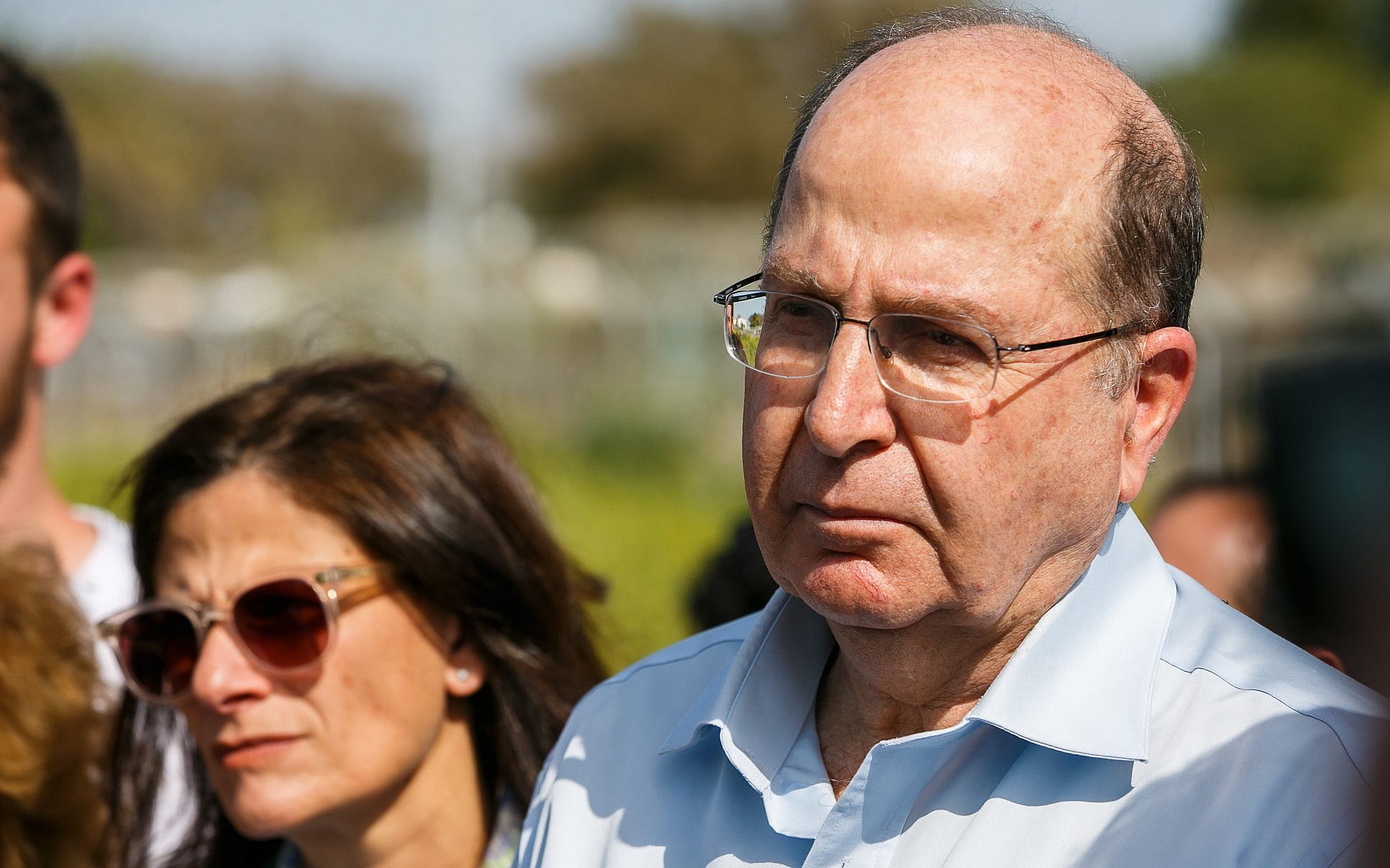
Meanwhile, former Israeli army chief and ex-defense minister Moshe Ya’alon told a Saudi news site that a blast in a large Hezbollah weapons depot at the port preceded the explosion of ammonium nitrate.

Blue and White’s Moshe Ya’alon is seen during a visit to the Gaza border
area with other members of the party on March 13, 2019. (Flash90)

Ya’alon, of the Yesh Atid-Telem party, was quoted by the Elaph Arabic website as saying Hezbollah had been aware of the material’s presence there and had control over the port.

He said Israel had warned Lebanon about Hezbollah’s weapons stores and stockpiling of dangerous materials in Beirut and elsewhere in the country. He added that it was up to the Lebanese people to choose independence or continued servitude to Iran through Hezbollah.

A view of the ammonia tank in Haifa on June 30, 2017. (Flash90)

The Channel 13 report also noted that Nasrallah, ina 2016 speech, threatened to fire missiles at an Israeli ammonia storage tank in the northern port city of Haifa. “Lebanon has a ‘nuclear bomb’ today,” Nasrallah said in the speech. “The idea is that some of our missiles, combined with the ammonia in Haifa, will create the effect of an atom bomb.” (The tank has since been emptied out.)

Prime Minister Benjamin Netanyahu addresses the General Assembly at the United Nations in New York September 27, 2018, and holds up a placard detailing alleged Hezbollah missile sites in Beirut. (AFP / TIMOTHY A. CLARY)

And it also cited a speech by Israeli Prime Minister Benjamin Netanyahu to the UN General Assembly in 2018, in which Netanyahu accused Hezbollah of storing missiles and other weapons in civilian areas. The prime minister alleged that one such site was “on the water’s edge” in Beirut.

Preliminary evidence released by Lebanese officials indicates that the explosion was connected to 2,750 metric tons of highly explosive ammonium nitrate which was left unsupervised in the port for almost six years. Documents allege that customs officials asked to move the vast trove numerous times but never received a reply.

In May, Israel’s Channel 12 reported that the Jewish state carried out a months-long delicate operation to assess Hezbollah’s operations in Germany and presented its findings to German intelligence and law agencies. Mossad reportedly gave Germany information about warehouses in the south of the country where Hezbollah stashed hundreds of kilograms of ammonium nitrate. Israeli intelligence was also said to have handed over details of key individuals in Hezbollah’s operations in Germany.

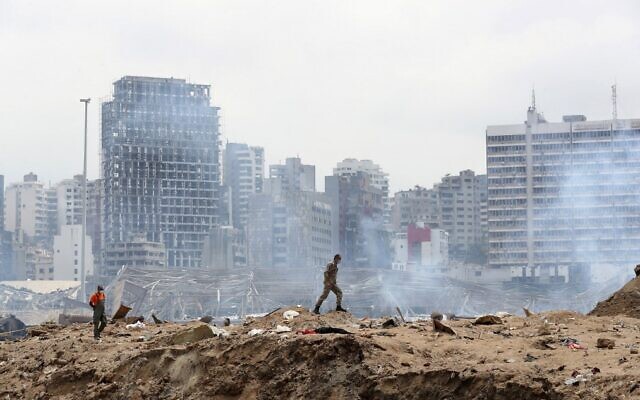
A soldier walks at the site of the massive explosion at the port of Beirut, August 6, 2020. (Thibault Camus/Pool/AFP)

The Friday Channel 13 report speculated that Nasrallah is fearful of an international probe of this week’s blast, possibly out of concern that Hezbollah might be implicated.

Supporters of Hezbollah terror group leader Hassan Nasrallah chant slogans ahead of his televised speech in a southern suburb of Beirut, Lebanon, January 5, 2020. (Maya Alleruzzo/AP)

Amid rising tensions with Israel in recent weeks, Nasrallah had originally intended to address the country on Wednesday, but postponed his speech after Tuesday night’s port explosion sent the country reeling. So far 157 people have been confirmed dead and over 5,000 wounded. Around 300,000 Beirut residents were rendered homeless as the blast tore apart homes miles from the port.

Israel firmly denied initial speculation that it had anything to do with the explosion, has sent condolences, and offered medical aid. Senior Hezbollah officials, speaking on condition of anonymity to Lebanese media, have been equally insistent that neither Hezbollah nor Israel were involved.

(Times of Israel).

In rare joint stand, 6 Gulf Arab nations back extending UN arms embargo on Iran

0

Despite many disputes between its members, the Gulf Cooperation Council says it is ‘inappropriate’ to lift sanctions until Tehran ‘abandons its destabilizing activities in the region’.

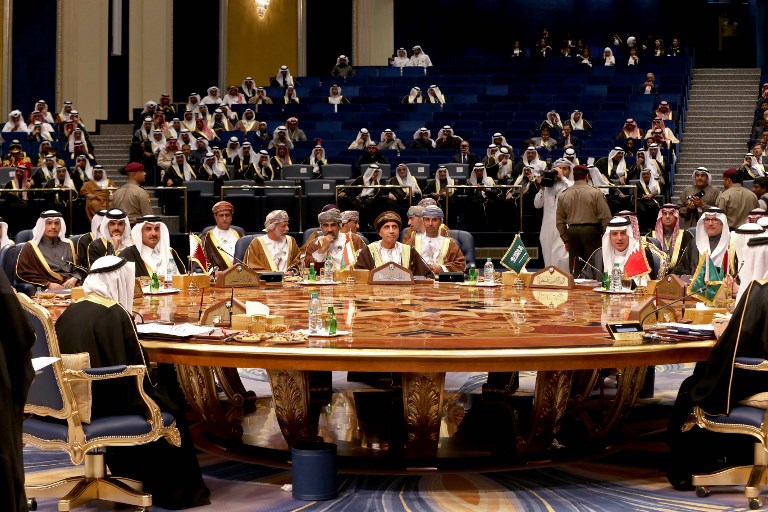
A six-nation bloc of Gulf Arab nations torn apart by internal strife endorsed an extension of a United Nations arms embargo on Iran on Sunday, just two months before it is set to expire.

The Gulf Cooperation Council (GCC) said it sent a letter to the UN Security Council backing an extension of an arms embargo that has kept Iran from purchasing foreign-made weapons like fighter jets, tanks and warships.

The GCC — comprised of Bahrain, Kuwait, Oman, Qatar, Saudi Arabia and the United Arab Emirates — asserted that Iran had “not ceased or desisted from armed interventions in neighboring countries, directly and through organizations and movements armed and trained by Iran.”

A Saudi-led coalition continues to battle Yemen’s Houthi rebels, whom the UN, the US and armament experts have accused of receiving arms from Iran. Tehran denies arming the Houthis, even as Iranian armaments and components have repeatedly turned up in Yemen.

“As such, it is inappropriate to lift the restrictions on conventional weapons’ movement to and from Iran until it abandons its destabilizing activities in the region and ceases to provide weapons to terrorist and sectarian organizations,” the GCC said.

Iran’s mission to the UN did not immediately respond to a request for comment on the GCC statement.

The UN banned Iran from buying major foreign weapon systems in 2010 amid tensions over its nuclear program. That blocked Iran from replacing its aging equipment, much of which had been purchased by the shah before the 1979 Islamic Revolution. An earlier embargo targeted Iranian arms exports.

Iran’s 2015 nuclear deal saw the UN agree to sunset the arms embargo this October. US President Donald Trump unilaterally withdrew his country from the deal in 2018, part of a maximum pressure campaign that has hurt Iran’s already ailing economy and led to a series of escalating incidents in the Middle East.

The GCC’s unified statement on Iran comes as the Council remains torn by the ongoing Qatar crisis, which saw Bahrain, Egypt, Saudi Arabia and the Emirates cut diplomatic ties and launch a boycott of the nation beginning in 2017. Kuwait has sought to mediate the crisis, though its 91-year-old emir now is hospitalized in the US suffering from an undisclosed ailment.

Amid the crisis, Qatar has had warmer ties with Iran and used its airspace while sharing a vast offshore oil and gas field with Tehran. The small nation is home to the massive Al-Udeid Air Base, home to the forward headquarters of the US military’s Central Command. Oman, which saw its long-serving sultan die earlier this year, long has had close ties to Iran and has served as an interlocutor between Tehran and the West.

Bahrain, Saudi Arabia and the Emirates long have viewed Iran far more suspiciously, accusing it of stirring up dissent among Shiite populations in the region.

The unified GCC statement comes after recent visits by outgoing US special representative for Iran Brian Hook amid the coronavirus pandemic.

(Times of Israel).

Israeli scientists discover earth’s magnetic field during destruction of First Temple

Magnetic measurements made by Israeli researchers reveal the immensity of the destruction of Jerusalem by the Babylonians.


Arutz Sheva Staff , 09/08/20 10:15


Every year on the 9th of Av (Tisha B’Av) Jews around the world remember the destruction of the First Temple. Now, thanks to the long historic memory of the Jewish People, and the archaeological findings that were discovered lately at City of David, researchers from Tel Aviv University, the Hebrew University and the Israel Antiquities Authority have been able to measure earth’s magnetic field in August of the year 586 BCE – revealing the immensity of the destruction of Jerusalem by the Babylonians.

This groundbreaking interdisciplinary study, published around the 9th of Av 2020 in the scientific journal PLOS ONE, is based on the PhD thesis of Yoav Vaknin from TAU’s Department of Archaeology, and was conducted in collaboration with Dr. Ron Shaar of the Hebrew University of Jerusalem, Prof. Erez Ben-Yosef, Prof. Oded Lipschits and Prof. Yuval Gadot of TAU’s Department of Archaeology and Dr. Yiftach Shalev of the Israel Antiquities Authority.

Fluctuations in the earth’s magnetic field have been defined by Albert Einstein as one of the five great mysteries of physics. The magnetic field that surrounds the earth is invisible, yet it plays an important role in the planet’s life. It serves as a screen that protects earth from radiation coming in from outer space, enabling life to develop and flourish, and is used as a navigation tool by humans, birds and marine mammals. Despite its importance, however, we know very little about earth’s magnetic field: How is it generated by the planet’s core? How and why does it fluctuate? And how do its fluctuations impact earth’s atmosphere?

To answer these questions and explain the magnetic field’s enigmatic behavior, geophysicists try to reconstruct its behavior during periods before direct measurements began. For this purpose they can use archaeological findings – such as pottery sherds, bricks, roof tiles and furnaces – that ‘recorded’ the magnetic field as they were burned. These findings contain magnetic minerals that were re-magnetized in accordance with the direction and magnitude of the field at that specific point in time– providing a window onto the history of earth’s magnetic field. The destruction of Jerusalem, dated 9th of Av 586 BCE, can serve as an exceptional chronological anchor for archaeomagnetic dating – accurate down to a single day.

In the process of an archaeological excavation currently conducted at the City of David National Park, at a place formerly known as the Givati parking lot, excavators found a grand public structure with a high-quality plaster floor. The directors of the excavation, Dr. Yiftah Shalev of the Israel Antiquities Authority and Prof. Yuval Gadot of Tel Aviv University, explain: “We dated the destruction of the structure to 586 BCE – the destruction of Jerusalem by the Babylonians, based on smashed pottery vessels typical of the end of the First Temple period, found on the floor. Apart from the broken utensils, we found signs of burning and large quantities of ashes. The findings are reminiscent of the 2nd Book of Kings chapter 25 verse 9: “And he burnt the house of the LORD, and the king’s house, and all the houses of Jerusalem, and every great man’s house burnt he with fire”. In this particular “important building” that burned down excavators found a large section of floor that had collapsed from the top story – and by measuring the magnetic field recorded in this fragment the researchers were able to reveal earth’s magnetic field at the time of the fire.

PhD student Yoav Vaknin of TAU sampled fragments of flooring scattered around the site and measured the magnetic field recorded in them at the Paleomagnetic Laboratory of the Institute of Earth Sciences at the Hebrew University. “The purpose of this study was twofold,” says Vaknin. “One goal was to rediscover the direction and magnitude of the magnetic field on the day of Jerusalem’s destruction. The other was to understand what the magnetic data recorded in the floor fragments can tell us about the destruction itself. Even without measuring the magnetic field we could assume that this grand building was destroyed in the event of the destruction of the First Temple, but the magnetic measurements proved that the building had been burned down, at a temperature higher than 932F, probably intentionally, and that the floor, supported by massive wooden beams, had collapsed during the fire.”

Vaknin adds: “We drew this conclusion from the fact that most of the floor’s fragments, cooling down after the collapse, recorded the same magnetic direction – regardless of their arbitrary position after falling from above. We were able to link the destruction of Jerusalem with the recording of earth’s magnetic field, thereby contributing to both geophysical and archaeological research. This is truly extraordinary. The archaeomagnetic method also has implications for future research. If we find a similar destruction layer with similar pottery at another site tomorrow, we will be able to compare the magnetic fields recorded at the two different sites, enabling us to determine whether the other site was also destroyed by the Babylonians.”

Dr. Ron Shaar of the Institute of Earth Sciences at the Hebrew University: “Measuring magnetic data from a floor burned thousands of years ago is no trivial matter. We had to characterize the magnetic particles, understand how the magnetic data was coded in the material, and develop measuring techniques enabling us to read this data. Nature hasn’t made life easy for us. Thus a significant part of the analytical work we do at the paleomagnetic lab is investigating the magnetic properties of the archaeological materials. Fortunately, in this particular study, Yoav was able to decipher nature’s magnetic code and give us important information from several angles: historic, archeological and geomagnetic.”

The destruction of the First Temple is corroborated by numerous archaeological findings from the Land of Israel in general and Jerusalem in particular, such as royal storage jars with rosette stamped handles and seals and seal impressions with names mentioned in the Biblical text.”


WP Twitter Auto Publish Powered By : XYZScripts.com