Home Blog Page 702

IDF evacuates civilian construction workers under fire from Gaza

0

The clash comes amid heightened tensions with Hamas along Israel’s southern border.


 Israel Defense Forces troops came under fire from the Gaza Strip on Sunday as they evacuated Israeli civilians contractors working on the security barrier along the border.

No casualties were reported during the incident.

Work was stopped at the border fence after the IDF received reports that the workers there had come under fire, the military said in a statement. According to the military, smoke rounds were launched to give the workers cover and an IDF force was dispatched to the area. When the troops arrived, they were also fired upon, said the statment.

The attack comes amid heightened tensions along the Israel-Gaza border, with balloons containing suspected explosives and incendiary devices launched into southern Israel on Thursday. The IDF responded by targeting “underground infrastructure belonging to the Hamas terror group in the northern Gaza Strip.”

“The State of Israel won’t accept any violation of its sovereignty or harm to residents of the south,” Israeli Defense Minister Benny Gantz tweeted on Thursday. “If the terror organizations still don’t understand, whoever tests Israel will be hit hard.”

North Carolina, Virginia rocked by most powerful earthquake in region since 1916

0
John Bacon            USA TODAY

A magnitude 5.1 earthquake along North Carolina’s border with Virginia on Sunday shook homes and rattled dishes as far away as Atlanta.

No serious damage or injuries were immediately reported.

The U.S. Geological Survey said the quake was the strongest to rock the region since a magnitude 5.2 quake in 1916. Sunday’s temblor which struck at 8:07 a.m., was centered just southeast of Sparta, North Carolina, about 100 miles north of Charlotte.

“It felt like a big locomotive going by and a big wave coming underneath the bed,” said Sparta Mayor Wes Brinegar told CNN. “A big wave coming to lift you. … I’ve lived here my whole life and have never felt anything like that.”

Brinegar said some foundations apparently cracked and books were knocked off shelves. More than 100 miles to the south in Stanley, Gary Hooper was sitting on my couch when the temblor hit.

“I felt the couch move and then all of a sudden it just shook the whole house for four or five seconds, although at the time it felt like it was much longer,” Hooper said. “I thought it was a tree falling.”

The quake shook residents out of their beds and drew a crowd to social media.

“OMG!!! We experienced an earthquake in Charlotte, NC this morning!!! Our whole house shook!!!” tweeted DJHiPrayzeRadio. “We are okay. There is no damage that we can detect!!!”

Bill Griesmyer, an engineer in Charlotte, said the quake was strong enough to drive people out of their homes.

“Not a big one but shook the house and brought the neighbors out in their yards to see what happened,” he said.

In Atlanta, Aisha Howard tweeted that “I know I’ve been awake since 430am but I’m pretty sure my apartment just shook in midtown ATL. I might need to get some rest”

Contributing: Kevin Ellis, Gaston Gazette

Dr. Mindy Boxer – Eastern vs. Western: How the Medical Practices Differ


Almost everybody knows there are two very unique ways of treating disease and maintaining health. But not everybody knows how these two methodologies differ from one another. And depending on where you live in the world, there may be one that is more prominent than the other. Both systems have their pros and cons. So let’s differentiate between the two. This is the battle between Eastern and Western medicine.  Let’s get ready to rumble!

To begin, we have to look at the history of both systems. Eastern medicine has been around for nearly 5,000 years and began when ancient herbalists experimented with plant substances and their effects on humans. There are substances that have been found to enhance health, beauty, energetics of the body, and the mind. Western medicine has only been around, in its current form, since the 19th century, although the roots began in ancient Greece and Egypt. It wasn’t until World War II that the development of synthetic drugs really began. This is also when the current Western medical system discovered it can manipulate certain actions in the human body through the use of synthetic pharmaceuticals. This difference is huge, as Eastern philosophy uses whole food formulas to nourish the body’s ability to heal itself, while Western philosophy isolates and forces therapeutic actions throughout the body by utilizing laboratory modified medicines.        

Next, we compare the examination methods. Eastern medicine is much more holistic in this regard, as it takes every aspect of the body into account. Because the body cannot be compartmentalized based upon the disease, it makes sense to consider how each bodily system is affecting the others. Eastern medicine does not evaluate an illness purely based on the symptoms a person is showing, but rather, on complex patterns of disharmony in the body.

The process of determining a person’s diagnosis begins with an evaluation according to the Eight Principles, which describe the basic qualities of a disease – Yin/Yang, Interior/Exterior, Hot/Cold, Deficient/Excess.

Western medicine compartmentalizes a person’s diagnosis, looking at each system individually rather than how they work together. This could be why there are more specialists in Western medicine, such as a psychiatrist, an endocrinologist or an orthopedic surgeon. Also, Eastern medicine practitioners are trained to listen with the whole body and pay attention to every ounce of sensory input.  This is quite different from Western medicine, where the focus is generally only on the system affected. Because of this way of thinking, pharmaceuticals and surgical procedures are based on how they affect each individual organ or organ system, instead of considering how the systems are intertwined with one another.

Another difference is the ultimate goals of each medical system. As Western medicine is all about fixing the physical body, the mind is also considered an organ, the brain. If the body is missing a substance, the Western medical approach is to supply that substance.  And while things like nutrients may be necessary to be supplemented sometimes, most man-made pharmaceuticals have far too many adverse side-effects.

The Eastern medical approach is to engage and support the body’s own self-healing mechanisms. This is done by balancing the energetics of the body and ridding the body of energetic blockages. If the body is missing a substance, the Eastern approach is to stimulate the body to create it, thus allowing the body to heal itself. However, when the body is severely compromised, as with trauma and severe illness, the body is undermined and the capacity to heal itself may be impossible.  

Obviously, there are several differences between the two medical systems. But if the two can work together, then humans will be ultimately better off. However, since Western medicine focuses so heavily on physical proof and Eastern medicine is more subtle focusing on the energetics of the body, the two systems have a long way to go until meeting eye-to-eye and working alongside one another. In the meantime, it is the decision of the patient to decide which route he or she will take. But it should be noted that the two systems can and do work very well together.

This article was posted in AcupunctureTraditional Chinese Medicine and tagged .

Mindy Boxer is a holistic practitioner who has grown into her specialties in an organic way. Understanding a range of disciplines allows her to integrate the wisdom of Ancient healing in combination with the most recent innovations in Scientific research. This dynamic blend has enabled Dr. Boxer to help patients in the prevention and treatment of disease for over 25 years.

Dr. Boxer has a particularly keen understanding of Women’s Health issues including Gynecological irregularity, PMS, Fertility, IUI & UVF support, Healthy Pregnancy & Delivery, and Menopausal issues. Her interest in the human body as a dynamic system has given her the understanding to deal with such problems as improper Digestion and elimination, Cancer Support, Allergies, back pain, tight neck and shoulders, carpal tunnel syndrome, respiratory distress, chronic fatigue, Insomnia, Stress, Anxiety and Depression.She has also studied the art and science of Homeopathy, earning her Diplomate in Homeopathy from the Hahnemann College of Homeopathy in 1995. This allows her to treat the whole person — physically, mentally, emotionally.Proper Nutrition, Herbs, Acupuncture, and Homeopathic remedies are the tools Dr. Boxer utilizes to allow the body to heal itself and find its way back to balance. She is dedicated to helping her patients find “Radiant Health and Well-Being.”

Video-Conferencing & Phone Consultations available.   Be safe,    Stay Healthy.

Phyllis Shallman – How to be a Lifelong Learner

0

Are you stagnating?

Have you fallen into a rut of living the same day over and over again, rehashing the same information and thinking the same thoughts? Maybe you’re bored and looking for adventure or intellectual stimulation. It turns out that there are actually a few things you can do to consistently push your mental capacities and become a lifelong learner!

Read daily
Good writing is magical. It can transport us to distant lands and introduce us to incredible worlds and characters. But reading can also transform our minds, especially when we encounter new and challenging ideas. We’re able to overcome the limitations of our own imaginations and experiences and see the world through someone else’s eyes.

Surveys have shown that almost all successful people, regardless of their backgrounds, read extensively.(1) And it’s no wonder; the ability to assume appreciate perspective is incredibly powerful. But what should you be reading?

Expand your horizons
Not all reading is created equal. Romance novels about vampires and werewolves might count as brain “junk food”. It also might be best to avoid a 19th-century philosophical treatise right out of the gate!

Instead, explore entry-level books about topics you don’t know a lot about. Dip your toe into new subjects and see if they spark your interest! You can always move to more advanced work on the subject from there. On the other hand, you can find new opinions and perspectives on topics that you’ve already mastered. How is your field changing or evolving?

Conversation is another great way to encounter new ideas. Chances are that you’re surrounded by vast amounts of knowledge sitting untapped inside your friends and family. You just need to know how to extract it! The keys are to listen seriously and ask real questions based on what you’ve heard. Most of us are more consumed with what we’re going to say next than with what the other person is saying. Honing in on what you’re hearing and trying to develop questions as you listen helps you understand what they’re saying and fuels your curiosity. It’s a virtuous cycle where everyone benefits!

Focus intensely
But the key to both of these lifelong learning strategies is to focus intensely. That means when you’re reading or taking a class, turn off your phone and absorb what’s right before you. Engage in conversation intentionally, asking real questions based on what the other person is saying. You might be surprised how tricky both of those things can be at first! But stick with it. Those learning muscles will grow stronger and stronger until you’re brimming with information!

One final tip: always ask why. Don’t just ponder something to yourself. Ask someone who might possibly have an answer! And don’t be vague. Be as precise and specific as possible when you ask your question. The best thing about learning is that you can potentially keep learning forever! Learn to love the process of learning, and you might be amazed by how far your brain power can go.

(1) https://www.businessinsider.com/rich-people-like-to-read-2015-8

President Trump orders $400 / week unemployment payments amid COVID crisis, hits Dems for stonewalling

0

Trump takes action after congressional stalemate.

President Trump signed four executive actions Saturday aimed at delivering relief to Americans struggling with the economic fallout of the coronavirus pandemic while
accusing Democrats of stonewalling greater aid efforts.

Trump announced a $400-per-week supplemental unemployment payment to
out-of-work Americans — short of the $600 weekly benefit that expired at the
end of July. He unveiled an extension of student loan relief and protections from
evictions for renters and homeowners.

Trump also issued a payroll tax holiday through the end of the year for Americans
earning less than $100,000, while promising more relief if he wins a second term.

The president signed the executive actions from his Trump National Golf Club in Bedminster, N.J., as club members cheered him on. He blamed Democrats for the coronavirus stalemate in Congress and said he’d take matters into his own hands.

“Democrats are obstructing all of it,” Trump said. “Therefore, I’m taking executive
action … and we’re going to save American jobs and provide relief to the American workers.”

For the new $400-per-week benefit, states would be on the hook for funding 25 percent
for the millions of jobless Americans, while the federal government would pick up 75 percent of the benefit, Trump said. Asked when the jobless would see the money,
Trump said it would be “rapidly distributed.”

The $400 boost is more than what many congressional Republicans wanted. Some opposed any extension of the federal aid, while others backed a boost no greater than $200 per week. Meanwhile, Democrats had been fighting for the full $600-per-week extension, which is on top of state unemployment benefits.

House Speaker Nancy Pelosi, D-Calif., and Sen. Chuck Schumer, D-N.Y., dismissed Trump’s “meager” actions and slammed the president for signing them from his Bedminster club.

“Today’s meager announcements by the president show President Trump still does not comprehend the seriousness or the urgency of the health and economic crises facing working families,” Pelosi and Schumer said in a joint statement Saturday. “We’re disappointed that instead of putting in the work to solve Americans’ problems, the President instead chose to stay on his luxury golf course to announce unworkable,
weak and narrow policy announcements to slash the unemployment benefits that
millions desperately need and endanger seniors’ Social Security and Medicare.”

Trump has long wanted a holiday on payroll taxes, which help fund Social Security and Medicare. But congressional Republicans have not fought for the provision because of
how much the suspension on tax collection could drive up an already staggering debt.

Acting unilaterally could prompt legal challenges. Since Congress controls new federal spending, Trump already predicted sidestepping lawmakers could have lawsuit consequences. But he dared opponents to deprive Americans of relief.

“If we get sued, it’s [from] somebody that doesn’t want people to get money,” Trump
said. “And that’s not going to be a very popular thing.”

Sen. Ron Wyden, D-Ore., said Trump’s payroll tax holiday could drain the Social Security trust fund and said some states cannot afford the 25 percent unemployment match, especially since the GOP has opposed additional money to state and local governments.

But Sen. Chuck Grassley, R-Iowa, said he supports Trump’s unilateral actions.

“I applaud @realDonaldTrump executive actions to help the American [people],” Grassley, the top Republican on the Senate Finance Committee, tweeted. “Democrats all or nothing strategy jeopardizes the certainty Americans need to pay their bills. [President] Trump puts the American [people] first, compared to nonstop political games by Democrats.”

House Democrats already passed their $3 trillion coronavirus relief bill in May. The Senate GOP last month proposed a $1 trillion plan, though didn’t bring the measure to a vote as Republicans were divided on whether more aid is even needed.

Pelosi and Schumer have been in talks all week with White House Chief of Staff Mark Meadows and Treasury Secretary Steven Mnuchin, but the two sides couldn’t strike a deal.

Democrats blamed the GOP for failing to understand the gravity of the crisis and for trying to “nickel and dime” struggling Americans, while the White House accused Democrats of not being willing to compromise.

Trump blasted the Democrats’ $3 trillion HEROES Act as a “radical left policy” that includes bailouts to states, sending stimulus help to undocumented immigrants, and funding for mail-in voting and other election provisions.

“They want to steal the election,” Trump said of Democrats.

Trump’s orders are narrower in scope than the trillions Congress is mulling for a massive stimulus to the virus-damaged economy.

The president didn’t address some of the big issues that congressional proposals sought to tackle, including another round of $1,200 stimulus checks, aid to schools to reopen safely, an infusion of cash to revenue-strapped state and local governments, food assistance, new lawsuit protections for businesses and money for mail-in voting for the 2020 elections.

Because of provisions in the Constitution that grant the legislative branch spending power, the White House can’t just pull hundreds of billions out of the ether without Congressional approval.

But the Trump administration believes it has access to $140 billion which it can “reprogram.” That includes $80 billion in untapped money from the big coronavirus bill signed into law in March and roughly $40 billion from the Disaster Relief Fund.

Trump’s executive order indicated he would use “up to $44 billion from the DRF” to
cover the federal government’s 75 percent share of the $400 weekly unemployment aid.

The White House believes it can divert the funding, similar to how Trump in 2019
declared a national emergency at the border with Mexico to shift billions of dollars
from the Pentagon budget to help pay for a border wall.

Carl Tobias, a law professor at the University of Richmond School of Law, said Trump may have some legal authority to defer payroll taxes and student loan repayments as well as extending housing assistance. But the $400 unemployment payments are a different story.

“The unemployment benefits are less clear because the Constitution gives Congress authority to spend money,” Tobias told Fox News. “[The president] may try to move around other money appropriated like Trump did with the wall. It is unclear that lawsuits could be resolved in time to stop some of his efforts.”

Democrats want the White House to continue negotiating with Congress on a big package.

“Democrats repeat our call to Republicans to return to the table, meet us halfway and work together to deliver immediate relief to the American people,” Schumer and Pelosi said Saturday. “Lives are being lost, and time is of the essence.”

No votes are expected in the House until the week of Sept. 14 unless both parties can reach a deal on a coronavirus stimulus package.

The need for relief is pressing as millions of Americans lost the $600-per-week federal unemployment benefit that expired at the end of July. A partial moratorium on evictions on properties with government-backed mortgages also expired at the end of last month.

There are about 110 million Americans living in rental households; up to 23 million renters – or 20 percent – are at risk of eviction by Sept. 30, according to an analysis by the COVID-19 Eviction Defense Project.

With the supplemental $600 in unemployment benefits now officially lapsed, about 24 million Americans say they have little to no chance of being able to pay next month’s rent, according to a survey by the U.S. Census Bureau.

Rent and mortgage payments are typically the largest monthly expense for Americans: 1 in 4 tenant families pays more than half of its income for rent, a rate that’s even higher in cities like San Francisco and New York, according to Harvard’s Joint Center for Housing Studies.

New jobless figures from the Labor Department, which cover the week ending August 1, show that more than 1.18 million workers sought aid last week, the lowest since March 14. The latest figures bring the total accumulated number of unemployment claims since the shutdown began to more than 55 million.

The unemployment rate has decreased to 10.2%, down from 11.1% in June.

(Fox News).

Revised California ethnic-studies curriculum draft ‘deeply problematic,’ still ‘exclusionary’

0

“The materials fail to adequately discuss anti-Semitism—and characterize American Jews only in the context of how some have secured white privilege, which is misleading and erases the experience of a significant part of our community, including Middle Eastern and North African Jews, as well of other Jews of Color,” said Sarah Levin, executive director of JIMENA.

California’s Department of Education released its recommendations to revise the state’s proposed ethnic-studies model curriculum at the end of July, as the original draft curriculum had come under fire for containing anti-Semitic and anti-Israel content, in addition to not addressing issues of anti-Semitism or including Jewish Americans.

Sarah Levin, executive director of JIMENA: Jews Indigenous to the Middle East and North Africa, said in a statement that while CDE’s new version “is an improvement over past versions, some of the supplemental materials that have been included are deeply problematic and exclusionary.”

“These supplemental materials ignore the stories of all our coalition members—who together represent an estimated 60 [percent] of Californians who hail from the Middle East and North Africa—while portraying the Arab American experience as a monolith to represent the region,” she continued.

“The materials fail to adequately discuss anti-Semitism—and characterize American Jews only in the context of how some have secured white privilege, which is misleading and erases the experience of a significant part of our community, including Middle Eastern and North African Jews, as well of other Jews of Color.”

In response to outrage at the draft, Newsom apologized to California’s Jewish community, vowing that it “will never see the light of day” and be substantially revised.

The latest revised CDE draft recommends the curriculum focus on “African American Studies, Chicana/o/x and Latina/o/x Studies, Asian American and Pacific Islander Studies, and Native American and Indigenous Studies,” though there are subtle differences such as noting that Arab Studies and others are to be considered as Asian Studies.

“The use of these four groups as an umbrella for a myriad of ethnically and culturally diverse representations was replicated when courses in ethnic studies were developed at the high school level,” said CDE. “It is important to note that there are groups that are sometimes addressed under the broadly defined umbrella of those core groups. For example, Arab Americans and Pacific Islanders have often been covered within the study of Asian American Studies.”

The CDE calls for content that calls out capitalism as a form of oppression, and highlights movements for study that were started and run by Socialists and Marxists, such as the Third World Liberation Front and the Black Lives Matter movement, which hold anti-Israel views.

Removes references to BDS movement

Regarding Jewish concerns, the new CDE draft has removed the glossary where BDS had been defined as a “liberation movement,” in addition to the full sections on Pacific Islanders and Arab-Americans that contained anti-Israel pejoratives.

Also removed is a University of California “A-G” course on Muslims and Arab Americans that included teaching about Islam, including its five pillars of faith, and about the “political and social turmoil between Palestine and Israel.” CDE explained that it was removed for technical reasons: “This course outline has significant problems with the resource links which rendered it unusable. Of the 86 total hyperlinks, 34 do not work, 2 have potential copyright issues, and 7 are behind a paywall or require a purchase to access.”

However, CDE added a UC a-g pre-approved course ostensibly taught in a charter school in the California town of Eureka that has a unit on Jewish Americans that seeks to examine the differences between them and Irish Americans, and what it means to be either in the 21st century. An a-g course is a high school course requirement students must take to be admitted to the University of California (UC) and California State University (CSU).

The unit seeks to “discuss parallels between language used to describe?Irish and Jewish immigrants to those used in the early years of the United?States to describe Native Americans. Students will investigate labor disputes and how they were ended and how that relates to the redefining of white. Posing questions on who gets to decide those that get to join the ‘club’ and why.”

Additionally, “students will write a paper detailing certain events in American history that have led to Jewish and Irish Americans gaining racial privilege. They will be asked to think critically about why and who is allowing this evolution?in white identity and how this shift is affecting the identity of Irish and Jewish Americans.”

CDE kept a UC a-g approved section on teaching about the Nation of Islam, and its philosophy and expansion. The course recommends students watch the Mike Wallace documentary about NOI titled “The Hate That Hate Produced.”

The Nation of Islam “has maintained a consistent record of anti-Semitism and racism since its founding in the 1930s,” according to the Anti-Defamation League.

Although CDE stated that ethnic-studies courses “address race within the context of how white dominated culture impacts racism and other forms of bigotry, including anti-Semitism and Islamophobia,” it does not define or provide content about either.

Moreover, in one UC a-g pre-approved course is a recommended resource edited by San Francisco State University professor Rabab Abdulhadi, University of Southern California associate professor Evelyn Alsultany and University of Illinois at Chicago professor Nadine Naber—all of whom have a history of anti-Israel activism. The book is titled Arab & Arab American Feminisms: Gender, Violence, & Belonging.

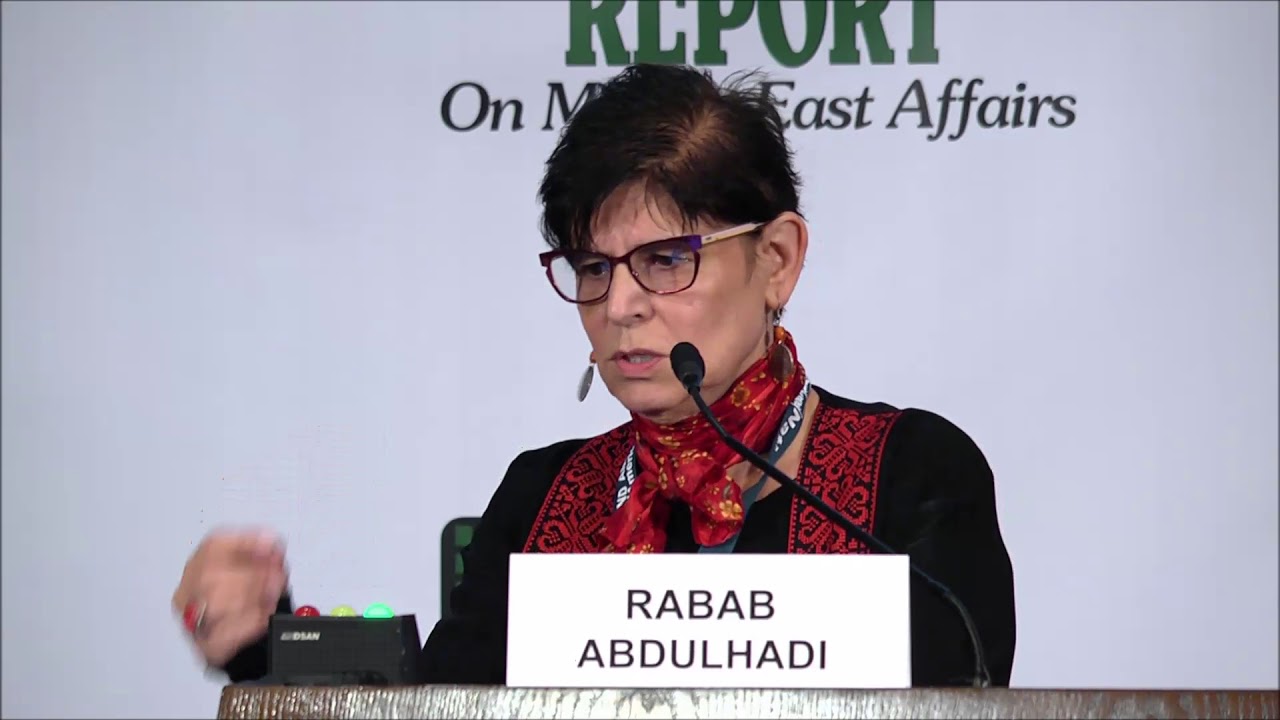
San Francisco State University professor Rabab Abdulhadi. Source: YouTube.

AMCHA Initiative director Tammi Rossman-Benjamin said that “the curriculum remains incredibly problematic and concerning.”

“The ethnic-studies movement, known as ‘critical ethnic studies,’ which is what this curriculum is a product of, is based on an ‘us vs them’ model,” she told JNS. “It views Jews as white and privileged, and not part of the ‘us,’ and is blatantly anti-Zionist.”

Rossman-Benjamin went on to say that “the goal of ‘critical ethnic studies’ is not to educate, but to indoctrinate students into adopting certain political views and engaging in specific forms of political activism, including those that vilify and harm Jewish students. Even more concerning is that right now, a California bill is moving through the legislature that will require all California high school students to take one of these classes, which, given that there are no safeguards against it, could easily become political and divisive at the sole discretion of the teacher.”

She called on California Gov. Gavin Newsom to not sign AB-331 into law “until safeguards are put into place to ensure any ethnic-studies required classes be based on pedagogically sound principles, not ones that push a specific political agenda and could easily lead to ethnic bigotry, including anti-Semitism.”

Ethnic studies to become required material for some

Despite the release of the revised curriculum, in recent months more than a dozen California school boards have adopted resolutions in support of the previously proposed ethnic-studies model curriculum.

As local school boards debate the issues regarding the ethnic-studies curriculum, bills in the California Assembly is being pushed forward that would require ethnic studies as a graduation requirement for high schools and California State University, known as AB-331 and AB-1460, respectively.

The California State Capitol in Sacramento. Credit: Wikimedia Commons.

AB-331 is a bill that, if passed, would require ethnic studies as a California high school graduation requirement, starting with the 2024-25 school year, “based on” the ethnic-studies model curriculum developed by the state.

It was introduced in the Spring of 2019 by Assembly Member Jose Medina, a Democrat who chairs the Assembly Higher Education Committee and is a member of the California Legislative Jewish Caucus.

AB-1460 is a bill that would require California State University students, starting with the 2021–22 school year, to take an ethnic studies course in order to graduate.

Several members of the Academic Engagement Network penned an open letter in opposition to AB-1460 that has gotten more than 100 signatures from faculty across the CSU campuses.

StandWithUs co-founder and CEO Roz Rothstein told JNS that while her group appreciates CDE “for taking out content that was explicitly anti-Israel and antisemitic, and including new guidelines to promote critical thinking,” at the same time, the proposed curriculum “still has significant flaws that must be fixed.”

The Instructional Quality Commission (IQC), which is an advisory board to CDE and other state and education boards, will review and revise the draft and post it online on Aug. 13 for a 30-day period of public review and comment ending on Sept. 30.

In November, the IQC will consider revisions and direct submission of the resulting curriculum to California’s State Board of Education following a 45-day period. The SBE is expected to take action on the proposed curriculum on March 17–18, 2021.

(JNS).

Likud, Blue and White scotch cabinet meeting, trade barbs as impasse deepens

0

Move comes after sides refuse to agree on agenda for weekly summit, marking new low for crumbling coalition as parties remain split over budget.

Israel’s ruling coalition appeared to slide closer to dissolution Saturday night as both the Likud and Blue and White factions announced that there would be no cabinet meeting Sunday, casting blame on each other for the impasse.

The extraordinary announcement brought a growing coalition crisis into sharp relief, as both parties appeared to dig in their heels amid rampant speculation that fresh elections could be around the corner over an intensifying budget brawl .

In a statement, Likud accused Blue and White of refusing to okay an agenda item on a proposal for a NIS 8.5 billion ($2.5 billion) coronavirus assistance program.

“The cabinet meeting will not convene tomorrow due to Blue and White’s refusals to put on the agenda a government economic assistance plan, by the prime minister and finance minister” the party said.

“The plan will create around 10,000 new jobs in the economy,” it added. “Likud demands from Blue and White to not prevent the transfer of funds to the citizens of Israel at this time, when it is coping with the coronavirus crisis.”

Israelis wear protective face masks in Tel Aviv on August 4, 2020. (Miriam Alster/Flash90)

Blue and White responded by charging that the meeting was called off “due to Likud’s insistence on not adhering to the coalition agreement.”

“This is not the first time Likud has not stood by its commitments, and every other excuse is a complete lie to the Israeli public,” it said.

It described the proposal of the assistance plan as a smokescreen, saying it had not yet been finalized.

The main bone of contention between the parties has been a dispute over the budget, sparking feverish speculation that Israel could be headed to its fourth election in under two years.

The government has until August 25 to approve a budget or it will automatically dissolve. Netanyahu and Gantz agreed to pass a budget through 2021 as part of the coalition deal between their parties, but the premier is calling for a budget that only covers the rest of 2020, citing the uncertainty caused by the coronavirus pandemic. Gantz on the other hand is insisting on a budget that runs through next year.

In an interview aired Saturday, Gantz stuck to his guns, saying he would not drop his demand for a budget that runs through 2021.

“To stabilize the government, a plan is needed for 2020-2021. Not a budget for the holidays or [for a] weekend, a budget for a full year,” he told Channel 12 news. “I won’t concede.”

While Netanyahu has to hand over the premiership to Gantz if he calls new elections before the Blue and White chief takes over as prime minister in November 2021, the coalition deal made an exception for a failure to pass a budget, leading to speculation the Likud leader was forcing the budget crisis to avoid having to leave office.

Gantz and Netanyahu agreed on a power-sharing deal in May after three consecutive rounds of elections proved indecisive. The deal split Blue and White, due to the party’s campaign pledge not to join a government led by the premier because of the graft charges against him.

According to a Channel 12 news report Tuesday, Netanyahu is offering to funnel hundreds of millions of shekels to yeshivas outside of the budget framework to reduce opposition by the ultra-Orthodox Shas and United Torah Judaism parties to breaking up the government and calling elections.

Prime Minister Benjamin Netanyahu, left, with Shas party chairman Interior Minister Aryeh Deri, March 4, 2020. (Yonatan Sindel/Flash90)

The network said that ultra-Orthodox objections to elections are based on concerns that it would further delay the budget — and with it money for the yeshivas.

Both Shas and UTJ backed Netanyahu for prime minister through the elections over the past year, but have threatened to ditch their alliance with the premier if disagreements over the budget lead to new elections, the Kan public broadcaster reported Tuesday.

(Times of Israel).

Turning the page on a different kind of Bar Mitzvah learning

0

A rabbi has honed a method of teaching Hebrew reading, which
he has now coalesced into a formal training program and book.

When Marina and Vladimir Druskin of Boston began planning for their son Mark’s bar mitzvah, they knew who their ideal Torah teacher would be. The only problem was that their go-to educator, Rabbi Levi Lipinski, had relocated and was no longer available for in-person classes.

“It was upsetting because they had such a good bond. Plus, the rabbi has his own Torah-training program, and so when Rabbi Levi said he can still train him, we decided to try it over Skype,” said Marina Druskin. “Mark loved it. He doesn’t want to study with anyone. He is singing the Torah, and I love it.”

Learning to read the Torah portion online is never easy, even during a pandemic lockdown with not much else for kids to do.

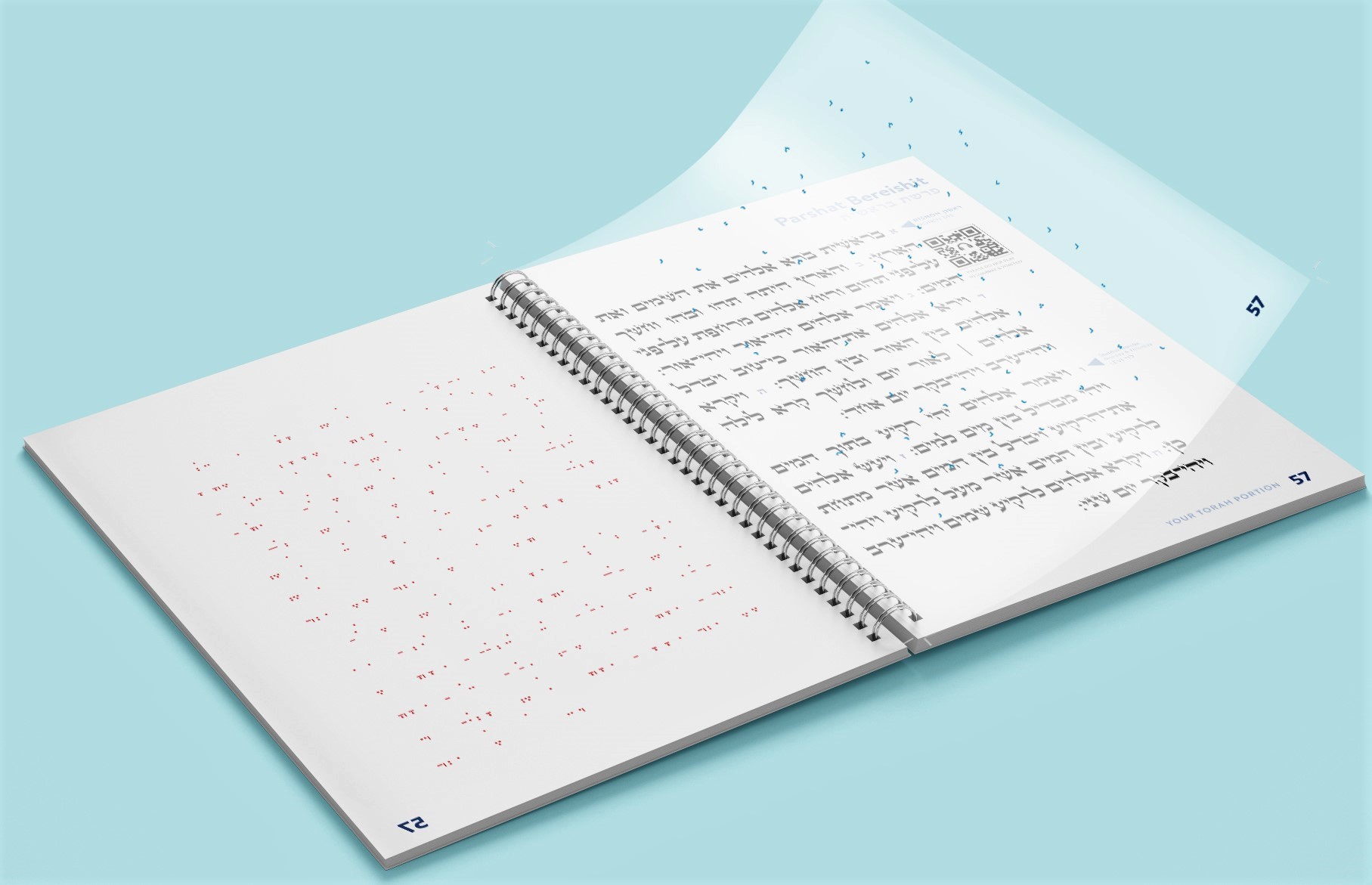
What sets Lipinski—a Chabad rabbi, educator and father of four who lives outside of Philadelphia—apart is his specific method for teaching boys how to read. It’s one that he has honed over years of bar mitzvah training, which he has now coalesced into a formal training program and book.

“In my design, everything is in one column. The cantillations and vowels are on a paper film that sits over the Torah print, and as the child moves forward with their learning, they can remove the layers of film,” said Lipinski, who is originally from Argentina.

Also, while many Jewish schools, be they day school or supplemental school, teach Hebrew reading, educators must also balance other subjects, including Jewish holidays, mitzvahs and more, in their limited school hours and may not have time to give students individual attention to help them perfect their Hebrew reading ability. That leaves some youngsters with limited proficiency, and as they approach their bar mitzvah service, they simply memorize the portion without mastering kriyah, or Hebrew reading.

Torah trainer and Hebrew reading using the “Tikkun L’Korim” book. Credit: Courtesy.

‘More communication and support’

Lipinski said his goal is to give his students the tools they need so that they feel confident whenever they choose to read from the Torah scroll, even if the next time they read is many years post-bar mitzvah.

Since the coronavirus started to spread worldwide, in addition to teaching kids who live in his area via Zoom, Lipinski is also teaching  Torah reading to students in New York, Israel and elsewhere.

“There are challenges to stay-at-home Torah training,” he acknowledged. “Some kids don’t have a quiet place where they can learn, some are suffering from a lack of social life, and over the computer it’s hard to see how students are feeling. It requires me to think ahead, and offer more communication and support. My goal is to make it as enjoyable as possible, so that they are capable and successful.”

Though their son Ari’s bar mitzvah took place before the pandemic started, Michi and Skip Pasternak were glad their rabbi referred them to Lipinski and his Torah-training method.

“The first day, I felt Ari couldn’t sit still for a lesson, but Lipinski is very good with kids. He knows what he is doing,” said Michi Pasternak. Noting that her son is very musical, Pasternak said sometimes the rabbi would teach him the reading using the piano as a complementary tool. “There was a lot of understanding in that; he has a way of teaching that kids just get.”

As for continuing to read Torah after his bar mitzvah back in December, Pasternak said her son continues to do so during prayer services at his Jewish high school.

And for Ari, who is entering eighth grade, the classes proved a real learning experience. The rabbi, he said, “would always answer my question. Even though I didn’t want to hear the whole answer, he’d answer the whole thing.”

(JNS).

NAACP refuses to fire anti-Semitic branch president in Philadelphia

0

NAACP said Rodney Muhammad, who recently promoted an anti-Semitic conspiracy online, will meet with community leaders to
“open a dialogue.”

The national leadership of the National Association for the Advancement of Colored
People (NAACP) rebuked the president of its Philadelphia branch, Rodney Muhammad,
but refused to fire him for sharing an anti-Semitic meme a couple weeks ago in defense
of black celebrities who have come under fire lately for anti-Semitism.

The NAACP’s leadership was “saddened and deeply disappointed by the harm caused by Mr. Muhammad’s actions” and believed that Muhammad “now recognizes the offensive nature of the imagery and post,” NAACP spokesperson Austyn Ross told The Philadelphia Tribune on Wednesday.

“Hate speech has no place at the NAACP, and such language and imagery are reprehensible,” said Ross, who added that NAACP president Derrick Johnson and Muhammad will meet with faith and community leaders in the coming weeks to “open
a dialogue and continue the educational conversations.”

Meanwhile, the Jewish Federation of Greater Philadelphia said on Aug. 2 that it will no longer work with the Philadelphia NAACP as long as Muhammad is there.

“While Mr. Muhammad still has yet to fully apologize for his most recent actions, an examination of the social-media channels maintained by him and the mosque he leads shows an alarming amount of bigoted and anti-Jewish sentiments,” said the Federation
in a statement.

“While we are willing to engage in dialogue with NAACP national president Derrick
Johnson, the Pennsylvania Conference and other local NAACP chapters, our obligation
to oppose hate and discrimination will prevent us from working with the Philadelphia chapter while Mr. Muhammad is employed there.”

In his second official statement since the backlash began, Muhammad said on July 30, “I do regret the insult, pain and offense it caused to all, particularly those of the Jewish community by this unfortunate episode. Our aim now is to engage in thoughtful, meaningful and we hope productive dialogue between our communities.”

‘They use it as a trick’

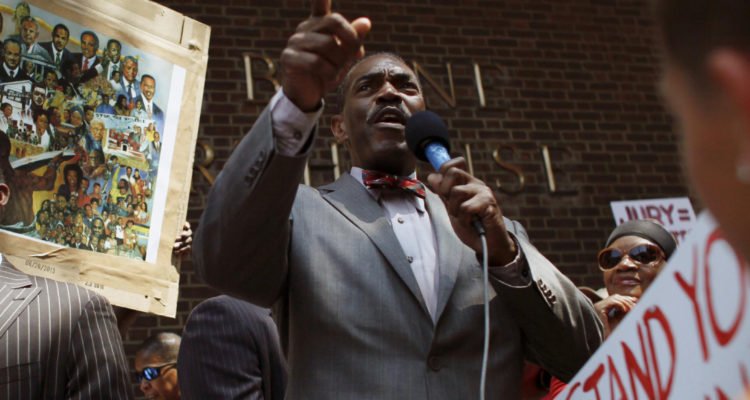
On his Facebook page, Rodney Muhammad shared the meme, which has pictures of
rapper Ice Cube, Philadelphia Eagles wide receiver DeSean Jackson, and actor/rapper/TV host Nick Cannon—all of whom have lately been accused of anti-Semitism and/or posting anti-Semitic rhetoric—with a caricature below of a Jewish man with a long and crooked nose wearing a kipah that is engraved on the wrist with a large, bejeweled hand pushing down on a group of people.

The meme includes a quote misattributed to the French philosopher Voltaire: “To learn
who rules over you, simply find out whom you are not allowed to criticize.”

The quote is actually attributed to American neo-Nazi, Holocaust denier and white supremacist Kevin Strom.

The meme suggested that the pushback against Ice Cube, Jackson and Cannon, as
well as apologies from the latter two, was part of a controversy orchestrated by Jews.

When contacted by a reporter, Muhammad deleted the post, initially claiming that he
didn’t recall sharing it. He eventually had to acknowledge the meme, but climed that
he “didn’t know that the image was anti-Semitic”, reported local PBS affiliate WHYY.

“To be real honest with you, I didn’t even pay attention to the picture,” he said.

Muhammad, who also goes by “Rodney Carpenter,” did not apologize, instead saying
that black people were being silenced by “members of it in agencies with other agendas” that decry anti-Semitism as a way to rebuke people.

“They use it as a trick,” he said. “If you’re in Europe and you criticize any of them like that, or if you’re in America, it’s anti-Semitism.”

Muhammad has praised Nation of Islam leader Louis Farrakhan, who has an extensive history of explicitly anti-Semitic rhetoric, on social media.

In a 2012 interview with Loyola University in Chicago, Muhammad slammed the Jewish people for their rebuke of Farrakhan’s statements.

“This is how much they think of themselves, that we’re supposed to [be] prioritizing
their concerns before we deal with ours,” he told the interviewer. “What arrogance,
man? That’s arrogance!”

(World Israel News).

Fury Over Beirut Blast Fuels Protests, Clashes With Police

0

Public fury over this week’s massive explosion in Beirut took a new
turn Saturday night as protesters stormed government institutions
and clashed for hours with security forces, who responded with
heavy volleys of tear gas and rubber bullets.

One police officer was killed and dozens of people hurt in the confrontations, which played out in streets that were wrecked from Tuesday’s blast at the port that devastated much of the city and killed nearly 160 people. Dozens were still missing and nearly 6,000 people injured.

The disaster has taken popular anger to a new level in a country already reeling from an unprecedented economic and financial crisis and near bankruptcy.

Activists who called for the protest set up symbolic nooses at Beirut’s Martyrs’ Square to hang politicians whose corruption and negligence they blame for the explosion.

The blast was fueled by thousands of tons of ammonium nitrate that had been improperly stored at the port for more than six years. Apparently set off by a fire, the explosion was by far the biggest in Lebanon’s troubled history and caused an estimated $10 to 15 billion in damage, according to Beirut’s governor. It also damaged 6,200 buildings and left hundreds of thousands of people homeless.

“Resignation or hang,” read a banner held by protesters, who also planned to hold a symbolic funeral for the dead. Some nooses were also set up along the bridges outside
the port.

Khodr Ghadir, 23, said the noose was for everyone who has been in power for the last 30 years. “What happened was a spark for people to return to the streets.”

A placard listed the names of the dead, printed over a photo of the blast’s enormous pink mushroom cloud. “We are here for you,” it read.

Dozens of protesters stormed the buildings of government ministries and the headquarters of the banking association, turning their rage to state and financial institutions.

Earlier Saturday, the protesters entered the empty buildings of the foreign ministry, declaring it a headquarters of their movement. Others then fanned out to enter the economy and energy ministries, some walking away with documents claiming they will reveal the extent of corruption that permeates the government. Some also entered the environment ministry.

Many protesters said they now had only their homes and even those are no longer safe. They blamed the government’s inefficiency and political division for the country ills, including the recent disaster that hit almost every home.

The violence unfolded on the eve of an international conference co-hosted by French President Emmanuel Macron and United Nations Secretary-General Antonio Guterres
aimed at bringing donors together to supply emergency aid and equipment to the
Lebanese population.

In a televised speech Saturday evening, Prime Minister Hassan Diab said the only solution was to hold early elections, which he planned to propose in a draft bill. He called on all political parties to put aside their disagreements and said he was prepared to stay in the post for two months to allow time for politicians to work on structural reforms.

The offer is unlikely to soothe the escalating fury on the street.

In central Beirut, some protesters threw stones at security forces, who then released
heavy tear gas. Near parliament, protesters tried to jump over barriers that closed the
road leading to the legislature. The protesters later set on fire a truck that was fortifying barriers on a road leading to parliament.

At least 238 people were hurt in the clashes, and 63 of them needed to be taken to the hospital, according to the Red Cross. Several protesters were carried away with blood running down their faces. At one point, gunfire could be heard, but its source was not immediately clear.

The country’s ruling class, made up mostly of former civil war-era leaders, is blamed for incompetence and mismanagement that contributed to Tuesday’s explosion.

“The current leaders’ bloodline needs to end. We want the death of the old Lebanon and the birth of a new one,” said Tarek, a 23-year-old university student who had prepared a mix of water and paint in a bottle to throw at the police. No peaceful protest would bring about change, he said.

Sandy Chlela, a 35-year old from Kousba in the north, disagreed with Tarek. She said
she had no illusion that the protests would bring change, but the demonstrations were
a necessary expression of anger and puts some pressure on the politicians.

“I know it will not change much but we can’t act as if nothing happened,” the computer programmer said.

The state, which is investigating the cause of the explosion, has been conspicuously absent from the ravaged streets of Beirut, with almost zero involvement in the cleanup. Instead, teams of young volunteers with brooms have fanned out to sweep up broken glass and reopen roads.

The U.S embassy in Beirut tweeted that “the Lebanese people have suffered too much
and deserve to have leaders who listen to them and change course to respond to popular demands for transparency and accountability.”

Documents that surfaced after the blast showed that officials had been repeatedly warned for years that the presence of 2,750 tons of ammonium nitrate at the port posed a grave danger, but no one acted to remove it. Officials have been blaming one another, and 19 people have been detained, including the port’s chief, the head of Lebanon’s customs department and his predecessor.

The protests came as senior officials from the Middle East and Europe visited in a show of solidarity with the tiny country that is still in shock.

The president of the European Council, Charles Michel, arrived in Beirut for a brief visit. Turkey’s vice president and the country’s foreign minister met Aoun and said that Ankara was ready to help rebuild Beirut’s port and evacuate some of the wounded to Turkey for treatment.

At the site of the blast, workers continued searching for dozens of missing people.

(The Yeshiva World).

WP Twitter Auto Publish Powered By : XYZScripts.com