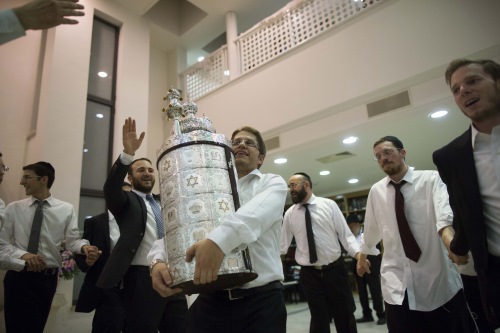
YERUSHALAYIM –A crowd of close to 100,000 people, according to police estimates, gathered at the Kosel Wednesday morning for the traditional mass Birkas Kohanim event, held on Chol Hamoed of Pesach and Sukkos, on the first day of Chol Hamoed for the Diaspora.
(Kosel Heritage Foundation)
Thousands of police and soldiers were on duty to prevent attacks on the mispallelim, and baruch Hashem, no security events were reported.
Popular singer Yoni Z’s new music video “Hoshana” is a sweeping, dramatic masterpiece, featuring a 36 piece orchestra and duet with his father Motti Zigelboum.
Seven weeks after the release of his debut album and just in time for Sukkos, Yoni Z releases his new music video, breaking boundaries once again with this moving and brilliant masterpiece, “Hoshana.”
Filmed in Kiev, Ukraine by the most innovative film producers the Orian Brothers of Olam Umlo’o Media in Israel, Yoni wanted to appeal on a more serious note to his audience.
“This is a very dear song to me, because it is the Chasidic music of my childhood. And to be able to duet alongside my father, made it all the more special. So I felt I had to come with a more mature angle this time around.”
Hoshana was written by Yoni and his friend, creative writer Sholom B. Nemenow.
It was filmed shortly before the High Holidays on a custom-built stage with 36 skillful musicians, conducted by Israel’s award-winning producer Eyal Mazig, who also wrote the original music for Hoshana on the album.
Alongside Yoni’s voice, we hear Yoni’s father duet with him, Cantor Motti Zigelboum.
Listening to Yoni and his dad in Hoshana, paired with the lighting and artistry in this stellar music video is a must-watch for all.
It was only a short time before Sukkot, and in all of Berdichev there could not be found a single etrog. The Tzaddik, Reb Levi Yitzchak, and the entire congregation, were concerned how they would be able to fulfill the important mitzvah of Lulav and Etrog. They waited, but no etrog arrived in Berdichev. Finally, the Tzaddik instructed his followers to go to the closest main highway – perhaps there they would find some Jew who had an etrog. And so they found a Jew, on his way home after a long journey, who had in his possession a very beautiful etrog. But his home was not Berdichev. He lived in another city, far from Berdichev; he was only passing through on his way home.
The followers of Reb Levi Yitzchak persuaded the traveling Jew to meet with the great Tzaddik, Reb Levi Yitzchak. The great Tzaddik tried to convince the Jew to spend Sukkot in Berdichev which would result in so many Jews having the merit of properly performing the mitzvah of Lulav and Etrog, and of course, Reb Levi Yitzchak too would also have the privilege of performing the mitzvah. The Jew would not agree. After all, he was traveling home to his family, whom he hadn’t seen for so long. How could he deprive them and himself of the simcha of Yom Tov, the joy of the Sukkot holiday?
In order to further persuade the traveler, the Tzaddik, Reb Levi Yitzchak, promised the Jew wealth and great nachat (pleasure) from his children. The Jew responded that he had, thank G-d, both wealth and wonderful children, and was not in need of anything more. Finally, in desperation, Reb Levi Yitzchak told the Jew that if he would fulfill the rabbi’s request, the rabbi would promise him that after 120 years, he would spend eternity together with the rabbi, in the rabbi’s four cubits in the World to Come.
When the Jew who owned the etrog heard this incredible offer from the great Tzaddik, he immediately acceded to the Tzaddik’s request and agreed to remain in Berdichev for the Sukkot holiday. Rabbi Levi Yitzchak and the entire community were delighted, and the Jew with the etrog was ecstatic.
Unbeknownst to the Jewish traveler, a secret command had been issued by the Tzaddik to all the people of Berdichev, that under no circumstances should they allow this Jew who brought the etrog to Berdichev to enter any of their sukkot during the holiday. No one knew why, but the decree of the Tzaddik, was an unalterable decree.
On the first night of Sukkot, after services, the traveling Jew returned from synagogue to the inn where he was staying, and found in his room wine for kiddush, candles, challahs, and a table covered with food. The guest was perplexed…Doesn’t the innkeeper have a sukkah? A righteous Jew like he, no sukkah? He went out to the yard and found a sukkah, beautifully built and arrayed, the owner and all the members of his household sitting around the table. The guest sought to enter, but he was not permitted. Why, why? How could this be? No response. So he went to the neighbors on the street and found them, each one in their own sukkah. He begged them to allow him to enter, to sit in their sukkah – for just a moment. No one answered. Finally, he learned that Rabbi Levi Yitzchak had decreed that he should not be allowed into a single sukkah in the entire city of Berdichev.
In panic, he ran to the Tzaddik’s home. “What is this?” he cried. “What is my trespass? What is my sin?” Said the Tzaddik: “If you will nullify the promise I made to you that you would sit with me in the World to Come, I will immediately instruct my followers to allow you to enter their sukkot. The guest was astonished – outraged – but was silent. “What can I do?” he thought to himself. “After all, is it an insignificant thing to sit together with this great Tzaddik in the World to Come? On the other hand, in my entire life I have never missed performing the mitzvah of sitting in a sukkah. How can I fail now, on the first night of the holiday, to fulfill this wonderful mitzvah?” Finally, the guest came to a conclusion — in favor of the sukkah. He said to himself: “Is it possible that all of Israel will sit in a sukkah and I will eat in a house, like a non-Jew? G-d forbid!” He then renounced the promise that Tzaddik had made to him, and at the demand of Reb Levi Yitzchak, extended his hand to confirm the agreement, and proceeded to sit in a sukkah.
When the festival concluded, Reb Levi Yitzchak summoned the Jew to his home. “Now,” said the Tzaddik: “I am returning to you my promise. You see, I did this to teach you, to inform you, that I didn’t want you to merit the World to Come for no reason, as if it were a business deal or bargain. I wanted you to truly earn a place in the World to Come because you were deserving, because of your deeds, and so I caused you to be tested in the mitzvah of sukkah. Now that you have passed the test, and have shown true devotion to the sukkah, you truly deserve to be my partner in the World to Come.”
Despite Israeli version, Kremlin blames IAF for plane downing
In Moscow press briefing, Russian Defense Ministry spokesman presents country’s findings on Syria’s downing of Russian reconnaissance plane during attempt to repel IAF strike on Latakia; ‘F-16 pilots used a Russian aircraft as a shield against the Syrian air defenses.’
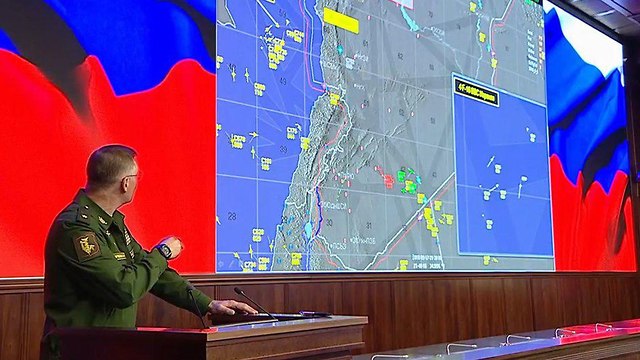
The Russian Defense Ministry announced on Sunday that Israel bears responsibility for the Syrian downing of a Russian reconnaissance plane during an Israel Air Force (IAF) strike last week.
The Defense Ministry presented the findings of its investigation into the incident and according to Russia Today (RT), the ministry holds Israel responsible for the downing of the Ilyushin IL-20 plane that killed 15 people on board.
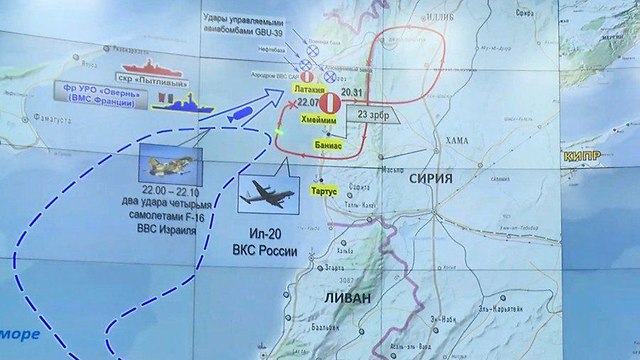
According to the report, the IAF deceived the Russians by presenting false information regarding the area in which the strike in Latakia was planned on September 17 which prevented the Russian plane from leaving the danger zone.
For several years, Israel and Russia have maintained a special hotline to prevent their air forces from clashing in the skies over Syria. Russia has provided key air support to President Bashar Assad’s forces since 2015, while Israel has carried out dozens of strikes against Iran-linked forces. Israeli military officials have previously praised the hotline’s effectiveness.
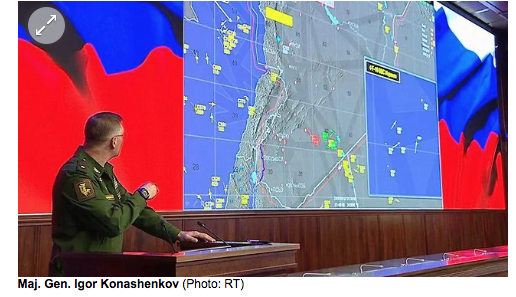
But ministry spokesman Maj. Gen. Igor Konashenkov on Sunday accused Israel of using the hotline to mislead Russia about its plans. He said the Russians were unable to get the Il-20 to a safe place because an Israeli duty officer had misled them, telling them of an Israeli operation in northern Syria while the jets were actually in Latakia, in the country’s west.
“The Israeli jets saw the Russian Ilyushin Il-20 and used it as a shield against the anti-aircraft missiles, while they carried on maneuvering in the region,” said Konashenkov in a briefing given to journalists in Moscow.
It was also said that the heads of the IDF do not appreciate the relationship with Moscow.
“The military leadership of Israel either has no appreciation for the level of relations with Russia, or has no control over individual commands or commanding officers who understood that their actions would lead to tragedy,” Konashenkov said in his minute-by-minute account.
Maj. Gen. Igor Konashenkov (Photo: RT)
“The actions of the Israeli fighter pilots, which led to the loss of life of 15 Russian servicemen, either lacked professionalism or were an act of criminal negligence, to say the least,” he continued.
Russia has claimed since the attack that Israel gave the Kremlin less than one minute’s notice before the attack, giving the plane insufficient time to fly to safety—”a clear violation of the 2015 Russian-Israeli agreements.”
RT said in its report that the IDF “failed to provide the location of their jets or properly specify their targets, claiming they were going to attack several ‘industrial facilities’ in northern Syria, close to the Il-20’s area of operation.
“The misinformation prompted the Russian Command to order the recon plane back to the Khmeimim air base. The Israeli jets, however, instead almost immediately attacked the western Syrian Latakia province.”
Konashenkov told journalists that after the initial Israeli strike in Latakia, the Israeli jets activated their radar-jamming systems and pulled back in preparation for another strike.
One of the jets, he said, then approached Latakia while the Russian aircraft was preparing to land.
“The Israeli pilot must have been well aware of the fact that the Il-20 has a much larger radar cross-section than his F-16, and would become a ‘preferred target’ for the Syrian air defense units, who use different friend-or-foe systems with the Russians,” the RT report paraphrased Konashenkov. “Thus, for the Syrians, the reconnaissance plane could appear as a group of Israeli jets.”
According to Konashenkov, Israel’s “negligent behavior” amounted to a what he described as flagrant violation of the very spirit of cooperation between the countries.
(Photo: RT)
He also emphasized that Russia has never broken its commitment to the deconfliction agreement and has always informed Israel about its military missions in advance and has never used its air defense capabilities against Israelis.
He said that Russia’s decisions not to unleash its air defense on Israeli jets often endanger their own servicemen.
Konashenkov claimed that Russia has forewarned Israel 310 times of operations and maneuvers that could affects its air force, while Israel had demonstrated an asymmetrical commitment by warning the Russians only 25 times even though the IAF has acknowledged carrying out more than 200 strikes against Syrian targets over the past 18 months alone.
“This is an extremely ungrateful response to all that has been done by the Russian Federation for Israel and the Israeli people recently,” Konashenkov said.
IAF chief Maj. Gen. Amikam Norkin presented to senior military officials in Moscow on Thursday the IDF report describing the attack in an effort to absolve Israel of responsibility and to avert a diplomatic crisis between Jerusalem and Moscow.
Norkin and other senior officers said they formed “a situation report of the event regarding all aspects, including the pre-mission information and the findings of the IDF inquiry.”
The Jewish Holiday of Sukkot begins at nightfall on the 15th of the Jewish (lunar) month of Tishrei, when the moon is at its zenith. It continues for another seven days, before leading directly into the holiday of Shemini Atzeret/Simchat Torah.
2. Sukkot Is the Holiday of Shelters
The holiday of Sukkot is celebrated by dwelling in the sukkah hut.
Sukkot is Hebrew for “booths” or “shelters.” As the verse states, “Your [ensuing] generations should know that I had the children of Israel live in shelters when I took them out of the land of Egypt.”1
What were these shelters? The Talmud tells us that they were the clouds of glory that encompassed the entire nation during their epic 40-year trek through the Sinai desert.
3. Sukkot Has Three Other Names
Sukkot also has an agricultural connotation, marking the time when farmers in Israel would gather the crops that had been drying in the fields. For this reason, scripture calls it ChagHaasif, “The Festival of Gathering.”2
Sukkot is a joyous holiday—so joyous that the sages called it simply Chag, Hebrew for “Festival.”
In our liturgy, we call it Zeman Simchatenu, “The Time of Our Rejoicing.”
4. The Sukkah Booth Is Covered With Organic Material
Teens finalize the roof with its sechach on top.
For the duration of Sukkot, the sukkah—a structure covered with greenery, bamboo, or something else that has been harvested from the ground—becomes our home. The covering is known as sechach. Koshersechach must have grown from the ground and been harvested. It cannot be the overhang of a nearby tree, for example. Common sechach choices include evergreen branches, cornstalks, palm fronds, bamboo, or specially produced mats.
5. The Sukkah Becomes Our Second Home on Sukkot
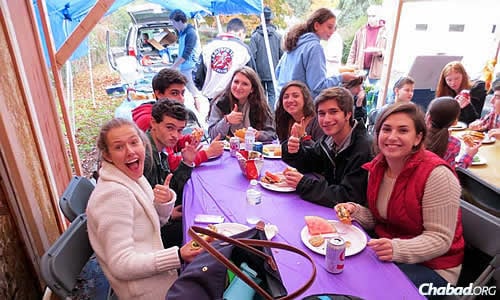
Students enjoy lunch during Sukkot.
We eat all meals, study, and schmooze (and even sleep) in the sukkah, where only the flimsy sechach separates us from the wide, open sky.
A sukkah can be erected just about anywhere, provided it’s under the sky. The Talmud talks about ox-cart sukkahs, boat sukkahs, treetop sukkahs and camelback sukkahs.3Nowadays there are are sukkah mobiles (on pickup trucks) and even pedi-sukkahs.
6. The Lulav and Etrog Are Taken (Almost) Every Day of Sukkot
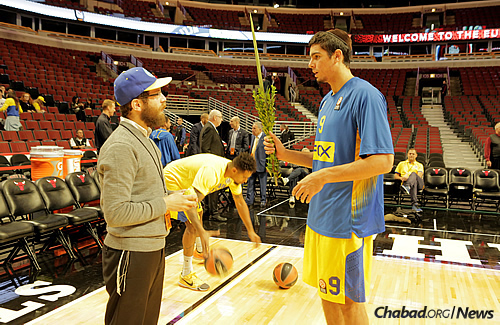
Rabbi Avraham Kagan, Co-Director of Chabad of River North and Fulton Market, gives a lulav and etrog to Maccabi player Itay Segev. (Photo: Yakov Studio)
Every day of Sukkot (besides for Shabbat) we take a bundle of greens—made of a lulav (palm frond), three hadasim (myrtles), and two aravot (willows)—along with an etrog (citron). We hold them together, bless G?d who “sanctified us with His commandments and commanded concerning the taking of the lulav,” and wave them gently in six directions. This is often referred to as the “lulav and etrog” or the arba minim, “four kinds.”
The four kinds are also held and waved during Hallel (“Psalms of Praise” said as part of the holiday morning service), as well as during the Hoshaanot, a daily Sukkot ceremony that involves circling a Torah scroll while chanting prayers for salvation.
7. There Are Special Blessings to Be Said
In addition to the blessing we say before taking the lulav and etrog, whenever you sit down to a meal in the sukkah, you say a blessing that concludes with the words “layshav basukkah,” in which you bless G?d “Who sanctified us with His commandments and commanded us to dwell in the sukkah.”
The first time you do each mitzvah you make another blessing, Shehecheyanu, which blesses G?d, Who has “given us life, sustained us, and brought us to this time.”
8. The Last Day is Hoshana Rabbah
Jews circling the bimah on Sukkot. Credit: Alex Levin
On the seventh day of Sukkot, the bimah (platform in middle of the synagogue) is circled seven times, instead of the one circuit done every day of the holiday thus far. Since the Hoshaanot are repeated again and again, this day is known as Hoshana Rabbah (“The Great Hoshana”). At the end of this once-a-year service, each person beats a bundle of five willows (also known as hoshaanot) against the ground.
On this day, it is customary to have a festive meal in the sukkah that includes challah dipped in honey (the last time for the season) and kreplach, dumplings stuffed with meat.
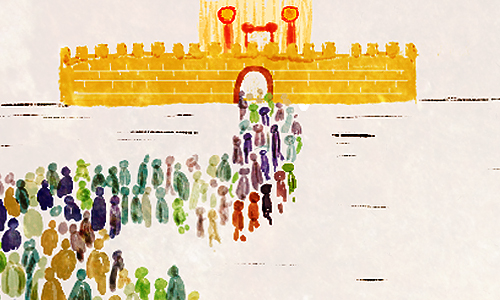
9. Sukkot Was a Pilgrimage Festival
The Torah mandates the Israelites to pilgrimage to the Holy Temple three times a year—Passover, Shavuot, and Sukkot—bringing sacrifices and other donations that they may have promised in the preceding months. Sukkot was the last of the three festivals, and, according to some, it was the final date before the divine “debts” would be considered overdue.
10. The Joyous Water Drawing Was on Sukkot
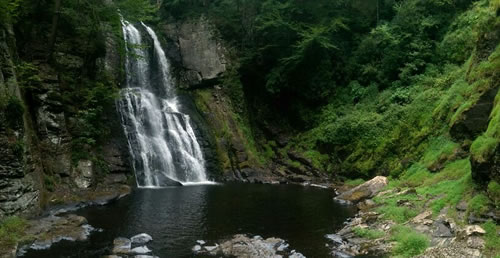
During Temple times, the nights of Sukkot were celebrated with extreme joy, to the degree that the sages testified, “Anyone who has not seen the joy of the water drawing, has never seen joy in his life.”4 The celebrations preceded the drawing of water from the shiloach spring, which was then poured into a special hole on the Temple altar.
Priests kindled fires on great lamps, lighting up Jerusalem as if it were the middle of the day. Throughout the night, pious men danced holding torches, scholars juggled, and Levites played music, while the lay people watched with excitement.
Nowadays, many communities hold celebrations on the nights of Sukkot in commemoration of the water-drawing ceremony. The Rebbe encouraged that the dancing spill out into the streets.
11. Spiritual Guests Visit Every Day of Sukkot
According to a mystical tradition found in the Zohar, the “seven shepherds” visit our sukkahs each day of the holiday. Known as ushpizin, the guests are: Abraham, Isaac, Jacob, Moses, Aaron, Joseph, David.
Some people recite a special text, in which they formally “invite” the ushpizin into their sukkahs.
12. Not All the Days Are the Same
The first two days of Sukkot (just the first day in israel) are Yom Tov. Like Shabbat, we refrain from many forms of creative labor, travel etc. The only two exceptions are that some acts of food preparation (such as cooking using a preexisting flame) and carrying things we need for the holiday are allowed. The prayers are also somewhat longer than usual.
The remaining days of Sukkot are known as chol hamoed, during which travel and other melachot (forbidden acts) are permitted (but strenuous work should be avoided if possible).
13. Sukkot Is Followed by Another Holiday
Images (from Flash90) were not captured on the holiday.
Immediately after the seven days of Sukkot, we step into Shemini Atzeret and Simchat Torah. In the Diaspora, this holiday extends for two days; in Israel, it is confined to a single day. Simchat Torah fetes the completion of the annual Torah-reading cycle and the start of the new cycle. It is marked with vigorous singing and dancing in the synagogue. This is the only instance of one Jewish holiday coming directly after another one.
Terrorists Attack Iran Military Parade, Killing Dozens
TEHRAN (AP) – Terrorists disguised as soldiers opened fire Saturday on an annual Iranian military parade in the country’s oil-rich southwest, killing at least 25 people and wounding over 60 in the deadliest terror attack to strike the country in nearly a decade.
Women and children scattered along with once-marching Revolutionary Guard soldiers as heavy gunfire rang out at the parade in Ahvaz, the chaos captured live on state media.
The region’s Arab separatists, once only known for nighttime attacks on unguarded oil pipelines, claimed responsibility for the brazen assault.
Iranian Foreign Minister Mohammad Javad Zarif blamed regional countries and their “U.S. masters” for funding and arming the separatists, issuing a stark warning as regional tensions remain high in the wake of the U.S. withdraw from the Iranian nuclear deal.
“Iran will respond swiftly and decisively in defense of Iranian lives,” Zarif wrote on Twitter.
The attack came as rows of Revolutionary Guardsmen marched down Ahvaz’s Quds, or Jerusalem, Boulevard. It was one of many around the country marking the start of Iran’s long 1980s war with Iraq, commemorations known as the “Sacred Defense Week.”
Journalists and onlookers turned to look toward the first shots, then the rows of marchers broke as soldiers and civilians sought cover under sustained gunfire. Iranian soldiers used their bodies at time to shield civilians in the melee, with one Guardsman in full dress uniform and sash carrying away a bloodied boy.
In the aftermath, paramedics tended to the wounded as soldiers, some bloodied, helped their comrades to ambulances.
The attack killed at least 25 people and wounded over 60, according to the state-run IRNA news agency. It said gunmen wore military uniforms and targeted a riser where military and police commanders were sitting. At least eight of the dead served in the Revolutionary Guard, an elite paramilitary unit that answers only to Iran’s supreme leader, according to the semi-official Tasnim news agency.
“We suddenly realized that some armed people wearing fake military outfits started attacking the comrades from behind (the stage) and then opened fire on women and children,” an unnamed wounded soldier told state media. “They were just aimlessly shooting around and did not have a specific target.”
State media later reported that all four gunmen had been killed, with three dying during the attack and one later succumbing to his wounds at a hospital.
President Hassan Rouhani ordered Iran’s Intelligence Ministry to immediately investigate the attack.
“The president stressed that the response of the Islamic Republic of Iran to the slightest threat would be harsh, but those who support the terrorists should be accountable,” IRNA reported.
Meanwhile, Supreme Leader Ayatollah Ali Khamenei described the attack as exposing “the atrocity and viciousness of the enemies of the Iranian nation.”
“Their crime is a continuation of the conspiracies by the U.S.-backed regimes in the region which have aimed at creating insecurity in our dear country,” Khamenei said in a statement. “However, to their dismay, the Iranian nation will persist on the noble and prideful path they have taken and will — like before — overcome all animosities.”
Tensions have been on the rise between Iran and the U.S. The Trump administration in May pulled out of the 2015 nuclear accord with Iran, and since then has re-imposed sanctions that were eased under the deal. It also has steadily ramped up pressure on Iran to try to get it to stop what Washington calls “malign activities” in the region.
Despite those touchy relations, the U.S. government strongly deplored the attack, saying that “the United States condemns all acts of terrorism and the loss of any innocent lives.”
“We stand with the Iranian people against the scourge of radical Islamic terrorism and express our sympathy to them at this terrible time,” State Department spokeswoman Heather Nauert said.
Initially, authorities described the assailants as “takfiri gunmen,” a term previously used to describe the Islamic State group. Iran has been deeply involved in the fight against IS in Iraq and has aided embattled Syrian President Bashar Assad in his country’s long war.
But later, state media and government officials seemed to come to the consensus that Arab separatists in the region were responsible. The separatists accuse Iran’s Persian-dominated government of discriminating against its ethnic Arab minority, though an Ahvazi Arab, Gen. Ali Shamkhani, serves as the secretary of Iran’s Supreme National Security Council.
Khuzestan province also has seen recent protests over Iran’s nationwide drought, as well as economic protests.
Iran has blamed its Mideast archrival, the Sunni kingdom of Saudi Arabia, for funding Arab separatists’ activity. State media in Saudi Arabia did not immediately acknowledge the attack, though a Saudi-linked, Farsi-language satellite channel based in the United Kingdom immediately carried an interview with an Ahvazi activist claiming Saturday’s attack.
Hong Kong Opens High-speed Rail Link With Mainland China
Hong Kong on Saturday opened a new high-speed rail link to inland China that will vastly decrease travel times but also raises concerns about Beijing’s creeping influence over the semi-autonomous Chinese region.
Costing upward of $10 billion and taking more than eight years to build, the system aims to transport more than 80,000 passengers daily between the Asian financial center of 7 million people and the neighboring manufacturing hub of Guangdong province.
The train travels the 26 kilometers (16 miles) through Hong Kong to Shenzhen across the border in China in just 14 minutes, down from about 1 hour currently. The through-train to Guangdong’s capital Guangzhou will take just over half an hour, about 90 minutes faster than current service.
Once across the border, passengers can link up with Chinese sprawling nationwide high-speed rail network serving more than 44 destinations, including Shanghai, Beijing and the western city of Xi’an.
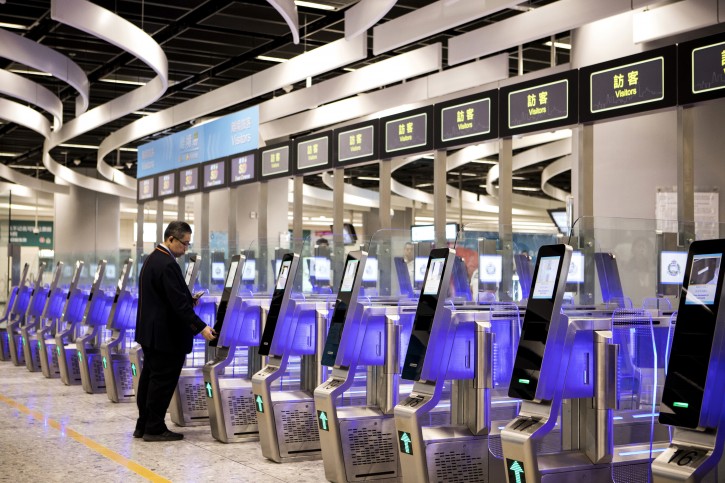
Passengers will clear Chinese immigration at the line’s newly built West Kowloon terminus, the source of major legal controversy when it was revealed that mainland Chinese law would apply within roughly one-quarter of the station’s area.
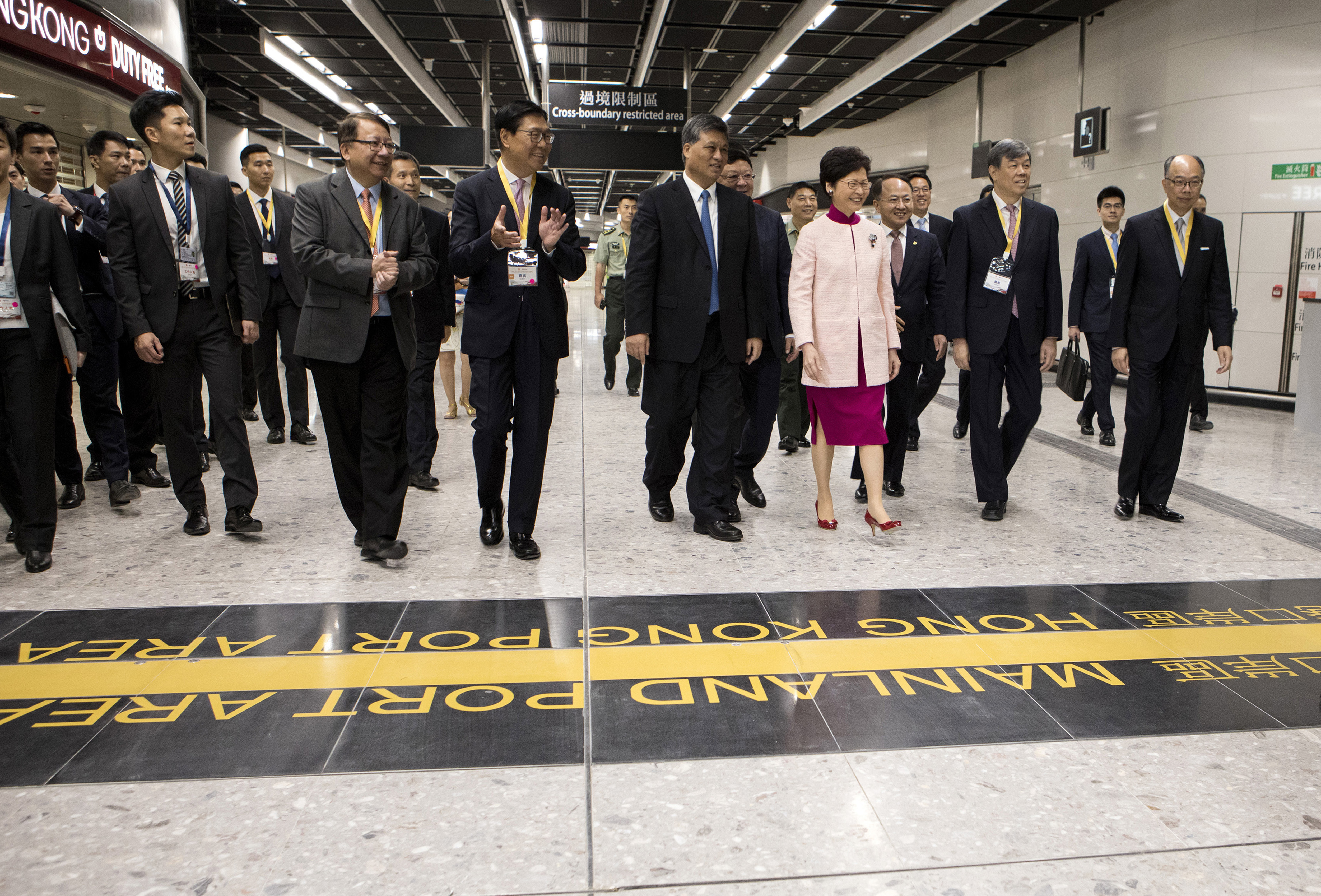
Frank Chan, Hong Kong’s transport and housing secretary, front row right, Carrie Lam, Hong Kong’s chief executive, front row third right, Ma Xingrui, governor of Guangdong Province, front row fourth right, Frederick Ma, chairman of MTR Corp., front row fourth left, and guests arrive to the border line into China during a tour in the Hong Kong Port Area at West Kowloon Station, which houses the terminal for the Guangzhou-Shenzhen-Hong Kong Express Rail Link (XRL), developed by MTR Corp., in Hong Kong, China, on Saturday, Sept. 22, 2018. AP
Some opposition lawmakers argued the move would be a violation of the Basic Law, Hong Kong’s mini-constitution under which it retained its own legal system and civil liberties after reverting from British to Chinese rule in 1997. That guarantees Hong Kong the right to maintain rights such as freedom of speech and assembly — which are routinely violated on the mainland — until 2047. Legal matters related to defense, foreign affairs and national security fall under Beijing purview.
However, Beijing’s tight control over the city’s politics and a continuing crackdown on politicians calling for greater economy and democratic reforms have spurred worries about an erosion of Hong Kong’s remaining autonomy.
The Hong Kong legislature’s passage in June of the plan to allow Chinese law to apply at the railway terminus was a significant moment for the opposition, coming four years after mass street protests demanding reforms fizzled out amid Beijing’s intransigence. Pro-democracy legislators have been expelled and charges brought against more than 100 protesters.
Supporters of the provision, including the territory’s Beijing-backed Chief Executive Carrie Lam, defended it as promoting speed and convenience.
Ma Xingrui, governor of Guangdong Province, front row left, and Carrie Lam, Hong Kong’s chief executive, front row second left, stand next to a Guangzhou-Shenzhen-Hong Kong Express Rail Link (XRL) Vibrant Express train bound for Guangzhou Nan Station on a platform in the Mainland Port Area at West Kowloon Station, which houses the terminal for the XRL, developed by MTR Corp., in Hong Kong, China, on Saturday, Sept. 22, 2018. AP
A Guangzhou-Shenzhen-Hong Kong Express Rail Link (XRL) Vibrant Express train bound for Guangzhou Nan Station stands on a platform in the Mainland Port Area at West Kowloon Station, which houses the terminal for the XRL, developed by MTR Corp., in Hong Kong, China, on Saturday, Sept. 22, 2018.
Prince William unveils statue of British spy Frank Foley, who saved 10,000 Jews
Duke of Cambridge presents monument of MI6 hero in Midlands town of Stourbridge, to honour his work saving Jews from the Holocaust.
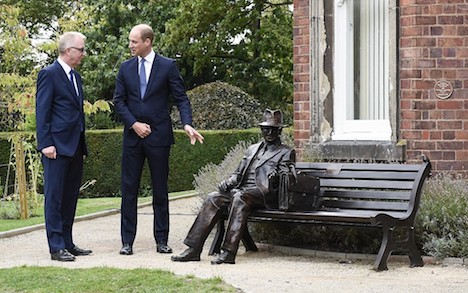
Prince William has demonstrated yet again how seriously he takes Holocaust education by unveiling a statue to honour a British spy who saved 10,000 Jews by issuing them with passports while working undercover in Berlin.
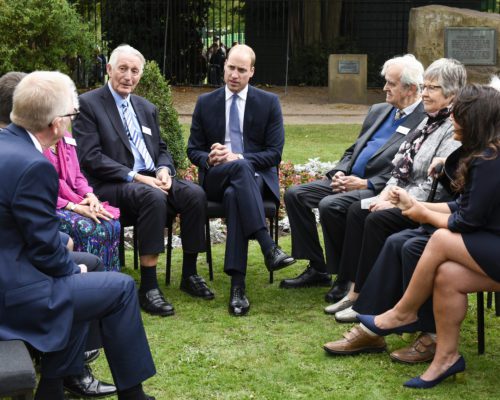
His Royal Highness, who appears to be following in his father’s footsteps, unveiled the statue to MI6 hero Frank Foley in the Midlands town of Stourbridge, where the veteran intelligence officer of two world wars chose to retire.
Prince William speaking with those that Frank Foley saved and HET’s Karen Pollock (far right).
It is the latest noteworthy involvement from the prince, who was visibly moved in June during his visit to Yad Vashem, Israel’s national Holocaust memorial centre.
Months earlier, William and wife Kate visited the Nazi concentration camp of Stutthof in occupied Poland, where they met two Holocaust survivors – Zigi Shipper and Manfred Goldberg – who had witnessed the camp’s horrors.
Unveiling the statue on Tuesday, William met members of Foley’s family, as well as people who were saved by Foley and descendants of others that Foley rescued in the 1920s and 1930s, in so doing putting his own safety at considerable risk.
Local MP Ian Austin, who spearheaded the campaign for a statue together with the Holocaust Educational Trust (HET), paid tribute to Foley, who worked undercover as a Passport Control Officer in the British Consulate in pre-war Berlin.
“I hope it will help people learn how Frank Foley refused to stand by when people were being persecuted because of their race or religion,” said Austin. “His life and courage show us that we all have a responsibility to stand up against intolerance and racism.”
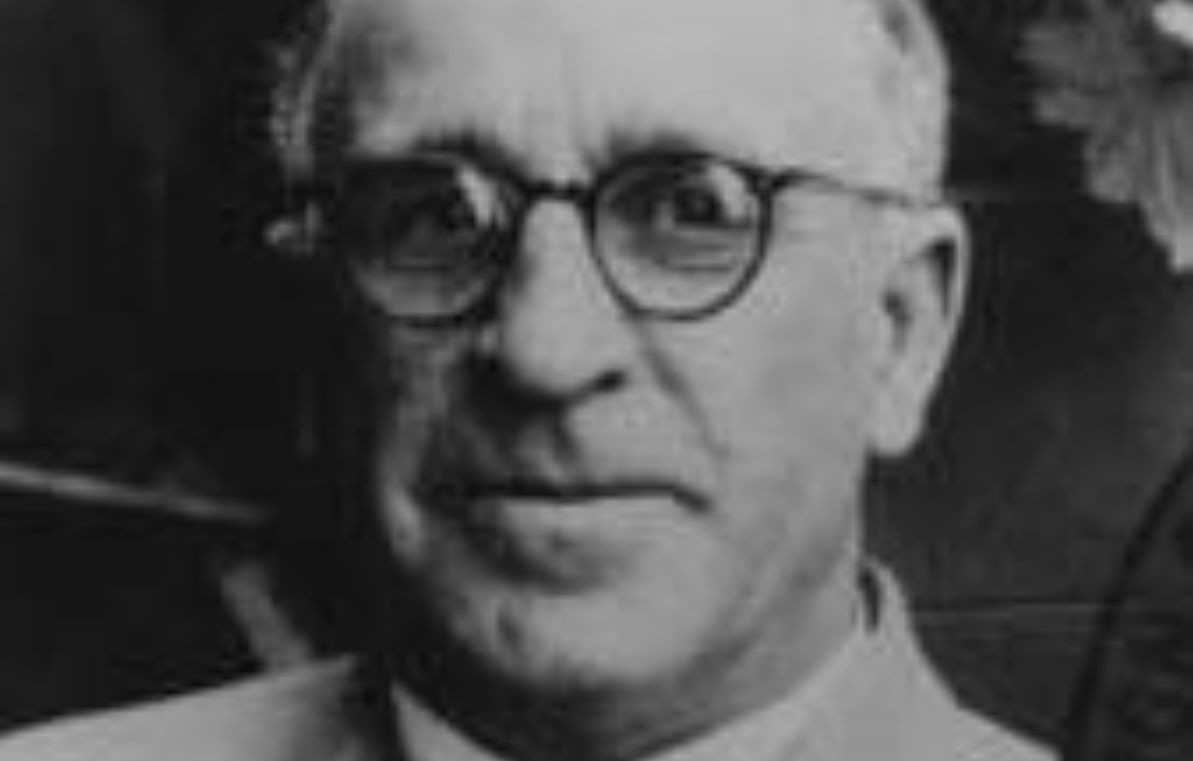
Frank Foley
Foley’s work, which – if discovered – would have led to his torture and execution, remained an official secret until long after his death in 1956, when those he had saved chose to speak out. Further research by the author Michael Smith led to Foley’s story being told in Smith’s book ‘The Spy Who Saved 10,000 Jews.’
MI6 boss Alex Younger said that normally “our successes are private, our failures public,” but added: “It is a wonderful thing for MI6 that one of its most distinguished members’ successes are no longer private.”
HET chief executive Karen Pollock said the intelligence officer “went to remarkable lengths to save Jews, right under the nose of the Nazis, even visiting concentration camps to remove them”. She added: “Foley is the ultimate role model. His heroic stand should be a source of pride and inspiration to us all.”
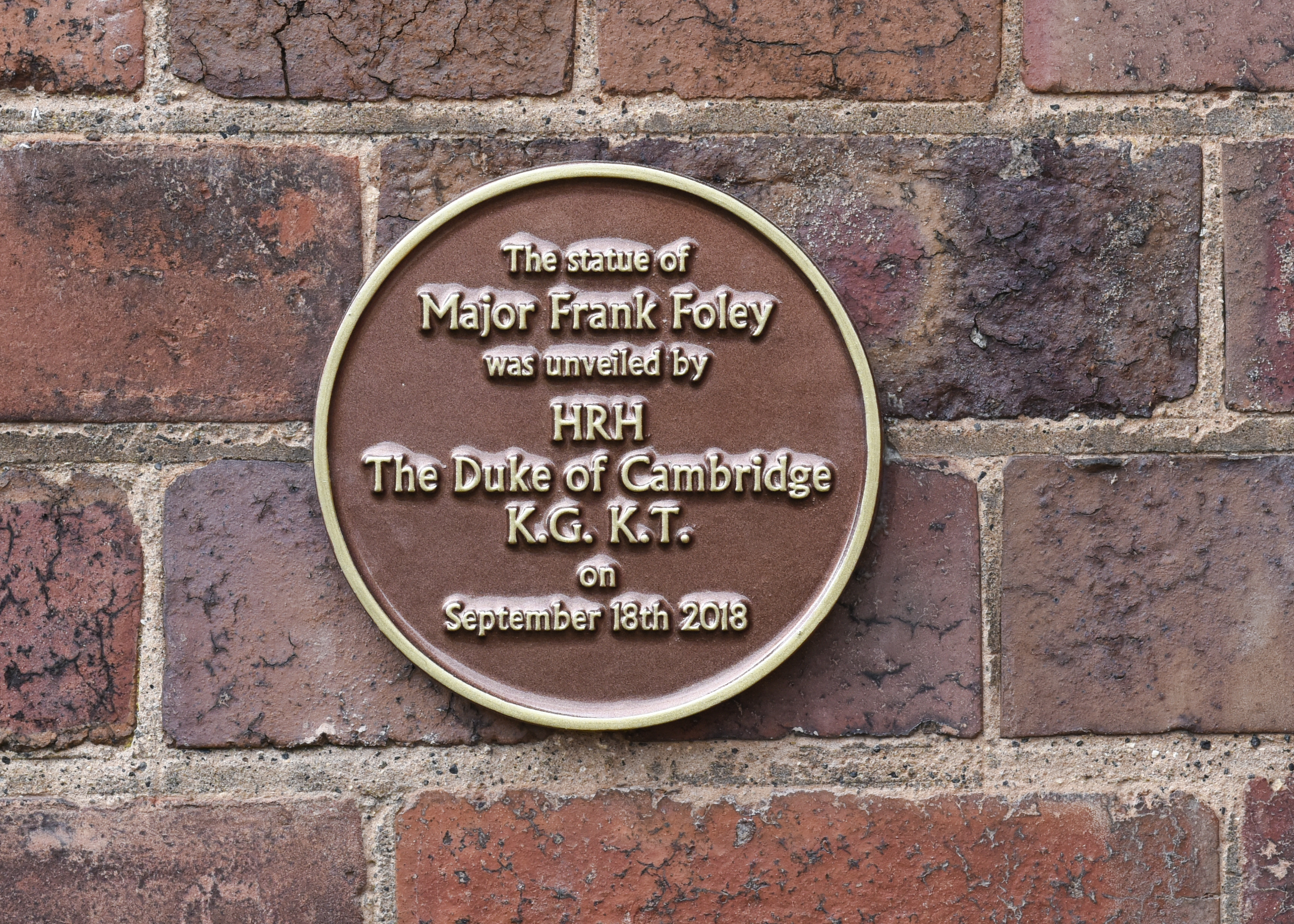
The plaque marking the new sculpture in the great man’s memory.
Werner Lachs, who was issued a visa by the spy in 1939, said: “The courageous and brave actions of Frank Foley made it possible for me to escape the hell of Nazi Germany. But for him, I too would have been a victim of the Holocaust. He was my saviour. I shall always honour and cherish his memory.”
Chief Rabbi Ephraim Mirvis added his voice to the chorus of appreciation, saying: “The sheer scale of what Frank Foley achieved, as the impending catastrophe of the Holocaust drew closer, is among the very finest testimonies to human bravery.
“As a timeless reminder of what we are capable of, ever more necessary today, there are few people more deserving of being cast in statue form than he is.”
Breath Test Device May Help Diagnose Early-Stage Parkinson’s Disease
By NoCamels TeamSeptember 18, 2018
“This article was re-published with permission from NoCamels.com – Israeli Innovation News.
A team of scientists at Technion – Israel Institute of Technology has developed a device they say can detect early-stage Parkinson’s disease using a breath test.
In a July study published in the scientific journal ACS Chemical Neuroscience, the scientists detailed their findings following testing of the device on the exhaled breath of 29 Parkinson’s disease patients after initial diagnosis by an experienced neurologist, and 19 control subjects of similar age. Their results, according to the research, showed accuracy levels of 81 percent.
Parkinson’s disease, a progressive neurodegenerative disorder that affects dopamine-producing neurons in a specific area of the brain called substantia nigra, has four main symptoms and can be difficult to accurately diagnose in its early stages. Symptoms develop gradually and include shaking or tremors, a slowness of movement called bradykinesia, stiffness in the extremities, and postural instability. Diagnoses are often first made by family physicians after which neurologists are usually consulted, according to the Parkinson’s Foundation.
There is no cure and treatment involves medication for symptoms – though none that can reverse the effects of the disease – and surgical therapy.
Parkinson’s disease will affect approximately one million people in the United States by 2020, while ten million worldwide are currently living with the disease. Some 60,000 Americans are diagnosed with Parkinson’s disease every year.
To continue reading this article on NoCamels.com, click here.”





 The Jewish Holiday of Sukkot begins at nightfall on the 15th of the Jewish (lunar) month of Tishrei, when the moon is at its zenith. It continues for another seven days, before leading directly into the holiday of Shemini Atzeret/Simchat Torah.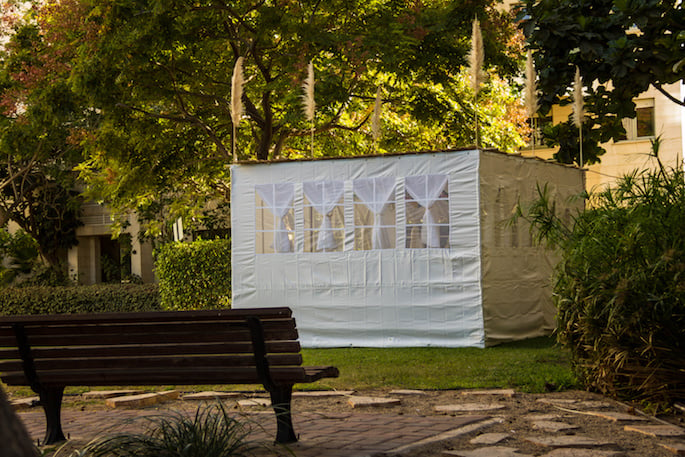
 Sukkot also has an agricultural connotation, marking the time when farmers in Israel would gather the crops that had been drying in the fields. For this reason, scripture calls it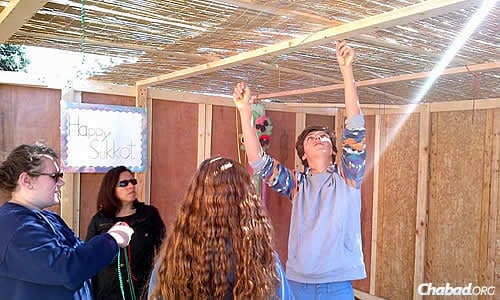
 In addition to the blessing we say before taking the lulav and etrog, whenever you sit down to a meal in the sukkah, you say a blessing that concludes with the words “layshav basukkah,” in which you bless G?d “Who sanctified us with His commandments and commanded us to dwell in the sukkah.”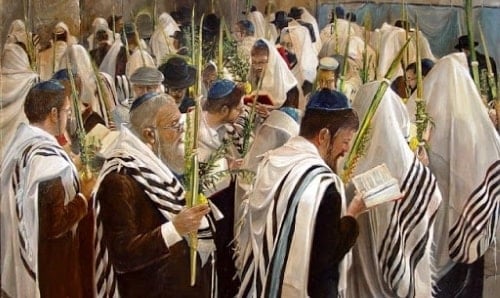
 The Torah mandates the
  During Temple times, the nights of Sukkot were celebrated with extreme joy, to the degree that the sages testified, “Anyone who has not seen the joy of the water drawing, has never seen joy in his life.”4 The celebrations preceded the drawing of water from the shiloach spring, which was then poured into a special hole on the Temple altar.
 According to a mystical tradition found in the
  The first two days of Sukkot (just the first day in israel) are