Home Blog Page 1139

Jeremy Corbyn: How he is making British Jews nervous enough to consider leaving

0

Jeremy Corbyn: How he is making British Jews nervous enough to consider leaving

With the rise of Labour Party leader and accused anti-Semite Jeremy Corbyn, Britain grappling with its decision to leave the European Union and Prime Minister Theresa May facing criticism over Brexit, Jewish community members are concerned—concerned enough to consider leaving.

 As one of the world’s oldest democracies, the United Kingdom has come to be seen as a country on the forefront of Western values and tolerance. But in recent years, the country has seen its once heralded and normally steady political system turned upside-down. Amid this turmoil, the U.K.’s Labour Party, the country’s second-largest, has been grappling with a massive anti-Semitism scandal under party leader Jeremy Corbyn—one that has led many in the Jewish community to fear for their future.

“Our view is that Jeremy Corbyn is an anti-Semite and that under his leadership, the Labour Party has become an anti-Semitic and existential threat to British Jewry,” said Gideon Falter, chairman of the Campaign Against Anti-Semitism, a British watchdog group.

At the same time, anti-Semitic incidents in the United Kingdom hit an all-time high in 2017. According to the Community Security Trust, a British watchdog that monitors anti-Semitism, there were 1,382 anti-Semitic incidents in 2017, a 3 percent rise from 2016. This includes a 34 percent increase in the number of violent anti-Semitic assaults from 108 in 2016 to 145 in 2017.

Meanwhile, a poll conducted for the U.K.’s Jewish Chronicle found that almost 40 percent of British Jews would “seriously consider emigrating” if Corbyn becomes prime minister.

Despite such worries, it’s not yet clear what the Jewish community’s response has been to what Falter described as an “existential threat.” From January to July, some 274 British residents made aliyah, a 7 percent increase over the previous year, according to the Jewish Agency for Israel. Of course, that’s out of 300,000 Jews in Britain, according to JAFI.

The increase is “not something you can draw conclusions from,” Yigal Palmor, director of communications and public affairs for JAFI, told JNS. Still, he noted that his organization has experienced an increase in the last year in inquiries about immigrating to Israel.

“I think it shows that there is a real concern; it’s not just coffee-table talk,” he said. “There is real concern within the Jewish community that Labour is lost.”

Corbyn cozies up to anti-Semites and terror groups

Unease has long lingered among British Jews about Corbyn’s leadership of the Labour Party because of moves such as welcoming leaders of terrorist groups Hamas and Hezbollah to Parliament, even describing them as “friends.”

But unease has turned into outright alarm in recent months, rather ironically as the Labour Party has worked to adopt its own definition of anti-Semitism. Unlike the International Holocaust Remembrance Alliance’s anti-Semitism definition, it originally omitted statements concerning Israel that according to Jewish leaders should be considered anti-Semitic. Finally, just this week, the party adopted the language norms.
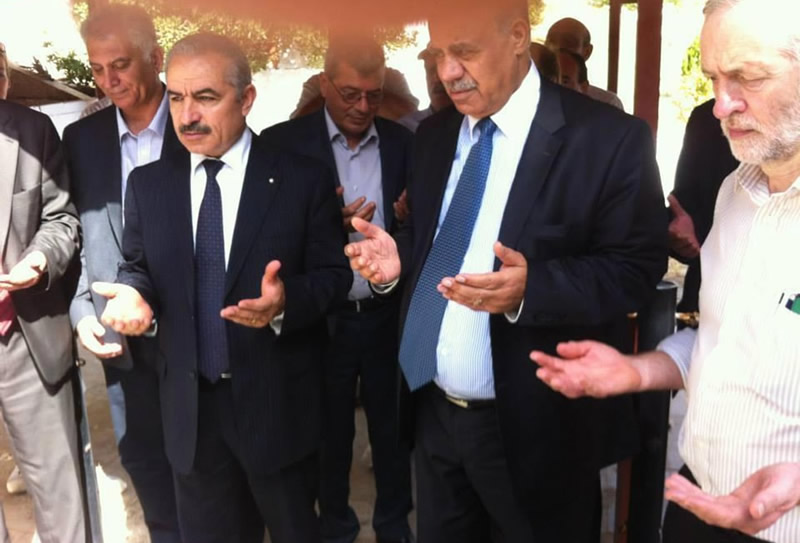
British Labour Party leader Jeremy Corbyn (right) before the grave of Atef Bseiso, the mastermind behind the massacre of 11 Israeli athletes at 1972 Summer Olympics in Munich, as published in the British press.

Then further evidence emerged supporting critics’ claims that Corbyn is an anti-Semite. In a 2013 video clippublished last month, Corbyn says, “Zionists … clearly have two problems. One is they don’t want to study history, and secondly, having lived in this country for a very long time, probably all their lives, they don’t understand English irony either. They needed two lessons, which we could perhaps help them with.”

The Labour leader made the comments at a conference promoted by the Palestinian terror group Hamas and featured “a range of anti-Semites, homophobes and conspiracy theorists,” according to the Daily Mail. “Several were connected to Hamas. One called for attacks on the Royal Navy in the past, and led a boycott of Holocaust Memorial Day.”

At the same time, it was revealed last month that Corbyn attended a memorial ceremony honoring the Palestinian terrorists behind the 1972 Munich Summer Olympics massacre, which left 11 Israeli coaches and athletes dead.

Jewish leaders have strongly criticized Corbyn for such statements despite the fact that last month, he released a video on Twitter in which he discussed strong Jewish historical ties to the Labour Party, saying, “Driving anti-Semitism out of the party for good and working with the Jewish community to rebuild trust are vital priorities.”

European Jewish leaders remain on edge

But statements that are critical of Israel can reveal anti-Semitic attitudes, and that’s the case with Corbyn, according to Marie van der Zyl, president of the Board of Deputies of British Jews, which led efforts to have the Labour Party adopt the wider anti-Semitism definition.

“His hatred of Israel and Zionism is so deep that he cannot separate it from anti-Semitism, and that ideology is at the root of his beliefs,” Van der Zyl told JNS.

However, on Tuesday, Labour’s ruling body agreed to adopt the International Holocaust Remembrance Alliance’s definition of anti-Semitism. Corbyn, however, pressed the party to include a statement that “it should not be considered anti-Semitic to describe Israel, its policies or the circumstances around its foundation as racist,” according to the BBC.

The party rejected the amendment, but later released a statement explaining that its acceptance of the anti-Semitism definition “will not in any way undermine freedom of expression on Israel or the rights of Palestinians.”

Corbyn’s efforts to include the additional wording regarding Israel, coupled with his previous statements and actions, keeps European Jewish leaders on edge.

“It is appalling that the Labour Party has once again ignored the view clearly and repeatedly stated by the Jewish community—that it should adopt the full IHRA definition without additions, omissions or caveats,” Jennifer Gerber, director of Labour Friends of Israel, said in a statement.

Labour taking this step finally sounds “positive,” said Gideon Falter, chairman of Campaign Against Antisemitism, but doing so “should never have been in question.”

“It is appalling that it has taken them until now, two years after the government adopted the definition, to finally accept something as basic as what constitutes anti-Semitism, albeit under duress,” he said.

Along with the Campaign Against Antisemitism, the European Jewish Congress welcomed the move, but called for Labour to apply the IHRA standard and purge its anti-Semitic members.

“Now that the Labour Party has adopted the IHRA definition in full, it must be used to root out anti-Semitism because its adoption is only a first relatively small step and not an end in itself,” the EJC said in a statement. “If the Labour Party does not root out and punish all those who contravene the definition, then this will be meaningless and mere window-dressing.”

The World Jewish Congress echoed the aforementioned sentiments.

“Corbyn must now do everything in his power to ensure that all such cases are dealt with as a matter of priority,” said WJC CEO and executive vice president Robert Singer. “At a time of heightened populism and extremism in Europe and beyond, we have been disheartened to see a lack of leadership from a once well-respected party on this issue. We hope action will be forthcoming.”

Israel Closes Paraguay Mission After Asunción Switches Embassy Back to Tel Aviv

0

Israel Closes Paraguay Mission After Asunción Switches Embassy Back to Tel Aviv

By TPS • 5 September, 2018


Minister Binyamin Netanyahu instructed the foreign ministry to close Israel’s embassy in Asunción Wednesday, after Paraguay did an about turn and announced it would move its embassy back to Tel Aviv from Jerusalem less than four months after making the switch in the opposite direction.

The Prime Minister’s Office said in a statement that it viewed the decision by Paraguay “very gravely” and that it would “cloud bilateral relations.”

“Paraguay wants to contribute to an intensification of regional diplomatic efforts to achieve a broad, fair and lasting peace in the Middle East,” Foreign Minister Luis Alberto Castiglioni said reversing the decision made by President Horacio Cartes.

Cartes was replaced by fellow conservative Mario Abdo Benítez in August.

Cartes opened the embassy in Jerusalem on May 21, following moves earlier that month by the United States and Guatemala.

Netanyahu called the move at the time “a great day for Israel, a great day for Paraguay, a great day for our friendship.”

New take on the new year: Young Jewish cooks revamp Rosh Hashanah menus

0

New take on the new year: Young Jewish cooks revamp Rosh Hashanah menus


Brisket with roasted potatoes and carrots, freshly baked challah, matzo ball soup…

If you celebrated Rosh Hashanah (the Jewish New Year) growing up, these were probably mainstays on your holiday table. Move over, Bubbe (Grandma) and step aside, Mom. A new generation of Jewish cooks is revamping holiday menus and making Rosh Hashanah foods that are fresh, flavorful and fun.

Growing up in Bayside, Jodie Honigman has fond memories of holiday meals hosted by her mother, aunt or grandmother. But Honigman’s religious observances mean that she now hosts the 10 members of her extended family, including her 96-year-old Zayde (Grandpa).

“My husband Dan and I are Shomer Shabbos, so we don’t drive on the Sabbath or on the Jewish holidays,” she explained. “We invite people to our house…we can’t always go to other people’s houses because it’s too far to walk. My mom comes over and cooks at our house. She still contributes to the meal.”

No meat? No problem

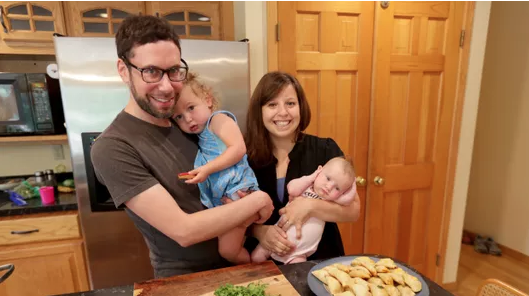
Honigman and husband, Dan Fleischman, are both vegetarian, so traditional matzo ball soup is replaced with squash soup, and brisket is replaced with bourekas, Israeli savory pastries stuffed with potatoes, cheese or vegetables.

“I became vegetarian at 22,” Honigman said. “It forced me to cook differently than my mom had. Most of what she cooked was chicken or meat or fish, (so) being vegetarian forced me to think outside the box.”

Thinking outside the box is an enjoyable task for Honigman and Fleischman, who love to incorporate international Jewish food traditions into their cooking.

 “We both had the opportunity to travel, which has broadened our culinary palate and exposed us to different Jewish communities,” Fleischman said. “I spent Sukkot (another Jewish fall holiday) 13 years ago in India, and Jodie spent a Shabbat in Tunisia.”

“There’s the harissa and cumin, and we have a Tunisian eggplant filling for one of the bourekas, so that’s Middle Eastern and North African, and these incorporate spices and flavors from places we’ve been,” he said.

Foods with meaning

On Rosh Hashanah, it’s customary to eat foods that symbolize elements of the New Year. In Hebrew these symbolic foods are called simanim.

According to Miri Rotkovitz, author of “Bubbe and Me in the Kitchen: A Kosher Cookbook of Beloved Recipes and Modern Twists,” “There are certain foods that, over the years were imbued with meaning and a feeling that if you included these, it would be a totem for a good year.

“Many foods have this special place at the table for Rosh Hashanah.”

The traditional apples and honey to symbolize hope for a sweet new year are the most common simanim. Honigman, the Jewish life coordinator and Jewish studies teacher at Milwaukee Jewish Day School, incorporates symbolic Jewish foods from other cultures.

“I had learned all these traditions of Rosh Hashanah, and certain foods are supposed to symbolize abundance,” she said. “We were looking at the cookbook ‘Olive Trees and Honey’ by Gil Marks, it’s vegetarian Jewish recipes from around the world. We use squash and leeks to symbolize the abundance of the New Year, so we make pumpkin squash soup.”

“Squash and pumpkin are symbolic of Rosh Hashanah because of the many seeds,” added Fleischman, vice president of Jewish Family Services. “Seeds represent mitzvot (good deeds), abundance and good things.”

Full-circle foods

Author Rotkovitz grew up cooking with her grandmother.

“Even though she passed away when I was 10, I have vivid memories of her in the kitchen,” she said in a phone interview. “When I was in graduate school, I revisited her recipe collection in its original green tin recipe file.”

There, Rotkovitz discovered that many of the foods her grandmother encouraged her to try were becoming popular again and Rotkovitz used her training as a dietitian to create new versions based on her grandmother’s traditional recipes. “There are several recipes I created that were inspired by memories of my grandmother and foods that I had at her table,” Rotkovitz said. The roasted beet salad is one example.

“My grandmother tried get me to taste beets, she would tell us how they were so rich in iron and so healthy, but I hated them. Then when I was older and tasted roasted beets, I said, ‘I get it.’

 “I’m a clinical dietitian by training and I love seasonal fresh produce. We feel like this is a new concept, but it’s really going back to our roots.”

Hosting Rosh Hashanah often means feeding a big group, and for that Rotkovitz’s marmalade roasted chicken is a perfect choice.

“The chicken recipe is adaptable, and you can make more for a lot of people,” she said. “If you’re afraid to make chicken on the bone and it’s daunting, a lot of stuff gets thrown into a roasting pan and it comes out nicely. It’s a good one for entertaining and it reheats well.”

For dessert, whole-grain sunken peach and raspberry cake is a variation on a traditional loaf-shaped apple cake.

“The base of this cake is very similar to the cake batter in apple cake, but it’s going into a 9-by-9 pan with the fruit on top,” Rotkovitz said. “And I do a version of the cake with whole grain — that’s not that far from how our great grandmothers were cooking.”

A vegetarian Rosh Hashanah menu is fine for the under-40 set, but how does the rest of Honigman’s family feel about it?

“Some of them like it better than others,” Honigman said. “My Zayde (grandfather) likes the soup, and my parents have gotten used to it; they don’t like all of our recipes, but they like these.

“We’ve had good results. We have homemade challah and lots of things for everyone to eat. My mom sometimes brings salmon so the older people could have a protein and my parents are eating a lot more diverse ethnic food than when I was growing up.”

RECIPES

These first two recipes for Rosh Hashanah are adapted from Jodie Honigman’s favorite cookbook: “Olive Trees and Honey: A Treasury of Vegetarian Recipes from Jewish Communities Around the World” by Gil Marks (Houghton Mifflin Harcourt, 2004).

This hearty vegetarian soup is a delicious start to a holiday meal and would be a delicious first course for any meal.

Squash, Leek, and Chickpea Rosh Hashanah Soup

Recipe tested by Joan Kazan

Makes 10 servings

  • Olive oil
  • 2 large leeks (white and light green parts only), roughly chopped
  • 1 teaspoon minced garlic
  • 2 butternut squash, peeled and cut into 1-inch chunks (see note)
  • 4 carrots, cut into chunks
  • 3 cans (15 ounces each) chickpeas, rinsed and drained
  • 1 teaspoon ground cumin
  • 1 teaspoon cayenne (optional)
  • Pinch of saffron
  • Pinch of ground turmeric
  • Salt to taste
  • Water (or vegetable stock)
  • Cilantro to garnish
  • Harissa as garnish

Coat bottom of a large pot with a light coating of olive oil over medium heat. Add leeks, garlic, squash and carrots and sauté until vegetables are soft. Add chickpeas and seasonings and continue cooking, stirring. Add water (or stock) and bring soup to a boil. Reduce heat and simmer, covered, about an hour. Add salt. Garnish with cilantro and/or harissa.

Notes: Tested used four (12-ounce) packages of precut butternut squash, which worked fine.

This makes a chunky, hearty soup. If you prefer a smoother soup, use an immersion blender or pour into a blender.     

—————

Savory turnovers (bourekas) are popular in Israel for their versatility. You can stuff the dough with any combination of your favorite vegetables or cheese. These are vegetarian, but bourekas also could be stuffed with ground meat or chicken.

Turkish Bourekas (Turnovers)

Makes about 30

Pastry dough:

  • ½ cup lukewarm water
  • ½ cup vegetable oil
  • ¾ teaspoon table salt or 1 ½ teaspoons kosher salt
  • 2 ½ cups flour

Fillings (see recipes below):

  • Mashed potatoes 
  • Eggplant-tomato
  • Pumpkin-cheese 

Eggwash: 1 egg mixed with 1 tablespoon water

  • Sesame seeds for garnish

Make pastry: Combine water, oil and salt in a bowl. Stir in 1 cup flour. Gradually stir in enough of the remaining 1 ½ cups flour to make a soft and pliable dough. When stirred, dough should come away from the sides of the bowl. Wrap dough completely in plastic wrap and let stand at room temperature 30 minutes. It won’t rise much, but after 30 minutes should be soft, easy to use, and not too sticky.

Preheat oven to 375 degrees.

Divide dough into 1-inch balls. Place on a baking sheet and press flat.

Make the filling of your choice. Fill each pastry circle with a spoonful of filling in the center. Fold in half to create turnover and seal edges with tines of a fork. For a shiny top, brush with eggwash. Garnish with sesame seeds.

Bake in preheated oven 20 minutes or until golden brown.

Note: If desired, you can also roll out the dough with a rolling pin and cut out circles with a cookie cutter.

Turkish eggplant and tomato filling:  

  • 1 eggplant
  • 1 tablespoon kosher salt plus salt to taste (divided)
  • ¼ cup olive oil
  • 2 ½ cloves garlic, chopped
  • 2 to 3 tomatoes, chopped
  • ½ cup chopped cilantro
  • Ground black pepper

Cut eggplant into ½-inch cubes. Place in a colander and add the 1 tablespoon salt. Wait a half hour, then wash off the salt and squeeze out the liquid.

Sauté garlic in olive oil until light brown. Add eggplant and tomato, season with salt, and cook until liquid evaporates. Add cilantro and pepper.

Potato filling:

  • ½ pound potatoes
  • 1 medium onion
  • Olive oil
  • ¼ cup (½ stick) butter
  • 2 eggs, beaten

Peel and cut potatoes into large chunks and place in pot with cold water to cover. Bring to a boil and boil until tender, about 15 to 20 minutes.

Meanwhile, sauté onions in olive oil until golden.

When potatoes are ready, drain and mash with butter and add onions. Allow to cool. Season with salt and pepper to taste. Stir in eggs.

Pumpkin-cheese filling:

  • 1 can (15 ounces) pureed pumpkin
  • 1 cup crumbled feta cheese
  • ½ cup grated Parmesan cheese
  • 1 egg, beaten

Mix all ingredients together. Season to taste. Add eggs.

—————

A traditional honey cake is a centerpiece for Rosh Hashanah dessert tables. This recipe is adapted from “Can’t Believe It’s Kosher, Jewish Tradition’s for Today’s Lifestyle,” a cookbook created by Congregation Beth Israel Sisterhood.

Honey Cake with Cherries

Makes 3 loaves

  • 1 cup chopped dates
  • 1 jar (10 ounces) maraschino cherries, drained and chopped
  • 1 teaspoon baking soda
  • 1 ½ cups water
  • ¼ cup (½ stick) butter
  • 2 ½ cups sugar
  • 5 eggs
  • 1 cup vegetable oil
  • 1 cup honey
  • 4 teaspoons baking powder
  • ½ teaspoon ground cloves
  • ½ teaspoon ground nutmeg
  • 1 teaspoon ground cinnamon
  • 5 cups flour

Preheat oven to 350 degrees.

Combine dates and cherries in a saucepan with baking soda and water. Cook until hot, then remove from heat and let cool.

In a mixing bowl, cream together butter and sugar. Add eggs, oil and honey. Add baking powder, spices and flour. Mix well. Stir in date and cherry mixture.

Divide batter among three (9-by-5-inch) greased loaf pans.

Bake in preheated oven about an hour, until a toothpick inserted into center comes out dry.

—————

18 Empowering Contemplations For Rosh Hashanah

18 Empowering Contemplations For Rosh Hashanah

Thinking about what it is and what we do with it

1. When the World Began


Adam, the first human being, opened his eyes to a world that appeared to have always been. He lifted his eyes to the vast sky above. He gazed about at the bustling life. He beheld mighty mountains and majestic waterfalls, flowing rivers and verdant forests.

And he cried out, “This is not a sky! This is the vast glory of my Maker!
This is not a mountain, or a waterfall, a tiger or an ant—
—this is all the majesty of an Infinite Being, who created a world out of kindness and might, beauty and wonder, glory and majesty, so that His creatures might know Him!
I know what this is! This is not just a jungle! This is the garden of a great and magnificent King!”

That is why Rosh Hashanah is called the first day of creation, for only then did the world know it had meaning.

And on each Rosh Hashanah we replay that scene, we discover meaning in our world, and the world is born again.


2. Soul, Space, Time


The ancient Book of Formation teaches that there is more to the universe than time and space. There is a soul.

Whatever is found in the universe’s soul is found somewhere in its space. And whatever is found in space, is found in time.

In the soul of the universe there is a consciousness from which all consciousness extends.

In space, there is the Land of Israel, a space from where all space is nurtured.

In time, there is Rosh Hashanah, a time from which all time is renewed.

Rosh Hashanah means Head of the Year. Not just a starting point, but a head, a new beginning of time on which a new consciousness enters our universe. For whatever will transpire in the coming year is first conceived in these two days.


3. The Drama


All the cosmos came to be because G?d chose to invest His very essence into a great drama: the drama of a lowly world becoming the home of an infinite G?d. A marriage of opposites, the fusion of finite and infinite, light and darkness, heaven and earth.

We are the players in that drama, the cosmic matchmakers. With our every action, we have the power to marry our mundane world to the Infinite and Unknowable.


4. First Day


More than Rosh Hashanah is about the One Above, it is about us below.
He created the world. But we drive it to its destiny.

That is why it is called “the beginning of Your works”—even though it is not the anniversary of the creation of the universe, but of the human being. It is the true beginning, as all of time begins on this day.

Because on this day, more than any other, we are empowered to switch tracks, to transform our destiny and thereby the destiny of all of creation. Through us, the bitter darkness that shrouded truth and goodness can become a flaming torch of light.

All is defined by destiny. Even the past is redefined by the arrow of its future. The very existence of that time that held that past is re-created once it achieves its hidden destiny. A destiny that only you can reveal.

That is all that matters: Now, the first day of all of time, future and past.


5. Happy Birthday, Universe


Every year, our sages taught, with the cry of the shofar the entire universe is reborn.

And so, at that time, with our resolutions and our prayers, we hold an awesome power: To determine what sort of child this newborn year shall be—how it will take its first breaths, how it will struggle to its feet and how it will carry us through life for the twelve months to come.

In truth, it is not only once a year: At every new moon, in a smaller way, all life is renewed again.

And so too, every morning, we are all reborn from a nighttime taste of death.

And at every moment—in the smallest increment of time—every particle of the universe is projected into being out of absolute nothingness, as it was at the very beginning.

Which is why there is always hope. Because at every moment, life is born anew. And we are the masters of how this moment will be born.


6. Editing the Past


Rosh Hashanah is the beginning—not only of this new year, but of all years previous.

How could that be?

Because on that day you are empowered to reach back into time and adjust the meaning of all that has passed.

True, He is the Author. But He has assigned us as editors. We adapt the storyline, transform the plot.

By transforming who we are today, we rewrite our own past and author a whole new world.


7. We Are the Child


Your child is not like everyone else; your child is you.

And yet, your child is not you; your child is his own person.
A paradox.

Our souls are that paradox—on a greater scale: the nexus between G?d and His universe, where His own breath becomes His creation.

That is why we are called His children. And we call Him our Father.


8. G?d’s Lawyers


On Rosh Hashanah, G?d puts Himself on trial.

G?d is beyond this world He has made, but He is found within it, as well. He is found in every atom, in every event, in every life of this world.

If so, though it may sound strange, He, as He is beyond this world, takes Himself, as He is present within this world, to trial.

“Is there meaning to be found,” He asks Himself, “in sustaining this world and all that inhabits it?”

Who will plead on His behalf? We, the human being. We act as the defense. We must demonstrate that, yes, there is awe, there is love, there is meaning, there is purpose in every detail of our life, and it is good.

In truth, we need only awaken the spark of G?d within our own souls. That spark within us connects with the Infinite Light of G?d above. The circuit is complete and a new universe begins.

Each year, it is a different world, an entirely new world. A world of even greater meaning.


9. Do-It-Yourself Lawyer


As thinking human beings, we have an unlimited capacity to find excuses, to discover ingenious and innovative ways to distance the perpetrator from the act.

We can blame it on youth, on old age, on parents, on children, on financial hardships, daily environs, psychological state. We can easily discharge anybody of any responsibility for any negative deeds that stain their hands.

We can all be wonderful advocates and lawyers for one another—and the Merciful One Above surely enjoys hearing such things.

But if you want to get ahead in life, don’t be your own lawyer.


10. Pleading To Exist


The Book of Life is the story of the coming year, written anew every Rosh Hashanah.

But the Book of Life is not authored like other books. In this book, the characters inform the Author how the story should be told.

Isn’t this strange, that a created being should take part in its own creation? Can a caricature hold the pencil in his artist’s hand? Can the characters of your own story edit your words? Can the figments of your own imagination tell you what to imagine?

Yet here we are, created beings pleading with our Creator, “Grant us life! Good life! Nice things! Be out there, in the open! Get more involved with your world!”

Here we are, in the inner chamber of the Divine Mind, where it is determined whether we should be or not be, participating in that decision.

We are created beings, yet there is something of us that lies beyond creation.


11. My Dad, the King


On Rosh Hashanah, we call G?d both king and father.

King, because He dictates what will be and what will not.

Father, because there is something of Him within each of us.

Indeed, as we choose, so He will dictate.

Choose life.


12. The Ultimate Author


How is G?d a king? Does He wear purple robes? Does He sit upon a golden throne?

A king speaks and his word is fulfilled. G?d speaks and the world comes into being. He is the author and we are the characters of His story.

Such a great author that His characters can speak back to Him, and discuss with Him the path His story must take.


13. Hide and Seek


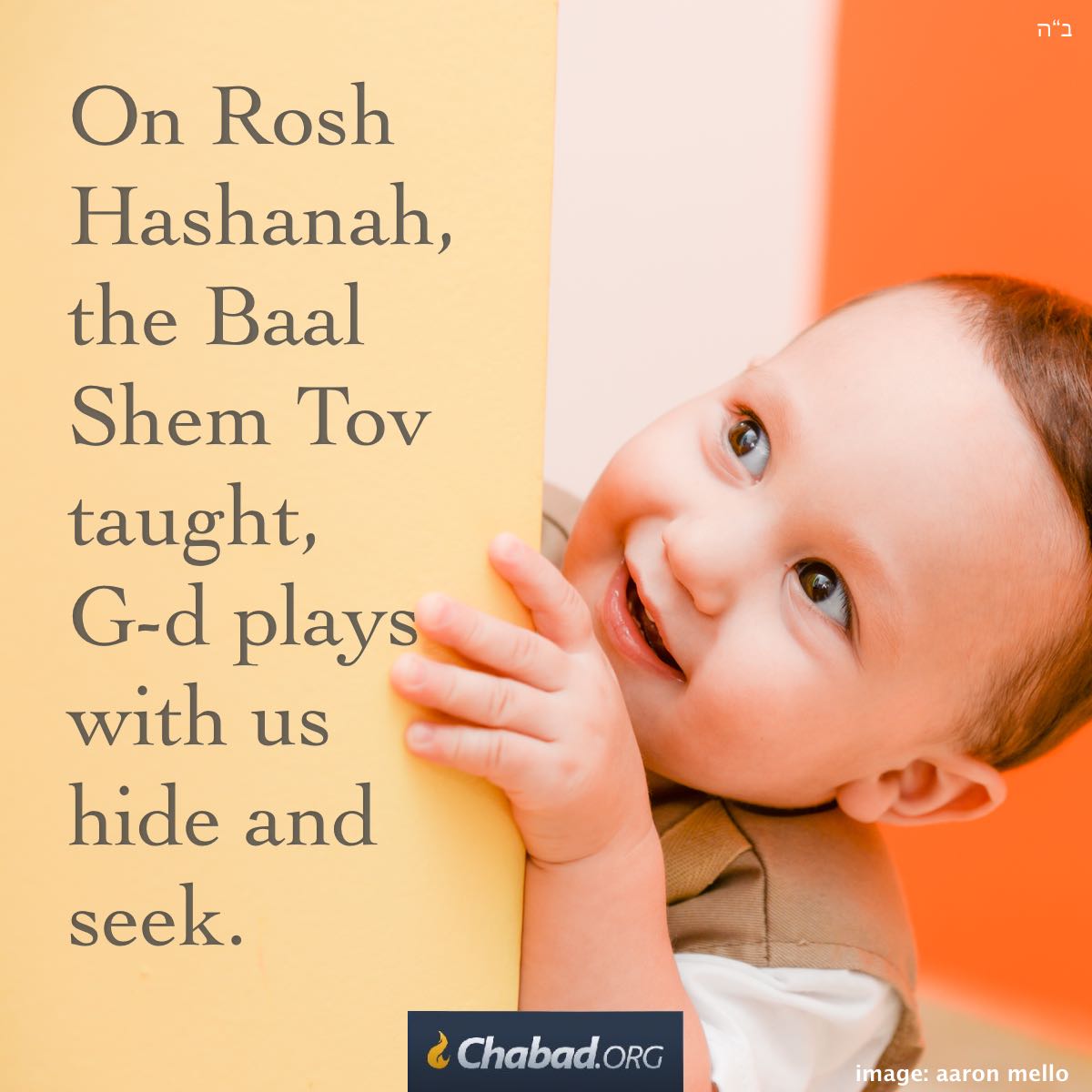
Rosh Hashanah, the Baal Shem Tov taught, is a game of hide and seek. G?d hides, we seek.

But where can G?d hide? Wherever you go, there He is. As the Zohar says, “There is no place void of Him.”

Rather, what the Baal Shem Tov meant is more like peek-a-boo—when parents hides behind their own fingers. So too, G?d hides Himself within the guise of an awesome, indifferent king, judging His subjects strictly by the book until the most sublime angels shiver in dread.

And we seek. We seek the father behind the stern voice. We are the small child who climbs into the king’s arms, tears off the mask and exclaim, “Daddy!”

Which is just what He was waiting for.


14. G?d Beyond He and She


When we refer to G?d’s presence within our world, giving life to all things, then She is the Shechinah.

When we refer to G?d’s transcendence beyond this world, we call Him “The Holy One, blessed be He.”

In our prayers, collectively our souls take the role of the Shechinah, petitioning the Holy One, blessed be He.

Our mitzvahs, our Torah study and our prayer unite these two aspects of G?d into a perfect whole. Through them, we reveal the essential G?d who is beyond beyond both the immanent and the transcendent—beyond all description and bounds.

And that is what we mean when we say, “On that day, G?d will be One and His name will be One.”


15. The Cosmic Mirror


The words of Torah we speak resonate in the heavens. And yet higher. For they are His words, on the rebound to Him.

On Rosh Hashanah, we say His words that recall His affection for our world;

He speaks them too, turning His attention back towards our earthly plane.

On Rosh Hashanah, we cry out from our very essence with the call of the shofar; He echoes back, throwing His very essence inward towards His creation.

Together, man and G?d rebuild creation.


16. The Primal Shofar


The sound of the shofar
is not the cry of a human voice.
It is the howl of an animal’s horn.

It is a cry so primal, so raw,
that the mind ceases to ponder,
the heart suspends its throb.

With the fury of a beast pent up in its cage,
the naked essence of the soul bursts out,
howling, ripping through heaven’s curtains,
awakening the primal essence of all being.

The raw core of your soul below
touches the primal essence above,
and now their reunion may begin.


17. The Essence-Cry


There are things that are important to us, so we speak about them.

There are things so important to us that the words flow out in a burst of emotion, rich words, expressive and vibrant.

And then there are things that shake us to the core. Things that do not care for the mind’s permission or for the right words—for the mind cannot fathom them, the most poignant words could not contain them. Things that can only break out in a cry, in a scream, and then in silence.

This is the sound of the shofar: The very core of our souls crying, “Dad! Don’t leave me here alone!”


18. Words & World


In the beginning, G?d spoke and the world came into being.

On Rosh Hashanah, every year, we speak praises and prayers, petitions and pleas. We speak of ourselves and we speak of others—in the synagogue, and at home.

On Rosh Hashanah, every word we speak counts. Because according to what we speak, and how we speak, so G?d speaks.

And accordingly, our world comes into being.


New Report Trails the Rise of Israeli Fintech

0

New Report Trails the Rise of Israeli Fintech

Over the last 18 months, 16 multinational financial firms have started operating in the Israeli tech hub or increased their local footprint

Amarelle Wenkert       10:3405.09.18
CTECH by CALCALIST

Over the last 18 months, 16 multinational financial firms started operating in the Israeli tech system, or increased their local footprint through strategic partnerships and investments, according to a new report by Start-Up Nation Central (SNC), a nonprofit working to promote Israeli tech.

Newcomers include French insurance firm AXA SA, Bank of Montreal, Fosun, TD Bank, AmTrust, and Mastercard.

In early 2017, AXA partnered with the Israeli venture capital firm Jerusalem Venture Partners (JVP) to sponsor an insurtech startup competition in Israel. Also in 2017, New York-based insurer AmTrust Financial Services, Inc. hired a local scout, Yair Smith, to spearhead the company’s search for Israeli technology.

Credit company Visa Inc. launched a technology scouting office in Tel Aviv in February. In June, Visa announced a $100-million venture investment fund focused on startups in Europe and Israel. The fund will look for technologies in areas like payments, information security, fraud prevention, and e-commerce, Visa said.

In March, Euronext-listed bank BNP Paribas SA made an undisclosed strategic investment in Viola Fintech, an Israeli $150 million fund.

Growing international interest is echoed by a rise in the number of new startups. According to the report, 76 fintech startups were founded in 2017, with an additional 30 companies launched in the first half of 2018.

The first half of 2018 saw Israeli fintech companies raise a record-breaking $422 million in investments, 33% more than the previous half year period, the report said.

Of some 480 fintech companies operating in Israel today, social trading company eToro Group Ltd. has raised the most so far in 2018. In March, eToro announced a $100 million Series E round led by China Minsheng Financial Holding Corporation Limited, a diversified holding company, with participation from Tokyo-based SBI Group, and Korea Investment Partners.

While unique in its scope, the eToro deal was indicative of the growing foreign interest in the Israeli fintech sector. According to SNC’s report, 73% of all venture capital-backed investment into Israeli fintech startups this year has involved foreign money.

he report states that deals in the fintech sector have become heftier in 2018, with median deal size nearly tripling since the last half of 2017. The first half of the year also saw a sharp rise in the amount of debt financing in Israel. $441 million in debt was raised in 2018, more than double the entire amount raised in this manner in 2017, by companies such as online lender BlueVine Capital Inc. and Alternative financing provider Behalf Inc.

Earlier this month, Calcalist reported that the Israeli Ministry of Finance is looking to establish regulatory sandbox programs designed to allow local fintech startups to test new technologies, services, and business models in a live environment, with minimal legal requirements. By doing so, the Israeli government hopes to help the local fintech sector introduce more innovative services domestically. The finance ministry estimates that out of the nearly 500 active Israeli fintech companies, only around 50 offer their services in Israel.

Plane with sick passengers quarantined at JFK

0

Plane with sick passengers quarantined at JFK


 – Emergency personnel responded to reports of sick passengers aboard an Emirates flight arriving at JFK Airport on Wednesday morning.  Hazardous materials crews were called to the scene just after 9 a.m. after the plane landed safely.  The New York City mayor’s office say the plane has been quarantined.


An airport source tells Fox 5 News that there was a “medical emergency” onboard the plane.  Passengers were in the process of being removed from and placed onto busses.  Some flight crew members were seen being loaded into ambulances on the tarmac.


All of the passengers from the plane were going to be examined away from the main terminal to make sure that there was not any risk of a contagious disease spreading.


A spokesman for New York City Mayor Bill de Blasio says representatives of the U.S. Centers for Disease Control and Prevention were on the scene.


A New York Police Department counterterrorism division tweeted that it was monitoring what appeared to be a “medical situation.”

NYPDCounterterrorism


UK Labour Party accepts full definition of anti-Semitism

0

UK Labour Party accepts full definition of anti-Semitism

Finally taking this step sounds “positive,” said Gideon Falter, chairman of Campaign Against Antisemitism, but doing so “should never have been in question.”

 After only adopting part of the International Holocaust Remembrance Alliance’s definition of anti-Semitism, the U.K. Labour Party on Tuesday reversed its course and adopted the meaning in its entirety.

However, the Jewish community has been anything but fully satisfied due to party leader Jeremy Corbyn’s long anti-Semitic history.

“However, those who surround Jeremy Corbyn have succeeded in adding an addendum based on a fallacy that the definition prevents free speech,” continued Falter. “Any such addition is an attempt to undermine the definition’s validity, despite its adoption around the world and the fact that the definition is already heavily caveated. We have also seen an amendment that Jeremy Corbyn attempted to add to the definition, which adds to the clear evidence that he himself fears the undiluted definition because of his past actions.”

Along with the Campaign Against Antisemitism, the European Jewish Congress welcomed the move, but called for Labour to apply the IHRA standard and purge its anti-Semitic members.

“Now that the Labour Party has adopted the IHRA definition in full, it must be used to root out antisemitism because its adoption is only a first relatively small step and not an end in itself,” the EJC said in a statement. “If the Labour Party does not root out and punish all those who contravene the definition, then this will be meaningless and mere window-dressing.”

The World Jewish Congress echoed the aforementioned sentiments.

“Corbyn must now do everything in his power to ensure that all such cases are dealt with as a matter of priority,” said WJC CEO and executive vice president Robert Singer. “At a time of heightened populism and extremism in Europe and beyond, we have been disheartened to see a lack of leadership from a once well-respected party on this issue. We hope action will be forthcoming.”

Friedman: We’ve thrown $10b. at Palestinians; peace isn’t a millimeter closer

0

Friedman: We’ve thrown $10b. at Palestinians; peace isn’t a millimeter closer

Explaining why Trump defunded UNRWA, ambassador to Israel complains that US taxpayers’ funds were used to perpetuate refugee problem; also slams PA stipends to terrorists


The United States has “thrown more than $10 billion” in aid to the Palestinians, but that spending has brought the region no closer to peace or stability, the US Ambassador to Israel David Friedman charged Tuesday, in an address explaining why US President Donald Trump thought it was important to halt US funding to UNRWA, the UN’s Palestinian refugee agency.

Friedman lamented that US taxpayer funds, rather than be used positively, had been partly spent on Palestinian Authority stipends to terrorists, to fund inciteful education, and to finance an agency — UNRWA — that, by extending refugee status to descendants of Palestinian refugees, was perpetuating rather than helping solve the refugee problem.

“To spend hard-earned taxpayer dollars to fund stipends to terrorists and their families, to expend funds to perpetuate rather than to mitigate refugee status, and to finance hate-filled textbooks — I ask you, how does that provide value to the United States or the region?”

Friedman added that the US would continue to seek other ways of supporting Palestinians.

“Make no mistake, the USA is a generous nation and we would love, truly love, to invest in this region for the return on investment of peace and stability in Israel and a better quality of life for the Palestinians,” he said. “Indeed, we continue to provide funding, 40 percent of the funding for the UN High Commission on Refugees. UNHCR, in contrast to UNRWA, seeks to end statelessness, not deploy it as a political weapon.”

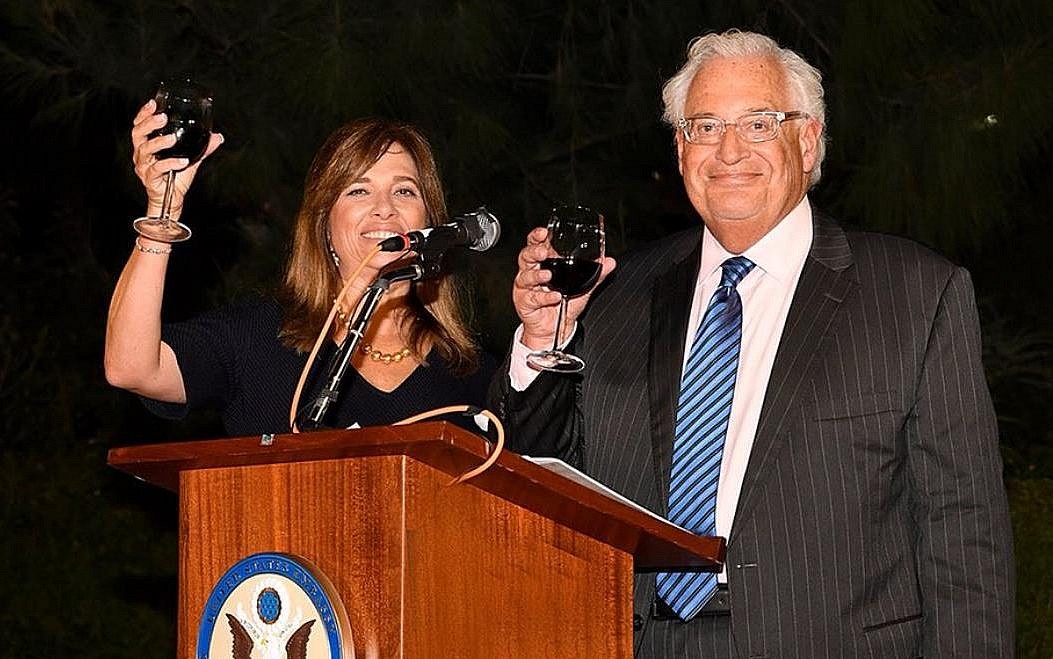
US Ambassador to Israel David Friedman (with his wife Tammy) makes a Rosh Hashanah toast for peace, September 4, 2018 (Courtesy)

In a Rosh Hashanah toast, Friedman also issued a call for peace: “Let us dedicate ourselves to building upon our great accomplishments, to making the US-Israel relationship even stronger, and to bringing peace, prosperity and security to the region.”

Last Friday, the State Department said in a written statement on UNRWA that the United States “will no longer commit further funding to this irredeemably flawed operation.”

The US had supplied nearly 30 percent of the total UNRWA budget, which provides health care, education, and social services to Palestinians in the West Bank, Gaza Strip, Jordan, Syria, and Lebanon.

Announcing the end to all its funding for UNRWA, the State Department castigated the agency for failed practices, and indicated that it rejected the criteria by which UNRWA defines Palestinian refugees, whereby the UN agency confers refugee status not only on original refugees but on their millions of descendants.

“The fundamental business model and fiscal practices that have marked UNRWA for years – tied to UNRWA’s endlessly and exponentially expanding community of entitled beneficiaries – is simply unsustainable and has been in crisis mode for many years,” the statement said, a reference to the fact that the agency grants refugee status to descendants of the original Palestinian refugees, something not granted by the UN to refugees from any other place.

The Palestinians claim that five million “refugees” — tens of thousands of original refugees from what is today’s Israel, and their millions of descendants — have a “right of return” to Israel. Israel rejects the demand, saying that it represents a bid by the Palestinians to destroy Israel by weight of numbers.

It says there is no justification for UNRWA’s unique criteria, by which all subsequent generations of descendants of the original refugees are also designated as having refugee status, including those born elsewhere and/or holding citizenship elsewhere; such a designation does not apply to the world’s other refugee populations.

Israel’s population is almost nine million, some three-quarters of whom are Jewish. An influx of millions would mean Israel could no longer be a Jewish-majority state.

On Tuesday, the White House also announced that it planned to slash more than $200 million in overall aid to Ramallah.

That same day, US Ambassador to the United Nations Nikki Haley questioned Palestinian claims to a “right of return” to modern Israel, saying she believed that the hot button issue should be taken “off the table.”

Haley suggested the Trump administration would consider an official rejection of the Palestinian demand that all refugees who were displaced between 1947 and 1948 — as well as all of their descendants — be allowed to return to modern-day Israel following a final peace accord.
Source: The Times of Israel

ZOA’s Title VI Case Against Rutgers Reopened by US Civil Rights Office

0

ZOA’s Title VI Case Against Rutgers Reopened by US Civil Rights Office

Landmark Decision Will Use State Dept’s Accurate Anti-Semitism Definition to Assess Motive


ZOA President Morton A. Klein and Director of the ZOA Center for Law and Justice Susan Tuchman, Esq. released the following statement:

In a long-awaited decision, the U.S. Department of Education’s Office for Civil Rights (OCR) is re-opening the ZOA’s 2011 case against New Jersey’s Rutgers University, which alleged that Jewish students were subjected to a hostile environment in violation of Title VI of the Civil Rights Act.  In a groundbreaking decision issued on August 27, 2018, OCR declared that in assessing the evidence of whether students were discriminated against based on their actual or perceived Jewish ancestry or ethnicity, OCR will be using the working definition of anti-Semitism that the U.S. Department of State currently uses.  This definition accurately addresses how anti-Semitism is expressed today; it recognizes that Jew-hatred can be camouflaged as anti-Israelism or anti-Zionism.  OCR is not only reassessing the evidence already in the record; the agency is also going to determine whether a hostile environment for Jewish students currently exists at Rutgers.

The ZOA is proud that it was our work that led to this important decision, which will help OCR assess and address anti-Semitic harassment and discrimination. It was also the ZOA’s work that led to OCR’s decision in October 2010 to reinterpret Title VI to protect Jewish students.

The ZOA is proud that it was our work that led to this important decision, which will help OCR assess and address anti-Semitic harassment and discrimination. It was also the ZOA’s work that led to OCR’s decision in October 2010 to reinterpret Title VI to protect Jewish students.

OCR’s decision comes more than seven years after the ZOA filed a student-backed Title VI complaint against Rutgers, on July 20, 2011.  The complaint alleged that (1) a Jewish student was harassed by the Outreach Coordinator of the University’s Center for Middle East Studies who physically threatened and posted anti-Semitic comments about the student on Facebook; (2) a Jewish student was physically threatened by other students on Facebook; and (3) at an anti-Israel event titled “Never Again for Anyone,” an anti-Israel student group called “Belief Awareness Knowledge and Action” (BAKA) discriminated against Jewish and pro-Israel students by imposing and selectively enforcing an admission fee against them.

After investigating the three allegations, OCR issued a letter of findings on July 31, 2014.  OCR determined that there was insufficient evidence of discrimination with respect to all three allegations and closed the ZOA’s case. The ZOA filed a timely appeal on September 29, 2014.

Almost four years after the appeal was filed, and after numerous inquiries by the ZOA, OCR finally issued a decision on the appeal.  The decision was delivered in a letter to the ZOA from new OCR head Kenneth L. Marcus, Assistant Secretary for Civil Rights.

Assistant Secretary Marcus decided to re-open OCR’s investigation of the ZOA’s third claim, regarding the anti-Israel event on January 29, 2011.  Mr. Marcus concluded that when OCR investigated the claim, it erred in disregarding evidence that Jewish students were treated differently by being charged an admission fee for the event.  OCR also erred in disregarding evidence to substantiate the ZOA’s allegation that the University failed to respond appropriately to student complaints regarding the allegedly discriminatory imposition of the admission fee at the event.

In fact, as Assistant Secretary Marcus determined, the ZOA did furnish such evidence to OCR. An email from a BAKA student volunteer at the anti-Israel event stated, in relevant part:  “We need to start charging because 150 Zionists just showed up!”  Student witnesses corroborated that this volunteer sent the email, and that the University refused to consider the email or the students’ complaints about how they were treated at the event.

Assistant Secretary Marcus stated that “it is important to determine whether terms such as ‘Zionist’ are actually code for ‘Jewish.’”  It is also “important to determine whether the conduct related to Israel was motivated by anti-Semitism.”

To determine whether students were discriminated against on the basis of their actual or perceived Jewish ancestry or ethnicity, OCR will – for the first time – use the International Holocaust Remembrance Alliance (IHRA) working definition of anti-Semitism.  This definition – widely used by governmental agencies, including the State Department – accurately reflects the many forms of contemporary anti-Semitism, including that some Jew-hatred is expressed as opposition to Zionism or Israel.

At Assistant Secretary Marcus’ direction, OCR’s New York office will reopen the ZOA’s case to reassess the evidence in the record in light of the State Department’s definition of anti-Semitism.  In addition, OCR will determine whether a hostile environment currently exists at the University for students of actual or perceived Jewish ancestry or ethnic characteristics.

Morton A. Klein, the ZOA’s National President, and Susan B. Tuchman, Esq., director of the ZOA’s Center for Law and Justice, strongly praised Assistant Secretary Kenneth Marcus and his decision to re-open the ZOA’s Title VI case against Rutgers:  “It took a leader like Kenneth Marcus to finally decide the ZOA’s appeal and to also make it clear that OCR will finally be using a definition of anti-Semitism that makes sense and that reflects how anti-Semitism is so frequently expressed today, particularly on our college campuses.  Hate groups like Students for Justice in Palestine try to convince others that their attacks on Zionism and Israel are legitimate political discourse.  But as the State Department definition of anti-Semitism recognizes, these attacks are often a mask for Jew-hatred, plain and simple.

“We are grateful to Assistant Secretary Marcus for the experience and qualifications he brings to OCR.  Under his leadership, we believe OCR will be better equipped to fulfill its mission to protect Jewish students and ensure that they are afforded a learning environment that is physically and psychologically safe.  This is what every student deserves.  We look forward to cooperating with OCR and providing the agency with whatever additional information it needs to reassess the evidence in the record and to determine whether a hostile environment currently exists at Rutgers.

“We are also deeply grateful to the students and others who had the courage and conviction to support the ZOA’s Title VI complaint and to come forward in OCR’s initial investigation. They have all waited far too long for the justice they deserve.  We are hopeful that with Assistant Secretary Kenneth Marcus’ leadership at OCR, Rutgers will finally be held accountable for failing to protect Jewish students from harassment and discrimination.”

WP Twitter Auto Publish Powered By : XYZScripts.com