
Yehoshua Heshel Mishulovin to Chanie Niasoff

Almost anyone who’s ever gone out on a date has some sort of “date story” about the nightmares they encountered when meeting someone for the purpose of spending their lives together. You’ll find dates who got arrested, ones who fell asleep, and everything in between. Perhaps my favorite date story is one that didn’t happen to me.
A friend who lived in Brooklyn had a cousin come in from “out of town,”which for the purposes of this article shall geographically refer to any locale with fewer than six pizza shops per capita and only four shuls to choose from on your block. She was to go out with a fellow from the Brooklyn area so she traveled into New York to make it easier for him.
As they waited in her cousin’s second-floor apartment, the time arrived for her date to pick her up, but he didn’t show up. After a few minutes, they heard a car unceremoniously honk outside. Now, as it was Brooklyn, a car honking was not uncommon, but after a few more tootles, my friend went down to the car. The guy behind the wheel rolled down the window and called out to him, “Yeah, I’m here to pick up Suri. Is she ready?” Stunned, my friend walked upstairs and told her this was, indeed, her date for the evening.
Suri was floored by the man’s pure callousness and lack of respect for her. “If he can’t even get out of the car to come get me,” she said, “I’m not going.” Her cousin dutifully brought the message back down to the waiting young man. “Suri says she isn’t coming down.”
Perturbed, the young man smacked the steering wheel and said, “Oh, come on! They ALWAYS say that!”
While we may chuckle at this poor fellow’s oblivion to what he was doing wrong, we should realize that we’re not all that different. Albert Einstein is quoted as saying: “Insanity is doing the same thing over and over again but expecting different results.” I noticed that in real life, we do just that.
When my girls were younger, I had an epiphany one day when one asked the other a question. Her sister answered with a generic reply, but the questioner, looking for precise information began to get annoyed. She raised her voice and asked THE EXACT SAME QUESTION!
I asked her, “Sweetie, if you didn’t like the answer she gave you, why did you ask the same question again? If you would clarify your question, and say, “OK, but can you tell me…” perhaps you would get what you want. This way, she will just respond as she did before.”
I thought about this during Sefira, when I counted the same way I have counted for years, making my way to forty-nine nights, but not really feeling a difference. Shouldn’t something have happened? Shouldn’t I have seen some result after another year of counting? But that’s just it – it was “another year of counting.” My Shemona Esrai isn’t much different. Do I think about what I’m saying or just expect that saying the words is enough?
We often feel that if we go through the motions of something, a result will magically appear from some external force and we will receive a great benefit. What we often fail to realize is that we can’t change the world; we can only change our reactions to it. If we don’t get what we hoped, then we need to change how we go about our attempts to get it, or at least our expectations of what we need to get.
One of the most useful products in the “home handyman’s toolkit” is WD-40. As they say, all you need is duct tape and WD-40. If something moves, duct tape it. If it won’t, use WD-40. Do you know why it’s called WD-40? Because it took the staff of Rocket Chemical Company forty tries to get the Water Displacement formula worked out. Phillips 76 got its name because the drillers came up dry 75 times in 75 other places before striking oil and finding success.
What if they had kept making batches of WD-1? Or if Phillips tried drilling in the same hole time and time again, getting more and more upset that they hadn’t struck oil already? Do you think we’d have heard of these companies? Of course not.
There’s a lesson in that. If we meet with disappointment, we can and should recognize that it might not have been meant to be. At the same time, that’s not to say we shouldn’t try again in a different way. Disappointments may just be G-d’s way of saying, “You need to try something else.”
There’s a great quote that I’ve used as my signature on my e-mails that encapsulates this idea. “When things don’t go according to plan, change the plan.” Not to would just be insane.
Jonathan Gewirtz is a freelance writer whose work has appeared in publications around the world. He also operates JewishSpeechWriter.com, where you can order a custom-made speech for your next special occasion. For more information, or to sign up for the Migdal Ohr, his weekly PDF Dvar Torah in English, e-mail info@JewishSpeechWriter.com and put Subscribe in the subject. © 2013 by Jonathan Gewirtz. All rights reserved.By Rabbi Jonathan Gewirtz

We hope this advice is of assistance to you and please feel free to contact OHEL’s Rapid Response Trauma team for more assistance. We can be reached at 1800-603-OHEL
Dr. Norman Blumenthal, Ph.D.
OHEL’s Director of Trauma, Bereavement & Rapid Response Team Dr. Norman Blumenthal is a well known specialist and speaker in trauma. A licensed clinical psychologist in private practice in Cedarhurst, NY. Dr. Blumenthal is the former Director of Bereavement and Crisis Intervention Services for Chai Lifeline. Dr. Blumenthal also serves as Educational Director of the Bella and Harry Wexner Kollel Elyon and Semikha Honors Program at the Rabbi Isaac Elchanan Theological Seminary of Yeshiva University. Dr. Blumenthal is past Vice President of NEFESH. (An International Network of Mental Health Professionals).
OHEL TRAUMA Services Meets the Immediate Needs of Individuals, Families and Communities Facing Trauma. We offer Experienced Trauma Specialists, Provide Comfort and Professional Counseling, Resources and Referrals.
Please contact OHEL at 1800-603-OHEL or trauma@ohelfamily.org

Sangria
Take an abundance of fruits and chop them finely (cherries, peaches, apples, oranges etc.) In a big jug or bowl throw in the chopped fruits together with a stick of cinnamon (can substitute with other spices if desired). Add a bottle of white or red wine (dry or semi-dry), a cup of orange juice, some liquid sugar (according to your taste) and a dash of brandy (you can also swap this for orange liquor or cognac). The wine itself does not need to be very expensive, the opposite, use a young, refreshing wine such as the Mount Hermon Red.
Sangria can also be made with a sparkling wine such as Gilgal Brut, or for those who like it a little sweeter, Golan Moscato, for an added twist to the cocktail.
If wanting to surprise your guests with a more unusual drink, Debbi Sion, head of the training and education department at the Golan Heights winery in Israel recommends two more fun and easy to prepare cocktails to be drunk under the stars:
Merlot -Tea Punch
In a deep glass mix together 60ml of Golan Merlot, 20ml of dark rum, 40 ml or Peach ice tea, 20ml of orange juice and 10ml of lemon juice. Add lots of ice and garnish with a ginger star.
Summer Blanc
Fill a deep glass with small melon balls. Poor 60 ml of Yarden Sauvignon Blanc mixed with 10ml of lemon juice over the melon. If feeling like splurging, scatter some violet leaves over the drink.
By Anna Harwood
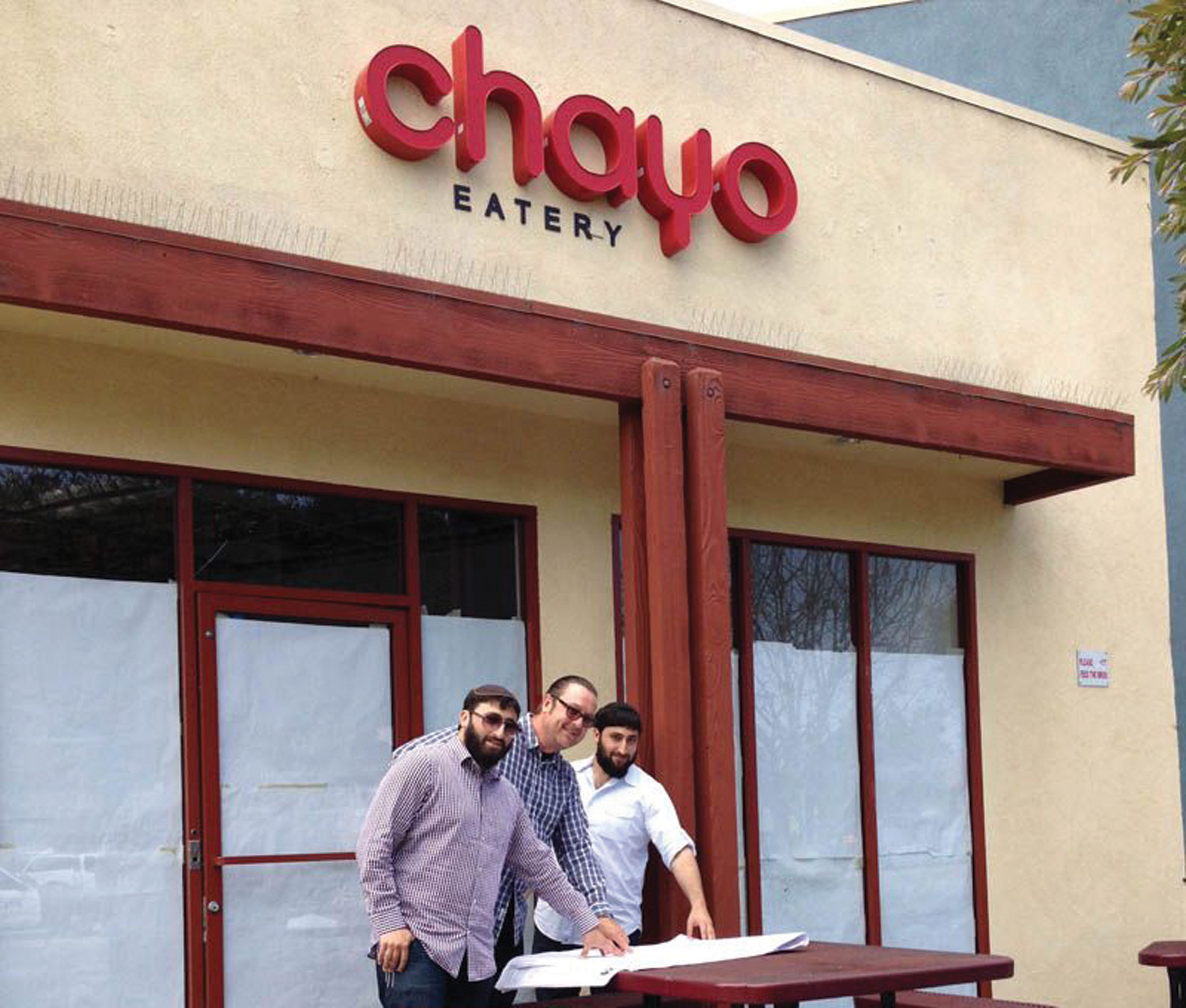
Brothers Abe and Levi Chayo have opened Redondo Beach, California’s first Kosher eatery, offering dairy and vegetarian dishes.
When Rabbi Yossi and Shterna Mintz opened their fledgling Chabad center in Redondo Beach, Calif., people told them it was a lost cause, saying that no Jews lived there.
Seventeen years later, with a new kosher restaurant under construction and Hebrew day school on the horizon, the community has grown and developed beyond their wildest imagination.
The restaurant, slated to open in July, is the brainchild of two brothers, Abe and Levi Chayo.
“My brother lives in Redondo Beach and works in Torrance,” a nearby business district, says Levi Chayo. “I was living in New York at the time, and he told me that there are many Jewish people in his area who keep kosher, and they could really use a kosher restaurant. I decided to go for it.”
But the 21-year-old had no experience in the business and knew he would need to beef up his hospitality know-how before opening up his own place. After working in a number of Brooklyn restaurants for several months, he felt ready to take the plunge.
So Chayo flew to Torrance and started planning. “Even though there are a fair number of kosher businesspeople and families in the area, we are working on making food so memorable that we will be able to compete with the non-kosher restaurants as well. We plan on baking all of our own bread and pizza dough in-house, and will be importing exclusive chalav Yisrael cheeses from the East Coast,” he said, referring to dairy products produced under the constant eye of a religious supervisor to ensure that kosher standards have been maintained throughout the production process.
The restaurant, to be named Chayo Eatery, will offer dairy and vegetarian dishes.
Shmuli Pinson, CTO at a nearby high-tech firm, says “it will be nice to have a kosher place to go for lunch meetings or even just to grab a quick bite during the work day.”
Mintz, who co-directs Chabad of the Beach Cities (Hermosa Beach, Manhattan Beach and Redondo Beach),explains that although the restaurant is a private venture, it dovetails with Chabad’s mandate to encourage more Torah awareness and observance.
Keeping kosher is a crucial step
At a public gathering in the summer of 1975, the Lubavitcher Rebbe, Rabbi Menachem M. Schneerson, of righteous memory, urged those present to encourage and facilitate observance of the kosher dietary laws, as part of his 10-point mitzvah campaign. The Rebbe explained that keeping kosher a crucial step toward living a Torah lifestyle; whatever a person eats has an effect on his or her thoughts, emotions and outlook, he said. At that time, the Rebbe offered to pay half of the expenses incurred during the koshering process, whereby a kitchen is purged from any unkosher traces and dedicated for exclusive kosher use.
Mintz says having a restaurant to recommend will make it much easier for him to guide people to kosher observance: “I can now tell people that if you can have a kosher lunch delivered, why would you eat unkosher?”
Chip Herwegh echoes that point. “Until now, there really were no options other than preparing and eating everything at home,” he says. “We have been talking about this for years. Having a kosher restaurant right here is going to make it much simpler for me to go kosher. This is a very important step in community-building.”
A native of Manhattan Beach, Calif., Herwegh first became acquainted with the Chabad center when he married a Jewish woman. As the family became more involved in Judaism and their three children enrolled in the Chabad Hebrew school, Herwegh underwent conversion. He chose the Hebrew name Gavriel Noach, after Rabbi Gabi Holtzberg, director of the Chabad house in Mumbai, India, who was murdered in the November 2008 terror attacks there, along with his wife, Rivkah, and four guests.
“Gabi was out there spreading light, and I hope to be able to do a little bit of that as well,” says Herwegh, one of the principal organizers and funders of the restaurant.
Mintz sees the new establishment as a real milestone.
“Over the years, our community center in Redondo Beach has expanded to include three rabbis and 56 other employees,” he explains. “Our center offers a mikveh ritual bath, a synagogue where hundreds pray regularly, a preschool with an enrollment of over 140. Our satellite center in Manhattan Beach has a Judaica store and a full array of Chabad activities from Torah classes to clubs for seniors and toddlers.
“Yet having a kosher restaurant in Torrance is something that we could have never imagined.”
Levi Gelb, an entrepreneur-writer who grew up in the area, says: “When I was young, we had a little congregation in a storefront, and we would drive to L.A. to have anything Jewish. The fact that our community can support a kosher eatery tells me that the area has really come a long way. There are a lot of young families, and people are moving in. It is becoming a real community.”
By Menachem Posner – Chabad.org

Rosh Yeshiva Rabbi Ezra Shochat recalled “the lifelong dedication to Ahavas Yisroel” of S. Monica Shliach Rabbi Avremel Levitansky OBM.
The 6th yahrtzeit of beloved S. Monica Shliach Rabbi Avrohom HaLevi Levitansky obm was marked at an event on Sunday Yud Sivan with hundreds in attendance.
As people entered the Shul, they Davened Mincha and were helped with Teffilin if needed. They then washed and sat down at the tables to enjoy a full dinner, and spend some time “Farbrenging” with their table mates, recounting their experiences with Rabbi Levitansky, or “Avremel” as he was fondly known.
Rabbi Eli Moshe Levitansky, Director of Chabad on SMC Campus, emceed the event which began with the 12 Pesukim recited by the children. He then called on Shliach of the Rebbe to Beverly Hills, and Rav of Anash, Rabbi Yosef Shusterman, who welcomed the crowd, and spoke of his dear friend and colleague, whose Yahrtzeit was being commemorated.
The guest speaker of the evening, Rabbi Ezra Shochat , Rosh Yeshiva of Yeshivas Ohr Elchonon Chabad then addressed the theme of the evening, “The lifelong dedication to Ahavas Yisroel.” He called upon everyone to take these lessons to heart, and add in observance of practical Mitzvos, and to help others to do so as well.
Following in the tradition of his father, Zev Mayer Levitansky made a Siyum on Maseches Sota. He then made a Hadran, connecting the Halachos of a Sota with a number of lesser-known stories of his father which illustrated his character trait of love and dedication to Jewish education.
Rabbi Maimon, a close friend of Rabbi Levitansky and a direct descendant of the Rambam made a Siyum on the Rambam, after which Rabbi Isaac Levitansky, Shliach of Chabad of Simcha Monica, shared a Sicha of the Rebbe on the Siyum Harambam.
The official part of the evening ended with Benching and Maariv, after which the tables were rearranged to Farbrengen style, where the Farbrengen continued until late into the night. A Teshura was distributed which included letters of the Rebbe and some of Rabbi Levitansky’s stories.
Amongst those who Farbrenged were Rabbi Avtzon, the Rosh Yeshiva of RAPS, Rabbi Schwartz, one of the first pioneering Shluchim, Rabbi Shimon Raichik, Rabbi of Congregation Levi Yitzchak, and Rav of Anash, as well as Rabbi Dovid Thaler, Menahel of the Mesivta, who related many memories which they shared with Rabbi Levitansky.
Participants were asked to donate to the Camp Fund, one of Rabbi Levitansky’s primary projects, to ensure that every Jewish child has a Torah true summer; something which the Rebbe spoke about many times.
In 1775, one year prior to the American declaration of independence, a Portuguese Jew came to America, making landfall on the shores of New York. Haym Solomon found himself sympathizing with the colonists and decided to support the Revolutionary War efforts, becoming the biggest financer of the Continental army, pioneering the now over 300 year old tradition of Jews supporting the United States.
May is Jewish American Heritage Month, as proclaimed by President Obama and the United States Congress. Despite years of oppression and persecution, Jews have always risen up to help bring improvement and progress to society. For more than 350 years, Jews have been making major contributions to American culture, including arts, science, medicine, sports, business, government and military service.
Honoring the myriad contributions and achievements of Jewish Americans in the United States, Congresswoman Debbie Wasserman-Shultz explained, “Jewish American Heritage Month [is] to increase tolerance and raise awareness about …the depth and breadth of contributions of Jews through 350 years of Jewish life in America… through every walk of life is incredibly important.”
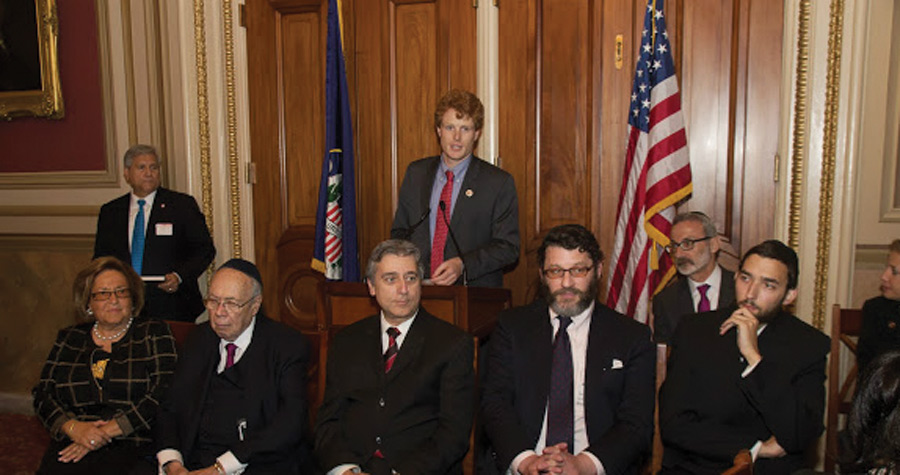
This tradition has continued annually and this year, five individuals or groups, each of whom are pillars of the Jewish community, will be honored by Members of Congress at a celebration, coordinated by The Friedlander Group, in the Capitol Building held on May 22nd for their contributions to American society. With their collective participation in human rights, health services, business, technology, government, justice system, and law enforcement the honorees are the embodiment of American ideals. The Tribute event will be chaired by Greg Rosenbaum, Co-Chair of the Jewish American Heritage Month Foundation, with Rabbi Joseph Potasnik, executive vice president of the New York Board of Rabbis, acting as Master of Ceremonies.
Greg Rosenbaum acknowledged the importance of The Friedlander Group’s event as an integral part of the Washington, DC celebration: “Honoring distinguished Jewish Americans who have contributed so much to our nation in the Capitol Building fulfills the purpose of Jewish American Heritage Month this May and its promise for years to come.”
The special guests recognized at this year’s annual celebration include:
Harvey and Gloria Kaylie have been stalwart supporters of OHEL Children’s Home and Family Service for over a decade.
Harvey Kaylie is the founder of Mini-Circuits, a global leader in the development and manufacture of multiple core technologies. Since 1969, OHEL has been helping people of all ages surmount everyday challenges, heal from trauma, and manage with strength and dignity during times of crises, in the realm of foster care, housing, outpatient counseling and day programs. OHEL serves thousands in need every day in communities in New York, New Jersey, South Florida and Los Angeles, California. Driven by a shared vision to break down stigma in the community, the Kaylies provided the seed capital for OHEL to open the groundbreaking Camp Kaylie at OHEL – the first-of-its-kind integrated summer camp for kids of all abilities. In the words of Harvey Kaylie, “Over my long and successful career, the accomplishment of which I am most proud is Camp Kaylie. My dream of a state-of-the-art camp providing a marvelous experience for children of all abilities has been fulfilled.”
Founded over 40 years ago, The Rothenberg Law Firm LLP is exclusively dedicated to representing injured people of every race, gender and creed, and is an outspoken opponent of attempts to limit the rights of injury victims. The firm has earned national prominence and recognition for its cutting edge work in product liability, traumatic brain injury, wrongful death, medical malpractice, and construction litigation. The firm opposes all forms of religious discrimination, and its founder, Allen L. Rothenberg, has served as the national president of COLPA, the National Jewish Commission on Law and Public Affairs, in which he works tirelessly to ensure that the United States accommodates religious observance within a secular society not only for Jews, but for members of all religions. The Rothenberg family of lawyers includes parents Allen and Barbara, six of their eight children who work in the firm – Harry, Marc, Beth, Ross, Scott and Melissa – as well as Randi, a former Federal prosecutor, and Rachel, a pediatric nurse practitioner.
The Edmond J. Safra Synagogue, the dream of Mr. Edmond J. Safra A”H, the world renowned banker and philanthropist, is celebrating its 10th anniversary. Through the dedication and generosity of Mrs. Lily Safra, his beloved wife, Mr. Safra’s dream has become a reality. The synagogue has flourished and become home to the Sephardic community of New York’s Upper East Side. It is an active element in the growth of the Jewish congregation under the leadership of Rabbi Elie Abadie, M.D. 10 prominent families from the Upper East Side will join us at the Ceremony. Simcha Eichenstein is a senior advisor to New York State Comptroller Thomas P. DiNapoli in the division of Intergovernmental and Community Affairs. He is considered a rising star in New York State government who upholds the highest ethos of Jewish commitment to public service and has earned the respect of elected officials from across the political spectrum for his integrity, and overall keen insight to the various challenges facing the state of New York. In addition to acting as sole trustee of the $150.6 billion Common Retirement Fund, one of the largest institutional investors in the world, the Comptroller’s office maintains the State’s accounting system and administers the State’s approximately $15 billion payroll.
As the founding director of Kestenbaum & Company, a New York City based boutique auction house dedicated to the sale of Rare Books, Manuscripts, Ceremonial and Fine Art, Daniel E. Kestenbaum regards the essential core value of his company as seeking out and subsequently publicizing the importance of Judaic historical artifacts that are crucial to a keener understanding of one’s Jewish identity and thus leading to a more upstanding appreciation for ethical citizenry. Kestenbaum & Company is now the largest niche Hebraica auction house in America having sold to date more than 30,000 lots at auction of antique Jewish rarities. With 25 years in the auction business, senior collectors, specialized dealers, acquisition directors and museum curators around the world rely on Daniel’s expertise and integrity. He is a much sought after expert consultant and appraiser in his specialized fields of rare Hebrew books and manuscripts, Judaic antiques and fine arts.
For more information please visit: www.TheFriedlanderGroup.com/JewishHeritageCelebration or email Tribute@TheFriedlanderGroup.com

We are very spoiled here in Los Angeles. Within footsteps we have an abundance of kosher markets, countless kosher restaurants offering food for almost any palate. You can choose which mikveh to visit with a handful of choices in a matter of a few miles. Generally speaking, in the United States a community is lucky if it has even one Jewish day school. In Los Angeles we have tens of schools ranging for every age and level of observance. Not sure what synagogue to attend? You can literally spend months, Shabbat after Shabbat, trying out new places every week all within a matter of blocks. In the U.S.A., other than possibly New York, it doesn’t get better than to be a Jew in Los Angeles—and we even have better weather than New York! So perhaps we could even rank first among all as the top place in the United States to live as Jew. However, as most of us know, and as I see in my private practice over and over again, this luxury of living such a full and expansive Jewish life comes with one major complication: the price tag.
Families who wish to live a Jewish life and raise children in a Jewish context—be it a Jewish school or Jewish camp—must reach deep within their pockets to make it happen. For many, this takes a massive toll on the stability of marriage and family and the ability of schools and camps to financially accommodate their communities. Among divorced couples, financial stresses and pressures rank among the top reasons for fighting and eventual break-up, and our Jewish community is not immune to this. While discussing this with one of my clients currently going through divorce, he made an astute comment. He said, “A religious (defined by keeping kosher, sending kids to Jewish schools and camps) Jewish couple or family earning $100,000 a year is equal to a non-religious or non-Jewish family earning $50,000 a year. The money simply doesn’t go far due to the additional financial burden affiliated with expenses for Jewish living. It can be almost impossible to make ends meet.”
This time of year is particularly stressing for Jewish families. At this time many people are going through the financial aid process for the following school year while also having to make arrangements to pay for summer activities. I see an increase in arguments between spouses which always leads to an increase in general dis-ease in the family’s home. But these things are not new, and chances are if you are reading this you may personally be impacted by similar challenges. The question becomes how do we as a community work to alleviate some of these financial burdens? I’ve seen some amazing work done by schools and camps in offering financial aid. I know the Jewish Federation of Los Angeles helps to support Jewish schools and camps through various programs making it easier on families. However, I recently had another idea, and it involves truly seeing if people—specifically our communities’ business establishments—are willing to step up to the plate. After all, there are hundreds of thousands of Jews supporting businesses up and down Pico, Fairfax, LaBrea and all of the other heavily Jewish neighborhoods. Perhaps one or more of them would consider helping out if they don’t already do so.
Here is what I propose: I’d like to see every single kosher market, Judaica store, kosher restaurant, and other shops up and down our major Jewish streets where the Jewish community supports commerce to commit 3% of their gross earnings towards the Jewish day school or camp of their choosing as a donation to support the financial assistance programs at those respective places—without raising prices for goods and services. I’d like to see our consciousness here in L.A. be one of understanding that raising Jewish children is indeed a community affair and that in order for families to be able to do so with less financial stress our neighborhood establishments can step up and support us just as we support them as patrons. I’d like to see a sign in the window of each establishment that says, “We donate 3% of your purchase to (fill in the blank) financial aid program to support our community’s families.” If you are the owner of such an eatery, shop, or market, I’d like to know you are doing it so that I can shout it from the mountain top and let everyone know. If we are going to be able to continue to raise Jewish families without being crushed by the financial demands of doing so then we must, as a community as a whole, support one another.
I look forward to receiving emails from readers and business owners letting me know about signs going up in windows up and down Pico, Fairfax, and the rest about the 3% solution of helping one-another. Establishments who prove they are doing so will be recognized in future columns. We do have the power as a community to lessen the burden. My email is mia@bhcounselingcenter.com and your comments are always welcome. Wishing you a successful end to the school year and mazal tov on any graduates in your families!
By: Mia Adler Ozair
Mia Adler Ozair, MA, LPCC, NCC is a licensed clinical psychotherapist and educator with a private practice in Beverly Hills, California. Mia is licensed in both California and Illinois and she can be reached through her website at www.bhcounselingcenter.com or followed on Twitter @MiaAdlerOzair.

You may not know it, but dental cavities are the most common childhood disease, with more than half of children affected! Despite this surprising fact, for most children the disease is very preventable. This article hopes to give some helpful educational advice and tips to help you do all you can to prevent dental disease in your child.
Brushing with fluoridated toothpaste
A walk through the oral care aisle in the pharmacy can be very overwhelming with so many products claiming to prevent cavities! However, the best tools are something we are all familiar with, an old fashioned toothbrush and toothpaste. Many scientific studies have shown that the easiest and most effective way to prevent cavities in our children is routine and well-performed brushing with fluoride toothpaste. Covering all sides of the teeth in fluoride toothpaste daily provides a steady defense against the cavity process. For this to be effective, we need to be confident that the brushing is being performed properly. Therefore, we encourage parents to start brushing their children’s teeth as soon as they come in, and continue to help their children until they have the ability to brush well on their own, usually around age 7 or when they can tie their own shoelaces.
Fluoride
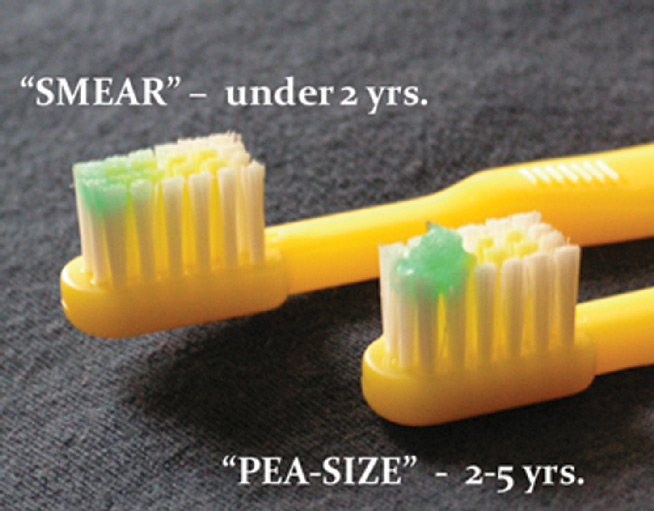
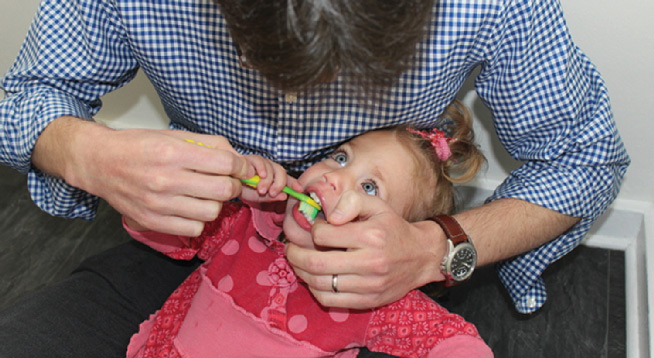
Like any other medicine, fluoride has recommended dosages that allow for the maximum benefit with minimum risk. Too much fluoride may result in a condition called fluorosis, which shows up as a white speckled appearance on the adult teeth. For this reason, different amounts of toothpaste are recommended for different age children to ensure that the optimal dose will always be given. These recommended amounts of toothpaste are calculated with the assumption that all the paste will be swallowed, which is unlikely and gives a large margin of safety. Once a child can reliably spit out toothpaste, the amount placed on the brush is not as critical. The following pictures illustrate the proper toothpaste amounts and proper tooth brushing positioning based on age:
The cause of cavities
Many people think that cavities are caused by sugar, but they really are caused by bacteria! That’s right, cavities are an infectious disease! Babies are not born with cavity causing bacteria, therefore it is important for parents to limit the amount of saliva sharing activities such as spoon sharing during the early months of a child’s life. Parents should also be careful not to place a pacifier in their own mouth to hold or clean it. Once colonized, these bacteria cause cavities by converting sugar into acid, which dissolves the teeth. After each instance of sugar entering the mouth, an acidic “cavity causing” environment lasts for about 30 minutes.
Diet
With this in mind, another important preventive factor is being careful about sugar in a child’s diet. Frequent encounters with sugary foods or drinks keep the mouth in a “cavity causing” environment for lengthy amounts of time which place the child at much higher risk for cavities. While it’s not realistic or fair to expect sugar to be removed from the diet, we recommend that sugary snacks or drinks only be given with a meal and for a limited amount of time. Cheese, fruits, vegetables, water, and plain milk are excellent between meal snacks that are actually good for the teeth!
Sealants
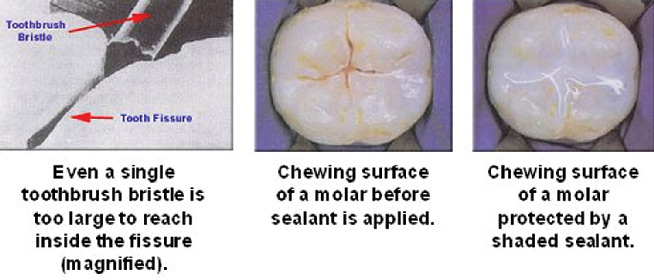
The most common site for cavities is on the pits and grooves of the teeth; these are called “pit and fissure” cavities. The cavity causing bacteria are able to easily find shelter in these areas and release acid without much difficulty. For many years, the only way to fight these cavities was keeping the grooves clean and using fluoride. Fortunately, dentistry has a much more powerful tool these days called “sealants.” These sealants are a liquid plastic material that is flowed into the pits and grooves of teeth then hardened with a blue light. The grooves are then protected from bacteria, thereby preventing the most common form of decay. Sealants are usually only applied to permanent molar teeth, once at age six and again at age twelve. They are checked at each cleaning and reapplied if needed, ensuring constant protection. Since their introduction, sealants have drastically reduced the amount of “pit and fissure” decay. It is important to note that modern sealant materials are BPA free.
 Trauma
Injuries to the mouth and teeth are fairly common in healthy and active children. At first, these injuries can appear very serious and scary, as the mouth has many blood vessels and will swell easily. However, most of these injuries will heal fully and quickly without any intervention from a dentist. There are three instances when immediate treatment is necessary to save the tooth:
An adult tooth is knocked out
A tooth is very loose due to injury
A child cannot bite down fully due to injury
If any of the above occur, a dentist should be seen right away and will be happy to accommodate you. Any other tooth injury still warrants a visit to dentist for an evaluation, but can wait until a convenient time.
Conclusion
We hope this guide gives you some helpful information and food for thought. Our main goal is to prevent children (and future adults) from experiencing this disease by education, prevention, and early intervention. A good early foundation associated with positive experiences sets up a child for a lifetime of healthy, fear-free dental care. We are committed to being engaged with the community to achieve this goal, so please let us know how we can help you!
By: Dr. Michael Kleinman
Dr. Michael Kleinman practices Pediatric Dentistry in Beverly Hills and Santa Monica. He firmly believes that almost all dental disease is avoidable and enjoys teaching parents about what preventative measures should be taken at home, including: proper oral hygiene, diet, and what to do in a dental emergency. He can be reached at mkleinmandds@gmail.com, (310) 657-6434, or online at: http://www.beverlyhillspedo.
Stars of ”Scandal” and ”Once Upon A Time” visit leading Israeli Humanitarian Organization
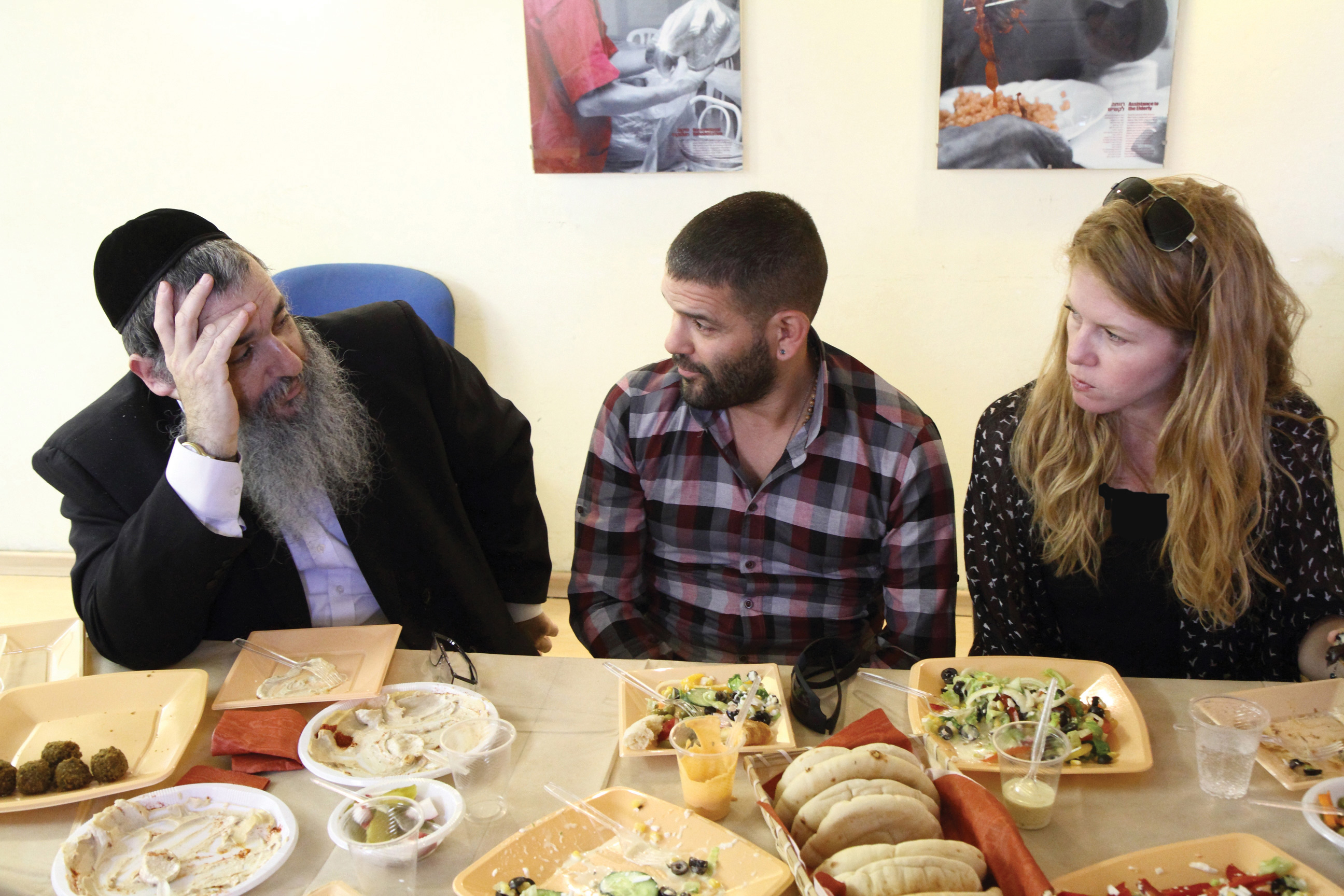
For the second year in a row, Meir Panim, Israel’s leading relief organization, hosted a star-studded group of celebrities, led by Irwin Katsof, the Director of ‘America’s Voices in Israel.’ The group, which included Katie Lowes (‘Greys Anatomy’, ‘Scandal’), Adam Shapiro (‘Scandal’), Lana Parilla (‘Once Upon a Time’) Bellamy Young (‘Criminal Minds’, ‘Scandal’), and Guillermo Diaz (‘Scandal’), visited Meir Panim in a wonderful finish to what has been a whirl-wind, week-long visit across Israel.
During the course of their visit, the stars heard about Israel’s recent social “cottage cheese” revolution and about Israel’s working poor, but, despite it all, were amazed to realize what a happy, vibrant country Israel is.
“You can see by your expressions how completely engaged you are in this organization,” enthused Lowes. “It’s an honor to be shown this very special part of Israeli society.”