Home Blog Page 449

The Taliban’s Coming Back to Social Media. Is Hamas Next?

0

Tech companies giving the Taliban a soapbox for terror get a thumbs up from Hamas.

As the Taliban negotiates with senior politicians and government leaders following its lighting-fast takeover of Afghanistan, U.S. social media companies are reckoning with how to deal with a violent extremist group that is poised to rule a country of 40 million people.

Social media platforms like Facebook, Twitter and YouTube don’t have sterling histories dealing with terror groups like Hamas.

While a social media crackdown on the Taliban would see spillover restrictions on Hamas, it appears tech companies will give Afghanistan’s new rulers a chance to prove themselves. This would open the door for Hamas to claim similar rights.

Should the Taliban be allowed on social platforms if they don’t break any rules, such as a ban on inciting violence, but instead use it to spread a narrative that they’re newly reformed and are handing out soap and medication in the streets? If the Taliban runs Afghanistan, should they also run the country’s official government accounts?

And should tech companies in Silicon Valley decide what is — and isn’t — a legitimate government? They certainly don’t want to. But as the situation unfolds, uncomfortable decisions lie ahead. And Hamas, which controls the Gaza Strip, will be watching.

Does the Taliban use social media?

The last time the Taliban was in power in Afghanistan, Facebook, Twitter and YouTube did not exist. Neither did MySpace, for that matter. Internet use in Afghanistan was virtually nonexistent with just 0.01% of the population online, according to the World Bank.

In recent years, that number has vastly increased. The Taliban have also increased their online presence, producing slick videos and maintaining official social media accounts. Despite bans, they have found ways to evade restrictions on YouTube, Facebook and WhatsApp. Last year, for instance, they used WhatsApp groups to share pictures of local health officials in white gowns and masks handing out protective masks and bars of soap to locals.

On Twitter, Taliban spokesman Zabihullah Mujahid has been posting regular updates to more than 300,000 followers, including international media. Twitter suspended another account, @AfghPresident, which has served as the nation’s de facto official presidential account, pending verification of the account holder’s identity.

“There’s a realization that winning the war is as much a function of a nonmilitary tool like social media as it is about the bullets,” said Sarah Kreps, a law professor at Cornell University who focuses on international politics, technology and national security. “Maybe these groups, even from just an instrumental perspective, have realized that beheading people is not a way to win the hearts and minds of the country.”

Wait, the Taliban were allowed on Twitter?

Facebook and YouTube consider the Taliban a terrorist organization and prohibit it from operating accounts. Twitter has not explicitly banned the group, though the company said Tuesday that it will continue to enforce its rules, in particular policies that bar “glorification of violence, platform manipulation and spam.”

This essentially means that until the accounts violate Twitter’s rules — for instance, by inciting violence — they are allowed to operate.

While the Taliban is not on the U.S. list of foreign terrorist organizations, the U.S. has imposed sanctions on it. Facebook said Tuesday that the group is banned from its platform under its “dangerous organization” policies. which also bars “praise, support and representation” of the group and accounts run on its behalf.

Facebook also emphasized in a statement that it has a dedicated team of Afghanistan experts that are native speakers of Dari and Pashto, Afghanistan’s official languages, to help provide local context and to alert the company of emerging issues.

Facebook has a spotty record when it comes to enforcing its rules. Doing so on WhatsApp, also owned by Facebook, could prove more difficult given that the service encrypts messages so that no one but senders and recipients can read them.

Twitter said it is seeing people in Afghanistan using its platform to seek help and that its top priority is “keeping people safe.” Critics immediately questioned why the company continues to ban former President Donald Trump even as it allows Mujahid to post.

What about Hamas?

As the situation unfolds, the major companies are grappling with how to respond. It’s not an entirely unique situation — they have had to deal with groups such as Hamas and Hezbollah, for instance, which hold considerable political power but are also violent and have carried out acts of terrorism.

“For the past decade, Hamas has used social media to gain attention, and convey their messages to international audiences in multiple languages,” wrote Devorah Margolin, senior research fellow at the Program on Extremism at The George Washington University, in a July report. For example, she wrote, both the political and military wings of Hamas operated official accounts on Twitter.

Despite attempts to use its English-language account to make its case to the international community, Margolin said the group still used Twitter to call for violence. In 2019, Twitter closed the official accounts, @HamasInfo and @HamasInfoEn, for violating its rules, saying there is “no place on Twitter for illegal terrorist organizations and violent extremist groups.”

Twitter found itself at the center of a deeper controversy that underlines the difficulties social media companies may face with the Taliban. In response to a 2020 tweet by Iran’s Ayatollah Ali Khamenei calling for the genocide of Israel, Twitter said the tweet didn’t violate company policy.

A Twitter official then told alarmed Knesset members that that Iranian calls to wipe out Israel were just “foreign policy saber-rattling on military-economic issues [that] are generally not in violation of our rules.”

Later that year, Twitter founder Jack Dorsey admitted to U.S. Senators that Twitter had no restrictions on Holocaust denial and calls for Israel’s destruction.

Ayatollah Khamenei continues tweeting to more than 890,000 followers.

What happens now?

Facebook declined to say specifically if it would hand over Afghanistan’s official government accounts to the Taliban if it is recognized as the country’s government. The company pointed to an earlier statement saying it “does not make decisions about the recognized government in any particular country but instead respects the authority of the international community in making these determinations.”

Twitter declined to answer questions beyond its statement. YouTube, meanwhile, provided a boilerplate statement saying it complies with “all applicable sanctions and trade compliance laws” and bans the incitement of violence.

All that effectively leaves the door open for the social platforms to eventually hand over control of the official accounts, assuming the Taliban behave and U.S. sanctions are lifted. “That seems like a reasonable approach, because I think the social media platforms don’t necessarily want to be adjudicating is which groups are legitimate themselves,” said Kreps, who served in the U.S. Air Force from 1999 to 2003, partly in Afghanistan.

At the same time, she noted, the companies, especially Facebook, have learned a great deal — and paid a price — for the way the way social media helped incite genocidal behavior in Myanmar. And they’re unlikely to want a repeat of those horrors.

(United with Israel).
 

Bennett to New York Times: No to Iran, No to a Palestinian state

0

Ahead of his meeting with the U.S. president Thursday, the prime minister pushed his conciliatory approach to the administration even while continuing opposition to its policies.

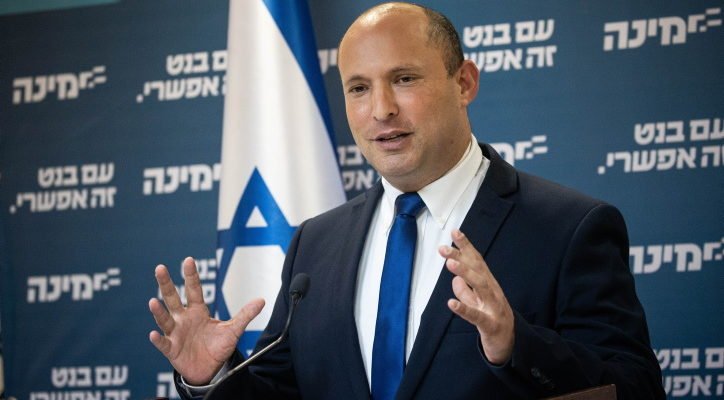
Prime Minister Naftali Bennett said no to a return to the Iran nuclear deal, no to a Palestinian state, but yes to a more conciliatory relationship with Israel’s strongest ally in an interview with the New York Times published Wednesday.

In his first interview with a foreign press association since coming into office, and just one day ahead of his meeting with U.S. President Joe Biden, Bennett said that he was coming to Washington with a “new, strategic vision on Iran,” the report said.

Although vague on the details, he did say the plan at least partially relied on Israel’s new standing in the region.

“What we need to do, and what we are doing, is forming a regional coalition of reasonable Arab countries, together with us, that will fend off and block this expansion and this desire for [Iranian] domination,” he said.

“Israel is here,” he added. “We are the precise anchor of stability, of willingness to do the job to keep this area safer.”

Israel has peace treaties with Egypt and Jordan, and normalized relations last year with the UAE, Bahrain, Morocco and Sudan through the Abraham Accords. Although Saudi Arabia has not yet signed on, Israel is widely considered to have quiet ties with Iran’s strongest opponent in the region.

Bennett said his plan also included potential Israeli action on the diplomatic and economic fronts, as well as continuing the efforts of Israel’s secret services in this sphere, dubbing them “the gray-area stuff.”

Iran has blamed Israel’s Mossad for a series of explosions and fires at various nuclear facilities and the assassination of its top nuclear scientists over recent years.

Although he is firmly opposed to Biden’s oft-stated desire to return to the 2015 nuclear deal, which he has called “irrelevant” due to Iran’s latest quick advances in nuclear enrichment, Bennett told the paper he would approach the topic differently than his predecessor.

Calling his administration “the good-will government” that is “reasonable with friends,” he told the paper that he would try to find common ground on Iran and would use Thursday’s meeting to set a softer tone in Israel’s relationship with the United States.

With his years-long hectoring opposition to the accords, former prime minister Benjamin Netanyahu angered many Democrats in Congress as well as the Obama-Biden administration that signed the deal with Iran.

On the Palestinian front, however, Bennett could not see any progress being made. There will be no Palestinian state on his watch, he said, in part because “the Palestinian leadership is fractured and rudderless.”

But peace talks are also a nonstarter because he knows they could break up his fragile coalition that runs the gamut from nationalist Jewish parties to left-wing and Arab ones.

“This government is a government that will make dramatic breakthroughs in the economy,” he said. “Its claim to fame will not be solving the 130-year-old conflict here in Israel.”

(World Israel News).

Supreme Court Agrees: Biden Admin Must Reinstate Trump-Era ‘Remain In Mexico’ Policy

0

The Supreme Court denied a Department of Justice petition for an emergency stay, forcing the Biden administration to reinstate the Trump administration’s “Migrant Protection Protocols,” better known as the “Remain in Mexico” policy.

President Joe Biden tried to end that policy through an executive order during his first several days in office.

“The Supreme Court on Tuesday said the Biden administration likely violated federal law in trying to end a Trump-era program that forces people to wait in Mexico while seeking asylum in the U.S.,” the Associated Press reported in a 6-3 decision ruling against the Biden administration.

“A federal judge in Texas had previously ordered that the program be reinstated last week. Both he and the 5th U.S. Circuit Court of Appeals refused the administration’s request to put the ruling on hold,” the outlet noted.

“Justice Samuel Alito ordered a brief delay to allow the full court time to consider the administration’s appeal to keep the ruling on hold while the case continues to make its way through the courts.”

The “Remain in Mexico” policy forced migrants seeking asylum in the United States to wait south of the border until their case could be heard by an immigration court.

The Biden administration has, instead, reverted to a much more lenient policy, allowing migrants seeking asylum to stay in the United States once given a court date, creating the high risk that migrants may never return to immigration court or a processing facility.

Under the Obama administration, a similar policy was known, colloquially, as “catch-and-release.”

The end of “Remain in Mexico” is often cited as one of the primary reasons for the massive uptick in illegal immigrant encounters along the southern border. Without the threat of staying south of the U.S.-Mexico border until an asylum claim can be processed, many migrants who may have held off under the Trump administration are presenting themselves at the border under Biden.

As a result, United States Customs and Border Protection encountered more than a million illegal immigrants at the southern border in the first half of 2021.

In July, the number of migrants set a record for the single worst month for border patrol encounters since the Department of Homeland Security began keeping track in 2001.

The court’s 6-person majority did not issue any specific rationale for upholding the lower court’s ruling, but it did specifically cite its own opinion from last year, “rejecting the Biden administration’s effort to end another immigration program, Deferred Action for Childhood Arrivals” through an executive order, and rejecting the notion that the Trump administration’s measure was “arbitrary and capricious.”

The Biden administration, the court said, “failed to show a likelihood of success on the claim that the memorandum rescinding the Migrant Protection Protocols was not arbitrary and capricious,” according to AP.

“Back in April, along with the Texas Attorney General’s Office, I filed suit against the Biden Administration over their suspension of the Migrant Protection Protocols, or the ‘Remain in Mexico’ Policy, a successful President Trump-era policy that helped fight the crisis at the border,” Missouri Attorney General Eric Schmitt told the Daily Wire in a statement.

“After we won at the federal court and the Circuit Court of Appeals, we have again prevailed over Biden’s Department of Justice at the Supreme Court tonight – the Migrant Protection Protocols must be reinstated.”

“This is a huge win for border security and the rule of law, and highlights our efforts to continually fight back on federal government overreach.”

(Daily Wire).

Where are the Feminists?

0

While the Taliban barbarically repress women in Afghanistan, toxic feminists wage a war against American men.

Freedom Center Shillman Fellow Bruce Bawer’s excellent Frontpage article “Where Are the Gays?” paints a chilling portrait of the imminent torture, execution and amputations that await gay men under Taliban rulership in Afghanistan.

And, of course, western gays are silent. Many are too busy hooking up on multiple sex apps.

Many have never been concerned with rights that extend beyond the erogenous zones of their genitalia, and several are too busy celebrating the pedophilia presented in the best-selling young adult pornographic novel, Jack of Hearts (and Other Parts), as a moral victory over heteronormative patriarchy.

The majority of sex-addicted gay men live in a curated silo where drugs, hook-ups, flaunting open relationships, and chasing youth and beauty supersede condemning the horrific agenda of the Taliban — an agenda that will no doubt transport Afghanistan back
to the Dark Ages.

A reader suggested that a better article would be named: “Where Are All The Feminists?” Given the plight of women under the Taliban when they ruled Afghanistan from 1996-2001, feminists should be concerned about the repression of the rights of individual women in that country.

This concern should extend to the current resurgence of child marriage of young teenage girls to Taliban soldiers.

No, feminists in America will not be criticizing the Taliban, just as neither they nor gays in America have dared criticize the brutal treatment of women and gays under the governance of Hamas in Gaza.

Feminists in this country are too consumed with another task: the destruction of the American male, who is seen as the producer of imperialism, “racist capitalism,” and “systemic racial and gender oppression.”

This is their obsession. The destruction of the American male supersedes moral concern for the wanton annihilation of human lives in other countries.

They will not speak out against the Taliban because they hate America and American men more than they care about the rights of any individual singled out as a target for discrimination based on membership in a demonized group.

As we hurtle towards a possible post-American future, this new breed of feminists, a phalanx of zealots, has forged fourth-wave feminism, and it’s far more rabidly anti-male than previous iterations of the ideological movement.

You’d think because of its petty maliciousness and deranged radicalism, its appeal would be narrowly limited to the faculty lounges of liberal arts colleges. Yet since the inception of the #MeToo movement, the crazed foot soldiers of fourth-wave feminism managed not only to take their worldview mainstream, but also to put a headlock on the commanding heights of American culture. This is as impressive as it is terrifying.

These new man-haters are seething with toxic feminism, and the further spread of their noxious sentiment could likely spell the death of our country as we know it. Increasingly prevalent is their practice of exploiting female agency and identity to make blanket attacks on men, to neuter manliness, and to advocate for the end of masculinity.

These goals are being achieved while simultaneously promulgating the dual concepts that men are by nature nefarious and that female advancement can only come through the wholesale annihilation of heteronormative constructs of “maleness.”

The destructive consequences for relationships at every level of society—from the simple couple to the community to the nation—will be vast and irreparable.

The New Misandry, as I call it, arose out of the more extreme versions of second-wave feminism. Proponents of this form of feminism, such as Gloria Steinem and Kate Millett, Valerie Solanas (author of SCUM—Society for Cutting up Men) and Carol Hanisch, began the process of speaking to the irrelevance of men to women’s life and society in general.

Steinem’s famous dictum, “a woman needs a man the way a fish needs a bicycle,” spoke to the changing cultural attitudes towards men that regarded them as disposable, annoying, and of having nuisance value only.

Third-wave feminism, beginning in the early 1990s, saw a rise in affluent middle-class women influenced by Anita Hill who wielded their agency in strategic ways to exact a revenge against all men in the ways in which they imagined a malevolent, collectivist male psyche had inflicted irreparable damage on all women.

Fourth-wave feminism, which arose in the 2010s, gained traction with the creation of the #MeToo Movement. This form of feminism is the most toxic brand we find in the history of feminism. With full malice aforethought, its adherents depict masculinity as inherently toxic, and claim that only the abolition of maleness will result in the creation of an egalitarian world for women.

The #MeToo Movement started out with noble intentions of addressing harassment claims of women that were not being adequately addressed in the legal system. It quickly morphed, however, into a male-bashing movement that sought to strip men of their agency and dignity.

It engaged in a social eugenics program encroaching on all spheres of life—from abolishing the swimwear category in beauty pageants on the grounds that it was sexist, to attempting to cancel the James Bond movie franchise on the grounds that Bond represented old-fashioned sexist stereotypes of women that were degrading and eviscerative of female dignity.

It quickly created a toxic culture in which an accusation of male harassment was sufficient to introduce the presumption of guilt on the part of the man. We say this in the case of Christine Blasey Ford and other women who tried to destroy the life and career of Justice Brett Kavanaugh.

No compelling evidence was ever offered, just hyperbolic testimony based on hazy recollections of incidents that allegedly happened decades ago and that were never reported when they allegedly happened.

Their goal is to neuter young boys from K-12 by abolishing gender, and by queering the identity of young boys from as early as those in the 3rd grade.

Such feminists have been aided by weak and purposeless Beta-males. Governed by a “gynocentric paradigm,” they have supported the congeries of woke anti-male progressives for several reasons, ranging from political expediency to poor self-esteem.

The #MeToo Movement, the mother of fourth-wave feminism, is an insidious, Marxist-inflected, social eugenics organization bent on reshaping the sensibilities of men. Toxic femininity’s collusion with a particular kind of male gives us a look at the deeper crisis in masculinity which has created a new and rather ghastly phenomenon: the neutered Beta-male.

This man has allowed himself to be eviscerated of his male pride, his manliness, his masculine virtues, and the sense of dignity and empowerment he ought to feel in the enjoyment of his values. He feels a deep-seated hatred for real men whom he envies largely because they have never sold out to the ways in which toxic feminists and the larger culture have attempted to re-socialize them into being feminine men.

These neutered Beta-males are parasitic social ballasts who feed off toxic female power. They collude with such women to bring down real men to radically change the world. More important, their only experience of manliness comes from a weak collusion with women to destroy men who are stronger than they are.

The reality and cruel irony is that toxic feminists do not respect such Beta-men. They simply use them as pawns in politically expedient ways to serve their ends to end the patriarchy, male assertiveness, and a world in which men lead. We may describe such men as constituting a confederacy of gender-quitters—traitors against their own sex.

Now, more than ever, men—who built Western civilization and, for the most part, do the dirty work of its upkeep—are regarded as expendable, and by their very nature, an existential threat to the planet itself.

Against these attacks laden with presumption of guilt, we see that civilizational longevity, economic prosperity, and human flourishing are all irrevocably tied to manliness.

What we need to help counter this morally narcissistic form of feminism is a celebration of manliness into mainstream culture.

Real men seek no one’s approval or permission to express their singularity, and their unabashed manliness. They aspire to glory through heroic deeds, and they often risk their lives to save and vindicate those of others. They assert their virtue over authority, and they have a strong respect for meritocracy. They may be defeated, but they are never destroyed. They are men of action who take risks as a way of life.

Such men elicit admiration in a simplicity they possess. It is one forged in the crucibles of an attitude that desires to leave the world a better place than they found it through grit, resilience, honor, tenacity, and perseverance. Unlike compassion which invites us to look down on those towards whom we feel pity, admiration is a command to look up to those in control.

Toxic feminists such as Anita Hill, Gloria Steinem, Pauline Harmange, and others rely on one advantage: the Sanction of the Victims. Men who are psychologically victimized by such feminists rarely if ever speak out in radical defense of themselves, let alone their masculine natures.

Their silence suggests guilt which implies wrongdoing. This, in turn, grants such women a coercive monopoly on the moral narratives to indict men and, further: to stamp themselves with the imprimatur of innocence.

Men have too often been socialized to feel that they are somehow bad as men and exist as a problem to be solved. These toxic feminists take advantage of this moral weakness in men who are unable to inoculate themselves against the often-baseless accusations of women. Such men are presumed guilty by accusation alone.

Morally neutral male behavior that is derived from masculine culture is construed as damaging to the agency of women. Rather than defend their God-given, natural qualities, men instead resort to lame apologies, silence, moral atonement, acts of contrition and redemption.

Returning to Bruce Bawer’s initial question: the majority of gays and man-hating fourth-wave feminists are, in the end, irrelevant. The real question is: where are the real men—in the USA and in Afghanistan? Real men don’t surrender without a fight or, in the case of the Afghan President, Ashraf Ghani, abandon his military and his people and run in hiding at the first advance of these vicious trolls.

What we need are ways to fight the toxic feminism that aims to cripple the decisiveness of real men along with their heroic and warrior nature. This involves a comprehensive guide to taking out one of the most potent heads of the identity politics hydra.

Toxic feminism is a form of identity politics that trades on a univocal victim status to inflict punishment on men in general for the sheer thrill of garnering power over them.

Toxic feminists, like the majority of narcissistic gay men, will be ultimately revealed for what they are: ignoble social ballasts who will elicit the scorn and contempt of real women, and the abject indifference of masculine men.

Jason D. Hill is professor of philosophy at DePaul University in Chicago specializing in ethics, social and political philosophy, American foreign policy and American politics and moral psychology. He is a Shillman Journalism Fellow at the Freedom Center. Jason is the author of five books, including the forthcoming book, What Do White Americans Owe Black People: Racial Justice in the Age of Post-Oppression. Follow him on Twitter @JasonDhill6.

Caroline Glick: Joe Biden’s catastrophic judgment may implicate meeting with Bennett

0

As the president rejects all criticism of his personal failure in Afghanistan, there is effectively zero chance he will reconsider
his policy of 42 years on Iran.

The Taliban’s seizure of control over Afghanistan will loom large over Israeli Prime Minister Naftali Bennett’s visit with U.S. President Joe Biden this Thursday, and its implications are dire.

As Taliban forces seized control of one Afghan province after another, and everyone who was paying attention recognized that the capital would soon follow, Biden went on a two-week vacation.

The footage of the Taliban takeover of Kabul stunned the American public. The scenes of dozens of Afghans hanging off a U.S. military C-17 already wheeling down the runway at the Kabul airport, hoping desperately to be let inside, or of people being taken out of their homes and shot by Taliban gunmen, provoked a bipartisan outcry against Biden and his withdrawal of U.S. forces from Afghanistan.

So Monday, Biden took a break from his vacation. He flew to the White House. He gave a speech. And then he flew back to his vacation.

Biden spoke with undisguised irritation. He blamed his predecessor, Donald Trump, for signing a deal with the Taliban to remove the residual U.S. forces from the country. He blamed the Afghan military and government, which collapsed after the U.S. retreat. And
he blamed U.S. intelligence agencies, which he said had not anticipated the Taliban’s swift takeover.

And he praised himself for having the gumption to remove U.S. forces from the country.

Biden bragged, “I’ve argued for many years that our mission [in Afghanistan] should be narrowly focused on counter terrorism, not counterinsurgency or nation building. That’s why I opposed the surge when it was proposed in 2009 when I was vice-president. And that’s why as president I’m adamant we focus on the threats we face today in 2021, not yesterday’s threats.”

Cursory fact checks expose Biden’s disingenuousness. The parties he blamed were not responsible for the catastrophic blow the events in Afghanistan dealt to US credibility. And his decision to remove U.S. forces from the country did not make the United States safer or better placed to “focus on the threats we face today in 2021.”

Biden’s accusation that the Trump administration was responsible for the Taliban takeover of Afghanistan is wrong on several counts.

As former President Trump and his secretary of state, Mike Pompeo, explained last Sunday and Monday, the agreement Trump reached with the Taliban was conditions-based. Since the Taliban breached the conditions, there is little reason to believe that Trump would have implemented the troop pullout.

Moreover, Trump intended to evacuate civilians—both U.S. citizens and Afghan nationals who worked with the Americans along with their families—before pulling out U.S. military forces.

In the last two years of the Trump administration, Trump reduced the number of U.S. forces in Afghanistan from 15,000 to 2,500, without inducing panic or emboldening the Taliban. He quietly evacuated U.S. civilians—again, without inducing panic or demoralization.

Biden, in contrast, removed the military forces without giving the Afghan government or military a heads-up, demoralizing them. He and his advisers repeatedly said that there was no reason to fear a Taliban takeover, so at-risk civilians had little sense of the urgency of the situation or the need to leave the country as quickly as possible.

In a conversation with Israel Hayom, a former senior Trump administration official noted as well that unlike Biden, Trump was willing to listen to argument and change his positions to align them with the situation on the ground when necessary.

“After Trump ordered the removal of all U.S. forces from Syria in 2018, several people from both inside and outside the administration warned him that a full withdrawal would be dangerous. So he changed his plans. He withdrew most of the U.S. forces but left a few hundred in key locations and gave them the wherewithal to secure U.S. goals in the country,” the official said.

By the same token, the official argued, Trump would likely have kept a residual force in Afghanistan.

Indeed, that was the only force that remained in Afghanistan. And just as a skeletal U.S. footprint in Syria suffices to secure U.S. interests in the country, so the 2,500 non-combatant U.S. forces Biden removed from the country were able to work with Afghan and NATO forces to keep Afghanistan stable and keep the Taliban at bay.

Perhaps the oddest aspect of Biden’s indictment of Trump is that he treated Trump’s deal with the Taliban as immutable. Yet, as Pompeo noted, just as Trump abandoned Obama’s nuclear deal with Iran, so Biden was free to walk away from Trump’s deal with the Taliban.

Biden’s protestations regarding the deal are particularly ridiculous given that in his seven months in office, he has taken a cleaver to nearly all of Trump’s domestic and foreign policies.

Biden didn’t remove U.S. forces from Afghanistan because he had to keep Trump’s deal. He removed them because he wanted to.

This brings us to Biden’s devastating critique of the Afghan military, which he claimed was unwilling to defend the country. Over the past 20 years, 2,448 U.S. servicemen and women were killed in Afghanistan. Over the same period, 69,000 Afghan forces died defending their country from the Taliban.

Thus Biden’s statement amounted to malicious slander.

One of the main functions of the U.S. forces and contractors Biden removed was to serve as military air traffic controllers for Afghan forces. Their departure meant the Afghan military lost its close air support. And since the U.S. built the Afghan military as its “mini-me,” like the U.S. forces, Afghan forces were dependent on close air support to conduct land operations.

In other words, Biden is more responsible than anyone else for the Afghans’ post-American collapse. If he expected them to fight, he shouldn’t have left them dependent on U.S. traffic controllers which he withdrew without coordination or warning of any kind.

It is entirely reasonable for Americans to demand the return of their forces from Afghanistan. But on Monday, Biden presented the American people with a choice between fighting a major war against the Taliban which would see “untold numbers of servicemen killed”, or bringing the boys home in total defeat, as he opted to do.

Biden’s presentation was a gross distortion of the facts. The U.S. suffered no losses over the past 18 months. The choice was between more of that, and squandering everything U.S. forces in Afghanistan accomplished over the past 2o years.

This brings us to the intelligence community.

Since April, Biden, his advisers and Chairman of the Joint Chiefs of Staff Gen. Mark Milley have been insisting, presumably based on intelligence reports, that there was little reason to be concerned that a U.S. pullout would precipitate a Taliban takeover of the country. As one provincial capital after another fell to the Taliban, Biden and his advisers insisted it would take a long time for the Taliban to arrive in Kabul.

And on Monday, after the Taliban had taken Kabul and the Afghan president and the U.S. ambassador had fled the city, Biden claimed that the Taliban’s takeover “did unfold more quickly than we had expected.”

But here too, Biden did not tell the truth.

ABC News reported last Monday that U.S. intelligence officials are insisting they provided Biden with clear and detailed reports over the past several months which made clear that if he withdrew U.S. forces as he intended, the Afghan army and government would collapse and the Taliban would quickly retake control of the country. The regional military commanders similarly warned this would happen.

Taken as a whole then, the most notable aspect of the fiasco in Afghanistan is that to a large degree, Biden is its sole author. He was warned of the consequences. He chose to disregard the warnings. His party didn’t demand the pullout. The Washington establishment opposed it. Biden took his own counsel. This was his policy.

If Biden had been right, he would rightly be the toast of the town right now. But reality is a harsh judge. The facts were never on his side. Reason was never on his side. His judgement was never reasoned or fact-based. And as was eminently predictable, Biden was catastrophically wrong.

While dooming tens of thousands of Afghans to death and millions more to utter misery, Biden’s misjudgment is quickly multiplying the threats the U.S. faces.

The Taliban have seized U.S. aircraft abandoned at Bagram air base. Milley acknowledged that the terror threat to the U.S. has grown since the pullout. And thanks to Biden, the United States’ southern border remains open to all. Forces of jihad worldwide have received an unprecedented tailwind from the U.S. defeat. Hamas, Iran and others hurried to embrace the Taliban.

Biden’s policy also emboldened U.S. superpower rivals China and Russia. They responded to America’s humiliation by bringing Iran into the Shanghai Cooperation Organization.

U.S. allies are furious and alarmed as they see the
collapse of U.S. credibility
and strategic rationality.

And this brings us to Bennett’s meeting with Biden on Thursday.

Biden’s decision to stick to his guns on Afghanistan shows that once he has made up his mind about something, he is unwilling to listen to counterargument. And the only other major position that Biden has held consistently over the years is his position on Iran.

Whereas for 15 years Biden was an outspoken critic of the war in Afghanistan and demanded a swift U.S. withdrawal, since the Islamic Revolution in Iran in 1979, he has been among the terror regime’s most stalwart supporters in Washington. Biden’s policy towards the ayatollahs in Tehran has been appeasement for the past 42 years, even when he stood alone on the issue.

For instance, as chairman of the Senate Foreign Affairs Committee in 2001, Biden responded to the Sept. 11 attacks on the United States by calling for the Bush administration to give Iran $100 million in foreign aid.

Last week it was reported that ahead of Bennett’s visit with Biden on Thursday, government officials are hoping to convince him that given the failure of the nuclear talks in Vienna, the time has come for the United States and Israel to jointly attack Iran’s nuclear installations.

If Biden weren’t impermeable to reason, Israel’s argument might have had a shot. After all, in 1983, Ronald Reagan responded to the Hezbollah bombing of the Marine barracks in Beirut by invading Grenada.

But as Biden showed on Monday, and in an interview with ABC‘s George Stephanopoulos Wednesday, he will not rethink his choices or positions, even after they have failed. As Biden rejects all criticism of his personal failure in Afghanistan, there is effectively zero chance he will reconsider his policy of 42 years on Iran.

Moreover, unlike his policy on Afghanistan, his Iran policy is now shared by the U.S. intelligence community and military, the Washington establishment and the Democrat Party.

Whether Bennett would be better off postponing the trip until the smoke begins to settle, remains to be seen. But what is clear enough is that with Iran sprinting towards the nuclear finish line and U.S. credibility in a state of unprecedented collapse, if Israel wants to prevent Iran from acquiring military nuclear capabilities, Biden is not the man to see.

Caroline Glick is an award-winning columnist and author of “The Israeli Solution: A One-State Plan for Peace in the Middle East.”

(World Israel News / Israel Hayom / JNS).


Drought worsens in Southern California, with Ventura County in worst category

0

As sweltering drought conditions continue to worsen throughout California, Ventura and other Southern California counties have shifted from “extreme” to “exceptional” drought conditions, according to the U.S. Drought Monitor Report.

Along with Ventura County, northwest Los Angeles County, most of Kern County and the eastern portion of San Bernardino County are also in the federal report’s highest range, signifying “exceptional drought.” Almost all of California is facing detrimental drought conditions, with 50 of the state’s 58 counties under a state of emergency amid excessive drought conditions.

In Ventura County, Calleguas Municipal Water District officials have declared a water shortage, continuing their call to residents to conserve water.

A map of California, showcasing the areas affected by drought conditions as of Aug. 17.
(U.S. Drought Monitor Report)

“The board’s action urges residents, businesses and agencies in Metropolitan’s 5,200-square-mile service area to lower the region’s water demand to stave off more severe actions in the future, which could include restricting water supplies to Metropolitan’s 26 member agencies,” officials said in a statement Tuesday.

Officials at the Metropolitan Water District of Southern California, which supplies imported water to Calleguas Municipal Water District, said the state’s water supply has been “increasingly stressed by the extreme drought.”

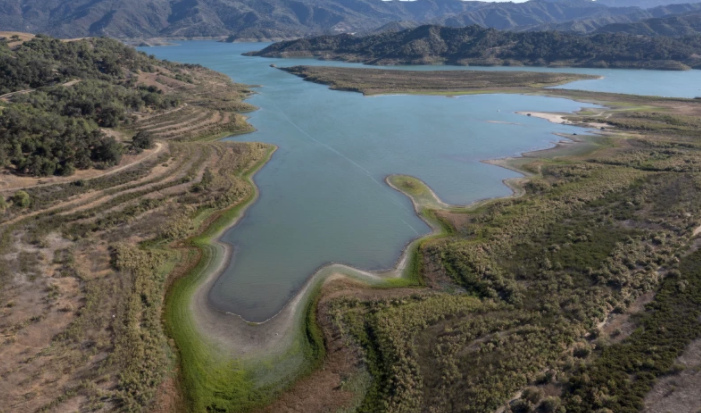
Lake Mead, NV - June 28: An aerial view of drought's effect at Hemenway Harbor, Lake Mead, which is at its lowest level in history since it was filled 85 years ago, Monday, June 28, 2021. The ongoing drought has made a severe impact on Lake Mead and a milestone in the Colorado River's crisis. High temperatures, increased contractual demands for water and diminishing supply are shrinking the flow into Lake Mead. Lake Mead is the largest reservoir in the U.S., stretching 112 miles long, a shoreline of 759 miles, a total capacity of 28,255,000 acre-feet, and a maximum depth of 532 feet. (Allen J. Schaben / Los Angeles Times)

Source: LA Times


Hamas demanding ‘impossible terms’ as deadlock with Israel continues

0

Col. (res.) David Hacham, a former Arab-affairs adviser to Israeli defense ministers, says any expectation of a significant change in Hamas’s extreme worldview is fantasy; the latest violence is part of a Hamas bid to “change the rules of the equation” with Israel.

BY YAAKOV LAPPIN

 Hamas in the Gaza Strip is pursuing terms that are impossible for Israel to accept as part of its extortion attempt to “change the rules of the equation,” a former defense official and expert on Gaza has said.

Col. (res.) David Hacham, an Arab-affairs adviser to seven Israeli defense ministers and a senior research associate at the Miryam Institute, told JNS that a central impasse blocking the path to a broader arrangement between Israel and Gaza is Hamas’s refusal to come up with realistic proposals to facilitate a deal for the release of the remains of two missing-in-action Israel Defense Forces’ soldiers who were killed in the 2014 war, in addition to two living Israeli civilians who entered Gaza and are being held by the terrorist organization.

With Israel linking progress on this issue to progress on a broader arrangement for Gaza’s reconstruction and economy—and Hamas refusing to budge on its unrealistic demands for facilitating an exchange deal to secure the release of the Israelis—a structural problem is in place, noted Hacham.

“Israel says that if Hamas wants progress on a broader arrangement, progress must be made on an exchange deal. Hamas says these are two separate issues, and it wants separate talks on increasing the entry of commodities and services into Gaza, and the entry of Gazan workers into Israel,” he said. “This is the key issue on the agenda. It is the central reason for all of the incidents we are seeing on the border. Hamas demands that Israel ‘lifts the siege.’ ”

In exchange for the release of Israeli civilians Avera Mengistu and Hisham Al-Sayed, and the remains of MIA personnel Hadar Goldin and Oron Shaul, Hamas’s leader in Gaza, Yahya Sinwar, has demanded that Israel release 1,111 Palestinian security prisoners.

“Hamas is raising impossible standards for Israel,” said Hacham.

“In principle, Hamas is seeking to change the terms of the equation that has existed for a long time between Israel and Hamas,” he said. “Their slogan of ‘lifting the siege’ means opening up Gaza’s border crossings to Israel and the outside world, the naval arena and the air arena.”

Egypt’s General Intelligence Directorate has played the central role in mediating talks between Israel and Hamas, with most of the talks taking place in Cairo.

With no progress being made on the swap deal, the other negotiations channel is designed to achieve what Israel calls an “arrangement” and what Hamas calls a hudna (“calm”).

To that end, talks have revolved on enabling more traffic of goods, merchants and businesspeople through the Gaza-Israel border crossings. Even though no final arrangement has been reached, Israel recently took the step of allowing 1,000 Gazan merchants and 250 businesspeople into Israel.

Throughout the deliberations, Israel has ensured a constant humanitarian flow of basic goods, food and medical supply into Gaza though trucks that pass through Kerem Shalom Crossing.

Hamas is also demanding the entry of funds for rebuilding sections of the Strip and repairing damages following the May conflict it prompted and fought with Israel.

Yet the fact that the talks are stuck on the swap issue means there is “no moving forward,” said Hacham.

This will not change as long as “Hamas does not allow progress on the MIA’s remains and captive issue,” he stated. Hamas’s initiative to jump-start Gaza’s economy and see large-scale infrastructure projects take place is thus being stalled by Hamas’s own refusal to compromise on its demands.

As a result, the fact that an agreement was reached in recent days allowing some $100 million a month of Qatari assistance cash for needy Gazan families to come has not altered the impasse.

That agreement will see the United Nations allocate the funds through special ATM withdrawal cards, after a list of recipients was authorized by Israel, which is a far cry from the old allocation method, when Qatar’s envoy to Gaza, Muhammad Al-Emadi, would arrive with suitcases brimming with cash.

In the old arrangement, Hacham said, “Israel didn’t fully supervise where this money went. We can assume that not all of it went to needy families; some went to developing Hamas’s terror infrastructure and local rocket-production centers.”

As a result, Israel refused to consider going back to the old arrangement. Yet now that the deal was reached, Hamas is far from being satisfied or willing to scale back its escalation tactics on the border.

‘Hamas believes its charger was drawn up by God’

Hacham said that those who are holding out hopes for a change in Hamas’s radical worldview are clinging to fantasies.

“Hamas is an enemy. It is guided, conceptually and ideologically, by a call for Israel’s destruction. It does not recognize Israel. Hamas has not changed its ideology, concepts or objectives,” he said. “And it can’t change them. I remember speaking with Sheikh Ahmed Yassin, who founded Hamas during the First Intifada in 1987, and asking him if the movement’s stances could change, whether mutual recognition could change. He told me, ‘Our charter was drawn up by God. So humans cannot change our charter.’ ”

Hamas’s 1988 covenant continues to reflect its ideology and policy towards Israel, said Hacham. “But we have to distinguish between Hamas’s practical actions and ideology. For tactical reasons, it is willing to reach ceasefires (hudnas), but not at the cost of recognition of Israel or acceptance of Israel as a legitimate element. Only as part of a tactical need.”

As a result of these dynamics, the chances of a long-term quiet with Hamas are slim, he assessed. However, stepped-up Israeli offensive actions and an Israeli determination to respond to each act of Hamas aggression could boost Israeli deterrence, he argued.

Boosted Israeli deterrence would, in turn, enable Israel to prioritize its strategic task of preventing Iran from breaking out to a nuclear weapon and dealing with Iran’s entrenchment in Syria, and Hezbollah’s threatening force build-up in Lebanon. “These are the issues at the top of Israel’s priority list. Hence, Gaza is a problem that has to be confined,” he said.

Deterrence can be improved through steps such as “commando raids or destroying their weapons storehouses, tunnels or even targeted killings—a tool that has proven itself,” said Hacham, while stressing that he is not in favor of a reoccupation of Gaza.

“But Israel can’t exclude retaking Gaza either. It has to take this option into account, but only in a scenario in which there are no other options,” he said.

Such a maneuver would involve heavy casualties among young IDF soldiers, he said, as well as civilians on both sides, despite Israeli efforts to avoid this; as such, it must be reserved as a last option.


B’nai Brith calls out Canadian uni for course on anti-Semitism taught by anti-Zionist prof

0

B’nai Brith Canada still concerned about risk updated, new course will “promote hostility toward Jews.”

B’nai Brith Canada is calling attention to an upcoming course on historic anti-Semitism taught at the University of Victoria that it worries has the potential to become a forum for anti-Semitic views.

“Towards an Understanding of Antisemitism” was originally to be taught in the fall semester by Shamma Boyarin, with an odd course description that stated: “Even the most fundamental aspects of anti-Semitism are controversial.” It also promised that “students will develop the ability to examine both current and historical instances of anti-Semitism with a critical eye,” according to B’nai Brith.

Upon learning of the course, B’nai Brith pointed out that it did not appear that Boyarin had “any academic background in anti-Semitism, having never taught a course about it before or published any articles on the subject. However, in recent months, he has issued a series of extremely incendiary tweets on the subject, including one calling Abe Foxman, the immediate past president of the Anti-Defamation League and one of the world’s most prominent opponents of anti-Semitism, a ‘Zionist pig.’”

B’nai Brith also stated: “In one particularly disturbing outburst, Boyarin alleged that ‘North American Jews’ have ‘actively contributed’ to ‘ethnic cleansing and genocide’ and ‘raised our kids to take part in it.’ In another tweet from June discussing his syllabus, Boyarin mocked the experience of Eve Barlow, a Jewish woman who endured a massive wave of online anti-Semitism during fighting between Israel and the Hamas terror group in May of this year.”

B’na Brith raised the issue of the “obvious impropriety” of the instructor scheduled to teach the course with administrators at the University of Victoria, and in early August the course was overhauled.

The description was changed to a course about “a historical survey of key texts and moments from Augustine to Luther” that “will focus on the particular role Christianity has played in developing and sustaining antisemitism in Europe.”

However, the course is still being taught by Boyarin, who has a background in religious and Medieval studies.

“Moving this course away from modern anti-Semitism is an important first step,” said B’nai Brith Canada CEO Michael Mostyn. “However, we are still concerned that instead of educating students on the scourge of Jew-hatred, there is a risk, albeit a reduced one, that hostility toward Jews will instead be promoted.”

B’nai Brith called on the University of Victoria to “provide assurances to the Jewish community that academic freedom will not be used as cover to falsely accuse Jews, as a whole, of contributing to genocide, among other anti-Semitic canards.”


First US Army Iron Dome Battery Completes Live Fire Test In New Mexico

0

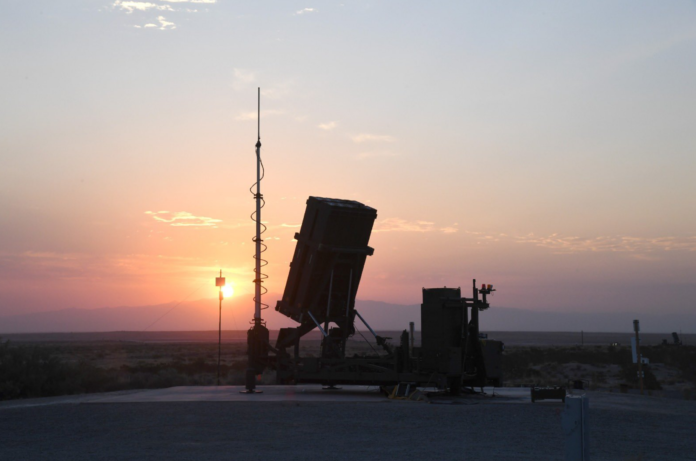
The first US Army Iron Dome Battery has completed a live fire test at New Mexico’s White Sands test range, according a statement from the Israeli Defense Ministry.

The US acquired the missile defense technology from Israel with the Israel Missile Defense Organization and Iron Dome developers Rafael, IAI Elta and mPrest supporting the test.

The live fire test marked the first time that US soldiers intercepted live targets employing the Iron Dome system, according to the statement.

The US and Israel signed an agreement in 2019 for the procurement of two Iron Dome batteries. The first battery was delivered in September 2020 and the second delivery was completed in early 2021.

“The US Army Iron Dome System is designed to defend supported forces against a range of threats including cruise missiles, unmanned aircraft systems, rockets, artillery and mortar threats,” the statement said.

Israel defense technology company Rafael Advanced Systems is the main contractor, with Elta Systems, a subsidiary of Israel Aerospace Industries, developing the radar. The command and control system was developed by mPrest Systems.

The Israel Missile Defense Organization leads the development of Israel’s missile defense system, which includes Iron Dome, David’s Sling, Arrow-2 and Arrow-3.

“[Delivering] Iron Dome to the US Army once again demonstrates the close relations between the Israel Ministry of Defense and the US Department of Defense, the effectiveness of the system against various threats, and the excellent technological capabilities of Israeli industries,” Israeli Defense Minister Benny Gantz said at the time of the second delivery.

“I am confident that the system will assist the US Army in protecting American troops from ballistic and airborne threats as well as from developing threats in the areas where US troops are deployed on various missions,” he added.

Algemeiner. (c) 2021.

{Matzav.com}

Twenty Six Bachurim Returning From Ukraine Hospitalized With Food Poisoning

0
BROOKLYNTwenty Six bachurim returning on a flight from Ukraine were stricken with serious food poisoning after they landed Tuesday evening in New York City.A large group of Visnitz chassidim of the Visnitzer Rebbe of Boro Park had travelled with their Rebbi, shlita, to visit mekomos hakedoshim. Although the Rebbe had already returned Monday evening, some 50 bachurim stayed in Ukraine a bit longer, and were on their way back home on Tuesday when some of them were overcome with illness.

(BOROPARK24)

The flight left Ukraine with the boys apparently eating tuna fish sandwiches before their departure. Some began feeling ill during the flight, and after they landed in New York and boarded a bus for Boro Park, the bus headed directly for the Hatzalah garage at 37th Street and 14th Avenue.

Due to the large number of bachurim who were not feeling well, Hatzalah of Boro Park was assisted in the transport by ambulances from Hatzalah of Crown Heights, Williamsburg, and Flatbush.

Eighteen boys from Boro Park and 8 boys from Monsey were hospitalized with food poisoning. Bechasdei Hashem, all are expected to make a full recovery.

Shomrim is assisting with the transportation of parents whose children are in the hospital.

Source: Hamodia

WP Twitter Auto Publish Powered By : XYZScripts.com