Home Blog Page 515

Faith-based legislators lobby governments against ICC war-crimes probe of Israel

“We’re seeing incredible support from Eastern Europe, but some of the Western European countries have really taken a harsh stance,” said Josh Reinstein, head of the Israel Allies Foundation and the Knesset Christian Allies Caucus. “We’re not going to let the Jewish state be singled out.”

Saying he is “appalled and shocked” by the war-crimes accusations made by the International Criminal Court against Israel, Josh Reinstein, head of the Israel Allies Foundation (IAF) and the Knesset Christian Allies Caucus (CAC), noted that it is “even
more egregious since [the ICC] was started to stop atrocities like the Holocaust and rampant anti-Semitism.”

Instead, he said, it is now “being used to demonize the one Jewish state in the world.”

IAF brought together faith-based advocates and legislators from around the world on Tuesday for an online discussion of how representatives can lobby their governments to fight the recent decision by the ICC to investigate Israel for alleged war crimes.

“We’re seeing incredible support from Eastern Europe, but some of the Western European countries have really taken a harsh stance when it comes to Israel,” said Reinstein. “We’re not going to let the one Jewish state be singled out.”

He called on caucus members to lobby their governments in order to “stop this ICC attack that is not only illegal but unfounded.”

IAF works with the U.S. Congress and parliaments around the world to mobilize faith-based support for Israel. According to its website, IAF believes Israel “has the right to exist in peace within secure borders with Jerusalem as its indivisible, eternal capital.”

‘Jewish nation is being put on trial’

Eugene Kontorovich, director of the International Law Department at the Kohelet Policy Forum, said the ICC “has now been turned into a biased, anti-Semitic forum for making sure Jews don’t live in places where some people don’t want them to live.”

Kontorovich said the investigation of Israel has “crossed so many red lines”.

“It is the only ICC matter that involves investigating a non-member state at the behest
of a member which is not a state.
That shows you how weird and
absurd the situation is.”

According to Kontorovich, the drafters of the Rome Statute simply cut and pasted the definitions of war crimes from existing documents except for one definition.

“For the war crime of deporting or transferring population into occupied territory, the ICC changed the language to “directly or indirectly” transferring a population. Why? Because it was understood that, in fact, Israel was not guilty of transferring anybody into occupied territory. Israel has not moved anyone. Israel simply allows Jews to live where they want to live.”

Nonetheless, he continued, it wants “to create a new crime simply for Israel, to use the ICC as a tool for punishing Jews for living in Judea and Samaria,” he said. “So they created another entirely new offense, an “indirect transfer of population”. That is why the United States and Israel did not join.”

Kontorovich slammed the ICC for ignoring mass atrocities and instead focusing on “Jews living in the Jewish Quarter of Jerusalem in places that have been part of the Jewish historical homeland forever.”

“By doing this,” he said of the ICC, “they seek to delegitimize Israel.”

“Courts have been used as vehicles for spreading anti-Semitism in the past,” he noted. “Merely because it is a judicial proceeding does not mean it has any presumption of regularity. Today, not just one Jew, but the entire Jewish nation is being put on trial.”

Kontorovich suggested attacking the ICC over its “perceived legitimacy” and called on IAF members to lobby their governments to threaten withdrawing membership “because membership is the source of its strength. It is the only language that it understands.”

Australian Parliament member Stuart Robert addressed the forum, saying his country “does not consider Palestine to be a nation.”

“We do not consider it to have standing within the Treaty of Rome, and therefore, our stated view is that the ICC and the pretrial committee has zero jurisdiction to consider such a matter because Palestine does not exist,” he said.

Israeli Knesset member Sharren Haskel, chairperson of the CAC, noted that the ICC was set up in 2002 to bring justice to those responsible for the worst crimes against humanity, adding that “there are countless actual attempts of genocide happening right now around the world … unfortunately, there are multiple opportunities for the ICC to examine war crimes within its member states.”

“But the ICC has chosen to ignore these war crimes within its jurisdiction and instead focused on Israel,” she said. “These types of double standards are blatant anti-Semitism.”

“Last time I checked a map,” she said, “there was no such state as Palestine. So the ICC certainly does not have the authority to create this state and draw territorial boundaries in order to suit their purposes of delegitimizing Israel.”

‘Palestine cannot be considered a state’

Michaela Marksová Tominová, deputy foreign minister of the Czech Republic, said “it is generally accepted that under customary international law, the existence of statehood presupposes fulfillment of several basic requirements, such as a permanent population, defined territory, a government, and a capacity to enter into relations with other states.”

“The Czech Republic does not believe that Palestine has fulfilled all of the above criteria for statehood under international law,” she said. “Concerning bilateral relations, the Czech Republic has not recognized Palestine as a state.”

European Union Parliament member Bert-Jan Ruissen said “we stand shoulder to shoulder with Israel. We shall never be silent when we see Israel is being treated unfairly. We distance ourselves clearly from the ICC decision.”

Ruissen accused the ICC of crossing its own boundaries “since it is clearly ignoring its own mandate.”

“The ICC does not have universal jurisdiction,” he said, adding that it can only apply jurisdiction in the territory of a member state, “and Palestine cannot be considered a state.”

“We urge the ICC to respect its own mandate instead of following a politically motivated agenda,” he said.

U.S. Congressman Doug Lamborn (R-Colo.) said the ICC decision is “absurd.”

“It is anti-Semitic, and it is illegitimate,” he said. “The fact that the ICC targets Israel, which is the freest and most liberal nation in the Middle East, really says more about the ICC than its ridiculous charges say about Israel.”

He promised to track developments as they relate to the Biden administration and said, “If in any way they waver in their opposition to the ICC, I will be leading the charge in Congress and there will be many of us, both in the House and Senate, I believe even a majority, who will oppose any support that might be given to the ICC by the United States.”

“We are watching closely to see specific and concrete actions. We hope and believe that Biden will not support the ICC in this matter,” he said.
Not fit to print: The NY Times on Sheikh Jarrah

0

The courts evicted Arab squatters from the Shimon Hatzaddik homes, and they have appealed. The NY Times, however, has made its own decision before the Supreme Court rules on the case. Op-ed.

In a nearly full page article entitled “As Court Decision Nears, Battle Over Evictions Spikes in East Jerusalem,” the New York Times manages to describe Jews as “settlers”  – in Jerusalem (!) –  nine times; as “far right” or “right-wing” twice; as “right-wing settlers” once (in case we did not already get this point); as “provocative,” as engaged in both “ethnic cleansing,” and “racism” once each.

Thus, Jews are described negatively
at least fifteen times.
Not so the Arabs, including Hamas.

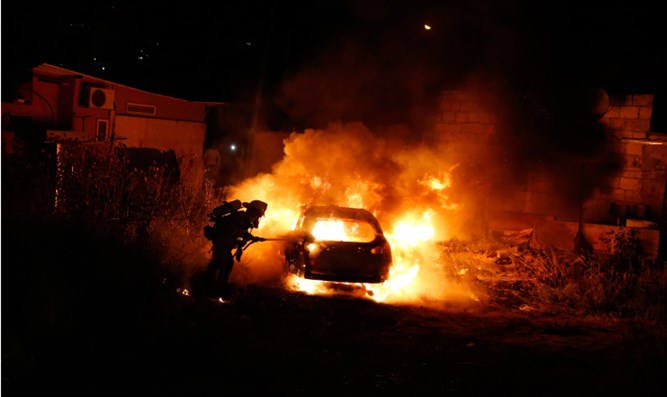
As for the Arab “protestors”—we are not told whether they are “violent” or “Islamist,” “provocative,” or “armed,” nor are we told whether they (or Martians, perhaps) set fire to the burning cars, or have drawn guns.

The reporter, Patrick Kingsley, and contributors, Irit Pazner Garshowitz and Iyad Abuhweila, overlook or disappear that information.

However, the article leads with the Israeli police spraying “skunk water, a noxious liquid used to deter demonstrators.”  They do not describe this as the use of non-lethal force.

The words these reporters use to describe Israelis: “Jewish settlers” and the Israeli police are buzz words, guaranteed to inflame readers and to encourage them to believe that “Israeli right-wing settlers” are white racist supremacists bent on “ethnic cleansing,” and as similar to white supremacists in America.

This is an example of propaganda, not objective reportage. It is certainly not fit to print.

Note that the houses are on land legally owned by Jews from before the establishment of the State of Israel in 1948, when the small neighborhood was known as Shimon Hatzaddik because the grave of the 3rd century sage is located there. In Arabic, the area is called Sheikh Jarrah.

It was overrun by Jordanian forces during the War of Independence and Arab squatters then took over the homes. In the 1967 Six Day War the area was returned to Israel.

The Arab families have already been formally evicted by a lower court. Israel’s Supreme Court is expected to rule in the coming days on whether it will allow an appeal by four of the Arab families to go forward.

(Arutz 7).

Phyllis Chesler, Ph.D, is an Emerita Professor of Psychology and Women’s Studies at City University of New York. Dr. Chesler is a co-founder of the Association for Women in Psychology (1969), The National Women’s Health Network (1974), and The International Committee for the (Original) Women of the Wall (1989). 


Arabs riot on Temple Mount, escalate violence

0

On Friday night, video circulating online showed Arabs throwing
chairs and rocks at police in Jerusalem.

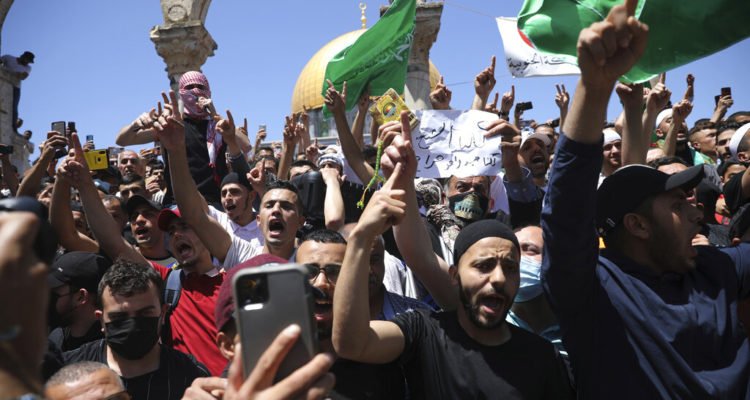
Late Friday night, Palestinians clashed with Israeli police on the Jewish Temple Mount at the Al-Aqsa mosque compound, escalating weeks of violence that have included a deadly drive-by shooting in Samaria and violent rioting in Jerusalem.

Six police officers were wounded, said Israeli law enforcement sources.

The Palestinian Red Crescent emergency service said 136 people were wounded in clashes with police there and elsewhere in Jerusalem, including 83 who were hospitalized.

Earlier Friday, two Palestinians were killed and a third was wounded after the men opened fire on a base belonging to Israel’s Border Police, the latest in a series of deadly confrontations Arabs launched during the Muslim month of Ramadan. More unrest appears likely next week.

Tensions have soared in recent weeks in eastern portions Jerusalem. At the beginning of the month of Ramadan, due to fears of the spread of corona, Israel blocked off a popular gathering spot where Palestinians traditionally socialize at the end of their daylong fast.

Palestinian leadership used the policy to incite violent rioting among Arabs.

Clashes also erupted after Jews attempted to take possession of property they purchased in Jerusalem, threatening to evict Palestinians occupying the property.

The United States said it was “deeply concerned” about the heightened tensions and called on all sides to work to de-escalate them.

The Al-Aqsa mosque compound sits atop the Jewish Temple Mount, the holiest site in Judaism.

It has long been a flashpoint for Palestinian violence and was the epicenter of the 2000 Palestinian intifada, a violent wave of terror attacks targeting Israeli civilians.

On Friday night, video circulating online showed Arabs throwing chairs, shoes and rocks at police, who fired stun grenades and rubber-coated bullets to disperse them. Smaller clashes broke out elsewhere in Jerusalem.

The Israeli police said protesters hurled stones, fireworks and other objects at them, wounding six officers who required medical treatment. “We will respond with a heavy hand to all violent disturbances, riots and attacks on our forces,” police said in a statement.

Earlier, some 70,000 worshipers had attended the final Friday prayers of Ramadan at Al-Aqsa, the Islamic endowment that oversees the site said. Thousands protested afterwards, waving the green flags of the Islamic terror group Hamas and chanting pro-Hamas slogans.

Neighboring Jordan, which serves as the custodian of Jerusalem’s Muslim holy sites, had earlier warned Israel against further “provocative” steps, while Israel’s archenemy Iran encouraged the violence.

In the attack on Friday morning, three attackers fired on the base near the northern Samarian town of Jenin. The Border Police and an Israeli soldier returned fire, killing two of the men and wounding the third, who was evacuated to a hospital.

Israelis and Palestinians are bracing for more violence in the coming days.

Sunday night is “Laylat al-Qadr” or the “Night of Destiny,” the most sacred in the Muslim holy month of Ramadan.

Sunday night is also the start of Yom Yerushalayim (Jerusalem Day), a national holiday in which Israel celebrates its reunification of the Jewish people’s eternal capital. Israelis observe the day by holding parades and other celebrations in the city.

Iran was meanwhile marking its own Quds, or Jerusalem, Day on Friday. The national holiday typically features anti-Israel protests and anti-Semitic speeches by Iranian leaders predicting Israel’s demise.

“The downward and declining movement of the Zionist regime has begun and will not stop,” Supreme Leader Ayatollah Ali Khamenei said in a televised address. He called for continuing armed “resistance” in the Palestinian territories and urged Muslim nations support it.

On Thursday, Israeli forces arrested a Palestinian suspected of carrying out a drive-by shooting earlier this week in Samaria that killed an Israeli and wounded two others. The day before, Israeli troops shot and killed a 16-year-old Palestinian near Nablus where several Palestinians had thrown firebombs toward soldiers.

Israel’s Foreign Ministry had earlier accused the Palestinians of seizing on a “real-estate dispute between private parties,” in order to incite violence.

“The (Palestinian Authority) and Palestinian terror groups will bear full responsibility for the violence emanating from their actions. The Israel police will ensure public order is maintained,” it tweeted earlier in the day.

The Islamic terror group Hamas, which rules the Gaza Strip and opposes Israel’s existence, has egged on the violence, and Palestinian terrorists in Gaza have fired rockets in support of the protesters.

Earlier this week, the shadowy commander of Hamas’ armed wing, Mohammed Deif, released his first public statement in seven years, in which he warned Israel it would pay a “heavy price.”

(World Israel News).


New reports map out Hezbollah’s missile arsenal, expose new military sites

From short-range Burkan rockets with massive warheads that can destroy buildings to medium-range Iranian Fateh 110 missiles that
can reach greater Tel Aviv, the Alma Center sheds new light on how Lebanon is brimming with Hezbollah’s firepower.

Reported Israeli strikes once again lit up Syria’s night sky early on Wednesday, with Israeli missiles slamming into multiple targets in northwest Syria’s Latakia region, according to Syrian state media.

The reports are the latest reminder of an ongoing shadow war raging between Israel and the Iranian-Shi’ite axis, in which the Iranians and Hezbollah attempt to smuggle and deploy advanced weapons to threaten Israel with and Israel sets out to disrupt this activity.

An Israeli organization closely monitoring this struggle is the Alma Education and Research Center, which monitors Israel’s northern borders and publishes in-depth studies on the activities of the radical Iranian axis in Lebanon and Syria.

“The reported airstrike in northwest Syria, in our estimation, targeted the precision missile project and related weapons to Hezbollah,” Alma tweeted on Wednesday, in reference to the latest airstrikes.

The precision missile project is the joint Iranian-Hezbollah initiative to upgrade Hezbollah’s projectiles and convert them into precision-guided missiles (PGMs). Unlike unguided rockets, precise missiles with guidance systems can strike targets within an accuracy of a 5-meter diameter.

The Alma Center has recently put together a detailed map of Hezbollah’s deployment of its arsenal while also exposing six new military sites used by Hezbollah in south Lebanon, which provides a glimpse into the scope of the terror army’s firepower, estimated to be larger in scope than that of most NATO armies.

“Hezbollah assesses that in its next conflict with Israel, it will face great difficulties in dealing with the IDF in open area,” Maj. (res.) Tal Beeri, director of the research department at the Alma research center, told JNS.

“It therefore decided to concentrate its activities in built-up areas. Hezbollah always did this, but since the 2006 Second Lebanon War, it shifted most of its activities into and around built-up areas,” explained Beeri, who spent 20 years in Israel Defense Force intelligence specializing in Lebanon and Syria.

Alma’s map shows two primary lines of “defense” created by Hezbollah designed to hamper any future IDF ground maneuver into Lebanon. It is from these zones that Hezbollah plans to direct heavy waves of projectile fire at Israeli population centers.

The first line, which begins at the Israeli border and runs north up to the Litani River, contains a large number of Grad and Fajr rockets with a 75-kilomter range, placing northern Israeli communities in their sights. A third type of rocket, called the Burkan, is deployed in southern Lebanon as well, and while its range is short, its firepower is devastating.

“The Burkan is designed for use against border civilian communities and against the IDF,” said Beeri. “It has a warhead of 400 kilograms. It can destroy a number of buildings on impact.”

The Burkan was “born” in the Syrian civil war, where forces allied to the Bashar Assad regime adopted a Russian doctrine of surrounding a rebel-held area, placing it under siege and shelling it will all manner of weapons. “This includes the Burkan rockets, which created huge destruction. If this falls in a crowded area, it paralyzes the adversary to the point of not being able to function,” said Beeri. Entire villages in Syria were destroyed through this technique, enabling Assad and his allies, including Hezbollah, to seize many areas.

Goal: ‘Challenge the IDF in urban warfare’

Throughout southern Lebanon, Hezbollah has turned some 200 southern Shi’ite villages into part of its “defensive” plan against a potential IDF ground maneuver. This is where the rocket-launchers have also been embedded. “The fact that they are in villages, as well as near to them, is how they plan to ensure their ability to challenge the IDF in urban warfare, with the limitations it places, such as human shielding,” said Beeri.

The use of underground tunnels, bunkers and command posts dug underground is also intended to make it hard on the IDF to hit the organization. “All of this is in built-up areas,” said Beeri. “This is also where Hezbollah installed its missile infrastructure.”

The first line of defense in Lebanon also contains a massive deployment of anti-tank missiles and shoulder-held anti-aircraft missiles, such as Stingers.

The second line of defense begins at the Litani River and stretches north, to the Zahrani River. In this zone, according to Alma’s assessment, medium-range Zilzal rockets with a range of 200 kilometers are deployed alongside more powerful anti-aircraft batteries.

“Here, too, apparently, are SA-8 surface-to-air missiles with a range of up to 60 kilometers,” said Beeri.

Further north, in Beirut, is Hezbollah’s central headquarters, and the city area is packed with Iranian and Syrian-made Fateh 110 rockets that can reach greater Tel Aviv. It is here that Hezbollah is trying to turn some of those rockets into precision-guided missiles. (Alma exposed 32 such missile sites in Beirut in previous reports.)

The Beirut-area coastline has advanced anti-ship missiles deployed, including the Chinese-made C-802 missile, which was used by Hezbollah in 2006 to strike an Israeli Navy Ship. “In our view and according to international media reports, Hezbollah views this as a strategic tool,” said Beeri.

Hezbollah is also likely armed with the supersonic Russian-made Yakhont missile in the Beirut area that can be used to target Haifa Port, the Haifa naval base and to challenge the Israel Navy’s freedom of maneuver. “As a bonus, they could try to target an offshore Israeli gas rig with this missile,” said Beeri.

“We believe the Yakhont is in Hezbollah’s possession, and if it is, it probably arrived from Syrian weapons warehouses. The war in Syria opened a big door for Hezbollah to import high-quality weapons from Syrian storage facilities. This is part of the local ‘arrangement’ between Hezbollah and Assad, and some of this is going on with the knowledge of the Russians,” he stated.

The Grad and Zilzal rockets come from production facilities in both Iran and Syria as well, smuggled in by the Iranian Quds Force.

The Bekaa Valley, in Lebanon’s east, serves as a logistical and operational rear for Hezbollah, as well as for hosting weapons factories that apparently also create components for precision-guided missiles.

“Our estimate is that in the Bekaa Valley, Hezbollah likely also has tens of Scud D missiles, which came from Syria,” said Beeri.

Advanced Russian-made air-defense systems—SA-17 and SA-22—are in the Bekaa Valley region as well, he estimated, imported with the help of Syria and Iran.

“We believe that Hezbollah trained in Syria on these missile batteries, then came back to Lebanon with them and brought back an unknown quantity of them,” said Beeri.

The majority of Hezbollah’s arsenal is short-range weaponry, but the ongoing attempt to turn Fateh-110s into guided missiles is a severe threat since it gives Hezbollah the ability to accurately target Israel’s strategic sites.

A guided Fateh-110 missile can launch at any target in greater Tel Aviv, he noted, and although Israel’s multi-layered air-defense systems will stop many incoming threats, they won’t be able to intercept everything.

Said Beeri: “What more do they need than the ability to hit central Israel?”

(JNS),


Cracks in Yamina party as MK insists he won’t support unity with Left

0

Yamina MK Amichai Chikli reiterated his opposition to the party joining with those who are ideologically unaligned.

Naftali Bennett, leader of the right-wing Yamina party, says he’ll work to form a unity government with left-wing and anti-Zionist Arab parties. However, not all of his party is on board. Knesset Member Amichai Chikli doubled down on his opposition to the idea on Thursday.

“Let there be no misunderstandings, I will vote against the formation of a government together with the Joint List and Meretz just as we pledged to the electorate,” Chikli tweeted Thursday.

The tweet reaffirms a letter he sent to Bennett that was leaked on Wednesday in which he spelled out his opposition to joining forces with the Left and Arab parties.

He said a unity government would constitute a breach of several promises made to the party’s electorate, including its pledge to form a right-wing government, to not lend a hand to making opposition leader Yair Lapid prime minister, and to not sit with the far-left Meretz party.

The Likud, sensing weakness, has been trying to pressure Yemina members to abandon the party in an effort to torpedo a unity government. According to reports, the Likud is targeting Chikli, Irit Silman and Ayelet Shaked.

However, it doesn’t appear that Chikli, who has been the only one publicly vocal against Bennett’s current efforts, would go so far as to desert his party. A few days ago on Twitter, he wrote, “There’s a fertile imagination in the halls of the Knesset. I’m with Naftali Bennett and behind his efforts to form a government, a right-wing government to start. And if that doesn’t come about then a unity government. We are one fist.”

In a surprise move that even Yemina’s No. 2, Ayelet Shaked, says has hurt them with their base, the party has taken a turn from ideological to practical politics with Bennett arguing the main thing is to prevent another election (which would be the fifth within less than three years).

“There are two options: to be dragged to a fifth, sixth and seventh election that will simply destroy the country, or to establish a broad emergency government, although it would be challenging, but one that will be able to get the wagon unstuck from the mud,” Bennett said on Wednesday.

“We made a final attempt to leave an opening for a right-wing government, but Netanyahu slammed the door on us,” Bennett said.

Netanyahu attacked Bennett on Wednesday, saying he will do anything to become prime minister and fulfill his personal ambitions.

Netanyahu’s position doesn’t look good at the moment.

On Wednesday, Lapid received the mandate to form a government. He will have 28 days to do so and has already expressed willingness to work with Bennett.

(World Israel News).

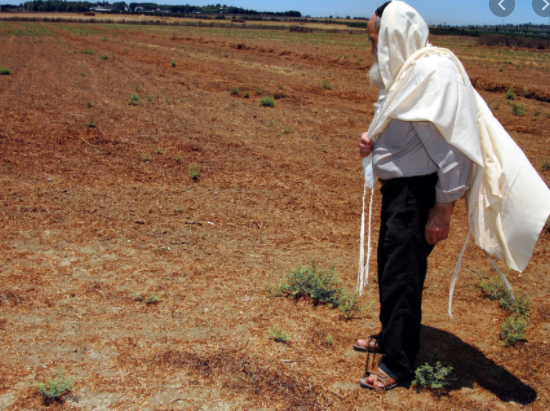
Elli Schwarcz – Shemita: Heavenly Blessings

This week’s parashaBehar, contains the mitzvot of observing the shemitah/yovel cycle in Israel. Here’s a quick rundown of their basic concepts:

  • Every seventh year it is forbidden to work the fields.
  • Wild-growth produce of that year is ownerless; poor people may enter others’ fields and take it.
  • This seventh year, shevi’it, is also called shemitah-Hebrew for ‘release’, as the lands (as well as outstanding loans) are ‘released’, and ‘Shabbat’- as it is a year of rest for the land.
  • Hashem promises that when Israel keeps these laws, its produce will be given special blessing so that the produce of the sixth year is sufficient to last until the eighth year’s crops are ready.
  • After every seven of the seven-year cycles, a Yovel year is observed. The Bet Din (High Court) blows the shofar, then Jewish slaves go free and lands return to the possession of their original owners. Additionally, this year is observed like a shemita year.

What’s the reason behind these mitzvot? Many commentators explain that by leaving our lands untouched (and by having them revert to their original owners in the Yovel year), we are showing that the land is not truly ours but rather Hashem’s; we acknowlege that although we seem to own private property and plant it, sow it and harvest its crops, we are not in charge of it all, but rather caretakers benefiting from Hashem’s generosity. Our rabbis quote the Talmud as a source for this explanation:

God told Israel: ‘Plant for six years but leave it fallow in the seventh, so that you will be aware that the land is Mine.’
Rashi: And (so) your hearts will not become haughty with the gains of your lands, (causing) you to forget the yoke of His Kingship.
-Gemara Sanhedrin 39a

Additionally, as the great Ksav Sofer and others point out, when we follow this commandment we are showing great faith in Hashem- both through displaying our belief that He owns and controls the Land, and by trusting His promise that we will have enough to eat during the shemita year and its aftermath. These two elements give more meaning to one of the Torah’s expressions for the shemita year-
??????????? ????????????, ??????? ?????????? ??????? ???????–???????, ???????:  ??????? ??? ???????, ?????????? ??? ???????
And in the seventh year, there shall be a complete Shabbat for the Land– a Shabbat for Hashem’s sake.
-Behar, 25:4
– being that when we observe Shabbat every week we reinforce these same two ideas, as we show our belief that: 1. Hashem created and owns the world (and we commemorate the day He stopped creating); 2. He provides us with our livelihood, and so we don’t work when He doesn’t want us to.

This idea, that Hashem owns the world and that we must acknowledge this through serving and thanking Him, is expressed perfectly elsewhere in the Talmud. Our Rabbis find a hint to the law of blessing God before and after we eat, through an apparent contradiction in Tehilim:

It says, ???????, ??????? ???????????
The world and what fills it belong to Hashem
-Tehilim 24:1
but it also says,
??????????? ????????, ??????? ????????? ????? ???????-?????.
The Heavens are the Heavens of Hashem- and Earth, He gave to people. !
-Tehilim 115:16
(-The first verse tells us that Earth belongs to Hashem, but the second one teaches that He gave it to us; this is a contradiction.)
-It’s not a question: one verse refers to before one makes a blessing, and one refers to after the blessing.
Rashi: After the blessing it belongs to the people.
-Gemara Berachot 35a

-Nice. Although the obligation to make a blessing before eating is technically only a Rabbinic one, we learn here that the idea that one must show gratitude to Hashem, acknowledging that He owns everything, is timeless. We also see that when we accept that Hashem owns everything, we actually bring the world into our own domain.

It follows, then, that shemita works in the same way; abstaining from working the land, at the same time that it shows that Hashem is the real Owner, is actually what grants us the permission to take possession of it at all! It should come as no surprise, therefore, that failure to keep the shemita can be tragic. To quote the continuation of the earlier Gemara Sanhedrin, once the Jews stopped properly keeping the laws of shemita, there were direct consequences:

but they did not do so (they did not observe the shemita), but sinned- and were exiled from the Land.

-Since they did not actively recognize Hashem’s ownership of the Land, He no longer allowed them to use it.

We can find an incredible hint to this parallel between blessings and shemita:
the gematria (number value) of  ??????? ???????????- ‘the land and what fills it’- is the same as ??????????- ‘like shemita’!

-Just as the shemita shows our faith in God and our acceptance of His ownership, so do the blessings we make on the food He gives us.

It gets even more interesting. We mentioned earlier that Hashem promises that keeping shemita will not bring harm. Now take a look at the language of the relevant pesukim:
????? ????????, ???-??????? ?????????? ????????????:  ??? ??? ???????, ????? ??????? ???-?????????????
And if you will say, ‘What will I eat in the seventh year; we may not plant, nor will we harvest our crops!’
??????????? ???-?????????? ?????, ?????????? ????????????; ????????, ???-???????????, ?????????, ??????????.
-Then I will command My blessing for you in the sixth year, and it shall bring forth produce for three years.
-Behar, 25:20-21

-Amazing! Hashem’s promise that we would not suffer for our faith is expressed through…blessing. He blesses us, as we acknowledge His ownership, giving Him our own ‘blessings’. Not only that, but He ‘commands’ His blessing- and so this expression hints at the command we are given to ‘bless’ Him!

There’s a second explanation of the above Gemara regarding blessings.
Here’s the quotation again:
One verse refers to before the blessing, and one refers to after the blessing.
Rabbi Eli Mansour quotes the famous Rebbe of Kotzk, known in his time as both a tzaddik and the sharpest of men, with an alternative reading of the pasuk:
The Heavens are already made Heavenly by Hashem- but the land- the physical dimension- is given to people to make Heavenly.

-In other words, we know that our mission in this world is to take the physical and make it spiritual. We take food, relationships, land, speech, sleep, and every other part of our existence- and uplift them through keeping the Torah laws that apply to them. We don’t avoid the world around us; that’s not what God wants from us. He wants us to elevate it by following His path. And so we arrive at a new thought:
Before the blessing, the world is oursit’s still physicalAfter the blessing, the world is (more visibly) Hashem’s– we have made it more spiritual, more Heavenly.

And so we apply this thought to shemita as well. In the six years of regular living-before the ‘blessing’ of the seventh year, the world around is an ordinary place. But after having shown our trust in God through shemitah, after the year of ‘blessing’ it brings, the world around us has now become holy.

May we grow to recognize our world’s Owner-through blessing properly over food, supporting shemita observance in Israel and through our everyday following in Hashem’s path- and thereby make it a holier place. If we can do that, we will surely have brought blessing to ourselves, to our friends and families, and to the whole world.

Have a great Shabbat!
Elli Schwarcz


Elli Schwarcz is an alumnus of the Toras Moshe, Ner Israel, and Carteret Yeshivos, and has been involved in Jewish outreach for almost 15 years. He is a Hebrew School and English Language Arts teacher, and has a Master’s Degree in Counseling from Johns Hopkins University. Of all his pursuits, Elli most enjoys teaching high-level Jewish thought and Talmud to teenage boys, exposing them to the beauty and wisdom of their heritage while highlighting their own ability to engage in advanced Torah learning. Elli lives in Lakewood, New Jersey, with his wife and children.

Rabbi Jonathan Gewirtz – The Sound of Music

0

Operation Inspiration

I never was one to be very up on music. I never knew all the latest hits or up-and-coming singers, and my davening repertoire is limited primarily to those tunes I learned growing up. Hopefully, when I daven, there are enough people who remember the classics that they can figure out what tune I’m singing. Regardless, I don’t carry tunes well enough to innovate and introduce new applications of recent music.

One reason for this is also that when I drive, I rarely listen to music. Years ago, I worked right around the corner from my home, and one day I commented to someone that I was envious of those people with a commute who had that time to learn. Clearly, Hashem wanted to test my earnestness in this regard and I lost that job. When I went back to work several months later, it was about a forty-five minute commute which I found perfect for listening to most shiurim. I went through entire tape libraries over the years, becoming familiar with numerous speakers.

Alas, technology changed and the tapes gave way to CDs, which eventually were phased out in favor of streaming content like Torah Anytime and Daf Yomi shiurim. However, not always can I focus on a shiur. Sometimes, I recall that Elisha HaNavi called musicians to get him in the mood for nevuah and I allow myself to put on music. It’s nearly always a playlist my daughters have prepared.

One day, during Sefira, I felt the need to listen to something musical to enable me to drive better. I wasn’t planning to dance and party, but merely needed something to relax and take my mind off the road so I could better focus on the road. It’s complicated, but work with me.

Anyway, I put on a Sefira playlist of acapella music and listened to various singers as their voices lilted through pesukim of Tehillim and similar uplifting lyrics. At one point, I had been listening to a certain phrase for seemingly dozens of times and I decided that I was bored of that song. I reached over to change to the next one in line but then saw something that made me pause. The timer on the car stereo showed that I had been listening to that particular song for a bit over three minutes, and there were just thirty-seven seconds left. I leaned back and didn’t change it.

I told myself that it would be a good lesson in self-control. Do I need to get my way the second it strikes my fancy? Am I so special that I should demand things change when I say so? Instead, I let the song play until it ended, and then I got the change I was looking for.

It reminded me of a story I heard many years ago which I find so powerful.

A Rebbe, who was very hard to get in to see, once told his Gabbai that he would accept ten visitors that day. The fortunate ten men were ushered into the Rebbe’s study and dutifully handed him their kvitlach [notes with their names and requests for blessings on them.]

However, an eleventh man bullied his way into the room. When he approached the Rebbe, his note was refused. “You need to learn,” scolded the Rebbe, “that you can’t always get your way!”Taken aback by the harsh response, the man was crestfallen.

As he slunk toward the door with head bowed, the Rebbe called him back. “Give me your kvitel,” said the Rebbe soothingly. “I ALSO have to learn that I can’t always get my way.”

Like the man in the story who figured he’d be able to force his way in and get to speak to the Rebbe, many of us think we can use our cunning or power or wealth to get our way. We forget that, like the Rebbe, Hashem isn’t impressed by our methods. We can sometimes get a stark surprise when things backfire on us. (I DID see the speed limit sign, Officer, but I didn’t see YOU.)

Yet, more powerful than that realization, was the message of the Rebbe, that even HE couldn’t always get his way. He, who was the dispenser of brachos and the distributor of Hashem’s blessing to His people, was also subject to Hashem’s will. He also couldn’t afford to let himself get blinded by the glow of his own glory.

So, that day when I tired of the song, when I had the chance to beat down my Yetzer Hara just a bit, and endure something I would rather not have, I felt like I was teaching myself an important lesson. We are here on Earth to learn and change our middos. If we can do it on our own terms, by pacing ourselves and pushing ourselves to stretch beyond our comfort zones instead of demanding things be the way we want immediately, we may very well prevent the need for HaKadosh Baruch Hu to put us in more difficult situations where we might learn these lessons the hard way.

The Baalei Mussar say that not eating the last bite of a tasty dish is equivalent to fasting an entire day (or more.) It’s because we’re taking control of ourselves and fine-tuning our middos. Being able to do things like this instead of greater challenges sounds a lot better to me. In fact, I’d say it’s music to my ears.


© 2021 – All Rights Reserved

Did you enjoy this column? Feedback is welcome and appreciated. E-mail info@JewishSpeechWriter.com to share your thoughts. You never know when you may be the lamp that enlightens someone else.

Rabbi Lord Jonathan Sacks zt”l – “We the People” (Behar-Bechukotai 5781)

Rabbi Sacks zt’’l had prepared a full year of Covenant & Conversation for 5781, based on his book Lessons in Leadership. The Rabbi Sacks Legacy Trust will continue to distribute these weekly essays, so that people all around the world can keep on learning and finding inspiration in his Torah.

In the final parsha of the book of Leviticus, in the midst of one of the most searing curses ever to have been uttered to a nation by way of warning, the Sages found a fleck of pure gold.

Moses is describing a nation in flight from its enemies:

Just the sound of a windblown leaf will put them to running, and they will run scared as if running from a sword! They will fall even when no one is chasing them! They will stumble over each other as they would before a sword, even though no one is chasing them! You will have no power to stand before your enemies. (Lev. 26:36-37)

There is, on the face of it, nothing positive in this nightmare scenario. But the Sages said: “‘They will stumble over each other’” – read this as ‘stumble because of one another’: this teaches that all Israelites are responsible for one another.”[1]

This is an exceedingly strange passage. Why locate this principle here? Surely the whole Torah testifies to it. When Moses speaks about the reward for keeping the covenant, he does so collectively. There will be rain in its due season. You will have good harvests. And so on. The principle that Jews have collective responsibility, that their fate and destiny are interlinked – this could have been found in the Torah’s blessings. Why search for it among its curses?

The answer is that there is nothing unique to Judaism in the idea that we are all implicated in one another’s fate. That is true of the citizens of any nation. If the economy is booming, most people benefit. If there is law and order, if people are polite to one another and come to one another’s aid, there is a general sense of well-being. Conversely, if there is a recession many people suffer. If a neighbourhood is scarred by crime, people are scared to walk the streets. We are social animals, and our horizons of possibility are shaped by the society and culture within which we live.

All of this applied to the Israelites so long as they were a nation in their own land. But what about when they suffered defeat and exile and were eventually scattered across the earth? They no longer had any of the conventional lineaments of a nation. They were not living in the same place. They did not share the same language of everyday life. While Rashi and his family were living in Christian northern Europe and speaking French, Maimonides was living in Muslim Egypt, speaking and writing Arabic.

Nor did Jews share a fate. While those in northern Europe were suffering persecution and massacres during the Crusades, the Jews of Spain were enjoying their Golden Age. While the Jews of Spain were being expelled and compelled to wander round the world as refugees, the Jews of Poland were enjoying a rare sunlit moment of tolerance. In what sense therefore were they responsible for one another? What constituted them as a nation? How could they – as the author of Psalm 137 put it – sing God’s song in a strange land?

There are only two texts in the Torah that speak to this situation, namely the two sections of curses, one in our parsha, and the other in Deuteronomy in the parsha of Ki Tavo. Only these speak about a time when Israel is exiled and dispersed, scattered, as Moses later put it, “to the most distant lands under heaven.” (Deut. 30:4) There are three major differences between the two curses, however. The passage in Leviticus is in the plural, that in Deuteronomy in the singular. The curses in Leviticus are the words of God; in Deuteronomy they are the words of Moses. And the curses in Deuteronomy do not end in hope. They conclude in a vision of unrelieved bleakness:

You will try to sell yourselves as slaves—both male and female—but no one will want to buy you. (Deut. 28:68)

Those in Leviticus end with a momentous hope:

But despite all that, when they are in enemy territory, I will not reject them or despise them to the point of totally destroying them, breaking my covenant with them by doing so, because I am the Lord their God. But for their sake I will remember the covenant with the first generation, the ones I brought out of Egypt’s land in the sight of all the nations, in order to be their God; I am the Lord. (Lev. 26:44-45)

Even in their worst hours, according to Leviticus, the Jewish people will never be destroyed. Nor will God reject them. The covenant will still be in force and its terms still operative. This means that Jews will always be linked to one another by the same ties of mutual responsibility that they have in the land – for it was the covenant that formed them as a nation and bound them to one another even as it bound them to God. Therefore, even when falling over one another in flight from their enemies they will still be bound by mutual responsibility. They will still be a nation with a shared fate and destiny.

This is a rare and special idea, and it is the distinctive feature of the politics of covenant. Covenant became a major element in the politics of the West following the Reformation. It shaped political discourse in Switzerland, Holland, Scotland and England in the seventeenth century as the invention of printing and the spread of literacy made people familiar for the first time with the Hebrew Bible (the “Old Testament” as they called it). There they learned that tyrants are to be resisted, that immoral orders should not be obeyed, and that kings did not rule by divine right but only by the consent of the governed.

The same convictions were held by the Pilgrim Fathers as they set sail for America, but with one difference, that they did not disappear over time as they did in Europe. The result is that the United States is the only country today whose political discourse is framed by the idea of covenant.

Two textbook examples of this are Lyndon Baines Johnson’s Inaugural of 1965, and Barack Obama’s Second Inaugural of 2013. Both use the biblical device of significant repetition (always an odd number, three or five or seven). Johnson invokes the idea of covenant five times. Obama five times begins paragraphs with a key phrase of covenant politics – words never used by British politicians – namely, “We the people.”

In covenant societies it is the people as a whole who are responsible, under God, for the fate of the nation. As Johnson put it, “Our fate as a nation and our future as a people rest not upon one citizen but upon all citizens.”[2] In Obama’s words, “You and I, as citizens, have the power to set this country’s course.”[3] That is the essence of covenant: we are all in this together. There is no division of the nation into rulers and ruled. We are conjointly responsible, under the sovereignty of God, for one another.

This is not open-ended responsibility. There is nothing in Judaism like the tendentious and ultimately meaningless idea set out by Jean-Paul Sartre in Being and Nothingness of ‘absolute responsibility’: “The essential consequence of our earlier remarks is that man, being condemned to be free, carries the weight of the whole world on his shoulders, he is responsible for the world and for himself as a way of being.”[4]

In Judaism we are responsible only for what we could have prevented but did not. This is how the Talmud puts it:

Whoever can forbid their household [to commit a sin] but does not, is seized for [the sins of] their household. [If they can forbid] their fellow citizens [but do not] they are seized for [the sins of] their fellow citizens. [If they can forbid] the whole world [but do not] they are seized for [the sins of] the whole world. (Shabbat 54b)

This remains a powerful idea and an unusual one. What made it unique to Judaism is that it applied to a people scattered throughout the world united only by the terms of the covenant our ancestors made with God at Mount Sinai. But it continues, as I have often argued, to drive American political discourse likewise even today. It tells us that we are all equal citizens in the republic of faith and that responsibility cannot be delegated away to governments or presidents but belongs inalienably to each of us. We are our brothers’ and sisters’ keepers.

That is what I mean by the strange, seemingly self-contradictory idea I have argued throughout this series of essays: that we are all called on to be leaders. One may fairly protest: if everyone is a leader, then no one is. If everyone leads, who is left to follow? The concept that resolves the contradiction is covenant.

Leadership is the acceptance of responsibility. Therefore if we are all responsible for one another, we are all called on to be leaders, each within our sphere of influence – be it within the family, the community, the organisation or a larger grouping still.

This can sometimes make an enormous difference. In late summer of 1999 I was in Pristina making a BBC television programme about the aftermath of the Kosovo campaign. I interviewed General Sir Michael Jackson, then head of the NATO forces. To my surprise, he thanked me for what “my people” had done. The Jewish community had taken charge of the city’s 23 primary schools. It was, he said, the most valuable contribution to the city’s welfare. When 800,000 people have become refugees and then return home, the most reassuring sign that life has returned to normal is that the schools open on time. That, he said, we owe to the Jewish people.

Meeting the head of the Jewish community later that day, I asked him how many Jews were there currently living in Pristina. His answer? Eleven. The story, as I later uncovered it, was this. In the early days of the conflict, Israel had, along with other international aid agencies, sent a field medical team to work with the Kosovan Albanian refugees. They noticed that while other agencies were concentrating on the adults, there was no one working with the children. Traumatised by the conflict and far from home, the children were lost and unfocused with no systems of support in place to help them.

The team phoned back to Israel and asked for young volunteers. Every youth movement in Israel, from the most secular to the most religious, immediately formed volunteer teams of youth leaders, sent out to Kosovo for two-week intervals. They worked with the children, organising summer camps, sports competitions, drama and music events and whatever else they could think of to make their temporary exile less traumatic. The Kosovo Albanians were Muslims, and for many of the Israeli youth workers it was their first contact and friendship with children of another faith.

Their effort won high praise from UNICEF, the United Nations’ children’s organisation. It was in the wake of this that “the Jewish people” – Israel, the American-based “Joint” and other Jewish agencies – were asked to supervise the return to normality of the school system in Pristina.

That episode taught me the power of chessed, acts of kindness when extended across the borders of faith. It also showed the practical difference collective responsibility makes to the scope of the Jewish deed. World Jewry is small, but the invisible strands of mutual responsibility mean that even the smallest Jewish community can turn to the Jewish people worldwide for help, and they can achieve things that would be exceptional for a nation many times its size.

When the Jewish people join hands in collective responsibility, they become a formidable force for good.


[1] Sifra ad loc., Sanhedrin 27bShavuot 39a.

[2] Lyndon B. Johnson, Inaugural Address (United States Capitol, January 20, 1965).

[3] Barack Obama, Second Inaugural Address (United States Capitol, January 21, 2013).

[4] Jean-Paul Sartre, Being and Nothingness, trans. Hazel Barnes, New York, Washington Square Press, 1966, 707.


Group from Los Angeles Flies to Comfort Meron Families

0

The right thing to do”: Fathers whose sons survived the deadly crush on Lag BaOmer in Meron flew to New York with Chabad of SOLA’s Rabbi Avraham Zajac to daven at the Rebbe’s Ohel and comfort the families of the victims.

This past Shabbos, congregants at Chabad SOLA in Los Angeles sat together for a farbrengen after davening. On their minds was the tragedy in Meron, Israel, where 45 Jews were killed in a deadly crush on Lag BaOmer.

A few of the men present at the farbrengen were deeply shaken, as their own sons had traveled to Meron to celebrate the yartzeit of Rabbi Shimon Bar Yochai (Rashbi) together with many others from around Israel and the world.

As parents to boys that were in Meron and were safe from the tragedy, we were thinking how can we connect and show support for parents who lost children there, says Tzvika Ferszt, a member of Chabad SOLA.

Speaking with their Rabbi, Rabbi Avraham Zajac, the idea came up for a group of them to fly to New York and comfort the families who are sitting shiva.

Heading the delegation from California this week was Rabbi Zajac and joining it were Ferszt, Dovie Blauner, Danny Fishman, Edo Cohen, Yonatan Abesera and Levi Aron.

Their first stop was at the Rebbe’s Ohel at the Old Montefiore Cemetery in Queens, where they davened and thanked Hashem for their children not being harmed in the Meron crush which left some 150 people injured.

They then went on a journey visiting the family of Donny Morris (19) in Teaneck, Shraga Gestetner (35) and Yosef Amram Tauber (19) in Monsey, and Pinchas Menachem Knoblowitz (22) in Boro Park, all of blessed memory.

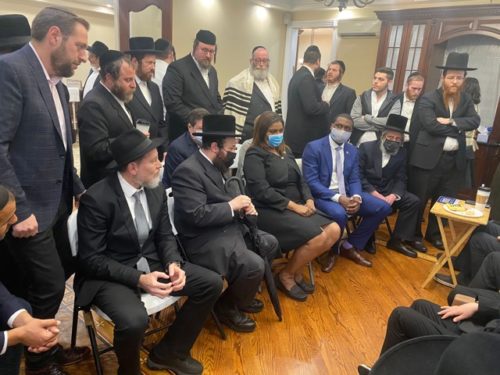
During the visits, they personally spoke with the mourners, heard about the lives of the children who were killed and shared kind words of comfort. They met with fellow rabbis, as well as Attorney General of New York Letitia James.

Calling it a kiddush hashem, Ferszt said people were deeply moved by the gesture that showed how the Jewish community cares and stands up for each other in times of need.

It was the right thing to do, he said. We went in for 24 hours and each of the families was very appreciative that we came. It was a very meaningful trip. We strengthened them and we came out uplifted.


WP Twitter Auto Publish Powered By : XYZScripts.com