Home Blog Page 530

Israeli Scientists Find Way to Switch Off Brain’s Urge-to-Eat Signals

0

The discovery is expected to pave the way for revolutionary treatments for obesity.

An international team of researchers headed by Israeli scientists announced a breakthrough discovery this week. They say they have figured out how “the master switch for hunger in the brain” works and as a result may be able to produce medicines to turn it off, giving a long sought-after medical solution to obesity.

The researchers at the Weizmann Institute of Science in Rechovot and Hebrew University of Jerusalem were joined for the project by scientists at Queen Mary University of London.

In scientific terms, the team discovered how to handle mutations affecting the melanocortin receptor 4, or MC4 receptor for short, the brain’s internal switch that controls whether or not you feel hungry.

When the MC4 is activated, the equivalent of being turned “on,” it sends out commands that cause us to feel full, which means that from the brain’s perspective, our default state is we are not hungry.

However, when the body’s energy levels drop, the brain produces a “time to eat” hormone that inactivates, or turns off, the MC4 receptor. That causes the brain to turn off the “feel full” mode and let you know you are now hungry.

After you eat, the brain then releases an “I’m full” hormone that binds to the MC4, replacing the hunger hormone and turning the receptor back on – returning the “feel full” mode back on so you stop eating.

One key problem is that there are people who have mutations that inactivate the MC4, which causes them to feel hungry constantly.

MC4 is known to control hunger and is a prime target for anti-obesity drugs, such as setmelanotide, because scientists have known that it can control hunger while bypassing all other energy-related signals in the body.

But until now it simply wasn’t known exactly how this hunger switch works.

The study began when PhD student Hadar Israeli came across an entire family in which eight members were plagued by persistent hunger and were all severely obese. Israeli knew that the family’s plight was due to a single mutation that ran in the family, affecting the MC4 receptor in their brains.

Israeli turned to a colleague, Dr. Moran Shalev-Benami of Weizmann’s Chemical and Structural Biology Department, and together with the scientists at Hebrew University and in London the team took samples from the family and discovered how the mutation behaves. They were surprised to find that calcium plays a role in the process.

“This was a truly unexpected finding,” Shalev-Benami said. “Apparently, the satiety signal can successfully compete with the hunger signal because it benefits from the assistance of calcium, which helps the brain restore the ‘I’m full’ sensation after we eat.”

Moreover, the scientists have identified the ways for pharmaceutical companies to design drugs that will bind only to MC4, avoiding side effects that may be caused by interactions with other receptors.

The bottom line is that a key cause of obesity has been identified, and with that knowledge, there is new hope for solving a major health conundrum.

“Our findings can help develop improved and safer anti-obesity drugs that will target MC4R with greater precision,” Shalev-Benami said.

(United with Israel).


Democrats Introducing Legislation To Pack Supreme Court With 4 New Justices, Report Says

0

House and Senate Democrats are reportedly preparing to unveil legislation on Thursday to pack the Supreme Court with four new justices, a move that would change the balance of power on the nation’s highest court.

“The bill would add four seats to the high court, bringing the total to 13, from the current 9,” The Intercept reported. “The bill is led by House Judiciary Committee Chair Jerry Nadler, Subcommittee chair Hank Johnson, and freshman Rep. Mondaire Jones. In the Senate, the bill is being championed by Ed Markey of Massachusetts.”

The legislation comes after Democrat President Joe Biden announced last week that he had created a commission to study court packing.

Court packing is a political move that is so controversial that the majority of Americans oppose it — because, according to The New York Times, he was “under pressure from activists.”

Before last year’s election, Biden said that voters did not “deserve” to know his stance on packing the courts.

Court packing is so toxic that even socialist Sen. Bernie Sanders (I-VT) does not support it and has warned that if Democrats do it then “the next time the Republicans are in power they will do the same thing.”

Leftist Supreme Court Justice Stephen Breyer, a registered Democrat, warned this week during a speech at Harvard that packing the court will diminish “confidence in the courts, and in the rule of law itself” which will lead to “diminishing the court’s power, including its power to act as a ‘check’ on the other branches.”

Even leftist Supreme Court Justice Ruth Bader Ginsburg warned against packing the courts, saying that it will make the court appear more partisan and will trigger a constant expansion of the courts every time there is a power change in Washington, D.C.

(Daily Wire).


America’s Mideast allies unite against Iran, see nuclear talks as ‘betrayal’

0

“The core of the administration’s Iran strategy is a devil’s bargain that will funnel billions into Iran’s imperial project across the Middle East in exchange for a temporary reprieve from Iran’s relentless march towards nuclear-weapons capability,” said John Hannah, a senior fellow at the Jewish Institute for National Security of America.

The renewal of indirect talks last week between the United States and Iran to revive the 2015 nuclear deal – the Joint Comprehensive Plan of Action – appears to have escalated tensions in the Middle East, as Israel makes it clear to its ally that it will not accept Iranian nuclear capability.

Western intelligence sources said Israel’s Mossad intelligence agency was behind a blackout at Iran’s underground Natanz nuclear facility in what seems to be a major setback for the Islamic republic’s nuclear program.

Ali Akbar Salehi, head of the Atomic Energy Organization of Iran, blamed Israel and called the act a “desperate move” and “nuclear terrorism”.

The sabotage of the Iranian nuclear facility could also add difficulties to the US-Iran negotiations.

John Hannah, a senior fellow at the Jewish Institute for National Security of America, told Jewish News Syndicate that at the heart of the administration’s plan to rejoin the JCPOA, none of US President Joe Biden’s advisers want to admit there is no deal without removing terrorism-related sanctions.

“The fact is there’s no way back to the deal unless the United States is willing to accept Iran’s demand that massive sanctions relief be granted to the central pillars of its region-wide terrorist enterprise: its Central Bank, oil sector and the [Islamic Revolutionary Guard Corps],” he said.

“There’s no escaping the reality that at the core of the administration’s Iran strategy is a devil’s bargain that will funnel billions of dollars into Iran’s imperial project across the Middle East in exchange for little more than a temporary reprieve from Iran’s relentless march towards nuclear-weapons capability.”

The renewed talks come as tensions remain high with Israel and other Arabs states, and as the International Atomic Energy Agency continues to chart Iran’s growing nuclear advances.

On Friday, the UN nuclear watchdog noted a new breach by Iran of the nuclear deal while talks were going on to renew the agreement.

The report said Iran was recovering scrap fuel plates with uranium enriched to nearly 20%, which was previously agreed to be “unrecoverable.”

‘America has caved’

Harold Rhode, a long-time former adviser on Islamic affairs at the Pentagon, said, “The Iranians are having a field day humiliating us.”

America has “shown weakness – the more Iran demands, the more the United States gives in,” he added.

Iran began enriching uranium at Natanz last month using advanced IR-4 centrifuges, according to a new report by the IAEA.

Rhode said that US allies in the region, such as Israel, Saudi Arabia, the United Arab Emirates and Egypt, are looking for other alternatives.

The media outlets of our allies in the region “are full of articles which, taken in their cultural context, indicate that the United States betrayed them and that China is making a bid to replace America as the world’s superpower.”

The United States has called talks in Vienna with Iran “indirect.”

Rhode said it may make “American negotiators feel good about themselves, but to our allies that have relied on the United States for protection and to enforce the international order, the word ‘indirect’ and ‘direct’ make no difference since the result is the same. America has caved.”

As a result, he added, “more Arab countries are looking to Israel to assume America’s role, though they would never say so publicly.”

Earlier this month, the New York Times reported that Israel had informed the United States that it was responsible for an attack against the Iranian vessel MV Saviz. Quoting an unnamed US official, the report stated that Israel claimed it was retaliation for Iranian attacks against Israeli ships in recent months.

Rhode said no one believed that it was an American attack at the time.

He stated: “Israel has the guts and ability to do so. America has the ability but has lost its way.”

(Israel Hayom / JNS).

World landmarks light up in blue and white in honor of Israel’s Independence Day

0

US initiative sees New York’s Cuomo Bridge and city halls in Austin, Boston, Denver, Houston, Las Vegas, Los Angeles and San Francisco light up in colors of Jewish state’s flag.

Buildings and landmarks across the US and the globe lit up in blue and white Tuesday evening in celebration of Israel’s 73rd Independence Day.

The initiative, which in the US was spearheaded by the Israeli-American Council, saw New York’s Cuomo Bridge along with city halls in Austin, Boston, Denver, Houston, Las Vegas, Los Angeles and San Francisco light up in the colors of Israel’s flag.

US Secretary of State Antony Blinken also extended “warmest wishes” on behalf of the Biden administration in honor of the occasion.

Outside the US, Ukraine joined in on the festivities, lighting up its city hall in Kyiv in blue and white. In Zagreb, Croatia, an Israeli flag was being projected on a fountain in the city center. In Uzbekistan, the Israeli flag was being projected on a hotel overlooking the central Amira Temura Square in the country’s capital of Tashkent.

Independence Day began Wednesday evening, as Memorial Day came to an end, with the annual state ceremony at Mount Herzl in Jerusalem.

(Times of Israel).

Israel prepares for construction boom in Judea and Samaria

0

Left-wing activists complain that over 12,000 housing plans were approved in 2020 – but overall building fell during the Trump years,
while the PA conducted many land grabs.

Construction in Judea and Samaria is set to take off in the coming years due to a jump in planning approvals under the watch of the Trump administration, the Associated Press reported on Wednesday in what appeared to be part news article and part cri de coeur for the Biden administration to stop it.

“If left unchallenged by the Biden administration, the construction boom could make fading hopes for an internationally backed two-state solution — Palestine alongside Israel — even more elusive,” the report begins.

The Biden administration says settlements harm peace efforts. “We believe, when it comes to settlement activity, that Israel should refrain from unilateral steps that exacerbate tensions and that undercut efforts to advance a negotiated two-state solution,” State Department spokesman Ned Price said.

However, the report of more housing approvals will be welcomed by those who support the settlement movement. Israel rejects the premise that settlements are an obstacle to peace, and Prime Minister Benjamin Netanyahu, during his last campaign, pledged to support settlement construction.

Some 12,000 housing plans in the region were approved at various levels last year. “That was the highest number since Peace Now started collecting data in 2012,” AP reports.

The AP also reported that its own investigation had discovered a “massive development of settlement infrastructure” that would help lead to a housing boom in the very near future.

According to Peace Now, more than 9,200 homes were built in the region over the Trump years.

“2020 was really the first year where everything that was being built was more or less because of what was approved at the beginning of the Trump presidency,” Peace Now spokesman Brian Reeves told AP. “It’s the settlement approvals that are actually more important than construction.”

Peace Now researcher Hagit Ofran says construction carried out in the region “is the ongoing policy of de facto annexation” and will destroy the ability to create a state for the Palestinians.

While criticizing legal building by Israel, the report ignores Palestinian Authority (PA) violations that have been going on for years.

The Regavim movement, an Israeli NGO that monitors land issues, has reported that from 2009 to 2018, the number of illegal Arab structures in Area C, which is completely under Israeli control, virtually doubled, from 29,784 to 58,435.

Regavim says that over 78,626 dunams of land were seized illegally up to 2018 with the total number growing. The group has documented many more seizures over the last two years as well.

In comparison, Jewish building in Judea and Samaria covered an area of 56,700 dunams in 2018. Jewish towns and villages currently cover only some 1.5% of the land in the disputed region as a whole.

While Peace Now has criticized the push for housing plans, which the AP attributes to Trump-era policies, in 2020 ground was broken for only 1,026 new homes according to Israel’s Central Bureau of Statistics (CBS).

“Overall, according to the CBS, there was a 31% dip in the number of settler housing starts during the four years Trump was in the White House when compared to the last four years of Obama’s time in the White House,” The Jerusalem Post reports. Obama is widely considered by Israelis to have favored the Palestinians in the dispute.

Other factors unrelated to the U.S. administration’s policies, like the corona pandemic, may have influenced housing starts.

(World Israel News).


PA slams UK’s ‘subversion of global order’ after Johnson opposes ICC probe

In a letter to Conservative Friends of Israel, British PM says court
has no jurisdiction to investigate Israel; Palestinian mission says statement marks ‘low point’ in relations.

The Palestinian Authority on Wednesday reacted angrily to British Prime Minister Boris Johnson’s statement a day earlier that London opposes the International Criminal Court’s decision to probe Israel for possible war crimes

In a letter to Conservative Friends of Israel, Johnson said, “We do not accept that the ICC has jurisdiction in this instance, given that Israel is not a party to the Statute of Rome and Palestine is not a sovereign state,” adding that the decision “gives the impression of being a prejudicial attack” on the Jewish state.

In response, the PA’s mission in London said the letter “marks a low point in UK-Palestine relations and undermines the UK’s credibility on the international stage.”

“The letter is a contradiction of international law. It is a contradiction of British policy. It subverts the rules-based global order. And it sets back efforts to secure a lasting and just peace in Palestine,” the diplomatic mission said.

“If Mr. Johnson disputes this, he disputes the legitimacy of the Court,” the Palestinian mission in London added.

In March, the ICC announced it would investigate possible war crimes committed by Israel and Palestinians following a request by the Palestinians, who joined the court in 2015 after being granted nonmember observer status in the UN General Assembly.

Israel has fiercely condemned the investigation, accusing the ICC of bias, claiming that Israel is demonstrably capable of investigating any alleged IDF crimes through its own legal hierarchies, and saying the ICC has no jurisdiction since the Palestinians do not have a state. Israel is not a member of the ICC, but its citizens could be subject to arrest abroad if warrants are issued.

Israel sent a formal response to the court on Friday. Though text of the response hasn’t been published, Prime Minister Benjamin Netanyahu’s office said in a statement Thursday that it would say Israel won’t cooperate with the investigation.

The ICC probe is expected to focus on three main areas: the 2014 war between Israel and Hamas; Israeli settlement policy; and the 2018 Great March of Return protests, a series of violent demonstrations along Gaza’s border with Israel that left dozens of Palestinians dead.

The probe will also look at terrorist rocket fire from Gaza at civilian areas in Israel.

Israeli observers noted the significance of the timing of the investigation’s span: On June 12, 2014, Hamas terrorists kidnapped and murdered three Israeli teenagers in the Gush Etzion area of the West Bank. Prosecutor Fatou Bensouda’s investigation — complying with  a request submitted by the so-called State of Palestine — is set to focus on events beginning the following day.

The brutal terror attack, which horrified Israelis and drew international condemnation, was a pivotal moment in the lead-up to the fighting in Gaza later that summer. With the investigation set to consider events beginning the day after the murder, i.e. June 13, 2014, the terror crime appears to have been intentionally excluded from the court’s investigation.

Bensouda is to be replaced as prosecutor in June by British lawyer Karim Khan. Israel reportedly hopes Khan may be less hostile or even cancel the probe.

(Times of Israel).


Rabbi Jonathan Gewirtz – Engineering

0

Operation Inspiration


While not one of my proudest moments, at the time I thought myself pretty clever, when I made a comment to an employee at a kiddie amusement park I visited. As I got off the little train that circled the park with my six-year-old, I thanked the fellow with the striped cap and overalls who’d been driving the train and quipped, “I bet when you told your mother you wanted to be an engineer, this isn’t what she had in mind.” I don’t recall if he laughed, but looking back I can’t imagine that he would.

Being an engineer, as in machines, not driving a locomotive engine, has an air of prestige about it. That’s because it conveys a certain level of knowledge and understanding about how things work. For example, I once met a fellow who spoke five languages and had a degree in mechanical engineering. What did he do for a living? He played professional football and was a placekicker whose accuracy level at the height of his career bested 90%. (His name is Morten Andersen if you want to look him up.)

So why, if he had such a prestigious degree, was he spending his time kicking a football? Precisely because he had an understanding of how things work and he recognized that he could make a whole lot of money kicking a ball, while not risking getting beaten up too badly (kickers are rarely tackled) and he would do much better than if he’d found a job as an actual engineer.

Well, I’m far from an engineer, but sometimes when the need arises, I attempt to get technosavvy and fix things. In Yeshiva I once took apart a tape recorder. When I put it back together, it worked pretty much as it had before… yeah, pretty much. I also found that I had a few screws left on my desk that didn’t seem to have a home. A friend told me, “That’s what happens when they over-engineer something.” You get superfluous parts that you don’t really need in order for the item to work. Of course, I’m not really an engineer, and maybe that’s why the tape recorder “seemed” to work properly, but I wouldn’t know for sure.

It’s like vortex generators on an airplane wing. They seem like a simple little piece of metal that nobody would miss if they were gone. But. in some cases, without them, an airplane might fall out of the sky. Oops!

Recently, I had occasion to do more of my technical wizardry. I’d put my laptop computer in my suitcase when I flew. When I unpacked it, I found that though it started up, the screen was black. I searched for answers and videos on YouTube and when none of the key-combinations worked, I finally realized that I had to unscrew the back of the laptop. I wasn’t exactly sure what I would do once I did that, but first things first. As I used an eyeglass screwdriver to remove the numerous little screws, I made a neat little pile of them as I removed each one. After about the fourth or fifth, I realized that they were not all the same size! Oh no! I didn’t know which hole had the long screws and which had the short ones. I tried to match them up by the corresponding screws on the other side, to thereby figure out which ones had been long or short, but as I would soon find out, that was sadly a failure.

I wasn’t sure what to do once I opened the computer, but with numerous prayers on my lips, I tugged on various wires and plugs which didn’t actually move, and I reseated the RAM (the memory chip mentioned in one of the DIY videos.) Then, having no other plan, I closed the laptop and found myself struggling with those screws but managed to put them all in. As I turned the laptop over to open it, a couple actually fell out. Clearly, they had been short screws in long holes. Oops again. Meanwhile, I turned on the laptop and lo and behold, it worked! Baruch Hashem!

A person watching this story unfold, who didn’t know much about how things work, might have been tempted to say that since, once I removed those screws, the laptop was able to work, obviously those had been the problem. The problem is that this person lacks a fundamental understanding of why each part is in the machine and how it functions. Therefore, to offer an opinion would be presumptuous.

What about those people who feel that various mitzvos don’t make sense? Maybe they feel something is archaic or incorrect. Society frequently changes its position on things and sadly those sentiments seep into our consciousness as well. But we need to realize that we are not engineers and we are not qualified to identify how or why things work in Hashem’s universe. How do we know if that part was holding together something critical? We don’t, but yet we foolishly offer our opinions.

My computer experience reminded me that we don’t know what we’re doing, but Hashem does. We therefore need to follow His instructions and recognize that if something exists or is a mitzvah or a prohibition, it’s because that’s how things work. Those people who fail to realize that? Well, let’s just say they may be missing a few screws.


© 2021 – All Rights Reserved

Did you enjoy this column? Feedback is welcome and appreciated. E-mail info@JewishSpeechWriter.com to share your thoughts. You never know when you may be the lamp that enlightens someone else.

Elli Schwarcz – Tzara’at Honesty With Ourselves

0

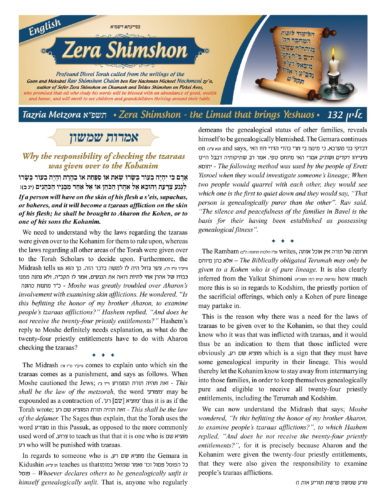
Tzara’at is a type of leprosy- a skin disease- described in the Torah. This affliction is actually unique in that it is spiritual in nature; its root cause and even its symptoms are unrelated to regular physiological rules. Our Rabbis, in the Talmud and Midrash, teach that there are several causes of tzara’at, which usually comes as a form of punishment. For example, the principal sin for which one contracts tzara’at is lashon hara, speaking badly of others; Miriam famously received the malady after speaking badly* about her brother Moshe Rabbenu.

The leprosy spots themselves are not the worst part for someone with tzara’at; rather, the obligations the Torah places on him are.
Fist of all, his impurity forces him to stay outside of the Jewish encampment until a Kohen declares that the tzara’at is gone. On top of that, he must announce loudly to all passers-by that he is a metzora (one who has tzara’at) so that they can steer clear of him. Afterward, the metzora must also undergo a humbling offering ceremony before finally being allowed re-entry into society.

The Da’as Sofer (Rav Akiva Sofer, Hungary & Israel; 1878-1959) makes an observation on the verse introducing these laws:

A man who will have on the skin of his flesh a rising, a scab, or a bright spot, and it become in the skin of his flesh the plague of tzara’at, then he shall be brought to Aharon the Kohen or to one of his sons the Kohanim.
-Tazria, 13:2

Why, he asks, does the Torah not simply state

“And it will be tzara’at?

Why mention for a second time that the affliction is “on the skin of his flesh?”

The Da’as Sofer answers that these words are there to hint to a universal phenomenon: a person can’t see his own faults, as he is biased regarding his own character and deeds; it is therefore imperative to get pointers and guidance from friends, parents, teachers, and Rabbis. The people around you- especially those with wisdom and experience who also have your best interest in mind- are equipped to see those mistakes that you may minimize or excuse. As the K’sav Sofer (the Da’as Sofer’s grandfather) explained the verse,

And they shall confess their sin, and the sin of their fathers, in their treachery which they committed against Me- and also that they have gone casually with Me.

In the next verse Hashem tells us that He will punish B’nei Israel measure for measure- even though the verse we’ve just read describes B’nei Israel as repenting and admitting their wrongdoing! How does this make sense?
The K’sav Sofer explains that the verse is referring to a very problematic confession; it reads,

and they will claim that the sin of their fathers was the cause of their bad behavior.

-That is, if B’nei Israel recognize that they have strayed from the correct path, but insist on blaming their parents by saying that the previous generation made mistakes that caused the current generation to fail,
in such a case Hashem will surely punish these sinners who refuse to accept that they themselves are to blame.

This concept is reflected by the law that a person– even if he is learned – cannot decide his own tzara’at case by declaring himself pure or impure (or questionable). He needs another person (specifically a Kohen) to do so. Why? According to the Mussar masters (ethics teachers), it’s because one cannot properly evaluate his own blemish.

Now the extra words of the verse can be read in a new way:

He must realize that the tzara’at is on the skin of his own flesh

-the metzora needs to recognize that if the tzara’at is on him, it is because he did something wrong and he is at fault.

We should still try to understand something: why does the Torah use the laws of tzara’at in particular to teach us the concept we’ve been discussing? The Torah could have just as easily taught us that one cannot see his own faults via a different set of laws.

The answer may be that this is a lesson for those who speak lashon hara. Someone who says negative things about another person only does so because he sees something negative to begin with. His cynical, judgmental view of his friend is what allows him to even think about expressing such thoughts. That being said, the message for such a person is simple: you only see (or think that you see) other people’s flaws because you can’t see your own. Realize that you yourself are far from perfect, and you may not be so quick to cast others in a bad light.

May we accustom ourselves to seeing the good in others, and learn to listen to those who want to help us improve.

Have a great Shabbat!

Elli

* Miriam meant no harm about her brother, and simply judged his actions based on equating him with other prophets when she should have viewed him as the single greatest prophet. Even so, she was punished with tzara’at. How careful we must all be to avoid really mean-spirited talk about others.


Elli Schwarcz is an alumnus of the Toras Moshe, Ner Israel, and Carteret Yeshivos, and has been involved in Jewish outreach for almost 15 years. He is a Hebrew School and English Language Arts teacher, and has a Master’s Degree in Counseling from Johns Hopkins University. Of all his pursuits, Elli most enjoys teaching high-level Jewish thought and Talmud to teenage boys, exposing them to the beauty and wisdom of their heritage while highlighting their own ability to engage in advanced Torah learning. Elli lives in Lakewood, New Jersey, with his wife and children.


Rabbi Lord Jonathan Sacks zt”l -How to Praise (Tazria – Metzora 5781)

Rabbi Sacks zt’’l had prepared a full year of Covenant & Conversation for 5781, based on his book Lessons in Leadership. The Rabbi Sacks Legacy Trust will continue to distribute these weekly essays, so that people all around the world can keep on learning and finding inspiration in his Torah.


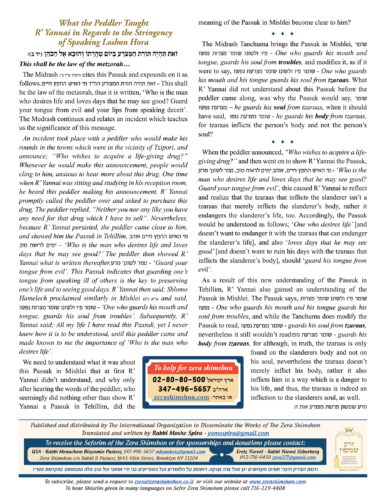
The Sages were eloquent on the subject of lashon hara, evil speech, the sin they took to be the cause of tsara’at. But there is a meta-halachic principle: “From the negative you can infer the positive”[1] So, for example, from the seriousness of the prohibition against Chillul Hashem, desecrating God’s name, one can infer the importance of the opposite, Kiddush Hashem, sanctifying God’s name.

It therefore follows that alongside the grave sin of lashon hara, there must in principle be a concept of lashon hatov, good speech, and it must be more than a mere negation of its opposite. The way to avoid lashon hara is to practise silence, and indeed the Sages were eloquent on the importance of silence.[2] Silence saves us from evil speech but in and of itself it achieves nothing positive. What then is lashon hatov?

One of the most important tasks of a leader, a parent or a friend is focused praise. We first discussed this idea in parshat Vayeshev, where we examined the classic text on this – a Mishnah in Tractate Avot (2:11) in which Rabban Yochanan ben Zakkai enumerates the praises of his five beloved students:

Eliezer ben Hyrcanus: a plastered well that never loses a drop. Joshua ben Chananya:  happy the one who gave him birth. Yose the Priest:  a pious man. Shimon ben Netanel:  a man who fears sin. Elazar ben Arach: an ever-flowing spring.

Every Rabbi had disciples. The imperative, “Raise up many disciples”[3] is one of the oldest rabbinic teachings on record. What the Mishnah is telling us here is how to create disciples. It is not difficult to create followers. Often a good teacher will, over time, notice that they have developed a large following, students who are uncritical devotees – but how to encourage these followers to become creative intellects in their own right? It is far harder to create leaders than to create followers.

Rabban Yochanan ben Zakkai was a great teacher because five of his students became giants in their own right. The Mishnah is telling us how he did it: with focussed praise. He showed each of his pupils where their particular strength lay. Eliezer ben Hyrcanus, the “plastered well that never loses a drop,” was gifted with a superb memory – an important ability in an age in which manuscripts were rare and the Oral Law was not yet committed to writing. Shimon ben Netanel, the “man who fears sin,” may not have had the intellectual brilliance of the others but his reverential nature was a reminder to others that they were not merely scholars but also holy men engaged in a sacred task. Elazar ben Arach, the “ever-flowing spring,” had a creative mind constantly giving rise to new interpretations of ancient texts.

I discovered the transformative power of focused praise from one of the more remarkable people I ever met, the late Lena Rustin. Lena was a speech therapist, specialising in helping children who struggled with stammers. I came to know her through a television documentary I was making for the BBC about the state of the family in Britain. Lena believed that the young children she was treating – they were, on average, around five years old – had to be understood in the context of their families. Families tend to develop an equilibrium. If a child stammers, everyone in the family adjusts to it. Therefore if the child is to lose their stammer, all the relationships within the family will have to be renegotiated. Not only must the child change. So must everyone else.

By and large, we tend to resist change. We settle into patterns of behaviour as they become more and more comfortable, like a well-used armchair or a well-worn pair of shoes. How do you create an atmosphere within a family that encourages change and makes it unthreatening? The answer Lena discovered was praise. She told the families with whom she was working that every day they must notice each member of the family doing something right, and say so – specifically, positively and thankfully.

She did not go into deep explanations, but watching her at work I began to realise what she was doing. She was creating, within each home, an atmosphere of mutual regard and continuous positive reinforcement.  She wanted the parents to shape an environment of self-respect and self-confidence, not just for the stammering child but for every member of the family, so that the entire atmosphere of the home was one in which people felt safe to change and help others to do so.

I suddenly realised that Lena had discovered a solution not just for stammering but for group dynamics as a whole. My intuition was soon confirmed in a surprising way. There had been tensions among the television crew with which I had been working. Various things had gone wrong and there was an atmosphere of mutual recrimination. After filming a session of Lena Rustin teaching parents how to give and receive praise, the crew likewise began praising one another. Instantly the atmosphere was transformed. The tension dissolved, and filming became fun again. Praise gives people the confidence to let go of the negative aspects of their character and reach their full potential.

There is in praise a deep spiritual message too. We think religion is about faith in God. What I had not fully understood before was that faith in God should lead us to have faith in people, for God’s image is in each of us, and we have to learn how to discern it. I then understood that the repeated phrase in Genesis 1, “And God saw that it was good,” was there to teach us to see the good in people and events, and by so doing, help to strengthen that goodness. I also understood why God briefly punished Moses by turning his hand to tsara’at – because he had said about the Israelites, “They will not believe in me.” (Ex. 4:1) Moses was being taught a fundamental lesson of leadership: It does not matter whether they believe in you. What matters is that you believe in them.

It was from another wise woman that I learned another important lesson about praise. Stanford psychologist Carol Dweck, in her book Mindset[4], argues that it makes a decisive difference whether we believe that our abilities are innate and determined once and for all (the “fixed” mindset), or whether we may assume that talent is something we achieve through time by effort, practice and persistence (the “growth” mindset). People who take the former approach tend to be risk-averse, afraid that if they fail this will show that they are not as good as they were thought to be. The latter group embrace risk because they take failure as a learning experience from which they can grow. It follows that there is good praise and bad praise. Parents and teachers should not praise children in absolute terms: “You are gifted, brilliant, a star!” They should praise effort: “You tried hard, you gave of your best, and I can see the improvement!” They should encourage a growth mindset, not a fixed one.

Perhaps this explains a sad aftermath in the life of Rabban Yochanan ben Zakkai’s two most gifted pupils. The Mishnah immediately following the one quoted above states:

He [Rabban Yochanan ben Zakkai] used to say: If all the Sages of Israel were in one scale of a balance and Eliezer ben Hyrcanus in the other, he would outweigh them all. However, Abba Saul said in his name: If all the Sages of Israel, including Eliezer ben Hyrcanus, were in one scale of a balance, and Elazar ben Arach in the other, he would outweigh them all. (Avot 2:12)

Tragically, Rabbi Eliezer ben Hyrcanus was eventually excommunicated by his colleagues for failing to accept the majority view on a matter of Jewish law.[5] As for Rabbi Elazar ben Arach, he became separated from his colleagues. When they went to the academy at Yavneh, he went to Emmaus, a pleasant place to live but lacking in other Torah scholars. Eventually he forgot his learning and became a pale shadow of his former self.[6] It may be that praising his students for their innate abilities rather than their effort, Rabban Yochanan ben Zakkai inadvertently encouraged his two most talented students to develop a fixed mindset rather than engage with colleagues and stay open to intellectual growth.

Praise, and how we administer it, is a fundamental element in leadership of any kind. Recognising the good in people and saying so, we help bring people’s potential to fruition. Praising their efforts rather than their innate gifts helps encourage growth, about which Hillel used to say: “He who does not increase his knowledge, loses it” (Mishnah Avot 1:13). The right kind of praise changes lives. That is the power of lashon hatov. Bad speech diminishes us; good speech can lift us to great heights. Or as W. H. Auden said in one of his beautiful poems:

In the prison of his days

Teach the free man how to praise.[7]


[1] Nedarim 11a.

[2] See for example Mishnah Avot 1:17; 3:13.

[3] Mishnah Avot 1:1.

[4] Carol Dweck, Mindset, Ballantine Books, 2007.

[5] Bava Metzia 59b.

[6] Shabbat 147b.

[7] W. H. Auden, “In Memory of W. B. Yeats,” Another Time (New York: Random House, 1940).


WP Twitter Auto Publish Powered By : XYZScripts.com