Home Blog Page 535

US Lawmakers Battle Violent Anti-Semitism Promoted in Palestinian Schools

0

“The curriculum taught in Palestinian Authority and UNRWA schools incites Palestinian children to violence and encourages them to acts of jihad and martyrdom,” warns IMPACT-se CEO Marcus Sheff.

A bipartisan group of U.S. lawmakers has reintroduced a bill to require the U.S. State Department to address hate and violence in the Palestinian school curriculum.

The measure—the Peace and Tolerance in Palestinian Education Act (H.R. 2374)—was introduced by Reps. Brad Sherman (D-Calif.), Lee Zeldin (R-N.Y.), Josh Gottheimer (D-N.J.), David Trone (D-Md.) and Brian Mast (R-Fla.).

It calls on the State Department to take a number of steps to monitor the Palestinian Authority educational curriculum, such as:

  • A determination of whether content and passages encouraging violence or intolerance towards other nations or ethnic groups have been removed from such curriculum
  • An assessment of the steps the Palestinian Authority is taking to reform such curriculum at schools to conform with standards of peace and tolerance in the Declaration of Principles on Tolerance by the U.N. Educational, Scientific and Cultural Organization;
  • A determination of whether U.S. foreign assistance is used, directly or indirectly, to fund the dissemination of such curriculum by the Palestinian Authority;
  • A detailed report on how U.S. assistance is being used to address curriculum that encourages violence or intolerance towards other nations or ethnic groups;
  • A detailed report about U.S. diplomatic efforts in the last five years to encourage accountability in Palestinian education.

“The United States has provided millions of dollars to support the education of Palestinian children with the stated goal of equipping Palestinians with the tools to build a democratic, secular and politically moderate Palestinian civil society as a driver for peace. As a result of the GAO’s findings, it is necessary for Congress to request additional reports from the State Department to ensure U.S. taxpayer dollars promote dignity and tolerance, and that the educational materials such schools employ do not incite hatred,” said Sherman.

He added that “last Congress, this bill passed the Foreign Affairs Committee unanimously. I hope to work with my colleagues to build on this support and secure the passage of this bill in the 117th Congress.”

The bill’s reintroduction was praised by IMPACT-se, a research, policy and advocacy organization that monitors and analyzes education.

“The curriculum taught in Palestinian Authority and UNRWA schools eradicates the possibility of peace. It incites Palestinian children to violence and encourages them to acts of jihad and martyrdom. This has gone on for far too long,” said IMPACT-se CEO Marcus Sheff.

“This bill’s welcome reintroduction will send a clear message that Congress will not tolerate the teaching of hate and anti-Semitism in Palestinian schools.”

(United with Israel / JNS)

Kim Says North Korea Is Facing Its ‘Worst-ever Situation’

0

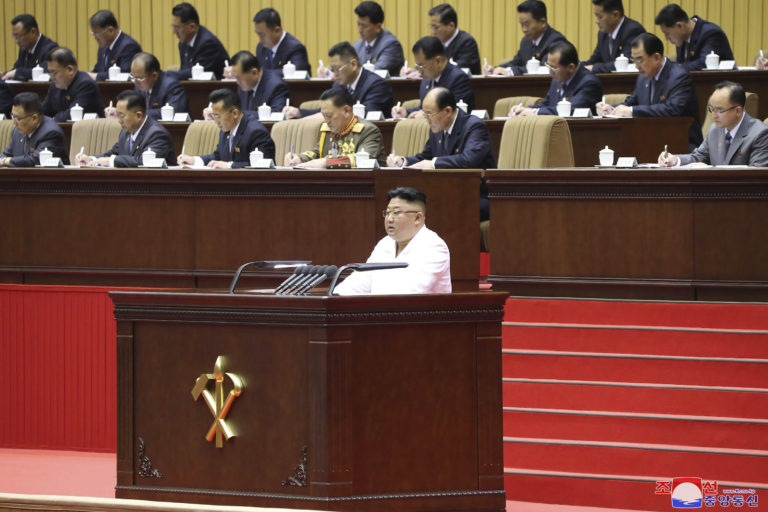
North Korean leader Kim Jong Un has acknowledged his country was facing the “worst-ever situation” as he addressed thousands of grassroots members of his ruling party during a major political conference in Pyongyang.

Experts say Kim is facing perhaps his toughest moment as he approaches a decade in rule, with North Korea’s coronavirus lockdown unleashing further shock on an economy devastated by decades of mismanagement and crippling U.S.-led sanctions over his nuclear weapons program.

The North’s official Korean Central News Agency said Kim made the comments during an opening speech at a meeting of the Workers’ Party’s cell secretaries on Tuesday.

“Improving the people’s living standards … even in the worst-ever situation in which we have to overcome unprecedentedly numerous challenges depends on the role played by the cells, the grassroots organizations of the party,” Kim said.

He urged members to carry out the decisions made at a party congress in January, when he vowed to bolster his nuclear deterrent in face of U.S. pressure and announced a new five-year national development plan.

The congress came months after Kim during another political conference showed unusual candor by acknowledging that his plans to improve the economy weren’t succeeding.

During Tuesday’s speech, Kim also criticized the party’s grassroots units for unspecified “shortcomings” that should be immediately corrected to ensure the “healthy and sustainable” development of the party.

Party cells, which consist of five to 30 members, are the smallest units of party authority that oversee the works and lives at factories and other places. The network is an important tool for Workers’ Party to perpetuate its power. The previous conference of cell secretaries was held in 2017.

The economic setbacks have left Kim with nothing to show for his ambitious diplomacy with former President Donald Trump, which collapsed over disagreements in lifting sanctions for the North’s denuclearization steps.

The North has so far rejected the Biden administration’s overture for talks, saying that Washington must discard its “hostile” policies first, and dialed up pressure by resuming tests of ballistic missiles last month after a yearlong pause.

(Vosizneias / AP).

Texas Gov. Abbott blames Biden as allegations emerge of sexual assault at child migrant facility

0

Texas Republican Gov. Greg Abbott demanded that the White House close a San Antonio facility housing migrant children Wednesday, following allegations that children there were being sexually assaulted.

During a Wednesday evening press conference, Abbott said he received tips that alleged the children at the Freeman Coliseum facility were being sexually abused and were not eating enough.

“These problems are a byproduct of President Biden’s open border policies and the lack of planning for the fallout for those disastrous policies,” Abbott told reporters.

The governor said that separate complaints were sent to the Department of Health and Human Services and the Texas Department of Family and Protective services Wednesday, alleging four different kinds of child abuse.

The agencies then informed the state leadership.

Abbott said allegations of sexual assault, an insufficient number of staffers, children not eating, and an inability to separate COVID-19 positive children from virus-free children, were the most critical complaints the Texas government has received.

“In short, this facility is a health and safety nightmare. The Biden administration is now presiding over the abuse of children,” Abbott told reporters, calling on the White House to immediately shut down the facility.

The governor called on the Texas Department of Public Safety and the Texas Rangers to immediately open an investigation into the allegations surrounding child abuse.

“The Biden administration caused this crisis and has repeatedly failed to address it,” Abbott said. “The administration failed to plan for the influx of children that they invited to come. Now they face allegations of despicable child abuse and neglect.”

(Fox News).


Netanyahu: We will not be bound by an Iran deal that threatens to destroy us

0

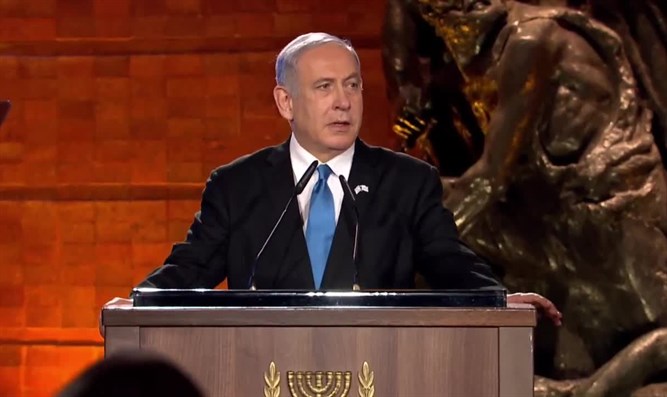
“We are obligated to only one thing: To prevent anyone who seeks to destroy us from carrying out their plot,” Netanyahu said.

Speaking from Yad Vashem in Jerusalem, Prime Minister Benjamin Netanyahu directed a warning at the Biden administration and others seeking to reenter the Iran deal during his speech on Holocaust Remembrance Day, which began at sundown on Wednesday.

His remarks come one day after reports that Iran and the U.S. will set up two working groups to get both countries back into compliance with the 2015 Iran nuclear deal. One will deal with lifting Trump administration sanctions. The other will focus on how to roll back Iran’s nuclear enrichment.

“The nuclear deal with Iran, which gives it international approval to advance the development of an arsenal of atomic bombs, is once again on the table. But history has taught us that such agreements, with such extremist regimes, aren’t worth the paper they’re written on,” Netanyahu said.

“Even to our best friends, I say: We are not bound in any way to an agreement with Iran that paves the way for nuclear weapons. We are obligated to only one thing: To prevent anyone who seeks to destroy us from carrying out their plot,” Netanyahu said.

It’s not the first time the prime minister has used his platform on Holocaust Remembrance Day to draw a comparison between Iran and the Nazi regime that attempted to destroy the Jews.

“During the Holocaust we did not have the power and sovereign right to defend ourselves. We were disenfranchised, defenseless. Today we have a state, we have a defensive force and we have the natural and complete right in the sovereign state of the Jewish people to defend ourselves by our own right,” Netanyahu said.

The prime minister’s direct and public repudiation of the Iran deal and the possibility of restarting it appears to contradict reports in the Hebrew press that Israel was planning on a different strategy when confronting the U.S. administration over Iran this time around as opposed to how it countered the threat during the Obama years.

According to one report, the Israelis were developing a different, quieter strategy.

However, the U.S. also said it would consult Israel before reentering the deal. The swiftness with which events are moving raises questions whether the Israelis were brought into the deliberative process in any serious way.

The original Iran deal was orchestrated by former President Barack Obama and then abandoned by former President Donald Trump in 2018.

(World Israel News)


Biden’s Push For Restoring Aid To Palestinians Faces Legal Hurdles And A Brewing Political Crisis

0

In recent days, the Biden administration has moved rapidly to restore funding to the Palestinians that had been largely severed during the Trump administration.

Concerns are being raised, however, that the funding could both violate existing U.S. law. It appears to also reward bad behavior by the Palestinian leadership through their continued support of terrorism and their targeting Israel in international forums such as the International Criminal Court.

Perhaps most importantly it’s bad in terms of optics: the PA’s refusal to even sit down with Israelis or Americans and engage in the peace process.

Last week, the Biden administration announced that it would allocate $90 million in aid to the Palestinians, with $75 million going to short-term projects to rebuild U.S.-Palestinian relations and $15 million for coronavirus relief.

Additionally, U.S. Secretary of State Antony Blinken announced on Wednesday plans to restart funding for UNRWA, the U.N. agency that deals with Palestinians refugees. This would include $150 million in direct financial aid to UNRWA, $75 million in U.S. economic support and $10 million in development funding.

Asaf Romirowsky, executive director of Scholars for Peace in the Middle East, told JNS that the decision to restore funding to UNRWA is a “serious mistake.”

“UNRWA remains a mainstay of Palestinian rejectionism, characterized by advocacy for the ‘right of return.’ Accountability and transparency are hard to come by at UNRWA, given its monopoly over Palestinians,” he said.

Romoriowsky added that “if Palestinian statehood is a real goal, then the creation of institutions that foster civil society and democratization should be a priority. UNRWA acts in direct opposition to Palestinian statehood and to the Palestinian Authority.”

Jonathan Schanzer, senior vice president at the Foundation for Defense of Democracies, told JNS that while it appears that the initial aid was designed to help the Palestinians deal with the ongoing pandemic, the additional aid could run into serious legal hurdles.

“There are clear indicators that the Biden administration seeks to widen the aid to include UNRWA or even broader support. It’s the widening support that could create complications, particularly with certain American laws in the books, including laws that Biden himself helped pass,” he said.

Indeed, the new administration—not even in office for its first 100 days—noted that the U.S. aid would bypass the Palestinian Authority and go directly to charities in the West Bank and Gaza Strip. But additional monies could run afoul of the Taylor Force Act, which prohibits funding to the P.A. as long as it provides stipends for terrorists or their families. It has been reported that Biden will likely hold off on direct economic aid to the P.A. while it determines how to navigate any legal obstacles.

‘Money is fungible’

“The TFA [Taylor Force Act] stops aid that directly benefits the P.A., with limited exemptions for hospitals vaccines and water treatment,” explained Sander Gerber, CEO at Hudson Bay Capital and a fellow at Jewish Institute for National Security Affairs (JINSA). “Given that Abbas has recently taken control of Palestinian NGOs, it hard to see the PA won’t gain a benefit from US aid.”

Gerber, who helped craft the Taylor Force Act, told JNS: “The point is that money is fungible, and if the P.A. saves money, it can spend it on terror. The Taylor Force Act seeks to stop using U.S. taxpayer dollars in money laundering for terror.”

The Biden administration also appears to be moving towards reopening the PLO Mission in Washington, D.C. Former President Donald Trump shuttered the mission in 2018 amid a larger fallout with the Palestinians that also saw the former president cut millions in aid to the West Bank and Gaza.

Yet similar to restoring aid to the Palestinians, the Biden administration will also face legal hurdles to reopen the mission. In 2019, Congress passed an anti-terrorism amendment that the Palestinians would become liable for $655.5 million in financial penalties against them in U.S. courts if they open an office in America proper.

“Under longstanding U.S. law, the PLO mission should be closed, but it remained open due to a presidential waiver. Trump didn’t renew that waiver,” said Gerber.

“Given that the PLO sponsors terror, I think it’s inappropriate for a terror sponsoring entity to have offices in D.C. I guess others disagree. But if Biden issues a waiver and allows the PLO to reopen their mission, the administration will be effectively sanctioning terror,” he said.

These measures arise amid political uncertainty both in Israel and the Palestinians. For Israel, which has held four inconclusive elections in the past two years, this comes as the Biden administration has shifted its tone on Israeli policies from the Trump era.

Last week, the U.S. State Department made headlines when it returned to using the term “occupied” when referring to the West Bank. Just a few days later, U.S. State Department spokesman Ned Price also lambasted Israel over its settlement policies.

“We believe when it comes to settlement activity that Israel should refrain from unilateral steps that exacerbate tensions and that undercut efforts to advance a negotiated two-state solution. That includes the annexation of territory. That includes settlement activity,” said Price.

And despite supporting Israel against an investigation by the International Criminal Court in The Hague on war-crime allegations, the United States dropped its sanctions against top ICC officials that had been imposed by the Trump administration.

Given this, it would seem that Washington would favor a change in leadership in Jerusalem.

“Using the past as a guide, the Biden administration would almost certainly prefer another prime minister to [Benjamin] Netanyahu,” said Schanzer.

‘Recipe for another political crisis’

Still, it appears that the political gridlock in Israel will not affect U.S.-Israel relations in the long term.

“The U.S.-Israel relationship is broad and deep,” said Schanzer. “Work is already underway, including at [the] high[est] levels. This will continue at a rigorous pace until there is a change of the guard. So, in this sense, I don’t think the political uncertainty is a significant factor at the moment.”

However, the brewing Palestinian political crisis could have significant ramifications, especially as the Biden administration is ramping up its efforts to restore ties. The P.A. will hold legislative elections next month as well as a presidential election in the summer for the first time in a generation.

On Friday, U.S. Secretary of State Antony Blinken also spoke with his Israeli counterpart, Foreign Minister Gabi Ashkenazi, where he emphasized “the administration’s belief that Israelis and Palestinians should enjoy equal measures of freedom, security, prosperity and democracy.”

“The readout from the Blinken call to Ashkenazi last week appeared to be an indirect call to allow the Palestinians to proceed with their planned May 22 legislative elections without preconditions,” said Schanzer.

“I don’t see this as much as a break from Trump policy as a deliberate decision to ignore the painful lessons of the 2006 Palestinian elections, during which Hamas gained control of the PLC [Palestinian Legislative Council] and set off a political crisis that endures to this day.”

Indeed, the Palestinian elections in 2006 eventually led to the ouster of the P.A. from Gaza by Hamas, which the Palestinian terror group has used as a base, along with other operative groups. They launched rockets and terror attacks against Israel, resulting in several wars and dozens of flareups over the last decade-and-a-half.

This could prove troubling again if Hamas gains victory in the upcoming Palestinian elections, which could lead to further instability, while also posing a dilemma for America and Israel over whether or not to engage with a P.A. controlled by Hamas.

“The White House decision to not take steps to prevent a Hamas victory strikes me as troubling, particularly since Hamas is a designated terrorist organization here in the United States,” said Schanzer. “This is almost certainly a recipe for another Palestinian political crisis.”

(Vosizneias / JNS).


Rabbi Lord Jonathan Sacks zt”l – Reticence vs. Impetuosity (Shemini 5781)

Rabbi Sacks zt’’l had prepared a full year of Covenant & Conversation for 5781, based on his book Lessons in Leadership. The Rabbi Sacks Legacy Trust will continue to distribute these weekly essays, so that people all around the world can keep on learning and finding inspiration in his Torah.

It should have been a day of joy. The Israelites had completed the Mishkan, the Sanctuary. For seven days Moses had made preparations for its consecration.[1] Now on the eighth day – the first of Nissan – one year to the day since the Israelites had received their first command two weeks prior to the Exodus (Ex. 40:2)  – the service of the Sanctuary was about to begin (Lev. 9:1 – 24). The Sages say that in Heaven it was the most joyous day since Creation (Megillah 10b).

But tragedy struck. The two elder sons of Aaron “offered a strange fire that had not been commanded” (Lev. 10:1) and the fire from heaven that should have consumed the sacrifices consumed them as well. They died. Aaron’s joy turned to mourning. “Vayidom Aharon” meaning, “And Aaron was silent.” (Lev. 10:3) The man who had been Moses’ spokesman could not longer speak. Words turned to ash in his mouth.

There is much in this episode that is hard to understand, much that has to do with the concept of holiness and the powerful energies it releases that, like nuclear power today, could be deadly dangerous if not properly used. But there is also a more human story about two approaches to leadership that still resonates with us today.

First there is the story about Aaron. We read about how Moses told him to begin his role as High Priest. “Moses [then] said to Aaron, ‘Approach the altar, and prepare your sin offering and burnt offering, thus atoning for you and the people. Then prepare the people’s offering to atone for them, as God has commanded’” (Lev. 9:7).

The Sages sensed a nuance in the words, “Approach the altar,” as if Aaron was standing at a distance from it, reluctant to come near. They said: “Initially Aaron was ashamed to come close. Moses said to him, ‘Do not be ashamed. This is what you have been chosen to do.’”[2]

Why was Aaron ashamed? Tradition gave two explanations, both brought by Nachmanides in his commentary to the Torah. The first is that Aaron was simply overwhelmed with trepidation at coming so close to the Divine Presence. The second is that Aaron, seeing the “horns” of the altar, was reminded of the Golden Calf, his great sin. How could he, who had played a key role in that terrible event, now take on the role of atoning for the people’s sins? That surely demanded an innocence he no longer had. Moses had to remind him that it was precisely to atone for sins that the altar had been made; and the fact that he had been chosen by God to be High Priest was an unequivocal sign that he had been forgiven.

There is perhaps a third explanation, albeit less spiritual. Until now Aaron had been in all respects second to Moses. Yes, he had been at his side throughout, helping him speak and lead. But there is vast psychological difference between being second-in-command and being a leader in your own right. We probably all know examples of people who quite readily serve in an assisting capacity but who are terrified at the prospect of leading on their own.

Whichever explanation is true – and perhaps they all are – Aaron was reticent at taking on his new role, and Moses had to give him confidence. “This is what you have been chosen to do.”

The other story is the tragic one, of Aaron’s two sons, Nadav and Avihu, who “offered a strange fire, that had not been commanded.” The Sages offered several readings of this episode, all based on a close reading of the several places in the Torah where their death is referred to. Some said they had been drinking alcohol.[3] Others said that they were arrogant, holding themselves up above the community; this was the reason they had never married.[4]

Some say that they were guilty of giving a halachic ruling about the use of man-made fire, instead of asking their teacher Moses whether it was permitted (Eruvin 63a). Others say they were restless in the presence of Moses and Aaron. They said: when will these two old men die and we can lead the congregation? (Sanhedrin 52a)

However we read the episode, it seems clear that they were all too eager to exercise leadership. Carried away by their enthusiasm to play a part in the inauguration, they did something they had not been commanded to do. After all, had Moses not done something entirely on his own initiative, namely breaking the tablets when he came down the mountain and saw the Golden Calf? If he could act spontaneously, why not they?

They forgot the difference between a Priest and a Prophet. As we have seen in previous Covenant & Conversations, a Prophet lives and acts in time – in this moment that is unlike any other. A Priest acts and lives in eternity, by following a set of rules that never change. Everything about “the holy,” the realm of the Priest, is precisely scripted in advance. The holy is the place where God, not man, decides.

Nadav and Avihu failed fully to understand that there are different kinds of leadership and they are not interchangeable. What is appropriate to one may be radically inappropriate to another. A judge is not a politician. A King is not a Prime Minister. A religious leader is not a celebrity seeking popularity. Confuse these roles and not only will you fail, you will also damage the very office you were chosen to hold.

The real contrast here, though, is the difference between Aaron and his two sons. They were, it seems, opposites. Aaron was over-cautious and had to be persuaded by Moses even to begin. Nadav and Avihu were not cautious enough. So keen were they to put their own stamp on the role of priesthood that their impetuosity was their downfall.

These are, perennially, the two challenges leaders must overcome. The first is the reluctance to lead. Why me? Why should I get involved? Why should I undertake the responsibility and all that comes with it – the high levels of stress, the sheer volume of work, and the neverending criticisms leaders always have to face? Besides which, there are other people better qualified and more suited than I am.

Even the greatest were reluctant to lead. Moses at the Burning Bush found reason after reason to show that he was not the man for the job. Isaiah and Jeremiah both felt inadequate. Summoned to lead, Jonah ran away. The challenge really is daunting. But when you feel as if you are being called to a task, if you know that the mission is necessary and important, then there is nothing you can do but say, Hineni, “Here I am.” (Ex. 3:4) In the words of a famous book title, you have to “feel the fear and do it anyway.”[5]

The other challenge is the polar opposite. There are some people who see themselves as rightful leaders. They are convinced that they can do it better than anyone else. We recall the famous remark of Israel’s first President, Chaim Weizmann, that he was head of a nation of a million presidents.

From a distance it seems so easy. Isn’t it obvious that the leader should do X, not Y? Homo sapiens contains many back seat drivers who know better than those whose hands are on the steering wheel. Put them in a position of leadership and they can do great damage. Never having sat in the driver’s seat, they have no idea of how many considerations have to be taken into account, how many voices of opposition have to be overcome, how difficult it is at one and the same time to cope with the pressures of events while not losing sight of long-term ideals and objectives. The late John F. Kennedy said that the worst shock on being elected President was that “when we got to the White House we discovered that things were as bad as we’d been saying they were.” Nothing prepares you for the pressures of leadership when the stakes are high.

Overenthusiastic, overconfident leaders can do great harm. Before they became leaders they understood events through their own perspective. What they did not understand is that leadership involves relating to many perspectives, many interest groups and points of view. That does not mean that you try to satisfy everyone. Those who do so end up satisfying no one. But you have to consult and persuade. Sometimes you need to honour precedent and the traditions of a particular institution. You have to know exactly when to behave as your predecessors did, and when not to. All this calls for considered judgement, not wild enthusiasm in the heat of the moment.

Nadav and Avihu were surely great people. The trouble was that they believed they were great people. They were not like their father Aaron, who had to be persuaded to come close to the altar because of his sense of inadequacy. The one thing Nadav and Avihu lacked was a sense of their own inadequacy.[6]

To do anything great we have to be aware of these two temptations. One is the fear of greatness: who am I? The other is being convinced of your greatness: Who are they? I can do it better. We can do great things if (a) the task matters more than the person, (b) we are willing to do our best without thinking ourselves superior to others, and (c) we are willing to take advice, the thing Nadav and Avihu failed to do.

People do not become leaders because they are great. They become great because they are willing to serve as leaders. It does not matter that we think ourselves inadequate. Moses did. So did Aaron. What matters is the willingness, when challenge calls, to say, Hineni, “Here I am.”


[1] As described in Exodus 40.

[2] Rashi to Lev. 9:7, quoting Sifra.

[3] Vayikra Rabbah 12:1; Ramban to Lev. 10:9.

[4] Vayikra Rabbah 20:10.

[5] Susan Jeffers, Feel the Fear and Do it Anyway, Ballantine Books, 2006.

[6] The composer Berlioz once said of a young musician: “He knows everything. The one thing he lacks is inexperience.”


With normalization, Sudanese who descended from Jews hope to connect with Israel

0

Jewish community is long gone, but some citizens hope rapprochement will be sealed with approval of transitional legislature so they can get back in touch with their Jewish roots.

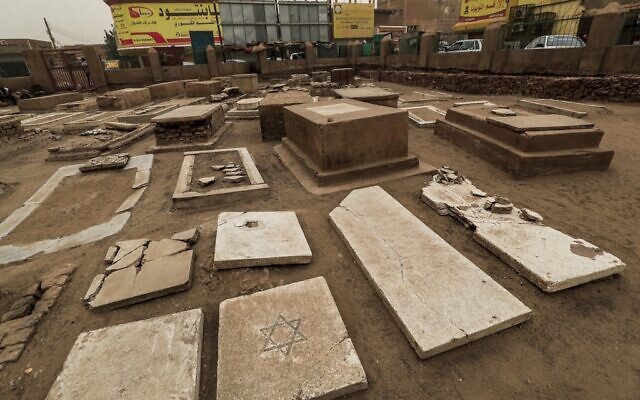
KHARTOUM, Sudan (AFP) — In a corner of a shabby central Khartoum neighborhood, Hebrew-lettered gravestones jut up from a rubble-strewn plot, remnants of the small but vibrant Jewish community that once lived in Sudan.

The cemetery stood for years as a reminder of an oft-overlooked chapter in Sudan’s history, but for decades it has been neglected, abandoned among cracked streets littered with trash and lined by tire shops.

“All we have from Sudan’s Jewish community is this rundown cemetery, some old photos and memories,” pharmacist Mansour Israil told AFP.

The grandson of an Iraqi Jew who settled in Sudan, Israil, whose family later converted to Islam, still lives in a neighborhood once known as “the Jewish quarter” in Omdurman, the capital’s twin city across the Nile river.

This picture taken on February 17, 2021 shows a view of grave markers at the 800-square-meter Jewish Cemetery in Sudan’s capital Khartoum, west of al-Hurriya Street (in the city-center of the capital). (Photo by ASHRAF SHAZLY / AFP)

The Jewish community in Sudan was already one of the smallest in the Middle East, and it dwindled in the latter half of the 20th century, as tensions surrounding the 1948 creation of Israel permeated the region.

In Sudan, like elsewhere in the Arab world, local Jews bore the brunt of growing anti-Israel sentiment.

“The hearts of many in Sudan changed,” said 75-year-old Israil, who watched his lively, diverse neighborhood transform, and his Jewish friends leave Sudan.

Dr. Mansour Israil, the grandson of an Iraqi Jew who settled in Sudan and whose family later converted to Islam, gives an interview with AFP at his pharmacy in the neighborhood once known as “the Jewish quarter” in Omdurman, the Sudanese capital’s twin city across the Nile river, on February 18, 2021. (ASHRAF SHAZLY / AFP)

Now, decades later, Israil and other descendants of Sudanese Jews see a recent rapprochement between their country and Israel as an opportunity to connect with their origins.

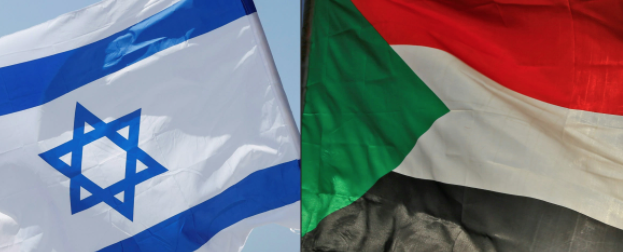
Last year, Sudan, the United Arab Emirates, Bahrain and Morocco agreed to normalize ties with the Jewish state under the US-brokered Abraham Accords.

It was a U-turn on longstanding policy after the 1967 Six Day War between Arab countries and Israel that saw the Jewish state take control of swaths of territory.

Arab leaders gathered in Khartoum after the defeat, announcing a resolution that became known as the “three nos”: no peace, no recognition and no negotiations with Israel.

At the time, Israil said, he got “threatening phone calls because of my family name.”

“Imagine how it was for the Jews.”

Descendants’ hopes

Pressure on the community had already mounted since the 1956 Suez crisis, when Britain, France and Israel invaded Egypt to regain control over the strategic canal, said Daisy Abboudi, a British historian and descendant of a Jewish Sudanese family.

While Sudan had by then gained independence from Anglo-Egyptian rule, its politics remained closely tied to its northern neighbor.

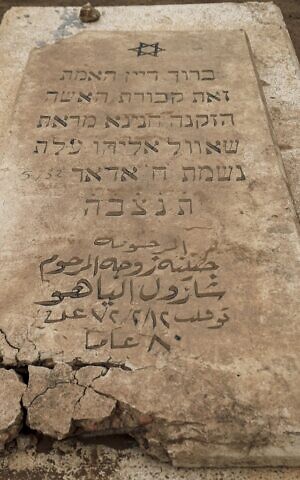
This picture taken on February 17, 2021 shows a view of a grave marker at the 800-square-meter Jewish Cemetery in Sudan’s capital Khartoum, west of al-Hurriya Street (in the city-center of the capital). (ASHRAF SHAZLY / AFP)

Sudan’s Jewish community, made up of no more than 250 families at its zenith in the 1940s and 50s, had virtually disappeared by the late 1970s, according to Abboudi, who is also deputy director of UK-based Jewish oral history project Sephardi Voices.

Jewish communities in other Arab states, including Egypt, Morocco and Iraq, had suffered similar fates from the late 1940s.

“It was much more subtle in Sudan compared to anywhere else in the Middle East… but community members started to feel very uncomfortable and realized maybe there is no future” in the country, Abboudi told AFP.

Some of Sudan’s Jewish families resettled in Israel, as were some of the remains from Khartoum’s Jewish cemetery, which were airlifted to Jerusalem and reburied in the 1970s, she said.

Sudan maintained a rigid anti-Israel stance during the three-decade Islamist rule of former president Omar al-Bashir, who was ousted amid mass protests in April 2019.

But six months after the Sudan-Israel deal was announced, the cabinet in Khartoum on Tuesday approved a bill abolishing a 1958 boycott of the Jewish state.

A post-Bashir transitional government has been pushing for re-integration with the international community and to rebuild the country’s economy after decades of US sanctions and internal conflict.

Sudan agreed to normalize ties with Israel in October in a quid pro quo for Washington removing the country from its “state sponsors of terrorism” blacklist months later.

For Salma, Israil’s niece who lives in Wad Madani, south of Khartoum, the move was “long overdue.”

“Normalization will make it easier to reconnect with my origins,” said the 35-year-old, who has sought to learn more about her Jewish roots and the bygone community.

(L to R) Amin Israil, the grandson of an Iraqi Jew who settled in Sudan and whose family later converted to Islam, his daughter Salma, and Yosar Basha, another Sudanese woman descended of Jewish origins, chat together at Israil’s home during an interview with AFP in Wad Madani, the capital of Sudan’s east-central al-Jazirah state, on February 11, 2021. (Photo by Ebrahim HAMID / AFP)

‘Why not Sudan?’

But many other Sudanese are not in favor of the normalization deal.

“There are still obstacles and the government seems a bit hesitant about this move,” Salma said. “Many in Sudan are still resistant.”

While Sudan’s transitional authorities signed the Abraham Accords in January, they maintain the deal will only take effect after a yet-to-be-formed transitional legislature has been approved.

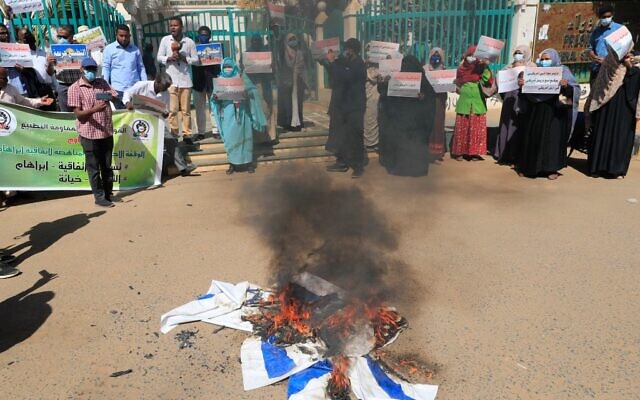
After the signing, dozens of protesters rallied and burned the Israeli flag outside the cabinet offices in Khartoum.

Sudanese demonstrators burn Israeli flags during a rally against their country’s recent signing of a deal on normalizing relations with the Jewish state, outside the cabinet offices in the capital Khartoum, on January 17, 2021 (ASHRAF SHAZLY / AFP)

The next month, when a prominent businessman hosted an event promoting religious tolerance that included a speech by a rabbi via videoconference, critics argued it would heighten tensions.

But like Salma, Yosar Basha, also Sudanese of Jewish origins, is “looking forward to when normalization takes effect.”

“I am almost sure we have extended family living in Tel Aviv or elsewhere in Israel that we lost touch with over the years,” Basha said. “Normalization will help us reconnect with our origins.”

And, she added, if other Arab countries “have either normalized or are moving toward normalization” with Israel, “why not Sudan?”


Jewish communities in Gulf commemorate Holocaust with Muslims

0

For the first time ever, the Jewish communities of Bahrain and Dubai will be participating in the Yellow Candle Project.


BY DAN LAVIE

 Jews in the Gulf will commemorate Holocaust Remembrance Day this week together with Muslims, through a program hosted by the Association of Gulf Jewish Communities (AGJC), the group announced on Tuesday.

“The event will include young Muslims from Bahrain and the United Arab Emirates who will share their experience visiting Yad Vashem [in Jerusalem] for the first time and learning about the atrocities of the Holocaust,” said the statement.

“On Thursday, April 8, at 7 p.m. in Bahrain, Kuwait, Qatar and Saudi Arabia (8 p.m. in Oman and the United Arab Emirates), the AGJC will host a webinar moderated by Emily Judd from the Higher Committee of Human Fraternity featuring young Muslims from Bahrain and the United Arab Emirates who will discuss their experiences visiting Yad Vashem. Later on, they will be joined by members of the Jewish community in the Gulf and together, they will discuss how Muslims and Jews can work together to create a new Middle East.”

Israel, the UAE and Bahrain have recently signed normalization agreements, paving the way for improving Arab-Jewish relations in the region.

The project includes an educational website that allows participants to explore age-appropriate themes within Holocaust education, according to the organization.

“It is truly remarkable that we can celebrate Yom Hashoah so openly this year in the Gulf, both as the broader Jewish community of the Gulf and in our individual communities,” said Rabbi Dr. Elie Abadie, rabbi of the AGJC and senior rabbi of the JCE.

Ebrahim Dawood Nonoo, president of the AGJC and The House of the Ten Commandments, said, “Yom Hashoah is both a day to commemorate the travesties which took place during the Holocaust, as well as to look toward the future and build a better world for the next generation so that it does not happen again.”

Jews living in the Gulf, he said, were “blessed” not to have to experience anti-Semitism.

“This is due to our close relationships with our Muslim neighbors as we look out for one another,” he said. “Therefore, it was important for us to also include a component of our program focused on how Muslims and Jews can build a new—and better—Middle East with a united front.”

This article first appeared in Israel Hayom.

After 63 Years, Sudan Moves to Repeal Israel Boycott Law

0
 By Aryeh Savir/TPS • 7 April, 2021

Jerusalem, 7 April, 2021 (TPS) — Sudan’s cabinet voted on Tuesday to repeal the 1958 law calling for a boycott on the Jewish state, several months after Israel and Sudan announced the normalization of relations, and 63 years after the enactment of the law.

The decision now requires the approval of Sudan’s Sovereign Council.

The law called for a boycott of Israel and Israelis and carried a sentence of up to 10 years in jail and a fine for those who breached it.

Sudan normalized it ties with Israel in October 2020 as part of a rapprochement with the US and its removal from the “state sponsors of terrorism” blacklist.

Israel’s Intelligence Minister Eli Cohen made a historic visit to Khartoum, the capital of Sudan, in January as the head of a joint delegation of the Ministry of Intelligence and the National Security Council, which was dispatched by Prime Minister Benjamin Netanyahu, weeks after Sudan joined the Abraham Accords.

A photo of the meeting was released Tuesday following the Sudanese cabinet’s vote.

Cohen stated that the repeal of the law “is an important and necessary step towards the signing of the peace agreement between the countries.”

“Cooperation between the two countries will help both Israel and Sudan and contribute to the regional security stability that is essential for economic development in the region,” he said.

“Sudan is one of the most important countries in Africa and a peace agreement with it will strengthen our international standing and contribute to the stability and prosperity of the two countries,” he added.

The talks in January dealt with a variety of diplomatic, security and economic issues, and for the first time, a Memorandum of Understanding was signed on these issues between the Sudanese Minister of Defense and the Minister of Intelligence.

The collaboration focused on the possibility of Israeli companies establishing infrastructure projects, including desalination facilities and renewable energy, training mainly in the fields of agriculture, and promoting business delegations of Israeli companies to develop these fields.

The establishment of formal relations between the countries has great potential for both in a variety of areas including security, economy, energy, agriculture and water.

Israel’s peace with Sudan was announced just over a month after Israel, the United Arab Emirates (UAE) and Bahrain signed a historic peace agreement at the White House on September 15, the first agreement to be signed between Israel and an Arab country in 25 years.

The UAE was the first major Arab state to recognize Israel since the Israel-Jordan Peace Treaty was signed in October 1994.

Announced on August 13, the Abraham Accords is the first between a Gulf state and Israel and is expected to lead to similar agreements with other Arab countries, possibly Oman or Saudi Arabia.

Morocco joined the Abraham Accords in December.

Day after Etihad Lands in Israel, Wizz Air Abu Dhabi Announces Flights to Tel Aviv

0
By TPS • 7 April, 2021

Jerusalem, 7 April, 2021 (TPS) — (WAM) – Wizz Air Abu Dhabi, the newest United Arab Emirates (UAE) national airline announced Wednesday its first flight to Tel Aviv on April 18, following the announcement that Israel has been added to the green list.

Tickets are already on sale, with fares starting as low as AED 99, or NIS 89 ($27).

The flights from Abu Dhabi to Tel Aviv will be available three times per week in April, moving to daily flights in May.

Kees Van Schaick, Managing Director of Wizz Air Abu Dhabi, said that “in light of the recently eased restrictions, I’m delighted to announce the date of the first WIZZ flight from Abu Dhabi to Tel Aviv later this month”.

“The connection between the two cities is a historic moment – the link between the UAE and Israel will further contribute to the tourism sector and help to diversify the local economy, while bringing new low-fare business and leisure opportunities for travelers,” he said.

This announcement came a day after Mohamed Mahmoud Al Khaja, UAE Ambassador to Israel, arrived in Tel Aviv on the inaugural flight by Etihad Airways from Abu Dhabi.

The initiation of regular flight services between the UAE and Israel by Etihad Airways comes in the wake of the historic Abraham Accords. The Accords, which established relations between the UAE and Israel, have fostered bilateral economic, political, diplomatic, and cultural cooperation since their signing in September 2020.

Delivering remarks upon his arrival at Ben Gurion International Airport, Al Khaja stated that “since the signing of the Abraham Accords between Israel and the UAE, our two countries have worked together to embark upon a new and dynamic era of cooperation.”

He added that “as our countries recover from the COVID-19 pandemic, we have much to look forward to in commercial, diplomatic, technological, health, and tourism exchanges.”

“Having made history with the Abraham Accords, the UAE and Israel are prepared to build upon our shared achievements to usher in the next phase of cooperation,” he continued.

Onboard Etihad’s inaugural flight to Tel Aviv was a diplomatic and economic delegation representing the UAE with the aim of developing bilateral cooperation and promoting tourism between the two countries. The flight also included Eitan Nae’eh, Israel’s Head of Mission to the UAE, and Tony Douglas, Etihad’s Group Chief Executive Officer of the Etihad Aviation Group.

Douglas said that “launching our first commercial scheduled operation is not only an important milestone for Etihad but a significant moment for the UAE and Israel.”

“We are proud to welcome such a high-profile delegation on board, proving the importance of this occasion, and we look forward to connecting Israel with Abu Dhabi, the UAE and onwards to destinations worldwide,” he said.

WP Twitter Auto Publish Powered By : XYZScripts.com