Home Blog Page 536

PA head Abbas to fly to Germany for medical treatment

Abbas is under severe political pressure. Senior Fatah officials tell TPS there is an atmosphere of rebellion against the rule of the 85-year-old.

The head of the Palestinian Authority (PA) Mahmoud Abbas has traveled to Germany for medical examinations, TPS has learned. The examinations are believed to be routine.

Abbas departed Ramallah in a Jordanian helicopter. He was expected to travel to Germany after a brief stop in Jordan.

Abbas is also et to meet German chancellor Angela Merkel in Berlin. He last met Merkel for talks in Germany in 2019.

Abbas, known to be a heavy smoker, has previously suffered from heart issues. He made several public appearances in recent days and is not believed to be suffering from ill-health.

Abbas is under severe political pressure, with senior Fatah officials telling TPS that there is an atmosphere of rebellion against the rule of the 85-year-old, who is now perceived as responsible for crushing the organization and splitting it into rival factions.

“Disaster, collapse, black day, the end of Fatah,” the organization’s activists say, raising the possibility that the situation may worsen in the near future. Those who worked alongside late PA chairman Yasser Arafat, including foreign officials, officers, and former senior officials, are attacking Abbas as responsible for the drama and historical division in Fatah.

The PA is set to hold its first election in 15 years on May 22nd. Meanwhile, there is growing speculation in Ramallah that Abbas will announce the postponement of the elections, justifying such a step by citing Israel’s refusal to allow ballot boxes in eastern Jerusalem.

A senior official told TPS there is an understanding, almost a decision by Abbas, to postpone the election and save Fatah.

(World Israel News / TPS).


Official: EU Agency To Confirm AstraZeneca Blood Clot Link

0

A top official at the European Medicines Agency said in an interview Tuesday there is a causal link between AstraZeneca’s coronavirus vaccine and rare blood clots. It is still unclear what the connection is and if the vaccine’s risks outweigh its COVID-protecting benefits.

Marco Cavaleri, head of health threats and vaccine strategy at the Amsterdam-based agency, told Rome’s Il Messaggero newspaper that the EU medicines regulator is preparing to make a more definitive statement this week.

Based on the evidence to date, Cavaleri said there’s a clear association between the AstraZeneca vaccine and the dozens of rare blood clots that have been reported worldwide amid the tens of millions of vaccine jabs that have been given out.

Last month, more than a dozen countries, including Germany, suspended their use of AstraZeneca over the blood clot issue. Most restarted — some with age restrictions — after the EMA said the benefits of the vaccine outweighed the risks of not inoculating people against COVID-19.

At the time, the EMA recommended the vaccine’s leaflet be updated to inform doctors and patients about the rare clots.

“It is becoming more and more difficult to affirm that there isn’t a cause-and-effect relationship between AstraZeneca vaccines and the very rare cases of blood clots associated with a low level of (blood) platelets,” Cavaleri was quoted as saying.

He said he appreciated the need for an unequivocal European recommendation on the safety of the vaccine for particular age groups but said he didn’t expect the EMA to be able to provide that now.

“Certainly the information about the product will be updated, affirming that these adverse events are linked to the vaccine. It will be declared in a very clear way,” he was quoted as saying.

Any further doubts about the AstraZeneca vaccine would be a setback for the shot, which is critical to Europe’s immunization campaign and a linchpin in the global strategy to get vaccines to poorer countries.

The AstraZeneca vaccine is cheaper and easier to use than rival vaccines from Pfizer and Moderna and has been approved for use in over 50 countries and groups, including by the 27-nation EU and the World Health Organization. U.S. authorities are still in the process of evaluating the vaccine.

Most European Union countries, including Italy, resumed using the AstraZeneca vaccine on March 19.

Cavaleri said while EMA was prepared to declare a link, further study was still needed to understand why and how the phenomenon occurs.

He said the rare blood clots, including some in the brain, coupled with a low level of blood platelets that may make people at risk of serious bleeding, “seem to be the key event to study further.” Cavaleri promised more details soon, adding: “In the coming hours, we will say that the link is there, but how this happens we still haven’t figured out.”

Cavaleri said the biological mechanism for how the vaccine might be causing the rare clots was still unknown and if it was linked to how the shot is made, other vaccines with similar technologies might also need to be evaluated.

Asked about Cavaleri’s comments, the EMA press office said its evaluation “has not yet reached a conclusion and the review is currently ongoing.” It said it planned a press conference as soon as the review is finalized, possibly Wednesday or Thursday.

Cavaleri was asked how he could arrive at such a causal conclusion given the relatively few cases of adverse events.

“Among those vaccinated there is a number of cerebral thromboses with a low level of platelets among young people that is higher than what we would have expected. This we have to say,” he was quoted as saying.

But he stressed the risk-benefit analysis remained positive for the AstraZeneca jab, even for young women who appear to be more affected by the clots.

“Let’s not forget that young women also end up in intensive care with COVID. So we need to do very meticulous work to understand if the risk-benefit analysis remains for all ages,” he was quoted as saying.

He said the EMA was in a difficult situation, given the different virus outbreaks in each of the EU’s 27 nations.

“Certainly, many people would like EMA to resolve the question for everyone, but it’s not that easy,” he said. “Let’s not forget that the weight of COVID is different in various countries. In Italy there are still around 500 people dying a day, in Norway nearly no one. These factors justify a different approach.”

He ruled out a preventive therapy to address the rare blood clots, saying there is still too much unknown about the phenomenon.

(Vosizneias / AP).


Israeli Farmers Grow Record Pepper Weighing More Than Half A Kilo

0

The Talmud in a number of places states that the proof that the land of Israel does not lack anything is that even peppers grow there. (Brachos 36b, Sukka 35a). Apparently peppers are exotic types of growths which require special conditions but the land of Israel has many different types of climates.

In modern times most Israeli peppers are grown in the Arava region which has the hot arid climate ideally required for them. Peppers are grown in special hothouses and the local water, which has a high saline content in contrast with other regions, contributes to their special qualities.

The peppers which are grown in a number of villages and kibbutzim in the Arava, are taken to the Eureka sorting house in the village of Idan and are then marketed locally and abroad. 40 tons of peppers are sorted daily to evaluate whether they maintain export standards for Europe, Russia and the US.

During the sorting process Monday the computer warned of an unusually large pepper which did not succeed in going through the sorting procedure. After weighing it the farmers were amazed to discover that it weighed 0.555 grams, more than half a kilo, almost 20 ounces! Most peppers weigh in at 250 grams, less than half the size of this pepper.

Shoham Ben Azuz, the director of the sorting house, thinks the pepper is a candidate for a world record, since the largest pepper known previously weighed half a kilo.

(Vosizneias).


Kamala Harris has gone 14 days without a news conference since being tapped for border crisis role

0

Harris, assigned to work with other countries to tackle migration and returning migrants to their home countries, has avoided border visit.

Vice President Kamala Harris continues to avoid a U.S.-Mexico border visit — or a news conference about her border-related duties — despite having visited Southern California over Easter weekend.

Harris was tasked late last month by President Biden with leading efforts to address migration to the southern border, where the nation is facing what’s been described as a “humanitarian crisis” amid a surge in migrants coming to the U.S.

She has now gone 14 days without holding a news conference specifically about her new border duties.

Harris failed to stop by the border during a visit this past weekend to her Los Angeles-area home, where she baked a “beautiful” pork roast and made rice and peas, she said, according to the Los Angeles Times.

On Monday, she was in Oakland to promote Biden’s infrastructure plan and visit local businesses. During that visit, she gave support to California Gov. Gavin Newsom in his efforts to stave off a recall, the paper reported.

On Tuesday, she visited Chicago to tout Biden’s vaccine effort and urged residents to get their shot against COVID-19. Her visit came on the same day that Biden directed states to open vaccine eligibility for everyone age 16 and older starting April 19 — moving up his deadline by two weeks.

“We’re all here to make a statement we understand the significance of getting vaccinated, that it’s bigger than us,” she said. “We are doing it because we know this is a room of role models and people look to you to see how things should be done.”

Her assigned efforts on immigration, which include overseeing diplomatic efforts with Northern Triangle countries, fit into a broader trend of the administration delegating substantial foreign policy responsibilities to her. For example, she has held calls with major world leaders like Canadian Prime Minister Justin Trudeau and Israel’s Benjamin Netanyahu.

Since the beginning of the administration and a week after Biden’s announcement, Harris has fielded questions from the media but has yet to hold a formal news conference. Meanwhile, the border crisis captivated the nation’s attention and raised a series of concerns about national security and the stability of the U.S. immigration system as a whole.

When Biden initially announced her appointment, he said she would be in charge of working to return migrants to their home countries.

“So this new surge we’re dealing with now started with the last administration, but it’s our responsibility to deal with it humanely and to – and to stop what’s happening,” Biden said month.

“And so, this increase has been consequential, but the vice president has agreed – among the multiple other things that I have her leading – and I appreciate it – agreed to lead our diplomatic effort and work with those nations to accept re- – the returnees, and enhance migration enforcement at their borders – at their borders.”

The White House later attempted to claim that Harris wasn’t involved with the “border crisis,” but was instead focused on addressing the “root causes – not the border.” Regardless, returnees include individuals who make contact with U.S. authorities at the southern border, as well as others who are returned while traveling through other countries.

The overwhelming flow of migrants has led to the viral photos of individuals packed into close quarters despite coronavirus restrictions, raising questions about two of the Biden-Harris campaigns’ central attacks on President Trump.

During the campaign, Biden lambasted Trump for not taking COVID-19 seriously and assailed his purported cruelty in placing migrant children in cages.

The border crisis itself encompasses a long list of issues and agencies throughout the federal government, particularly those housed under the Department of Homeland Security and the Department of Health and Human Services.

According to Harris’ office, she’ll work closely with various Cabinet members, including the secretary of state and the administrator for international development, as well as the special envoy for the Northern Triangle.

(Fox News).


Incredible! California allows hundreds of transgender inmates to request transfers to prison aligning with their declared gender identity

0

A California law that took effect this year has prompted hundreds of transgender prison inmates to put in a request to be transferred to a facility that aligns with their gender identity.

Since Jan. 1, 2021, some 261 such requests have been put in, according to the California Department of Corrections and Rehabilitation (CDCR).

Though transgender inmates make up just over 1% of the Golden State’s prison population, the requests have led to heightened fears among women’s facilities that the supposed influx of transgender inmates will lead to increased sexual violence.

“Men are Coming – Prepare for the Worst”

The Los Angles Times reported Monday that some prison guards have been telling female inmates that “men are coming” and to prepare for the worst.

According to the report, the state’s prison system has transferred four inmates to the Chowchilla women’s prison in Central California, approved 21 gender-based housing requests and denied none. Out of all 261 requests, only six requested to be housed in a men’s facility.

There are other concerns that some inmates will abuse the new law by making false claims about their gender identity so they can be transferred to a women’s prison.

Prisons spokeswoman Terry Thornton told Fox News that CDCR “is committed to providing a safe, humane, rehabilitative and secure environment for all people housed in its institutions.”

“Senate Bill 132 … supports CDCR’s endeavors to improve safety, help prevent sexual abuse and create a more respectful environment for the incarcerated transgender, non-binary and intersex community,” Thornton said.

Thornton said CDCR has a classification profess that reviews an incarcerated person’s history before and during incarceration, including their medical and mental health needs as well as safety concerns.

Thornton said information is gathered in screen tool under standards from the Prison Rape Elimination Act (PREA) which gives inmates one of three designations: at risk as a victim, at risk as an abuser, or not identified as being at risk.

“Inmates at risk as a victim cannot be housed in a cell with an inmate identified as being at risk as an abuser,” Thornton said.

The Times reported that the prison system maintains town hall discussions with inmates on a regular basis and that allegations of misconduct are taken seriously and investigated.

For the time being, the COVID-19 pandemic has slowed these transfers.

(Fox News).

Israeli forces carried out strike on Iranian ship in Red Sea, NY Times reports

0

Jerusalem reportedly told US it hit vessel in response to attacks on Israeli ships; official US report calls Saviz covert IRGC base; strike comes amid indirect US-Iran nuke deal talks.

Israeli forces carried out a strike on an Iranian ship in the Red Sea in retaliation for previous strikes by Iran against Israeli vessels, according to a Tuesday report.

A US official told The New York Times that Israel notified the US that Israeli forces attacked the ship around 7:30 a.m. local time on Tuesday.


Israel has not officially commented on the incident. Israel rarely confirms or denies strikes against Iran-linked targets, but sometimes claims credit for attacks that are a direct response to aggression by Iran or its proxies.


Iran’s semi-official Tasnim news agency reported Tuesday that the Iranian-flagged ship, the Saviz, was hit by a limpet mine.

Arabic media reports claimed the ship was an intelligence-gathering vessel linked to Iran’s Islamic Revolutionary Guard Corps.

Tasnim said Saviz “has been stationed in the Red Sea for the past few years to support Iranian commandos who are sent to escort commercial vessels.”

The outlet said the vessel had been hit by a mine that had been attached to it. Limpet mines are a type of naval explosive that attach to targets using magnets.

The New York Times said the ship was stationed in the area to combat pirates, making it the first military vessel known to have been attacked in the Israel-Iran shadow war. The Saviz was classified as a cargo ship.

Iranian media showed flames and smoke aboard the ship, but the level of damage was unclear, and it was unknown if there were any casualties.

The IRGC blamed Israel for the attack on social media, The New York Times said.

The US official said the attack may have been timed to let an American aircraft carrier, the Dwight D. Eisenhower, to move away from the area. The carrier was around 200 miles away at the time of the strike, the official said.

Unnamed American officials told Reuters that the United States was not responsible for the attack.

Israel’s Channel 12 reported that an intelligence firm believed the ship was used by the IRGC for surveillance and espionage purposes and was known to western intelligence.
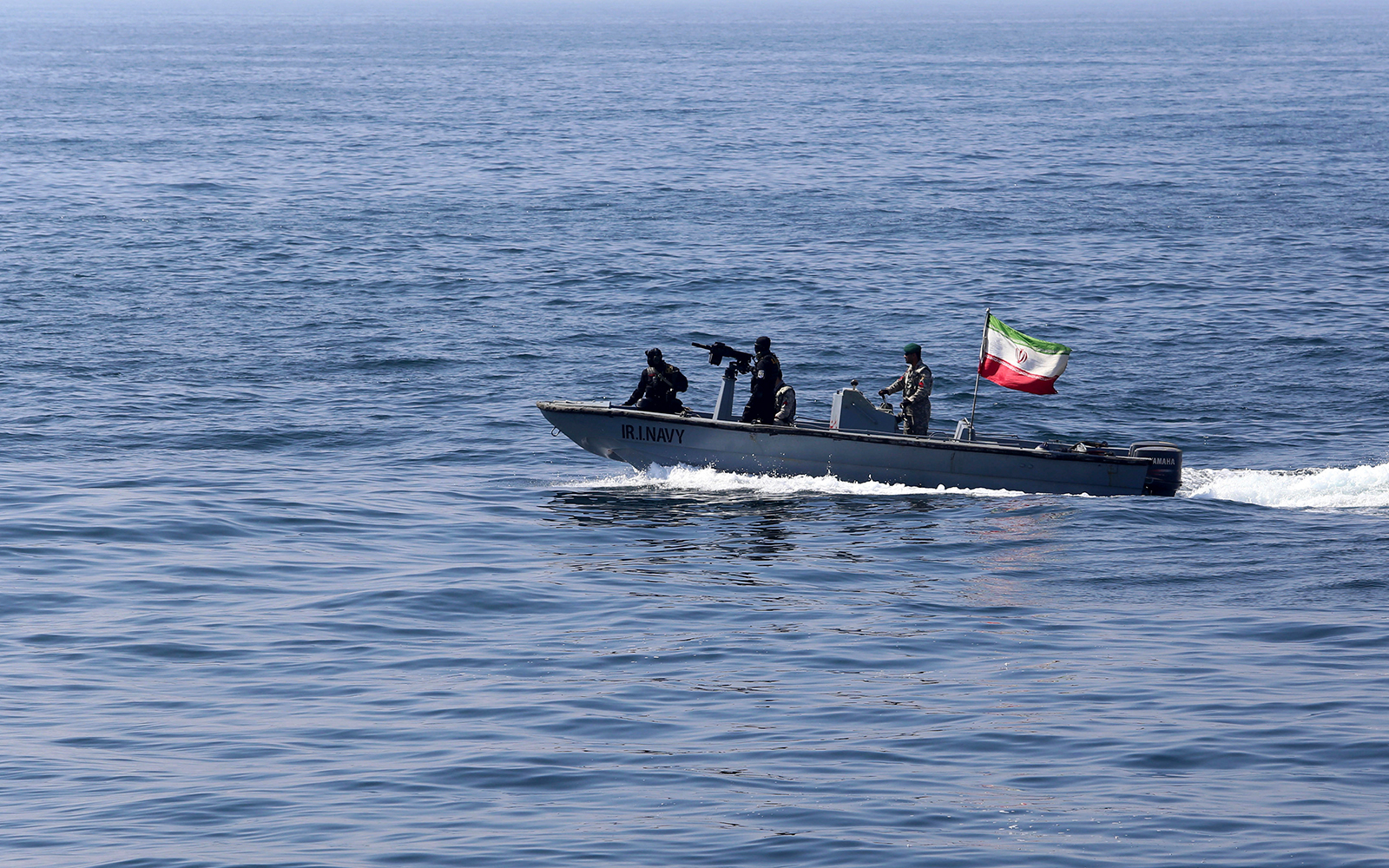
An Iranian naval vessel flying an Iranian flag participates in a joint naval exercise of the Russian navy, the Iranian navy and the Iranian Revolutionary Guard’s navy in the Indian Ocean, Feb. 17, 2021. (Iranian Army via AP)

The ImageSat intelligence firm said satellite imagery showed the ship had hardly moved in the past two years, strengthening suspicions that it was used to monitor maritime activities in the area.

The US Naval Institute said in an October 2020 report that the Saviz, although officially a merchant vessel, was “most likely a covert Islamic Revolutionary Guard Corps (IRGC) forward base.”

Saudi Arabia and other intelligence experts accused the IRGC of operating the Saviz, the report said.

The ship is located at a strategic choke point in the Red Sea. It can provide constant real-time intelligence to Iran about maritime traffic in the area from its strategic position, including on military vessels, the report said.

Uniformed men have been seen onboard the ship, and on the deck are small launch boats that are commonly used by the IRGC and not congruent with the ship’s purported civilian purposes.

“The inference is clear. There is no legitimate civilian explanation for the action,” the US Naval Institute report said.

The Iranian ship ‘Saviz’ in the Red Sea in 2018. (Al Arabiya video screenshot)

In recent months, reports have showed the Israel-Iran conflict has spilled into the sea, marking a new front in the conflict that previously took place via airstrikes, alleged espionage activities and on land.

Starting in 2019, Israel attacked Iranian commercial ships transporting oil and weapons in the Mediterranean and Red Sea, according to US media reports.

Israel and Iran have accused each other recently of attacking a number of merchant ships, damaging them with explosives. The vessels in each case were only lightly damaged and there were no injuries in the incidents.

On February 26, a blast struck the Israeli-owned MV Helios Ray, a Bahamian-flagged cargo ship, in the Gulf of Oman. Prime Minister Benjamin Netanyahu accused Iran of attacking the ship. Iran swiftly denied the charge, but experts say the attack bears hallmarks of previous attacks ascribed to Tehran.

The operation seemed to have been carefully planned, and mirrored a series of attacks on tankers in 2019 and an Iranian campaign against shipping vessels four decades ago.

Another Israeli-owned vessel reportedly came under missile fire in the Gulf of Oman in late March, possibly by Iranian forces.

The Israeli-owned cargo ship, Helios Ray, sits docked in port in Dubai, United Arab Emirates, Feb. 28, 2021. (AP Photo/Kamran Jebreili)

The Wall Street Journal reported last month that Israel has targeted at least 12 ships bound for Syria, most of them transporting Iranian oil, with mines and other weapons.

Iran, whose leaders have repeatedly called for Israel’s demise, backs the Hezbollah terrorist group, as well as terror groups in the Gaza Strip.

The Israeli military has launched hundreds of airstrikes in Syria since the start of the civil war in 2011 against moves by Iran to establish a permanent military presence in the country and efforts to transport advanced, “game-changing” weapons to terrorist groups in the region, principally Hezbollah.

Iran has blamed Israel for a recent series of attacks, including a mysterious explosion last summer that destroyed an advanced centrifuge assembly plant at its Natanz nuclear facility and the killing of Mohsen Fakhrizadeh, a top Iranian scientist who founded the Islamic Republic’s military nuclear program two decades ago.

Tensions have heated in the Middle East in recent months, as Iran repeatedly violated the terms of its 2015 nuclear deal with world powers ahead of talks with the Biden administration.

The US and Iran opened indirect talks aimed at rescuing the deal on Tuesday in Vienna.

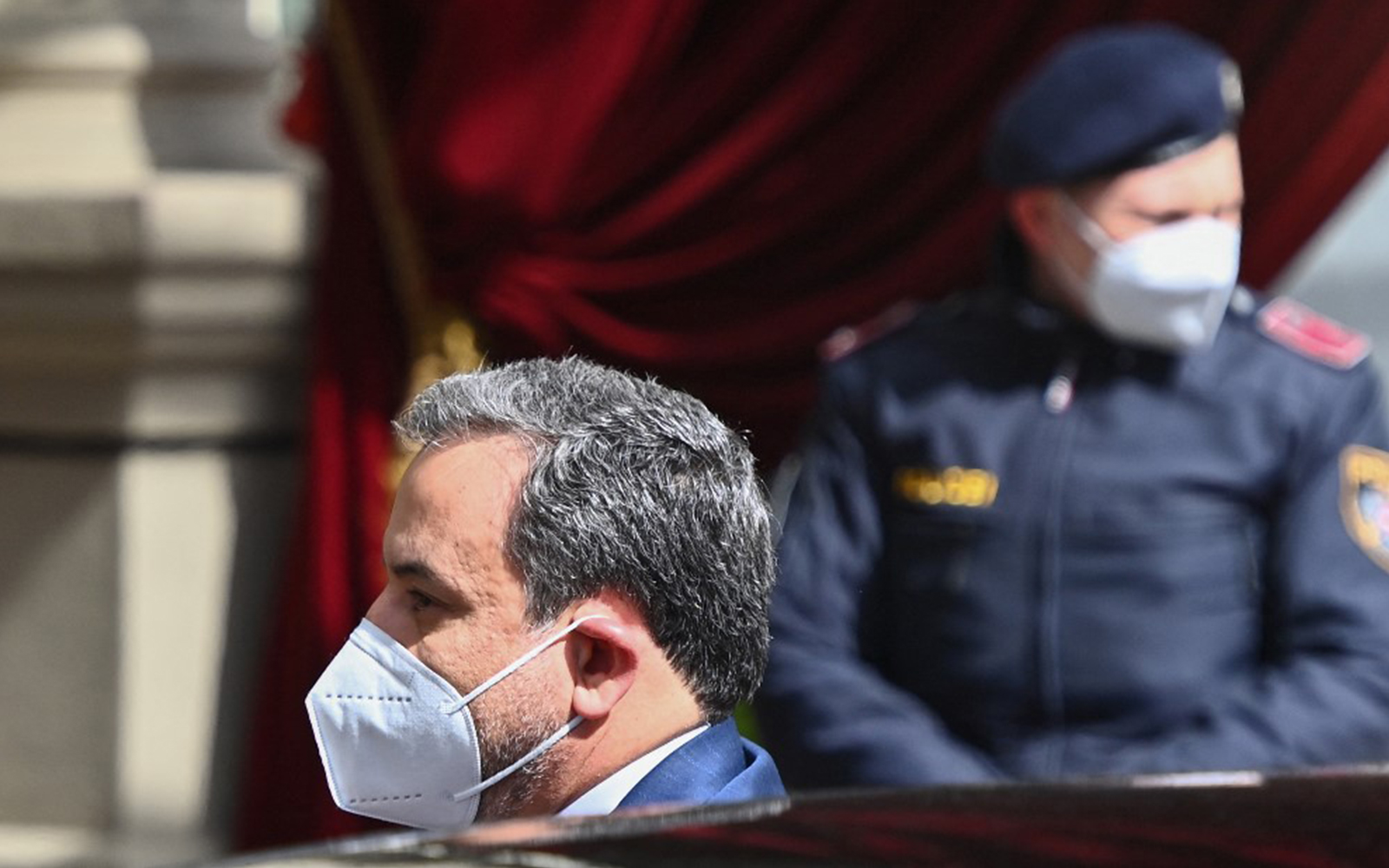
Abbas Araghchi, political deputy at the Ministry of Foreign Affairs of Iran, arrives at the Grand Hotel in Vienna on April 6, 2021, where diplomats of the EU, China, Russia and Iran held talks. (Joe Klamar/AFP)

The US, Iran and European intermediaries reported progress on reviving the deal following the Tuesday meeting, which saw the Biden administration and Iran hold indirect talks for the first time.

US President Joe Biden has said he is ready to reverse the decision of his predecessor Donald Trump to withdraw from the landmark 2015 agreement, negotiated to ensure that Iran did not develop a military nuclear program, but the White House has insisted that Iran first return to compliance. Tehran demands the US first lift sanctions, putting the sides at a stalemate.

Talks between the delegates from the remaining members of the 2015 agreement will continue Wednesday, a diplomat familiar with the discussions said.

Since Trump pulled the US out of the deal with Iran in 2018, re-imposing sanctions on Tehran, the remaining parties have been struggling to save the agreement, as Iran has gradually stepped up its nuclear activities, including by enriching uranium past the deal’s limits and barring inspectors from accessing sensitive sites.

Israel is strongly opposed to a return to the nuclear deal in its original form, and has communicated as much to Washington. The sides recently reestablished a bilateral group for cooperating in the effort to prevent Iran from acquiring nuclear arms, agreeing to set up a joint team for sharing intelligence about Iran’s nuclear program.

(Times of Israel).

Rivlin reluctantly taps Netanyahu to form government

0

President Reuven Rivlin on Monday gave Prime Minister Benjamin Netanyahu the first crack at forming a government but noted that he was doing so reluctantly, both because no party leader appeared to have enough support to succeed at cobbling together a ruling coalition and because he had “moral and ethical” reservations given that Netanyahu is on trial for corruption.

In announcing his choice, Rivlin spoke of his moral dilemma in light of Netanyahu’s ongoing corruption trial and the public discourse surrounding it, expressing his fears for the future of the country amid the divides that have resulted in four inconclusive elections.

“This is not an easy decision on a moral and ethical basis, in my mind,” Rivlin said. “And I fear for my country. But I am doing what is required of me as president of the State of Israel, according to the law and to the ruling of the court, and realizing the will of the sovereign – the Israeli people.”

Rivlin’s choice came a day after he held consultations with all party leaders in the Knesset to hear whom they will back to form a government. No party leader had the support of a majority of the Knesset’s 120 lawmakers.

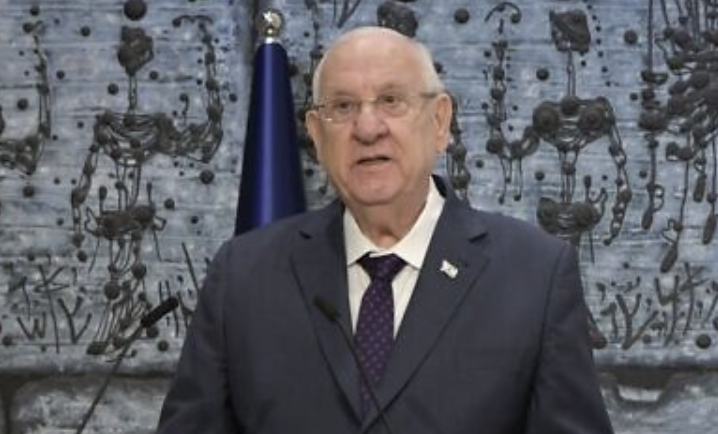
Reuven Rivlin announces his decision for a candidate to form a government on April 6, 2021. (Koby Gideon/GPO)

“The results of the consultations, which were open to all [they were aired live], led me to believe that no candidate has a realistic chance of forming a government that will have the confidence of the Knesset,” he lamented. “In fact, if the law would allow me to do so, I would hand the decision back to the representatives of the people, to the Knesset.”

However, noting that he could not do so by law, Rivlin said the principal consideration was “which candidate has the best chance of forming a government that has the confidence of the new Knesset.”

The president stressed that while “the question of giving the role to a candidate facing criminal charges was one of intense political and public disagreement over the recent election campaigns,” he did not allow it to influence his decision, as to do so would be beyond his authority.

“I know the position held by many, that the president should not give the role to a candidate that is facing criminal charges. But according to the law and the decision of the courts, a prime minister can continue in his role even when he is facing charges,” he said.

“The president of the State of Israel is not a substitute for the legislature or for the judiciary,” added Rivlin.

Underlining his reservations over his decision, Rivlin did not invite Netanyahu to a ceremony formally tasking him with forming a government, as is the norm when a prospective prime minister is named.

Prime Minister Benjamin Netanyahu claims he is the victim of an attempted political coup, in remarks after the first day of evidence against him in his corruption trial, April 5, 2021. (GPO)

Referring to Rivlin’s decision at a Likud faction meeting held Tuesday afternoon at the Knesset, Netanyahu urged political parties to end their “personal boycotts” and join his government.

The prime minister said he’ll make “every effort” to remove Israel from the “cycle of elections” and establish a “strong government for all of Israel’s citizens.”

“This won’t be a government of paralysis, but rather a government of action,” says Netanyahu. “To do this, the government must be united, both in policy and action. And to create it, we must first end the personal boycotts,” Netanyahu said.

He stressed that the establishment of a “strong and homogenous” coalition won’t be easy, but isn’t “impossible.”

Yesh Atid leader Yair Lapid gives a televised speech on April 5, 2021. (Screen capture: Facebook)

Opposition leader MK Yair Lapid tweeted in response to Rivlin’s decision that the president “had fulfilled his duty and he had no choice but to give the mandate to Netanyahu,” but said it was “a shameful sign of disgrace that stains Israel and casts shame on our status as a law-abiding state.”

Netanyahu will now have 28 days to try to muster a coalition that can win majority support in the Knesset, but, given that he only has the backing of 52 out of 120 lawmakers, it will be a challenge.

Netanyahu was endorsed by his Likud party, with 30 seats, Shas, with 9; United Torah Judaism, 7; and Religious Zionism, 6.

Lapid was recommended as prime minister by 45 lawmakers (Yesh Atid 17, Blue and White 8, Yisrael Beytenu 7, Labor 7, Meretz 6), and Naftali Bennett by the seven members of his own Yamina party.

The three parties that made no recommendation account for the final 16 Knesset seats (New Hope 6, Joint List 6, and Ra’am 4).

Rivlin met Monday with representatives of all 13 parties that won Knesset seats in the March 23 election. The 120 MKs were being sworn in on Tuesday afternoon.

Prosecutor Liat Ben-Ari (left) with colleagues at the trial of Prime Minister Benjamin Netanyahu at the District Court in Jerusalem, February 8, 2021. (Reuven Kastro/POOL)

Meantime, at Jerusalem District Court, prosecution witness Ilan Yeshua, giving evidence in Case 4000, the most serious of the three cases against Netanyahu, testified for a second successive day Tuesday.

Netanyahu, who was required to attend Monday’s opening of the evidentiary stage of his trial, requested to forgo the defendant’s right to hear the witnesses testifying against him, and was allowed to leave the court after lead prosector Liat Ben-Ari’s opening statement Monday, before Yeshua began his testimony. On Monday night, Netanyahu made a speech castigating Ben-Ari, the state prosecution and the police, claiming they fabricated the charges against him, were trampling democracy, and were attempting a political coup. Legal officials protested what they said was a speech endangering Ben-Ari and threatening the court.

Neither the pro- nor anti-Netanyahu bloc has a clear path to a coalition majority. Yamina and Arab Israeli party Ra’am have not committed to either bloc, and potentially hold the balance of power between them.

However, Netanyahu’s far-right ally, the Religious Zionism party, has vowed not to enter a coalition that relies on support, even from the outside, from Arab Israeli parties that it sees as anti-Zionist or backing Palestinian terrorism.

The anti-Netanyahu bloc has also been hobbled by disputes over who would lead it. Lapid said Monday he had offered to let Yamina chief Naftali Bennett serve first as prime minister in a government that would see the two rotate the premiership, but Bennett was holding out for better terms.

If Netanyahu does not succeed in forming a government, the president can either task a second person with the attempt (for another period of 28 days and a possible additional 14), or send the mandate back to the Knesset, giving the legislature 21 days to agree on a candidate supported by 61 MKs.

If the president appoints a second person and that person also fails to assemble a coalition, the mandate automatically returns to the Knesset for the 21-day period. During that time, any MK is eligible to attempt forming a government.

At the end of the 21-day period, if no candidate has been agreed upon by 61 MKs, the new Knesset automatically disbands and the country heads to yet another election, the fifth in under three years.

Rabbi Yossi Eilfort – Poway Two Year Anniversary

I don’t often document my Shabbos thoughts, but this week I felt compelled to do so.


To give a little context: I spent Pesach together with my family this year. Ka”h all 8 siblings were home, 5 of whom are now married with children. My father’s Chabad house also hosted the “Pesach in Gan Eden” Program. 2 Years ago, I spent Pesach with my in-laws in this same program, that time as a guest. The last day of that Pesach was the infamous attack at Chabad of Poway – a Chabad where I had spent many weekends, as the Rabbi’s son was a classmate of mine. In the days immediately following the attack I worked together with Drs David and Debbie Fox, as a volunteer for Project Chai (the Trauma and Bereavement Counseling branch of Chai Lifeline), speaking with countless survivors, witnesses, and friends of the victims. That event pushed me to take a much more active role in growing Magen Am.


This Shabbos, in Shuls across the world, we read the Shira. It is a unique piece of poetry and song that holds a special place in the Torah. It is one of 2 or 3 places that the actual writing of the Torah changes to reflect he poetic nature of the passages. In Chabad at La Costa, there is a tradition to read this portion out of a special Torah scroll we have. It is a scroll that is somewhere between 150 and 400 years old, that survived the Holocaust. I won’t document that entire story here – come visit my father if you’d like to hear more – but the Shira in this Torah was his first exposure to it, and it has a very special writing; each ‘kesser’ in the Shira has its own kesser on top. It also had survived in the very city that my home town is named after: Carlsbad. (Carlsbad, Czechoslovakia was known for its hot springs. Carlsbad, CA was named after it due to its own springs.)


As we read the Parsha, I couldn’t help but think about the symbolism of using this Torah to hear the story of Krias Yam Suf; Hearing the clear miracles and descriptions of Hashem fighting our battles for us. Of all the miracles this holiday could be named for, the name that we use most often is “Pesach”, which specifically recalls the miracle of Hashem punishing the Egyptian first-borns while sparing the Jewish families. Here we see another example of extreme divine protection. [Speaking of ‘protection’] That morning, before Davening began, I was meeting with the shul’s community security team to prepare for the day. One of the greeters had asked me if I thought hatred against Jews was caused/aggravated by recent political developments. While following along with the Torah reading, I saw an insight from Rashi:


When the Yidden were stopped by the sea, before it split, it says the looked back and saw ‘Egypt travelling after them’ utilizing the singular tense, while plural would seemed to have been more fitting. Rashi says “B’lev Echad, K’ish Echad” – “With one heart, like one man”. In the next Parsha when discussing the Jewish nation camping by Har Sinai it again uses the singular tense and Rashi says “K’ish Echad, B’lev Echad” – “Like one man, with one heart”. The obvious question is; Why the change? What’s the difference between the 2 phrases? Based on the earlier conversation, one potential answer is as follows: The Jewish people, by virtue of our spiritual DNA, have the innate ability to view each other as extensions of ourselves (of course, sometimes it takes extra focus to bring this awareness into our consciousness). This makes us ‘Like one Man’. Because of this, we are able to care for each other and focus on uniting to accomplish a larger mission (like bringing G-dliness into this world) ‘with one heart’.

The Egyptians, on the other hand, were not in this for each other. Each man had his own selfish interests and reasons for pursuing the Jews. However, because they all had a common interest of capturing the Jews, they were able to pursue ‘with one heart’ uniting them ‘like one man’. So the hatred of Jews has been around for a little while, and it has always been strong enough to unite our enemies against us.


This brings us back to the need for Protection. One of the theories and philosophies that heavily influences my work – in fact, it is a theory about which I hope to one day publish a book – is that the (Biblical) Jewish nation is unique in our relationship with War and the ‘Warrior Class’. In most cultures, there is a revered ‘Warriors Class’ that spends its energy and focus on combative skills and tactics, for the sake of war itself. In Biblical Jewish history, we see countless stories of wars fought and Jewish heroes/heroine. However, in the vast majority of these stories, that individual is not praised for their physical prowess or lethal warfighting abilities. From Avraham Avinu (in his war against the 4 kings) to Dovid HaMelech, we see that wars were won by Tzaddikim who fought only when a divine command called for it. These people were primarily known for their piety and dedication to Heavenly Service. That said, they certainly dedicated time to the practice of these combat oriented skills and philosophies.


In fact, if we look back into our history at great Jewish warriors known for being a warrior, we often find negative endings (Shimshon HaGibur). This may be a stretch, but even in more modern history, we find with Israel that many wars that were won, when fought knowing that we needed Hashem’s miracles. But wars fought with faith in the IDF’s own physical capabilities were often lost.


Back to the Torah reading – I found a possible challenge to this theory: In the Shira itself we find a possuk that reads “Hashem Ish Milchama; Hashem Sh’mo” – “G-d is a Man of War; G-d is His Name”… No minced words. The focus of the song regales the amazing physical feats of G-d’s warfighting abilities. So how can it be so that we do not honor a Warrior’s abilities? A second look at the possuk reveals the answer. When it says “Hashem” it uses the spelling for shem “HaVaYaH”. According to Kabbalah and Chassidus, this spelling reflects on G-d’s attributes of Mercy. The name “Elokim” reflects on justice and discipline. So when the possuk reads “G-d is a Man of War; G-d is His Name”, it could be read as follows: “G-d is a Man of War; [which attribute of G-d? How is a war to be fought?] G-d [HaVaYaH – The Merciful One.] is His Name [War is to be fought with mercy – only when necessary”].


A few years ago, my father asked me to speak on Parshas Beshalach and we explored the 4 schools of thought before the sea split. We discussed how each of these thought patterns exist today and how, at the end of the day, the correct answer was to just continue on with G-d’s direction. Continue moving forth, and He will make it possible to continue.


I feel that, as the Chag was coming to an end, it was time that we do what we must to bring this Divinely focused protection to the Jewish community. No more analysis paralysis. It is not about fighting, but it is also not only up to prayer. We need to have faith while we continue marching into this formidable task – because this is how we will reach our goal. May this will allow our community to continue working in Hashem’s ways with peace, ultimately resulting in the arrival of Moshiach Tzidkeinu.


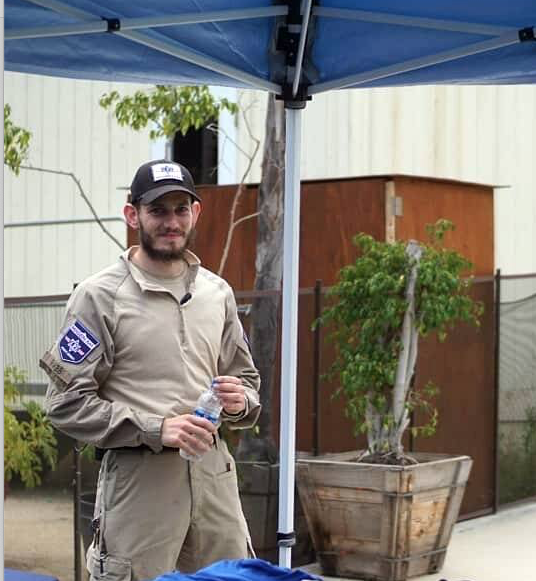
Tomorrow night – Tuesday, April 6th, Magen Am will be launching the first ever licensed, armed patrol staffed by returning IDF and US veterans, focused on the protection of neighborhoods with a densely Jewish population. This will begin in the La Brea/Hancock Park area of Los Angeles. The Patrol Team is staffed by Alumni of Magen Am’s Veterans Program, which was launched in October of 2020 under the Directorship of Leibel Mangel.

SHOCKER: Spirit Airlines Lies Through Their Teeth In Pathetic Statement Defending Actions Today [UPDATED]

0

In defense of their actions in Orlando, Florida on Monday, Spirit Airlines just released one of the most dishonest statements they could have possibly made.

As YWN published earlier, an Orthodox Jewish couple and their two children, one of them a special needs 7-year-old child, were thrown off a flight because their two-year-old child was not wearing a mask while eating a yogurt as she sat on her mothers lap.

The entire episode is well documented on viral videos where the flight attendant tells the parents “non compliance, and you need to get off.”

“But we are wearing masks!”, the parents tell the flight attendant, to which she replies “she’s not wearing a mask” – as she points to the innocent toddler eating her yogurt.

But now, Spirit Airlines calls media reports such as YWN – “incorrect information”.

The statement says that the flight was delayed “due to the adults in a party not complying with the federal mask mandate”.

Did Spirit Airlines bother watching the footage of the flight attendant pointing to the toddler and clearly stating “she is not wearing a mask?”

So who is getting fired at Spirit Airlines today?

The flight attendant who was not allowed back on the plane, despite everyone – including the family who was kicked off – back onboard? Or the person who drafted and published this blatantly false statement on Twitter?

UPDATE:
Minutes after our article was published,
Spirit Airlines deleted their tweet.

YWN has published quite a few articles about Spirit Airlines.

Multiple Orthodox Jews told YWN they were banned from the airline for no reason at all. No reason was ever given by the airline.

But the couple today is in good company.

Just two weeks ago, YWN published a story about Spirit Airlines which threw a 4-year-old autistic child WITH A DOCTORS NOTE off a flight for “no mask”. The child had a “medical note from his physician stating that he’s exempt from wearing masks because whenever he wears a mask he holds his breath or he starts freaking out and he will harm himself.”

(YWN World Headquarters – NYC)


Israeli Tumor-Freezing Technology Approved in US

0

The revolutionary Israeli treatment avoids surgery by using liquid nitrogen to freeze cancerous tumors.

The Israeli medical device company IceCure received a huge boost after American authorities approved the company’s revolutionary ProSense system for treating cancerous tumors by freezing them, Globes reported Sunday.

The U.S. Food and Drug Administration (FDA) gave marketing approval to ProSense as part of the FDA’s Breakthrough Devices Program that fast-tracks new devices to the market.

Based in Caesarea, north of Tel Aviv, and with offices in America, IceCure Medical developed a system that uses liquid nitrogen-based technology to freeze tumors so they can be removed without the need for surgery.

“Using ProSense, oncologists provide better quality patient care, achieve superior outcomes, and reduce the cost of care,” the company says.

ProSense, which can be used for several types of cancer, has proven to be effective and much less intrusive at removing breast cancer growths.

The FDA announcement was also great for business, with IceCure stock shares soaring 35% in value.

“We are delighted about the FDA’s recognition of our innovative cryoablation (freezing) technology as a breakthrough device, which meets the major needs for treating benign and cancerous tumors for a range of indications, including early stage and low risk breast cancer,” said IceCure CEO Eyal Shamir.

“Receiving breakthrough device status allows the company direct access to the FDA team examining the product.”

Founded in 2006, IceCure bases its technology on the science of cryoablation – the use of the super-cold temperature of liquid nitrogen at ?195°C (?320°F) – to destroy tumors safely, quickly and painlessly without the need for surgery.

The ProSense system provides physicians with full control over the procedure, ensuring that the treated zone is destroyed while leaving surrounding tissue undamaged.

(United with Israel).

WP Twitter Auto Publish Powered By : XYZScripts.com