Home Blog Page 705

Massive Beirut explosions: 78 killed, 4000 injured. Israeli involvement ruled out by both sides.

0

Lebanese terror group says ‘no truth’ to rumors of airstrike on one of its weapons caches; Israeli official says Jerusalem had nothing to do with explosion.

Massive blasts that struck Beirut were not caused by Israeli activity, sources in Lebanon and Jerusalem said Tuesday afternoon, as officials attempted to determine what sparked the huge explosions.

The blast was stunning even for a city that has seen civil war, suicide bombings and bombardment by Israel. It could be heard and felt as far away as Cyprus, more than 200 kilometers (180 miles) across the Mediterranean.

The health minister said more than 25 people were killed and over 2,500 injured.the blast.

Lebanese officials indicated that an initial explosion was caused by fireworks stored at
the port, and a second, even larger explosion may have been caused by the fire reaching explosive material that has been kept there for years.

The blasts came amid high tensions between Israel and Lebanon and hours after Prime Minister Benjamin Netanyahu issued a fresh warning to the Iran-backed terror group.

Senior Hezbollah officials told OTV Lebanon that social media rumors about an Israeli attack were false.

“There is no truth to rumors about an Israeli strike against Hezbollah weapons in the
port,” a source told the station.
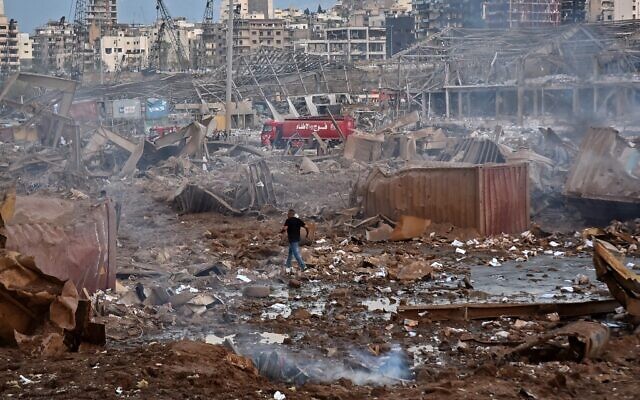
A picture shows the scene of an explosion near the the port in Beirut, August 4, 2020. (STR / AFP)

An Israeli official told journalists that Israel was not involved. The official spoke on condition of anonymity.

Foreign Minister Gabi Ashkenazi also indicated that Israel was not involved, adding, when talking to the country’s Channel 12 news, “I see no reason to not believe the reports that it was an accident.”

Yaakov Amidror, a former head of the National Security Council, indicated to Army Radio that the blast may have been the result of Hezbollah munitions exploding. Despite the lack of Israeli involvement, there was still some speculation that the blast would have been caused by explosive materials stored by Hezbollah.

“You need to take a look at which irresponsible entity puts things like that in a civilian port,” he said. “Even if Hezbollah is responsible for this, it is not the worst thing it is doing to Lebanon.”

Lebanon analyst David Daoud said that he thought it was unlikely that Israel was involved in the explosion, saying that Israel has no interest in escalation at this point. At the same time, he noted that much still remains unclear about the situation.

“I’m skeptical that this is an airstrike. It’s not impossible, but we know the rules of the game between Israel and Hezbollah. If the Israelis did this, it is a declaration of war. What we know for certain is that there was a preliminary explosion and a secondary explosion, which is commonly associated with an airstrike…but it’s still very unclear,” Daoud said.

“This could just be a perfect storm of noise,” Daoud added.

With rising tensions between Israel and Lebanon in previous days, many Lebanese had leaped to blame Israel for the explosion. Some interviewed by Lebanese channel LBC said that they had seen a missile strike the port, with one woman adding that she had “heard a plane.” The Lebanese Air Force, however, had not reported any Israeli activity in its airspace since Monday night.
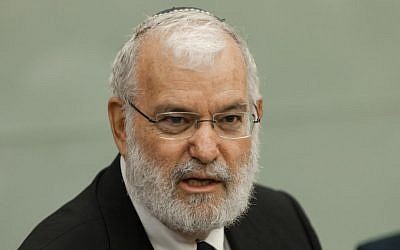
Former Israeli national security adviser Yaakov Amidror (Flash90)

At least 30 people were killed in the pair of explosions, Lebanon’s health minister said. Lebanese Red Cross director George Kataneh told al-Manar that more than 2,200 people were wounded.

The initial explosion Tuesday afternoon sent plumes of smoke into the sky and then a huge explosion that rocked the city. Video footage of the second blast showed an enormous orange fireball that dwarfed nearby buildings and sent a devastating tornado-like shockwave ripping through the city.

The first explosion in Beirut, according to Hezbollah-linked television station al-Manar, began with an electrical spark.

Beirut governor Marwan Aboud said that a team of first responders was dispatched to deal with the fire. The first fire, which burned for several minutes, led to a second, much more powerful explosion, which destroyed nearby buildings and shattered windows across the city.

The second explosion, according to Lebanese Customs Director Badri Daher, was caused by “nitrates.” Firefighters who were sent to the scene are still missing, Aboud said, possibly lost under the rubble in the collapsed port.

The incident came amid heightened tension on Israel’s northern frontier following a recent airstrike attributed to the Israeli military that killed a Hezbollah fighter in Syria, and anticipation that the Lebanese terror group would retaliate.
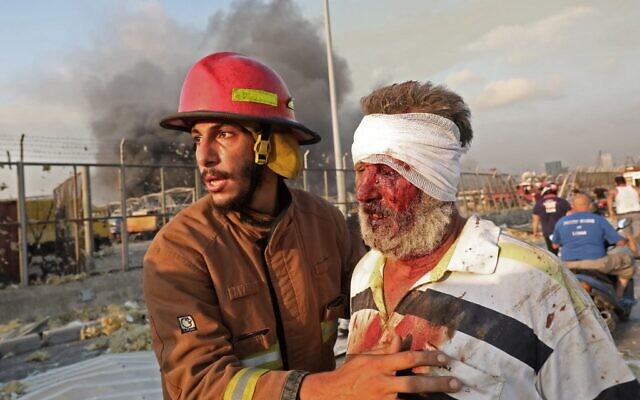
A wounded man is helped by a fireman near the scene of the explosion in Beirut, on August 4, 2020. (ANWAR AMRO / AFP)

Following the airstrike, the Golan Heights was hit by explosives fired from Syria and Israel responded by attacking Syrian military positions and beefing up its forces in the area.

Last week, Israel also said it thwarted an infiltration attempt from Lebanon by Hezbollah operatives, setting off one of the heaviest exchanges of fire along the volatile Israel-Lebanon frontier since a 2006 war between the bitter enemies.

Then on Monday, the IDF announced that it had struck targets in Syria after militants tried to plant explosives along the border in the Golan Heights. The four suspects in the incident were believed to have been killed by an Israeli missile strike while carrying out the attempted attack in the pre-dawn hours of Monday.
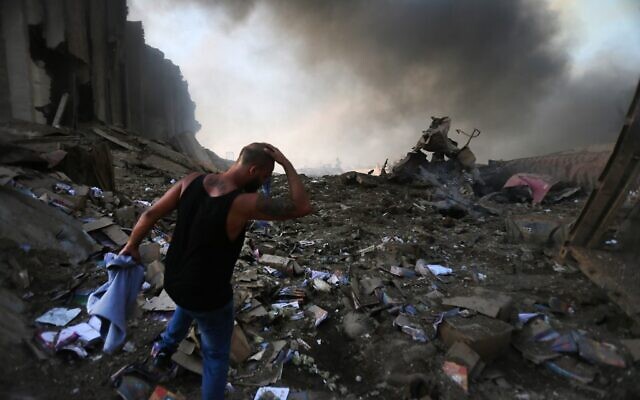
The scene of the explosion in Beirut, August 4, 2020. (STR / AFP)

Since 2011, Israel has launched hundreds of strikes in Syria, targeting government troops, allied Iranian and Hezbollah forces, and weapons heading to Lebanon while also vowing to end Iran’s military presence there. By contrast, though it sometimes uses Lebanese airspace to carry out attacks in Syria, Israel has avoided bombing in Lebanon.

What is claimed to have been a rare exception is an incident in August 2019, when a drone attack targeted a Hezbollah stronghold in Beirut. The British Times newspaper reported the attack, which was attributed to Israel by Lebanese authorities, targeted the Lebanese terror group’s precision missile project.

Israel has said it will not allow Hezbollah to obtain advanced weapons, among them precision-guided missiles it says the Lebanese group is trying to develop with Iranian assistance.

This is a developing story. Please check for updates.

(Times of Israel).

World’s largest plane lands in Israel with US-made trucks for Iron Dome

0

Massive Soviet era cargo plane lands at Ben Gurion Airport carrying military trucks to be fitted with Israel’s famous anti-missile defense system.

A gigantic Soviet-era cargo plane landed at Ben Gurion Airport Monday, bringing a load of American military trucks that will be integrated into Israel’s famous Iron Dome anti-missile system that is now also being sold to the U.S. military.

The huge Antonov 225 Mriya jet attracted a crowd of photographers and airplane aficionados as it roared overhead on its way to touching down. On board were a load of military truck chassis manufactured by the Wisconsin-based Oshkosh Corporation,

“These trucks will be used by the Iron Dome systems purchased by the U.S. Army in the framework of the agreement signed between the two countries,” the Ministry of Defense said.

The systems will be used “to defend U.S. military troops against a wide range of ballistic and aerial threats,” the ministry added, without giving details on where the systems will be deployed.

The Oshkosh trucks will be fitted with the Iron Dome equipment that has proven itself as a highly-accurate defensive system for shooting down unguided rockets. First introduced in 2001, some 10 Iron Dome batteries are believed to be deployed around Israel where they have shot down an estimated 2,000 rockets fired by terrorists, mostly from Hamas-controlled Gaza.

Last year the U.S. Defense Department signed a contract to purchase two complete Iron Dome Systems, meant as an interim missile defense solution for the U.S., but Defense News reported that Iron Dome could turn into a permanent solution depending on its performance in the field for the Americans.

Deliveries of the two systems for the U.S. Army are expected to commence in December 2020 and February 2021.

Known by its nickname Mriya (dream), the AN-225 is the largest aircraft ever produced and has over 30 wheels, six jet engines and a wingspan of 290 feet compared to the widest Boeing 747 jumbo jet whose wingspan is 211 feet.

Although the exact payload was not disclosed, the Mryia is big enough that it could theoretically carry eight of the Oshkosh Heavy Expanded Mobility Tactical Truck (HEMTT) trucks.

(World Israel News).

Pentagon calls for sea-launched nuclear missiles, but China condemns US ‘military hegemony’

0

Security officials believe Russia may be targeting America’s lack of ‘low-yielding’ nuclear warfare.

U.S. security officials have said that the development of sea-launched nuclear missiles is necessary to combat Russia, which has been developing their tactical nuclear weapons.

According to a July report by the State Department, Russia has continued to expand its “low-yield theater and tactical nuclear weapons,” while the U.S. retired its last sea-launched nuclear cruise missile (SLCM-N) in 2010, when the U.S. entered in the New START treaty with Russia that aimed to reduce nuclear arsenals.

The report notes that Russia is potentially relying on the U.S.’s lack of nuclear “first-use weapons” as a strategic “coercive advantage” — meaning the U.S. would not be able to respond to the use of low-yield theatre warfare without drastically escalating the conflict.

The 2018 Nuclear Posture Review has called for the U.S. to increase their nuclear ballistic arsenals in order to rise to Russia’s level of nuclear deterrence, according to the U.S. Department of Defense.

China is also reportedly beefing up their tactical nuclear capabilities, which would allow them to more easily invade another country, as Russia did in 2008 in Georgia and 2014 in Crimea.

“Developing and fielding SLCM-N signal the leaders of nuclear competitors in a concrete way that the United States has the capability and will to maintain operationally effective nuclear options to deter regional aggression,” the report said.

Pentagon officials announced earlier this year a contract with the United Kingdom to add a controversial W93 nuclear warhead to each country’s nuclear arsenals.

Security officials have said the warhead would be the next-generation submarine-launched ballistic missile (SLBM), a program that is expected to cost $14 billion.

“There is no time to waste when updating the nuclear triad,” Ranking member of House Armed Services Subcommittee on Strategic Forces, Rep. Mike Turner, R-OH told Fox News. “The United Kingdom in particular is reliant on the success of the W93 modernization program.”

“Furthermore, our allies are counting on us to follow through on our commitments and to keep our nuclear deterrent up to date,” he added.

In press conference Tuesday, Chinese Foreign Ministry spokesperson Wang Wenbin criticized the U.S. push to develop nuclear arms.

“Since its pullout of the INF Treaty one year ago, the U.S. has kept quitting more international treaties and organizations,” Wenbin told reporters Tuesday.

“It has announced decisions to unsign the Arms Trade Treaty (ATT), withdraw from the Open Skies Treaty, unilaterally loosen its standards on Unmanned Aerial Systems (UAS) export control as a Missile Technology Control Regime (MTCR) member state, and has not agreed to extend the New START Treaty yet,” he outlined.

The U.S. is attempting to pressure Russia into getting China to sign a nuclear arms agreement between the U.S., Russia and China. Russia has said they will sign to extend
the START treaty without conditions, but that they will not pressure another country.

If the U.S. does not agree to extend the original contract with Russia, it will be the first time since 1987 that the two Cold War era countries won’t be in a nuclear arms agreement.

Disarmament and nuclear nonproliferation officials are worried that the repercussions of a treaty fallout could cause another nuclear arms race. The treaty expires Feb. 2021.

“The above-mentioned negative measures of the US have seriously undermined regional and global peace and security, impacted the international arms control and disarmament process, weakened mutual trust between major countries, damaged global strategic stability,” Wenbin told to reporters Tuesday.

Wenbin said the U.S. has “exposed its true intention of pursuing unilateralism and seeking military hegemony.”

But U.S. security officials have argued that by re-developing smaller tactical warfare missiles, it “will lower the risks of nuclear conflict, bolster the confidence of allies and restore a degree of balance in non-strategic nuclear weapons that could create conditions more conducive to addressing this category of forces through arms control.”

(Fox News).

Report: Saudi Arabia constructed ‘yellowcake’ facility with China’s help

0

Western officials say Saudi Arabia has constructed with Chinese help
a facility for extracting uranium yellowcake from uranium ore.

Saudi Arabia has constructed with Chinese help a facility for extracting uranium yellowcake from uranium ore, Western officials with knowledge of the site told The Wall Street Journal on Tuesday.

The facility, which hasn’t been publicly disclosed, is in a sparsely populated area in Saudi Arabia’s northwest and has raised concern among US and allied officials that the kingdom’s nascent nuclear program is moving ahead and that Riyadh is keeping open the option of developing nuclear weapons.

Even though Riyadh is still far from that point, the facility’s exposure appears certain to draw concern in the US Congress, where a bipartisan group of lawmakers has expressed alarm about Saudi nuclear energy plans and about Saudi Crown Prince Mohammed bin Salman’s 2018 vow that “if Iran developed a nuclear bomb, we will follow suit as soon as possible.”

It is also likely to cause consternation in Israel, where officials have warily monitored Saudi Arabia’s nuclear work.

The Saudi Energy Ministry said in a statement it “categorically denies” having built a uranium ore facility in the area described by some of the Western officials, adding that mineral extraction—including uranium—is a key part of the country’s economic diversification strategy.

The Saudi statement said the kingdom has contracted with the Chinese on uranium exploration in Saudi Arabia in certain areas. A spokesman declined to elaborate on the ministry’s statement.

“Yellowcake” is a milled form of uranium ore which occurs naturally in Saudi Arabia and neighboring countries such as Jordan. It is produced by chemically processing uranium ore into a fine powder. It takes multiple additional steps and technology to process and enrich uranium sufficiently for it to power a civil nuclear energy plant. At very high enrichment levels, uranium can fuel a nuclear weapon.

Saudi Arabia has not kept its nuclear ambitions secret, but promised that its nuclear program will be used to supply domestic electricity, enabling the country to export more of its oil.

However, Saudi Arabian Crown Prince Mohammed bin Salman warned in 2018 that “without a doubt” if Iran develops nuclear weapons, “we will follow suit as soon as possible.”

Last year, the US approved the sale of nuclear technology and assistance to Saudi Arabia.

Israel has requested that the Americans remove all the nuclear fuel used from Saudi Arabia so that it would not be reprocessed.

The Chinese embassy in Washington didn’t respond to a request for comment. A State Department representative declined to say whether Washington has raised the issue with Riyadh, but said the US has warned all its partners about the danger of engagement with China’s civilian nuclear establishment.

(Arutz 7).

44% of UK Muslims back anti-Semitic conspiracy theories, poll finds

0

London-based Henry Jackson Society think tank report says integration may be key to tackling anti-Jewish prejudice in Muslim community.

Nearly half of British Muslims endorse some anti-Semitic conspiracy theories, a newly published report has found.

However, anti-Semitic sentiments drop sharply — by as much as 12 percentage points — among those Muslims who are more integrated into British society.

It also suggests that British Muslims who attend mosque most frequently have the warmest feelings towards Jews and the State of Israel.

The report, published by the London-based Henry Jackson Society think tank, finds that 44 percent of Muslims agree with the statement that British Jewish people tend to be more loyal to Israel than to the UK. Just 13% of Muslims disagree and believe British Jews are more loyal to the UK than to Israel.

A separate poll cited by the report suggests that 24% of the British public at large believe British Jews are more loyal to Israel than the UK.

The International Holocaust Remembrance Alliance definition of anti-Semitism states that “accusing Jewish citizens of being more loyal to Israel, or to the alleged priorities of Jews worldwide, than to the interests of their own nations” is a form of anti-Semitism.

The report is based on a poll of 750 British Muslims conducted by the Savanta-ComRes polling agency between November 25 and December 5, 2019. It draws comparisons with wider attitudes in the UK which were explored by an ICM Unlimited survey of 2,011 British adults carried out between December 6 and 9, 2019.

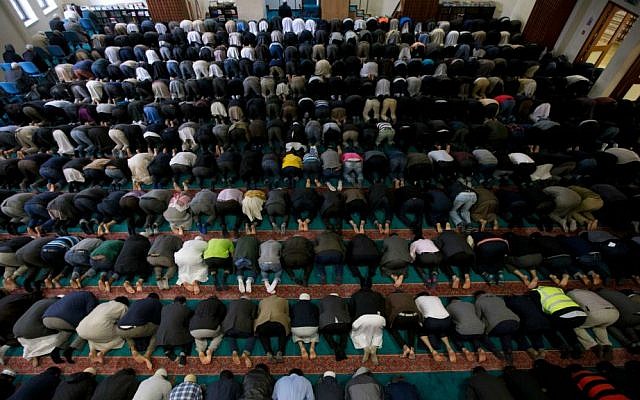
Illustrative: In this September 15, 2015 photo, men take part in prayers at the 7,000-worshiper capacity East London Mosque, the largest mosque in the United Kingdom. (AP Photo/Matt Dunham)

The poll also indicates that, contrary to some perceptions, younger people and those with a higher education are not less likely to hold anti-Semitic views. Forty-seven percent of Muslims with a college degree back the “dual loyalty” charge against British Jews, compared with 40% of those who did not attend university.

Forty percent of British Muslims between the ages of 18 and 24 believe Jews are more loyal to Israel than the UK. Seventeen percent of the general population within the same age range also hold the same view, ICM Unlimited found.

The Savanta-ComRes poll finds that 34% of British Muslims believe Jews have too much control over the global banking system. The ICM Unlimited poll reports that 18% of British adults share this view. Thirty-three percent of British Muslims also believe that Jews have a disproportionate influence in politics. That view fell to 15% of Britons at large, according to ICM Unlimited.

More British Muslims believe that Jews have too much control over the global media, arms industry and entertainment industry than do not share this view, the Savanta-ComRes poll finds.

“For too long, conspiracy theories about Jews have been shared with impunity around the UK’s Muslim communities by those who seek to spread division,” the report’s author, Dr. Rakib Ehsan, said in a press statement.

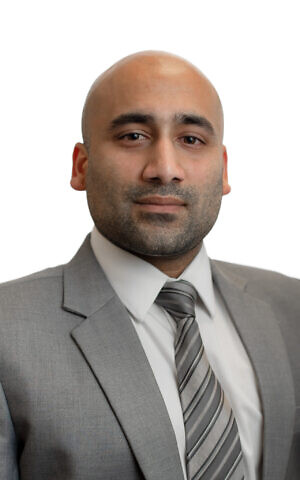
Dr. Rakib Ehsan of the London-based Henry Jackson Society think tank. (Courtesy)

“Unfortunately, the evidence has shown this has had an effect — I’m sorry to say that too many within British Muslim communities have been willing to indulge in anti-Semitic conspiracies,” he said.

“When British Muslims such as myself have attempted to raise concerns over anti-Semitism within our communities, we have all too often been greeted with abuse by co-religionists,” added Ehsan, who is a research fellow at the think tank.

The Savanta-ComRes poll revealed that Jews register the weakest faith-group favorability score — at 5.49 out of 10 — among British Muslims. Christians placed second-highest with 6.23, followed by Sikhs (5.78), Buddhists (5.68), and Hindus (5.58). The lowest rating is received by atheists and non-believers at 5.10.

The report also finds that Israel received the lowest favorability rating among British Muslims of nine countries and territories which the poll tested — with Palestine ranking second behind the UK.

The highest mean favorability score is registered for the UK at 7.6, with Palestine placed at 6.56, followed by Saudi Arabia (6.25), Iran (5.64) and India (5.36). Israel trails at 4.53 behind the US (5.14), Russia (5.06) and China (5.05).

However, the report also suggests that integration could play a key role in tackling anti-Semitism in the Muslim community.

It divides those polled into two distinct categories, what it terms “bonding” and “bridging” friendship networks. The “bonding” friendship network category includes British Muslim respondents who reported that about half, most, or all of their close friends belong to the same faith group. The “bridging” friendship network group includes British Muslims who stated that only a few or none of their friends are co-religionists.

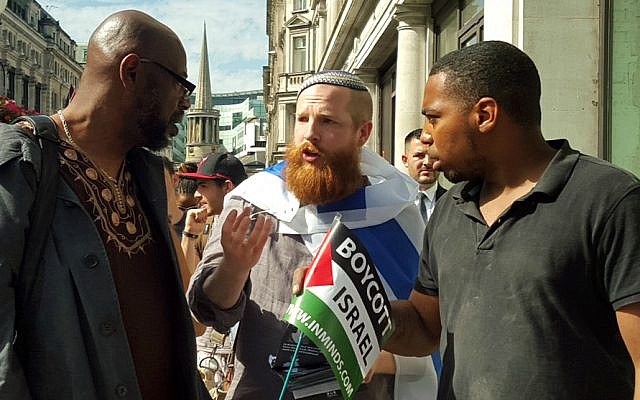
Illustrative: A Jewish counter-protester confronts demonstrators at a pro-Palestinian rally in London, in July 2015. (Courtesy)

The poll thus finds that Muslims in the “bridging category” were less likely to believe that Jews have too much control of the global media (30.2% compared with 37.7%) and less likely to believe that Jews have too much control of the global banking system (30.2% compared with 38.4%).

Similarly, the survey indicates that British Muslims in integrated friendship groups are less likely to believe that Jews have too much control of the global arms industry (26.0% compared with 37.9%); less likely to believe that Jews have too much control over global political leadership (28.1% compared with 38.1%); and less likely to believe that Jews have too much control over the global entertainment industry (27% compared with 38.6%).

“The one consistent thread throughout the report is that regarding social integration. British Muslims who are part of predominantly non-Muslim friendship groups report more favorable views towards both Jews and Israel, and are less likely to be of the view that Jewish people have too much control over the global spheres of banking, media, politics, entertainment and arms production,” writes Ehsan.

“Conversely, those who are part of social networks that predominantly — or indeed exclusively — comprise fellow Muslims, hold comparatively unfavorable views of both Jews and Israel,” he adds.

The report paints a complex picture about the role of mosque attendance. It finds that British Muslims who report attending mosque at least three or four times a week have the highest favorability rating towards Israel (5.13) with warmth towards the Jewish state dropping as attendance declines. Israel’s favorability score among Muslims who say they only go to mosque once or twice a year, or who never attend, was 3.55.

Religious leaders address crowds during a vigil at St Ann’s square in central Manchester, England, on May 24 2017. (AP/Rui Vieira)

A similar pattern emerges with regards to attitude towards Jews. British Muslim respondents who attend a mosque at least three or four times a week hold more favorable views of all faith groups polled, when compared to those who reported that they never attend, or only attend a mosque once or twice a year. The favorability score of Jews is 5.64 in the former group compared with 5.35 among the least frequent mosque-attenders.

At the same time, however, nearly 55% of British Muslim respondents who attend a mosque at least three or four times a week agree with the view that British Jews are more loyal to Israel than to the UK. The corresponding figure for respondents who never attend a mosque or do so only once or twice a year was more than 20 percentage points lower at 33.8%.

But, notes the report, “a comfortable majority of those who frequently attend a mosque, are also of the view that British Muslims are more loyal to Saudi Arabia than to the UK. Indeed, frequent attendees are far more likely to be of the view that various faith groups are more loyal to a foreign country of religious significance, than to the UK.”

The report suggests that these findings might reflect “a broader ‘Religion First’ perception” by which those who attend mosque more frequently believe that a number of faith groups, including their own, are “more loyal to other countries (and territories) of religious significance.”

(Times of Israel).

Facebook Blocks Rabbi for Teaching Spiritual Aspect of Coronavirus

0

The social media giant blocked a New York rabbi for teaching a
class that uses Torah to help explain the spiritual dimensions of
the coronavirus pandemic.

Rabbi Uriel Vigler is the director of a Chabad-Lubavitch center on New York’s Upper East Side, which helps connect Jews from all walks of life to their tradition and practices.

Rabbi Vigler was in for a rude awakening recently when Facebook sent him a message telling him that one of his Torah classes “goes against [its] Community Standards.”

The message from Facebook continues, “We have these standards because misinformation that could cause physical harm can make some people feel unsafe on Facebook.”

Rabbi Vigler’s class was billed as follows: “The ultimate vaccine for Covid-19 is to be found in this week’s Torah portion!”

Facebook is used to promote vicious Jew-hatred, glorification of Islamic terror, the most vile anti-Semitic conspiracies, and other forms of hate speech, and yet the social media platform with over two billion users saw fit to block a rabbi seeking to use the Bible to help assuage people’s anxiety and fear related to the worst health pandemic in 100 years.

In response, Rabbi Vigler posted online an impassioned letter to Facebook CEO Mark Zuckerberg, explaining, “I use [Facebook] to spread Torah and mitzvot and try to do my part in bettering the world, which is why I was absolutely astounded to discover I’d been banned this week.”

The rabbi continues, “I have never posted anything hateful or political in the 12 or so years I’ve been using your platform! As a rabbi, I serve a community comprising people on the right and people on the left, so I stick to my job — promoting and spreading Torah and mitzvot; I don’t dabble in politics.”

The class, explained the rabbi, discusses how “the Holy Temple in Jerusalem was destroyed because of hatred for one another,” exploring the Talmudic concept that equates “hatred to the three cardinal sins: idolatry, adultery, murder.”

“Expansive, unconditional love will lead to the Redemption, the rebuilding of the Temple, and the end to all ailments and illnesses, including COVID-19,” added the rabbi, noting, “This is one of our most basic beliefs, found in our holy Torah. So yes, the cure for coronavirus is in fact in the Torah!”

Promoting “expansive, unconditional love” violates Facebook’s “standards”?

(United with Israel).

Apple Fire in California was sparked by vehicle malfunction, blaze scorches 41 square miles

0

Thousands have been evacuated in Riverside and San Bernardino Counties due to the blaze


A wildfire that’s burning in the mountains east of Los Angeles and forced thousands of people from their homes was sparked by a malfunctioning vehicle, officials revealed on Monday.

“Specifically, a diesel-fueled vehicle emitting burning carbon from the exhaust system,” the agency said. “The determination is reinforced by multiple independent witnesses, as well as supporting physical evidence.”

The fire has destroyed at least four homes and two outbuildings while threatening dozens more, fire officials said.

As of Tuesday morning, the fire is 15 percent contained and has consumed some 41 square miles of dry brush and chaparral in Riverside County.

Firefighters watch the Apple Fire in Banning, Calif., Sunday, Aug. 2, 2020.

Firefighters watch the Apple Fire in Banning, Calif., Sunday, Aug. 2, 2020. (AP Photo/Ringo H.W. Chiu)

An emergency closure order was put in place Sunday prohibiting all entry into the San Gorgonio Wilderness Area, including the Pacific Crest Hiking Trail between the forest boundary and Forest Road 1N01, according to FOX11.

Hand crews work on the remaining hot spots from a brush fire at the Apple Fire in Cherry Valley, Calif., Saturday, Aug. 1, 2020.

Hand crews work on the remaining hot spots from a brush fire at the Apple Fire in Cherry Valley, Calif., Saturday, Aug. 1, 2020. (AP Photo/Ringo H.W. Chiu)

Several evacuations are in place in both Riverside and San Bernardino counties, impacting thousands of residents. At one point, sweeping orders impacted some 8,000 people.

Volunteers used to “close contact” with evacuees have had to adjust their approach during a time of social distancing, Medina said.

“I mean, that’s part of the recovery of a disaster, is that you have to show warmth and love and caring. And that’s hard when you’re standing six feet away. So that’s the biggest challenge,” Medina told KESQ-TV.

The wildfire has generated a smoke plume that was visible for miles around and contributed to poor air quality.

Smoke from the Apple Fire can be seen in this satellite image from NASA.

Smoke from the Apple Fire can be seen in this satellite image from NASA. (NASA/GOES-East)

Source: Fox News

Rabbi Jonathan Gewirtz – Story of My Life

0

Operation Inspiration

We all love stories, and storytelling is an important part of human existence. Stories make us feel and experience things we may not otherwise get to. They convey ideas and goals and emotion. And yes, they entertain us. Many stories are conjured up just for that last purpose, and it has given rise to certain phrases like “fairytale wedding,” or “storybook ending,” in which everything is beautiful and everyone lives happily ever after. Of course, these are just make-believe and can’t happen in real life, right?

R’ Berel Wein has said that all of his stories are true, just some haven’t happened yet. But they could, and perhaps, they should. That’s because the real stories that move and motivate humanity are the ones with a message. Not simply telling us about the past, these stories help to form the future.

I’m sure you could learn some lessons from typical kid’s stories too, like not to take an apple from an old woman in a forest, or “never enter a house made out of candy,” but how likely are those things to happen to you? Instead, I think that we should read and listen to stories of real people in real situations, and learn what can be done.

I shared a story recently of a man who was approached by a former student. Years earlier, a boy brought his new watch to school and during recess one of the other boys took it. After publicly asking for it to be returned, the Rebbi had no choice but to have the boys stand against the wall with their eyes closed. The rebbi walked along and checked their pockets until he found the watch. He went back to his desk and told all the boys to be seated. “The watch has been found. The boy who took it has a difficulty with his Yetzer Hara but he is not a bad boy.”

The former student, now a grown man himself, said, “You found the watch in my pocket but you never said anything to me. I thought you would criticize me privately but you never did. I thought to myself, “If that’s what being a rebbi means, then I want to do that.” I’ve been teaching Torah in cheder for 30 years now. But Rebbi, why didn’t you ever say anything to me?”

“The truth is,” said the teacher, “I didn’t know it was you. I had my eyes closed too.” Wow! This story was the discussion around many a Shabbos table.

But, do I know this story to be true? Have I checked all the facts? What if it didn’t happen? Wouldn’t that defeat the whole purpose? No, I haven’t and no, it wouldn’t. I know some storytellers will ensure to check all the facts down to the smallest detail. Sometimes it matters and sometimes it doesn’t. In this case, I don’t actually care whether it happened or not. What is important is that it COULD have happened, and, more importantly, it CAN happen in the future.

I don’t mean because it has the potential to eventually be true, but because that story will hopefully inspire people to become the protagonist in the story. A Rebbi may have thought that his role was to teach a misbehaving student a lesson, but now he knows that letting it slide a little and not shaming the child could go a lot further. The story empowers us to be different, better, and share the storybook ending in our own lives. Want another example?

In 1945, Arabs ran through the streets of Jerusalem throwing grenades indiscriminately.  Scores of people were injured and many were killed.  The morgue of the local hospital was filled with bodies draped in sheets. R’ Aryeh Levin z”l, showed up at the hospital with a photographer.  He walked over to a gurney, pulled back the sheet, and the photographer took a picture.  He moved to another corpse, and another, detailing the grisly carnage.

The Rabbanim were aghast.  “R’ Aryeh,” they said, “perhaps public opinion is important, and you may want to show the world the atrocities of the Arabs, but where is your sensitivity and compassion for the families of these men?  How will they feel when these pictures are sent to the press?”

“You misunderstand me,” said R’ Aryeh.  “In a few days, relative peace will resume and these bodies will have been buried.   Men will be missing and widows may become agunos, forbidden to remarry.  It is compassion which moves me to act in a seemingly callous way. I am taking these pictures to aid these women in being permitted to remarry and carry on with their lives. It’s not enough to sympathize and empathize, we must take action to prevent greater sorrow.”

While most of us would not have thought of the repercussions of the attacks on the morrow, R’ Aryeh did. He knew that as bad as today was, tomorrow people would pick up the pieces and move on, and he had to prepare for that. And that is a lesson on so many levels.


© 2020 – All Rights Reserved

Did you enjoy this column? Feedback is welcome and appreciated. E-mail info@JewishSpeechWriter.com to share your thoughts. You never know when you may be the lamp that enlightens someone else.

Advice to Jewish celebs: Grow up!

0

They’re mad at their parents for being pro-Israel, so they take it out on the rest of us, battering the Jewish world with their incessant whining.

I have a Jerry Seinfeld question. Why do Jewish celebrities keep whining about their parents?

Popular actor-comedian-director Seth Rogen ignited an Internet firestorm with his recent complaint that his parents “fed [him] a huge amount of lies about Israel.” They “never told him” that “Oh, by the way, there were people [Arabs] there.” But Rogen says he now knows the truth and realizes that having a Jewish state “makes no sense.”

What actually makes no sense is the notion that he didn’t know there were Arabs in pre-Israel Palestine. He didn’t know? Who in their right mind would think there were no Arabs? The 28 years of conflict leading up the creation of Israel in 1948 consisted of Arab pogroms against the Jews there. I sincerely doubt the Rogens were so delusional as to not be aware of that. But according to Rogen, they “fed him a huge amount of lies” about Israel. And by the way, was Rogen so immature as to solely rely on his parents’ narrative?

Another Jewish pop-culture icon managed to reach from beyond the grave to peddle a similar complaint about his parents. Harvey Pekar, icon of the comic-book world, spent his final days on this earth creating a full-length graphic novel titled “Not the Israel My Parents Promised Me.” It was published a few years back, shortly after his passing.

His parents’ apparent sin was being pro-Israel. I doubt that Mr. and Mrs. Pekar ever “promised” little Harvey that Israel was perfect. His book is a dreary regurgitation of standard anti-Israel nonsense that Pekar thinks he suddenly uncovered after shaking
free of the oppressive shackles of his mother and father.

His initial “enlightenment” came via a “Jewish Trotskyist friend” who revealed that Israel
was “racist.” That was soon followed by some uncle at a Passover seder making remarks “against gentiles.” Pekar turned that into a one-sentence summary of the Israeli-Arab conflict: “A lot of Israelis came from Eastern Europe, where they had been abused for centuries. They thought turnabout on gentiles was fair play.”

The rest of the book drips with resentment at “Chauvinist Orthodox Jews” and “demonic” Jewish settlers. One is actually shown holding a saw and telling an equally villainous cohort, “Hold that board steady, Chaim Yankel!”

And such cartoonish garbage and third-hand disinformation was sufficient for Pekar to claim to have turned anti-Israel? I kid you not.

A whole team of psychiatrists could have a field day analyzing all this pent-up hostility towards Jewish parents, uncles and assorted Chaim Yankels – and towards one’s own Jewish identity.

But the celebrity whiner whose complaints matter the most is the one who shares them
on national television and the op-ed page of The New York Times, Thomas L. Friedman.

The story of Friedman’s phony “disillusionment” with Israel has been told many times—by Jerold Auerbach, Daniel Pipes, the late Buddy Korn and others—but it bears repeating because it’s such a powerful illustration of an unpleasant phenomenon that just won’t go away.

Friedman himself summed up his life this way: “It is about a Jew who was raised on all
the stories, all the folk songs, and all the myths about Israel, who goes to Jerusalem in
the 1980s and discovers that it isn’t the Jewish summer camp of his youth … ”.

Those are Friedman’s own words in a book for which he won … a Pulitzer Prize, no less. And that’s how his life has been—an unending series of being handed prizes, plum appointments and international platforms, all based on his image as “The Disillusioned Jew.”

Poor little Tommy was “fed” pro-Israel “myths” (which he was obviously not smart enough
to “demythify” …) but then, during the 1982 Lebanon War, “discovered” the “truth” (which was of course anti-Israel) and proceeded to become one of Israel’s most persistent and vehement critics.

But it is all nonsense and a lie. Friedman’s hostility towards Israel wasn’t caused by the 1982 war. It began in 1974, when he was a student at Brandeis University (the same university where my daughter Alisa was a student when she was murdered while studying in Israel in 1995). He was a leader of a radical campus organization that was misleadingly named the “Middle East Peace Group.” The group’s “recipe for peace” was for Israel and the world to bow to the demands of Yasser Arafat.

None of us can forget the sight of Arafat speaking at the United Nations in 1974 with his gun holster on his hip. In those days, he didn’t even bother pretending that he was interested in making peace; he openly demanded the destruction of Israel, and continually sponsored massacres of Israeli women and children in places like Ma’alot and Kiryat Shemona.

Friedman and his fellow radicals in the “Peace Group” authored an open letter published in the campus newspaper, The Brandeis Justice, on Nov. 12, 1974, in which they condemned the American Jewish community’s criticism of Arafat’s speech.

They – obviously in their capacity as infallible psychiatrists and political visionaries – complained that Jewish rallies against Arafat would “only reinforce Jewish anxiety and contribute to Israel’s further isolation.” They demanded that Israel “negotiate with all factions of the Palestinians, including the PLO.” Of course, “negotiate” was a euphemism for “Give in to their demands already and stop embarrassing us American Jews.” But that didn’t disturb young Tommy. Not then, not later.

Pipes once compared Friedman to “an anthropologist who studies his disowned family.” That pithy description neatly sums up what the Thomas Friedmans, Seth Rogens and Harvey Pekars of the world seem to do best. They’re mad at their parents for being pro-Israel, so they take it out on the rest of us, battering the Jewish world with their incessant whining.

I, for one, am sick of it.

Stephen M. Flatow is a vice president of the Religious Zionists of America, an attorney in New Jersey and the father of Alisa Flatow, who was murdered in an Iranian-sponsored Palestinian terrorist attack in 1995. His book, “A Father’s Story: My Fight for Justice Against Iranian Terror,”
is now available on Kindle.

(JNS).

Israeli Creates ‘Anti-Viral Iron Dome’ to Stop Outbreaks of Jew-hatred

0

A Tel Aviv University professor discovered that the algorithm he used to detect the spread of coronavirus can also stop the spread of viral anti-Semitism on social media.

They are calling it the “Iron Dome” of virtual and viral epidemics.

Dr. Dan Yamin of Tel Aviv University is an expert in detecting the spread of infectious virus outbreaks and his methodology was adopted by the government of Israel in the fight against the coronavirus pandemic.

Remarkably, Yamin realized his system is also applicable to social media networks and the spread of viral messages – especially anti-Semitic messages.

“At the center of any infection process are contact and mixing patterns,” said Yamin, head of the Lab for Epidemic Modeling and Analysis at the Fleischman Faculty of Engineering. “These patterns represent the social interactions of individuals.”

His system monitors and models human behavior, and he found there is a common cause of both the spread of COVID-19 and the spread of viral messages online.

“The tool we developed helps locate the virus locally and also produces simulations of the spread of the virus – predicting what will happen if one policy or another is implemented in the field,” he said.

For example, Dr. Yamin’s group recommended that Israel’s Health Ministry reopen daycare centers, based on the data collected.

In addition, Dr. Yamin found that a targeted closure imposed on high-risk population groups and local infection groups is up to five times more effective in reducing mortality compared to a nationwide closure strategy. This finding helped the Israeli government adopt the current approach of targeted closures.

Although he is associated with the engineering faculty, Yamin did a post-doctoral fellowship at Yale University’s School of Public Health.

At Yale he was disturbed by the level of anti-Israel sentiment on American social networks and its ability to go viral. He immediately made the connection.

Based on the same patterns he studied in disease transmission, Yamin developed a system that uses artificial intelligence to identify how certain groups use viral marketing tactics to spread anti-Semitic and anti-Israel messages.

He says his approach is based on the missing factor in traditional epidemiology – data on the human factor. “These patterns represent the social interactions of individuals in society.” He adds that when it comes to the spread of disease, “whoever doesn’t consider these elements misses the point completely.”

Based on the contagious patterns of diseases he researched as part of his scientific work, Dr. Yamin began to build a system that uses artificial intelligence to identify how certain groups use viral marketing tactics.

The system, known as the “Iron Dome of Social Networking,” is designed to identify and track content that has the potential to go viral in terms of social media. Dr. Yamin explains that people who pass on tweets without overthinking are very similar to asymptomatic carriers of infectious disease. Many Twitter users inadvertently pass on information with overt or covert anti-Semitic messages.

Choosing when to respond on social media is a sensitive matter. Therefore, Dr. Yamin suggests using artificial intelligence, such as the one in his social media Iron Dome system, to assist in the decision-making process.

“Active writing for Israel on social networks is not always the best approach,” he says. “Most anti-Israel tweets are not viral, so why waste time on tweets that won’t get anywhere anyway?”

(United with Israel).

WP Twitter Auto Publish Powered By : XYZScripts.com