Home Blog Page 704

Biden’s Jewish outreach coordinator: Biden will return to the Iran deal

0

Keyak says Biden would bring US, Iran back to the 2015 nuclear agreement.

Aaron Keyak, the Biden campaign’s director for Jewish engagement, said the Democratic presidential candidate will return the U.S. to the 2015 nuclear deal during a virtual meeting on Tuesday hosted by the Jewish Democratic Council of America.

The title of the meeting was “The Jewish Vote: Why Jewish voters will support Joe Biden.”

Keyak said Biden would bring Iran back into compliance with the 2015 nuclear agreement, known officially as the Joint Comprehensive Plan of Action. Biden will “verifiably prevent a nuclear-armed Iran and find verifiable ways to ensure that it doesn’t happen in the long-term”, Keyak said.

Biden’s pointman to U.S. Jewry also slammed President Donald Trump for leaving the agreement.

“He tore up a deal with Iran that ‘was working’ to prevent that country from obtaining nuclear weapons…”, he said.

Keyak suggested the only reason Trump left the agreement was because “it was working”.

Trump withdrew from the nuclear deal on May 8, 2018.

“This was a horrible one-sided deal that should have never, ever been made,” Trump said. “It didn’t bring calm, it didn’t bring peace, and it never will.”

Prime Minister Benjamin Netanyahu strongly opposed the Iran nuclear deal. In July 2015, he denounced it as a “historic mistake,” saying “the Islamic state of Iran is going to receive a sure path to nuclear weapons” as a result.

Netanyahu also said: “In the coming decade, the deal will reward Iran, the terrorist regime in Tehran, with hundreds of billions of dollars. This cash bonanza will fuel Iran’s terrorism worldwide, its aggression in the region and its efforts to destroy Israel, which are ongoing.”

In promising a return to the deal, Biden will potentially be setting up a renewed confrontation with Israel over the agreement as happened during the Obama administration.

Keyak’s remarks were in line with the official position of the Biden campaign.

A Biden facts sheet page on the website of the Jewish Democratic Council of America, says Biden will “rejoin a diplomatic agreement to prevent a nuclear-armed Iran, if Iran returns to compliance with the JCPOA, using renewed commitment to diplomacy to work with our allies to strengthen and extend the Iran deal, and push back against Iran’s other destabilizing actions.”

Keyak was appointed to his position last month. He served as communications director and Middle East policy adviser for Rep. Jerrold Nadler (D-NY), and organized a media outreach group in 2012 to encourage the Jewish vote for Barack Obama’s campaign in Florida.

(World Israel News).

Israel offers humanitarian aid to Lebanon after Beirut explosions kill dozens

0

RIVLIN: WE SHARE THE PAIN OF THE LEBANESE PEOPLE

PM, defense and foreign ministers reach out to hostile neighbor through UN and international mediators after massive blast at port; president, opposition leader send condolences.

Israel on Tuesday night offered humanitarian aid to Lebanon, after explosions at a Beirut port killed dozens and injured thousands, in a rare show of support for the enemy country. As of Wednesday afternoon, there had been no official Lebanese response to the offer.

“Israel approached Lebanon through international defense and diplomatic channels to offer the Lebanese government medical humanitarian aid,” Defense Minister Benny Gantz and Foreign Minister Gabi Ashkenazi said in a joint statement.

Prime Minister Benjamin Netanyahu said he instructed his National Security Adviser, Meir Ben Shabbat, to discuss with UN envoy Nickolay Mladenov how Israel can assist Lebanon.

Mladenov confirmed Israel’s offer to work through the UN in a tweet, saying that “The region and the world must come together to help the people of Lebanon through this time of anguish.”

President Reuven Rivlin, in tweets in English, Arabic and Hebrew, added: “We share the pain of the Lebanese people and sincerely reach out to offer our aid at this difficult time.”

Knesset opposition leader Yair Lapid also sent his condolences to the families of the victims.

“This is the time to transcend conflict,” the Israel Defense Forces said in a tweet regarding Israel’s aid offer.

Lebanon was not expected to take the Jewish state up on the offer, despite the already-ailing country’s woes.

Israel has fought a number of wars in Lebanon, home of the Iran-backed Hezbollah terror group, which is sworn to the Jewish state’s destruction and is part of the Lebanese government. From 1982 to 2000 Israel occupied a swath of southern Lebanon to push out Palestinian groups, and in 2006 fought a devastating war against Hezbollah in the country.

While Israel in the past has avoided direct confrontation with Lebanon’s US-backed armed forces, it has indicated in recent years that it may not do so in a future conflict.

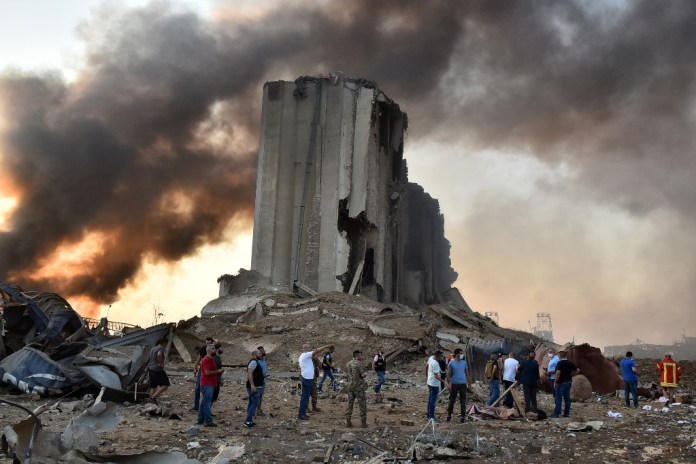
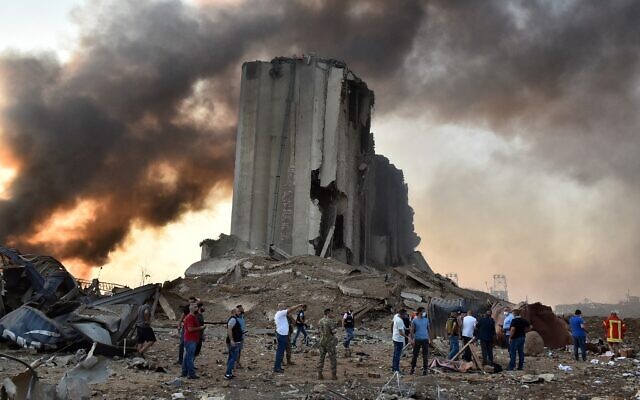
A destroyed silo at the scene of the explosion at the port in Beirut, on August 4, 2020 (STR / AFP)

Tensions have been high on the Israeli-Lebanese border recently, after Israel said it thwarted an infiltration attempt by up to five Hezbollah gunmen — a claim denied by the Hezbollah. Israel has been bracing for an attack from Hezbollah after killing one of its men in an airstrike in Syria last month.

An Israeli government official said Israel had nothing to do with the blast Tuesday. He spoke on condition of anonymity, because he was not authorized to discuss the matter with the media. Israeli officials usually do not comment on “foreign reports.”

Elsewhere in the Middle East, Qatar said it would dispatch field hospitals and Iran said it was ready to assist in any way.

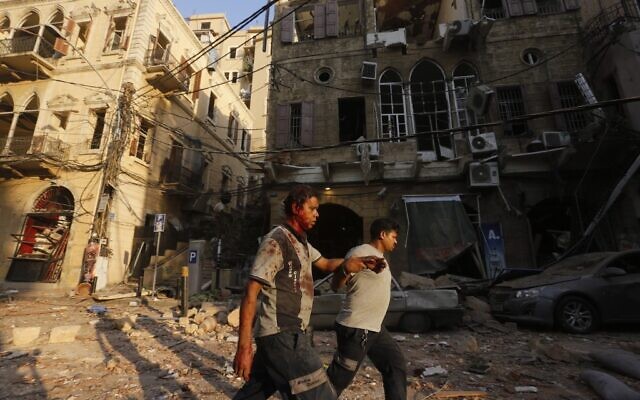
A wounded man is helped as he walks through debris in Beirut’s Gemmayzeh district following explosions at the port of Lebanon’s capital, on August 4, 2020. (Marwan TAHTAH / AFP)

The blast left at least 50 people dead and thousands more injured, according to officials. Many more people were said to be buried under rubble.

The cause of the blast, which sparked fires, overturned cars and blew out windows and doors, was not immediately known.

An initial explosion appeared to engulf a fireworks storehouse, which then sparked a massive mushroom cloud, sending a shockwave racing across the city. Abbas Ibrahim, chief of Lebanese General Security, said it might have been caused by highly explosive material that was confiscated from a ship some time ago and stored at the port. Local television channel LBC said the material was sodium nitrate.

Though some suspicions around the blast turned to Israel, due in part to its recent clashes with Hezbollah, both sides denied any link.

The blast came at a time when Lebanon’s economy is facing collapse, hit both by a financial crisis and by coronavirus restrictions. Many have lost jobs, while the value of their savings has evaporated as the currency has plunged in against the dollar. The result has thrown many into poverty.


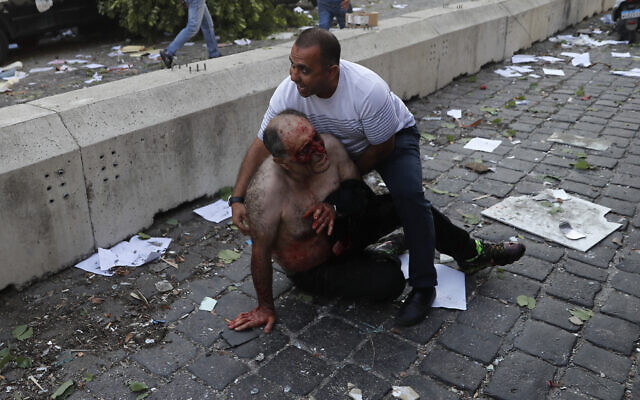
A Lebanese man helps an injured man wounded by the explosion that hit the seaport in Beirut, on Tuesday, August 4, 2020. (AP Photo/Hussein Malla)

Hours after the explosion, ambulances were still carrying away the wounded and officials said Beirut’s hospitals were full. Army helicopters helped battle fires raging at the port.

Several of Beirut’s hospitals were damaged in the blast. Roum Hospital put out a call for people to bring it spare generators to keep its electricity going as it evacuated patients because of heavy damage.

Outside the St. George University Hospital in Beirut’s Achrafieh neighborhood, people with various injuries arrived in ambulances, in cars and on foot. The explosion had caused major damage inside the building and knocked out the electricity at the hospital.

Dozens of injured were being treated on the spot on the street outside, on stretchers and wheelchairs.

“This is a catastrophe we have on our hands,” said one doctor, speaking on condition of anonymity because he was not authorized to make press statements.

“We’re doing surgery in the hallways,” a Beirut hospital director told al-Mayadeen.

Men clad in masks carry an injured person at the entrance of a hospital in the Lebanese capital Beirut on August 4, 2020 (IBRAHIM AMRO / AFP)

France was among the first countries to offer aid.

“France stands and will always stand by the side of Lebanon and the Lebanese. It is ready to provide assistance according to the needs expressed by the Lebanese authorities,” French Foreign Minister Jean-Yves Le Drian said in a tweet.

Qatar said it would send field hospitals to support Lebanon’s medical response.

Qatar’s ruler Emir Sheikh Tamim bin Hamad Al-Thani called President Michel Aoun to offer condolences, according to the state-run Qatar News Agency.

Sheikh Tamim wished “a speedy recovery for the injured,” QNA reported, adding that he “expressed Qatar’s solidarity with brotherly Lebanon and its willingness to provide all kinds of assistance.”

Field hospitals would be dispatched, the report added.

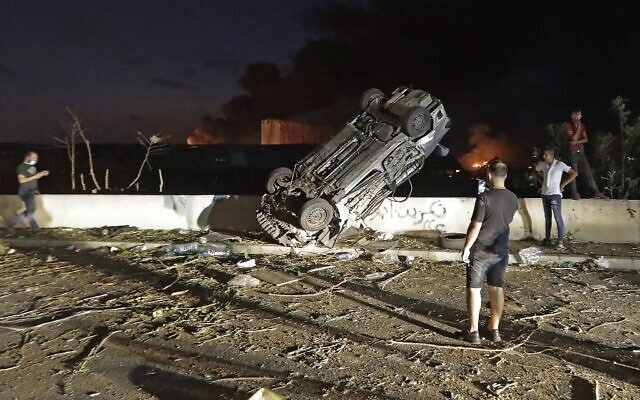
People gather by cars destroyed following an explosion at the port of Beirut on August 4, 2020. (JOSEPH EID / AFP)

Elsewhere in the Gulf, the United Arab Emirates’ Minister of State for Foreign Affairs Anwar Gargash tweeted that “our hearts are with Beirut and its people.”

Iran expressed Tehran’s support for the “resilient” people of Lebanon. “Our thoughts and prayers are with the great and resilient people of Lebanon,” Foreign Minister Mohammad Javad Zarif tweeted. “Iran is fully prepared to render assistance in any way necessary,”
he said.

Ilhan Omar’s Anti-Israel Boycott Calls Damage ‘Employer of Thousands of Her Voters,’ Warns Policy Expert

0

According to an Israeli policy expert, Ilhan Omar’s support for the anti-Israel BDS movement means she wants to boycott a company that employs thousands of voters
in her own district.

The anti-Israel boycott, divestment, and sanctions (BDS) movement says it seeks to economically and culturally harm the Jewish state, but even its founder, radical pro-terror activist Omar Barghouti, admits its ultimate goal is to destroy Israel as it currently exists.

Among BDS’ most high-profile supporters in the U.S. is Minnesota Congresswoman Ilhan Omar, who told a huge crowd at a Minneapolis synagogue during her campaign in 2018 that BDS is “not helpful,” only to make a 180 turn after her victory and admit to a Muslim website following that she fully supports the anti-Israel movement.

BDS and its accomplices, including members of the United Nations and its agencies, demand a boycott of companies and institutions with connections to Israel, and specifically those that do business in Judea and Samaria, where about half a million Jewish Israelis live.

One of the companies BDS targets is General Mills, which appeared on an anti-Israel boycott blacklist published by the United Nations in 2020.

As Israeli political analyst Asher Fredman recently pointed out on Twitter, Minnesota-based General Mills maintains several key facilities right in Ilhan Omar’s own district.

According to Fredman, General Mills employs thousands of Omar’s own voters, which means she is promoting a movement that not only singles out the Jewish state, but also could economically harm the very voters she was sent to Washington to represent.

This sad reality is a microcosm of a movement that is so obsessed with destroying Israel, it doesn’t care how much harm it does to the Arabs it claims to help.

BDS’ record of cutting off its nose to spite its face is shocking and tragic.

For example, an Israeli company SodaStream, which employs a huge, diverse workforce of Jews and Arabs, was pressured into moving one of its factories.

BDS claimed this as a major victory, despite the fact that it cost the livelihoods of hundreds of Arabs for whom the anti-Israel movement claim it advocates.

“SodaStream is still a major target of the BDS movement due to … [its] complicity in the ethnic cleansing of Palestinians in the Naqab (Negev) in the south of Israel,” claimed BDS.

In reality, SodaStream represents a beacon of coexistence and economic opportunity for Arabs and Jews alike.

“Everyone works together: Palestinians, Russians, Jews,” a Palestinian employee named Rasim commented to JTA in 2013. “Everyone works together, so of course we’re friends.”

Anti-Semitism Accusations That Won’t Go Away

Fredman connected the dots about BDS, Omar, and General Mills just days after she became embroiled in yet another anti-Semitism scandal.

Omar called out specific donations that her opponent Antone Melton-Meaux received and added the names of Jewish donors, claiming voters can’t trust Melton-Meaux because he
is “in the pocket” of his donors and voters should question whose money controls his campaign.

The American Jewish Committee (AJC) condemned her remarks, calling them “reprehensible” and blasting her for “continuing to traffic in anti-Semitic tropes”
and “seeking to fan the flames of anti-Semitism among her constituents.”

“Omar continues to target Jews, despite repeated attempts … to educate her on the consternation caused by her racist comments,” said the AJC. “This cannot be tolerated.”

This episode follows Omar’s “all about the Benjamins” claim, accusing pro-Israel lobby AIPAC of paying elected officials to support the Jewish state, which she famously accused of “hypnotiz[ing] the world” and perpetrating “evil doings” in 2012.

(United with Israel).

Mayor of Haifa, home to oil and chemical facilities, warns of Beirut-style disaster

0

Officials in northern port city see blasts in Lebanese capital as ‘wake-up call,’ urge government to speed up efforts to move dangerous oil, petrochemical industries away from bay.

The mayor of Haifa voiced concern on Wednesday that the “horror scenario” gripping Beirut could unfold in the northern Israeli port city, a day after blasts in Lebanon’s capital claimed the lies of at least 100 people and wounded thousands.

Calls to speed efforts to move potentially dangerous oil and chemical factories out of the densely populated Haifa area before disaster strikes came thick and fast in the wake of the massive explosion at the port of Beirut, which was linked to stockpiles of some 3,000 tons of ammonium nitrate.

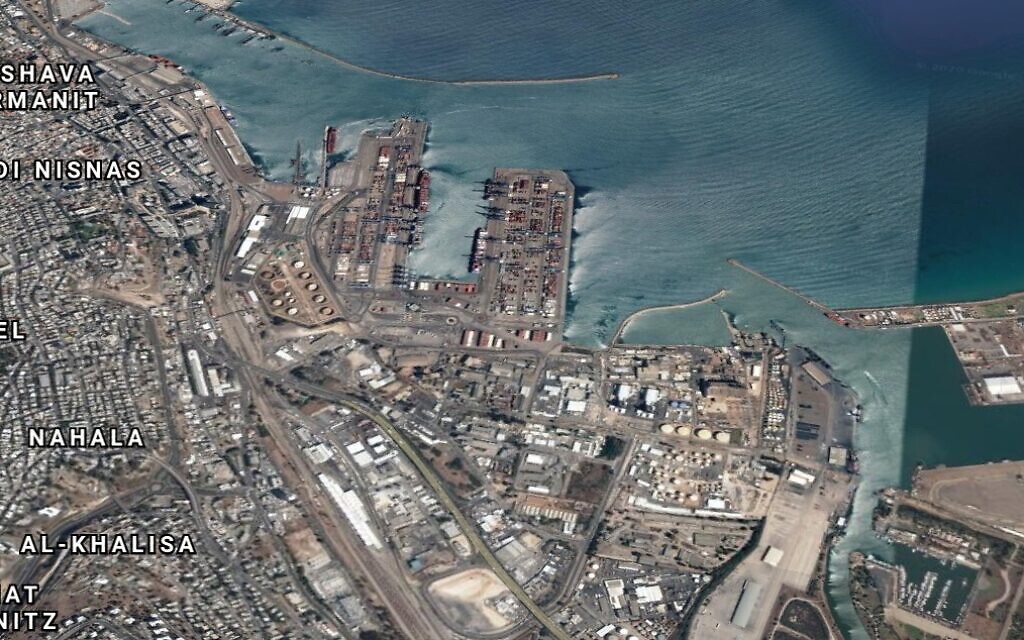
Close to residential areas housing 900,000 people, the Haifa Bay in northern Israel is home to the country’s biggest industrial area. It has two ports and more than 60 industrial plants including oil refineries and processing factories, power plants and storage facilities. It is crossed by major national road systems along which hundreds of thousands of people drive each day.

Haifa’s mayor, Einat Kalish Rotem, wrote on Facebook on Wednesday, “The fear of all of us, based on experts in the field, is exactly of a horror scenario like the one that erupted yesterday north of Israel….Yesterday we received a wake-up call from Beirut… There is no place for hazardous substances and polluting factories within the urban space and among the population. After being shocked by the harsh sights from Lebanon, it’s time to act.”

Haifa Mayor Einat Kalisch Rotem at the annual international Municipal
Innovation Conference in Tel Aviv, February 27, 2019. (Flash90)

Eli Dukorsky, mayor of Kiryat Bialik, just north of Haifa, echoed the plea for the evacuation of the petrochemical industries in a post on his Facebook page.

Over the years, numerous industrial accidents have taken place. One of the most serious in recent years happened in 2016, when a massive fire broke out at an oil refinery complex in Haifa, sending toxic black clouds floating over the bay for several hours.

For that, the Bazan Group oil refining and petrochemicals company was ordered earlier this year to pay a NIS 1.2 million ($335,000) fine for negligence, pollution and violation of permits.

On Tuesday — the day of the Beirut blast —  the Haifa District Court was debating whether to accept a class action lawsuit against 30 polluting factories in Haifa Bay that alleges negligence and violations of the Clean Air Act leading to high rates of non-Hodgkin’s lymphoma and lung cancer in the region.

‘We must learn lessons immediately’

Joint List party head MK Ayman Odeh said in a tweet that while the full horror of the Beirut explosion was still unfolding, “one thing is clear: We must learn lessons immediately and rid the Haifa Bay of refineries and keep them away from population centers… This is an immediate danger to our lives and those of our children.”

Environmental Protection Minister Gila Gamliel said in a statement that the tragedy in Beirut was “worrying” but repeated her pledge to move the petrochemical industries within a decade.

Miki Haimovich, chairwoman of the Knesset Internal Affairs and Environment Committee, which held a debate about the future of the Haifa Bay in late June, vowed to convene the committee again to discuss Israel’s readiness for a mass disaster involving hazardous materials.

The explosion in Beirut, according to Lebanese Prime Minister Hassan Diab, involved around 2,750 metric tons of ammonium nitrate stored near the capital’s cargo port.

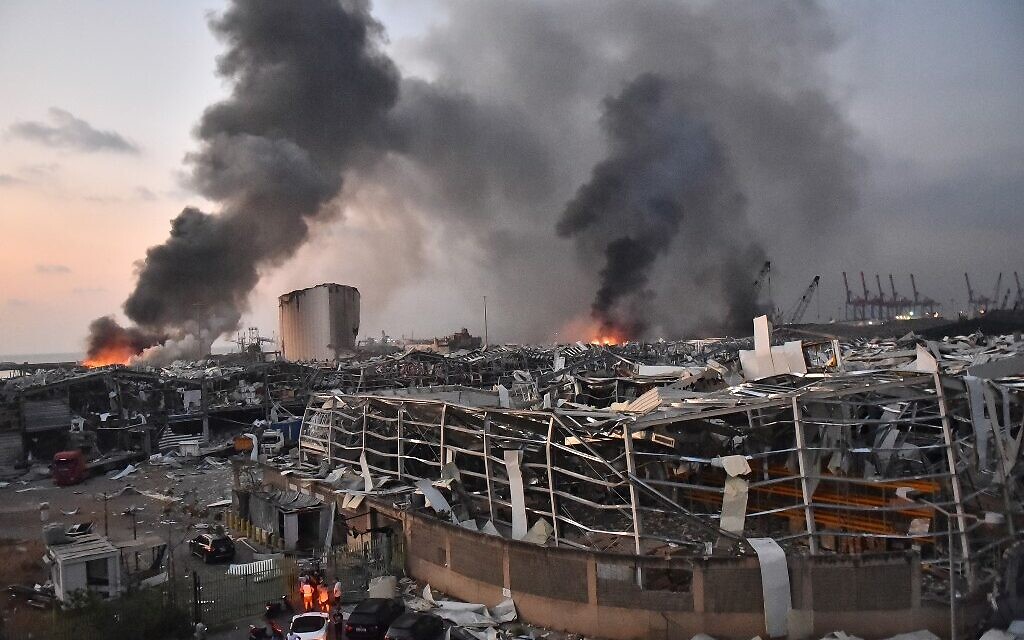
The scene of an explosion at the port of Lebanon’s capital Beirut, on August 4, 2020 . (STR / AFP)

Ammonium nitrate is mainly used as a high nitrogen crop fertilizer and also as a component in explosives for industries such as mining.

It results from the reaction of ammonia with nitric acid.

Ammonia, while not highly flammable in itself, can explode if containers are
exposed to high heat.

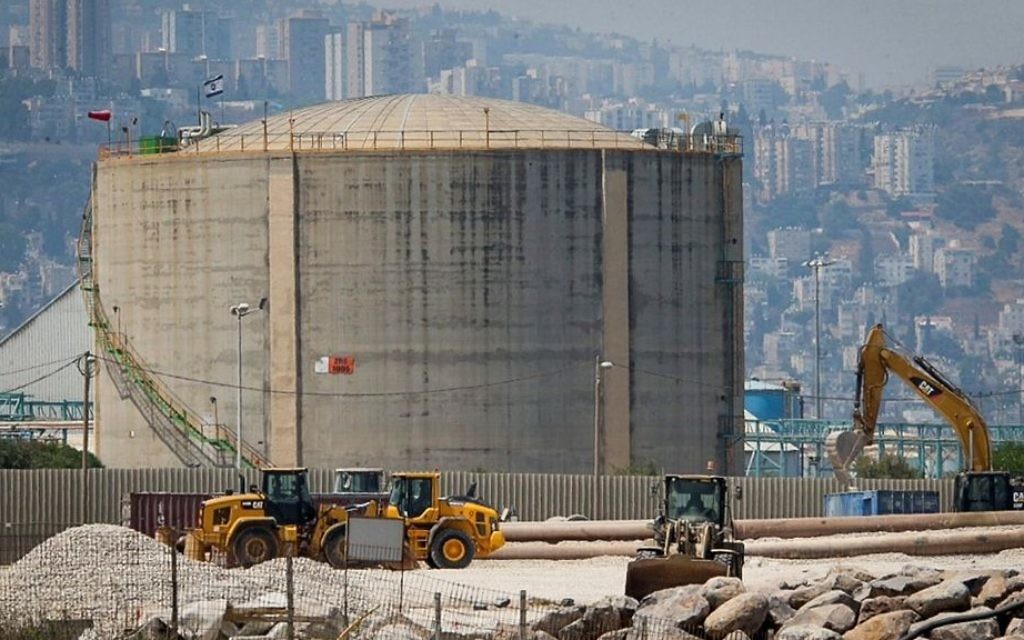
The ammonia tank in Haifa on June 30, 2017. (Flash90)

One source of danger was eliminated from the Haifa Bay two years ago when,
after years of public pressure, a massive ammonia storage tank was emptied
on the orders of the High Court.

Hassan Nasrallah, head of the Iran-backed Lebanese terror group Hezbollah,
has repeatedly threatened to bomb the tank.

Ammonia is now imported by ship and transported within Israel by pipeline.

Risks deemed low, but more research needed

In 2015, following a government decision to reduce air pollution and environmental risks
in the Haifa Bay, the Environmental Protection Ministry commissioned an exposure and
risk assessment of hazardous materials whose preliminary first phase results were put
out for public comment in  July 2019.

The survey was conducted by a risk assessment expert and former ministry chief scientist, Eli Stern, along with four consulting firms.

The survey examined and mapped more than 1,500 “foci of danger” covering materials used in processing and production or stored as raw materials or as end products.

It looked at the potential for serious operational incidents arising from damage to containers or fires and explosions of flammable materials that could take place in factories and terminals. But it postponed for a second stage of research the potential dangers of transporting such materials or of earthquakes or terror attacks hitting them. The seismically active Yagur Fault passes between Haifa Bay and the Jordan Valley.

A map of the Haifa Bay and nearby residential areas. (Google Earth)

The report, which its author described as more of a screening, concluded that the probability of danger was low in the vast majority of cases, but singled out four establishments for further research — Haifa Group, which produces specialty fertilizers; Dor; The Bazan Group’s Gadiv Petrochemical Industries; and Gadot East.

Despite the September 2019 deadline for public comments, however, no final Phase A report has been published yet and there is no timetable for the start of a Phase B.

Zalul, a marine environmental protection organization, said in its submission at the time that the report was only partial and seemed primarily aimed at relaxing the public, “or worse, blinding it” to the dangers. The submission even questioned whether the release date had anything to do with the a severely critical state comptroller’s report published a month earlier.

“An aggregate risk report is perhaps important and necessary, as long as it is done in full, and includes all the threats — earthquakes, pipelines, war and terrorism, and a description of the range of solutions divided between the various government ministries and the various arms of implementation,” Zalul said. “Until this is done, this report has no value.”

In a June 2019 report, the state comptroller stated that some 900,000 residents of Haifa and the surrounding metropolitan area were being exposed to carcinogenic pollutants just as much as when a national plan was developed and accepted by the Environmental Protection Ministry in 2015.

He noted that a 2014 report from his office had found that the cancer rate in Haifa was 15 percent higher than the national average, and that asthma among children was twice the national average. Since then, the rate had been growing, as had the prevalence of heart and respiratory diseases, he said.

Plans for a new Bay of Innovation in the northern city of Haifa after the removal of the polluting oil refinery industry, June 29 2020. (Screenshot, Knesset Internal Affairs and Environment Committee)

Both the National Economic Council, which advises the prime minister, and the Environmental Protection Ministry recommend shutting down within five years the
Bazan facilities, which have long polluted Haifa and largely defined its skyline, and replacing them with a green residential and commercial hub.

The Israel Lands Authority, which owns some 20,000 dunams (nearly 5,000 acres)
of land in the area, presented plans for the post-Bazan-era Haifa Bay to the Knesset
Internal Affairs and Environment Committee in June.

(Times of Israel).
Drone Strikes in Syria Kill 15 at Iranian Outposts and Shi’ite Positions

0

Unidentified aircraft carried out a series of strikes on bases and outposts belonging to the Iranian Revolutionary Guards Corps and Shi’ite groups near the Syria-Iraq border.

A drone strike near Bukamal in eastern Syria killed 15 members of pro-Iranian militias, the Syrian Observatory for Human Rights reported on Tuesday morning.

The observatory quoted what it called “reliable” sources, who said that unidentified aircraft had carried out a series of strikes on bases and outposts belonging to the Iranian Revolutionary Guards Corps and Shi’ite militias near the Syria-Iraq border.

According to reports, the strikes targeted the militias’ weapons stockpiles. The report said that the 15 dead were foreign citizens, and militia vehicles were reportedly seen at border crossings, carrying the bodies of the casualties into Iraq.

Media outlets aligned with the Syrian rebels said on Tuesday that the pro-Iranian militias were on alert following the strike.

Also on Monday, Syria’s air-defense systems were activated against “hostile targets” southwest of Damascus on Monday evening, the Syrian news agency SANA reported.

A source in the Syrian military told SANA that at approximately 10:40 p.m., Israeli helicopters had fired missiles at a number of sites near Quneitra, causing unspecified “material damage.”

The IDF confirmed that Israeli Air Force aircraft had targeted sites including “observation posts and intelligence collection systems, anti-aircraft artillery facilities, and command and control systems” at Syrian army bases, in retaliation for an attempt earlier on Monday by a group of terrorists to place a bomb on the Israel-Syria border in the southern Golan Heights.

The IDF issued a statement saying that it held the Syrian regime responsible for all actions that occurred within Syria’s borders, and that it would continue to take “determined action” against any attack on sovereign Israeli territory.

Tensions have been high on Israel’s northern frontier following the Israeli airstrike that killed the Hezbollah fighter in Syria last month. Following the airstrike, the Israeli Golan Heights was hit by explosives fired from Syria, and Israel responded by attacking Syrian military positions and beefing up its forces in the area.

(United with Israel).

US Sending Highest Official To Taiwan Since Ties Cut In 1979

0

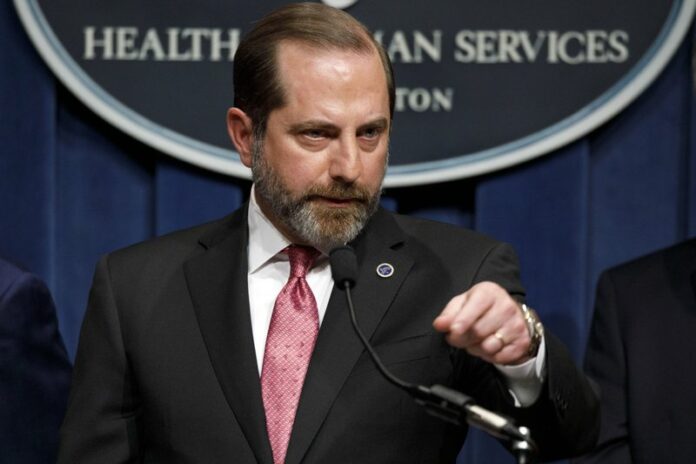
The U.S. secretary of Health and Human Services is scheduled to visit Taiwan in coming days in the highest-level visit by an American Cabinet official since the break in formal diplomatic relations between Washington and Taipei in 1979.

The visit by Alex Azar, and especially a planned meeting with Taiwan’s president, will likely create new friction between the U.S. and China, which claims Taiwan as its own territory to be annexed by force if necessary.

Taiwan is a key irritant in the troubled relationship between the world’s two largest economies, which are also at odds over trade, technology, territorial claims in the South China Sea and China’s response to the coronavirus pandemic.

In Beijing, foreign ministry spokesman Wang Wenbin said China has lodged “solemn complaints” over the visit with U.S. officials in both Beijing and Washington.

“The Taiwan issue is the most important and sensitive issue in China-U.S. relations,” Wang said at a daily briefing. He said Washington needs to stop all forms of official contact with Taiwan and make good on its commitment to Beijing to “avoid serious damage to China-U.S. relations and peace and stability across the Taiwan Strait.”

The U.S. maintains only unofficial ties with Taiwan in deference to Beijing, but is the island’s most important ally and provider of defense equipment.

The American Institute in Taiwan, which operates as Washington’s de facto embassy on
the island, said Wednesday that Azar’s “historic visit will strengthen the U.S.-Taiwan partnership and enhance U.S-Taiwan cooperation to combat the global COVID-19 pandemic.”

In a tweet, Taiwan’s Ministry of Foreign Affairs said it looks forward to welcoming Azar and his delegation. “This is the highest-level visit by a U.S. Cabinet official since 1979! Taiwan and the U.S. are like minded partners cooperating closely in combating coronavirus and promoting freedom, democracy and human rights worldwide.”

The ministry said Azar will meet with independence-minded President Tsai Ing-wen, with whose government Beijing cut off virtually all contacts four years ago, and with Foreign Minister Joseph Wu and top health officials.

Tsai tweeted to Azar that “Your timely visit is another testament to the strong Taiwan-US partnership based on our longstanding friendship & shared values.”

AIT said Azar will discuss the disease, global health and Taiwan’s role as a supplier of medical equipment and technology.

The visit is believed to be scheduled for next week, although AIT said details on the timing and agenda would be announced later.

Azar would be the first HHS secretary to visit Taiwan and the first Cabinet member to visit in six years, the last being then-Environmental Protection Agency Administrator Gina McCarthy. His Cabinet ranking is higher than previous U.S. visitors’.

“Taiwan has been a model of transparency and cooperation in global health during the COVID-19 pandemic and long before it,” Azar said in the AIT statement. “This trip represents an opportunity to strengthen our economic and public health cooperation with Taiwan, especially as the United States and other countries work to strengthen and diversify our sources for crucial medical products.”

Azar’s visit was facilitated by the 2018 passage of the Taiwan Travel Act that encouraged sending higher-level officials to Taiwan after decades during which such contacts were rare and freighted with safeguards to avoid roiling ties with Beijing.

McCarthy’s visit to Taiwan in 2014 sparked a protest from China’s foreign ministry, which accused the U.S. of betraying commitments made to it about maintaining only unofficial links with Taipei.

China objects to all official contact between Taiwan and the U.S. But its increasing diplomatic pressure, including poaching Taiwan’s few remaining diplomatic allies and excluding it from international gatherings including the World Health Assembly, have fostered already considerable bipartisan sympathy for Taipei in Washington and prompted new measures to strengthen governmental and military ties.

Azar’s visit can also be seen as a signal to China that the US is prepared to push back on
China’s increasingly aggressive behavior in many political and military areas.

Taiwan’s strong performance in handling its COVID-19 outbreak has also won it plaudits while highlighting its exclusion from the World Health Organization and other U.N. bodies. Despite its close proximity to China, where the global pandemic is believed to have originated, the island of 23 million has recorded just 476 cases and seven deaths from COVID-19, largely as a result of rigorous testing and case tracing.

“In contrast to authoritarian systems, U.S. and Taiwan societies and economies are uniquely equipped to drive global progress in areas such as medicine and science to help the world tackle emerging threats,” AIT said. “The COVID-19 pandemic is the most recent example of joint U.S.-Taiwan efforts to confront global challenges for the good of the world.”

(The Yeshiva World / AP).

Chief Rabbi Yitzchak Yosef: Whoever endangers others must bear his guilt

0

Sephardic Chief Rabbi meets with Coronavirus Czar, issues joint statement calling on public to obey Health Ministry guidelines.

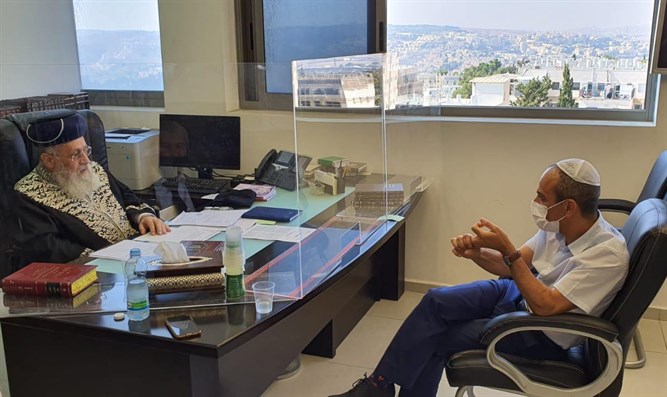
Israeli Coronavirus Czar Prof. Roni Gamzu met Tuesday with Sephardic Chief Rabbi Yitzhak Yosef to consult with him on halakhic issues related to the fight against the coronavirus.

After the meeting, the Chief Rabbi and Prof. Gamzu issued a joint statement in which they implored the public to obey the instructions of the Health Ministry and other relevant authorities.

At the beginning of their joint statement, they highlight the health dangers and the need to tighten the guidelines for “dealing with the corona epidemic that has claimed many victims, young and old, healthy and sick.”

“Our Torah is the Torah of life, and commands us very strongly to protect our lives, and the Torah also said, and to live by it, and as the sages extrapolated in Tractate Yoma 85:B: and not to die by it,” the statement continued.

Rabbi Yosef quoted Maimonides, who wrote: “And it is forbidden to procrastinate in desecrating the Sabbath for a patient who is in danger, as it is said: And a man will do them and live by them, and not that he will die by them.”

Rabbi Yosef also cited the Tosafists in Tractate Baba Kama, who wrote that a person should be even more careful in not causing harm to others than he would be for himself.

Rabbi Yosef and Prof. Gamzu both declared that it is an obligation to wear a mask in public spaces and inside synagogues, as well as to maintain social distancing and to avoid large crowds.

Regarding people who experience symptoms such as difficulty breathing, fever, cough or the loss of smell and taste, the two stated that “it is an absolute obligation for them to be tested and it is strictly forbidden for a person to judge his own condition and endanger others.”

“As I have already written in regards to the Health Ministry guidelines, according to the Halacha, whoever puts others in danger, it is possible that someone will be murdered by his hand, and he will bear his guilt,” Rabbi Yosef said.

(Arutz 7).

URGENT: Tehillim for Rav Dovid Feinstein Shlita, Scheduled for a Procedure

0

The Rosh Hayeshiva of Mesivta Tiferes Yerushalayim, Chaver Moetzes Gedolei HaTorah, Maran Hagaon Rav Dovid Feinstein Shlita, [Tehillim Name: Dovid ben Shima] has been hospitalized in serious condition over the past few weeks.

He is scheduled to have a procedure today. Everybody who can is urged to please say Tehillim for the success of the procedure, and that the Rosh Hayeshiva should have a refuah shelaima, b’soch she’ar cholei amo Yisroel.


Rabbi Lord Jonathan Sacks – The Covenant and the Love (Eikev 5780)

An interesting phrase appears at the end of last week’s parsha and at the beginning of this week’s, and they are the only places where it appears in the Torah. The phrase is ha-brit veha-chessed (Deuteronomy 7:9) or in this week’s parsha, et ha-brit ve-et ha-chessed (Deut. 7:12).


Know therefore that the Lord your God is God; He is the faithful God, keeping the britand the chessed to a thousand generations of those who love Him and keep His commandments. (Deut. 7:9)
If you pay attention to these laws and are careful to follow them, then the Lord your God will keep the brit and the chessed with you, as He swore to your ancestors. (Deut. 7:12)

The phrase is strange. The relationship between God and Israel is defined by brit, covenant. That, essentially, is the content of the Torah. What then is added by the word chessed?

The translators have a problem with it. The Jewish Publication Society’s translation of the opening verse of our parsha is: “And if you do obey these rules and observe them carefully, the Lord your God will maintain faithfully for you the covenant that He made on oath with your fathers.” This translates chessed as “faithfully” and takes it as a qualification of the verb “maintain” or “keep”. This is a very stretched translation.

A non-Jewish translation, the New International Version, translates ha-brit veha-chessed as “covenant of love.” This is a very Christian translation. The covenant entered into between the Israelites and God was a covenant of law, not just of love.

Rabbi Aryeh Kaplan, in The Living Torah, got it right when he translated it as “God your Lord will keep the covenant and love with which He made an oath to your fathers.” Not “covenant of love” but “covenant and love.” But still: what is the covenant, and what is the love that is distinct from the covenant?

This might seem a minor matter were it not for the fact that this phrase, which is rare in Tanach, makes an appearance at key moments of Jewish history. For example, it figures in King Solomon’s great prayer at the consecration of the Temple in Jerusalem:

“Lord, the God of Israel, there is no God like You in Heaven above or on Earth below—You who keep the covenant and love with Your servants who continue wholeheartedly in your way.” (1 Kings 8:23)

When, after the Babylonian exile, the nation gathered around Ezra and Nehemiah in Jerusalem and renewed the covenant, they said:

“Now therefore, our God, the great God, mighty and awesome, who keeps His covenant and love, do not let all this hardship seem trifling in Your eyes—the hardship that has come on us, on our kings and leaders, on our Priests and Prophets, on our ancestors and all Your people, from the days of the kings of Assyria until today. (Neh. 9:32)

At these critical moments, when Moses renewed the covenant on the banks of the Jordan, when Solomon dedicated the Temple, and the people in Ezra and Nehemiah’s time rededicated themselves, they took care to define the relationship between God and the people as one of brit and chessed, covenant and love. It seems that both are necessary, or they would not have used this language on these three defining occasions many centuries apart.

What then is the meaning of chessed? Significantly, Maimonides dedicates the penultimate chapter of The Guide for the Perplexed to the analysis of three words: chessedtzedakah and mishpat. On chessed he says:

In our Commentary on Pirkei Avot (5:7) we have explained the expression chessed as denoting excess. It is especially used of extraordinary kindness. Loving-kindness is practised in two ways: first, we show kindness to those who have no claim whatever upon us; secondly, we are kind to those to whom it is due, in a greater measure than is due to them … The very act of creation is an act of God’s loving-kindness: “I have said, ‘The universe is built in loving-kindness’” (Ps. 89:3)…[1]

The difference between the three terms is that I am legally entitled to mishpat. I am morally entitled to tzedakah. But to chessed, I am not entitled at all. When someone acts toward me in chessed, that is an act of pure grace. I have done nothing to deserve it.

Maimonides notes, citing the phrase from Psalms that “The universe is built in lovingkindness,” that creation was an act of pure chessed. No one ever creates something because it deserves to be created. Creations do not exist before they are created.

We can define this in human terms more precisely. The book of Ruth is known as the work, par excellence, of chessed: “Rabbi Zeira said, ‘This book does not have anything in it concerned with impurity or purity, forbidden or permitted. Why then was it written? To teach us the greatness of the reward for acts of chessed.”[2]

There are two key scenes in the book. The first occurs when Naomi, bereaved of her husband and two sons, decides to return to Israel. She says to her two daughters-in-law, “Go back, each of you, to your mother’s home. May the Lord show you kindness, as you have shown kindness to your dead husbands and to me…” She was telling them that they had no further obligations toward her. They had been married to her sons, but now they are widows. Naomi has no other sons. Being Moabite women, they will be strangers in Israel: they have no reason to go there. You owe me nothing, she is saying. You have been kind, you have been good daughters-in-law, but now we must go our separate ways.

The second speech occurs when Ruth has gone to gather grain in the field of Boaz, who treats her with great care and consideration. She asks him: “Why have I found such recognition in your eyes that you notice me—a foreigner?” The two key words here are “recognition” and “foreigner.” “Recognition” means that you have behaved toward me as if you had obligations to me. But “I am a foreigner.” The word used here is not “stranger,” i.e. a resident alien to whom certain duties are owed. It means, a complete outsider. Ruth is saying to Boaz, you do not owe me anything.

That is what makes Ruth the supreme book of chessed, that is, of good done to another who has no claim whatsoever upon you. What Ruth does for Naomi, and what Boaz does for Ruth, are not mishpat or tzedakah. They are pure chessed.

Now let us return to the question with which we began. Why did Moses, and Solomon, and Nehemiah define the relationship between the Jewish people and God not in terms of a single concept, covenant, but added to it a second idea, namely chessed, meaning an act of love.

Covenant is essentially reciprocal. Two people or entities pledge themselves to one another, each committing to a responsibility. This is how it was defined by God at Mount Sinai: “Now if you obey me fully and keep My covenant, then out of all nations you will be My treasured possession, for all the earth is Mine” (Exodus 19:5). Ifyou are My people, I will be your God. If you serve me, I will bless you. Every covenant has an if-then quality to it. Therefore, every covenant is inherently vulnerable. That is what Moses emphasised throughout Devarim. Don’t take the land or its blessings for granted. If you do well, things will go well, but if you do badly, great dangers lie in store.

That is covenant. Chessed, in contrast, has no if-then quality. It is given out of the goodness of the giver, regardless of the worth of the recipient. When Moses, Solomon and Nehemiah referred to chessed in addition to the covenant, they were making an implicit request of God of the most fundamental significance. Even if we fail to honour the covenant, please God be gracious to us, for You are good even when we are not, and You do good even when we do not deserve it, when we have no claim on You whatsoever – ki le-olam chasdo, for His chessed is eternal.

The verses in our parsha sound conditional: “If you pay attention to these laws … then the Lord your God will keep the brit and the chessed …” This suggests that we will be shown chessed if we deserve it, but if not, not. But it isn’t so. At the end of the curses in Bechukotai, God says: “Yet in spite of this, when they are in the land of their enemies, I will not reject them or abhor them so as to destroy them completely, breaking my covenant with them: I am the Lord their God.”

God will never break the covenant, even if we do, because of His chessed. Tanach describes the relationship between God and Israel in two primary ways: like a husband and wife, and like a parent and a child. Between husband and wife there can be a divorce. Between parent and child there cannot be. They may be estranged, but the parent is still their parent and the child is still their child. Marriage is a covenant; parenthood is not. Do not forsake us, we say to God, because whatever we have done, You are our parent and we are Your children. Chessed is the kind of love a parent has for a child, whether they deserve it or not. Chessed is unconditional grace.

I believe that chessed is the highest achievement of the moral life. It is what Ruth did for Naomi, and Boaz for Ruth, and from that kindness came David, Israel’s greatest king. Reciprocal altruism – I do this for you, and you do this for me – is universal among social animals. Chessed is not. In chessed God created the universe. In chessed we create moments of moral beauty that bring joy and hope where there was darkness and despair. 

Shabbat Shalom

[1] The Guide for the Perplexed, III:53.

[2] Ruth Rabbah 2:14.


WP Twitter Auto Publish Powered By : XYZScripts.com