Home Blog Page 926

Federal Reserve cuts interest rates by 0.25% – its first in a decade

0

Fed chief Jerome Powell ‘let us down’, says Trump amid disappointment that rates were not cut harder

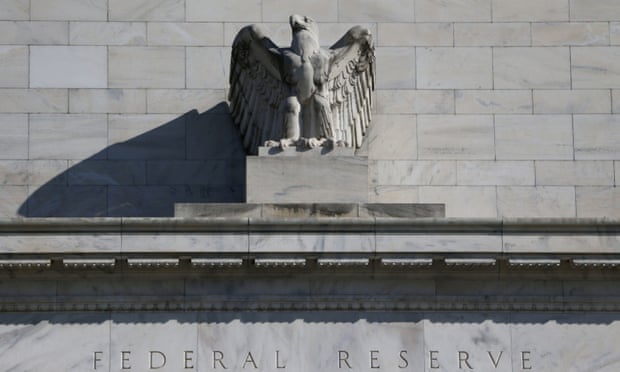
The US Federal Reserve has cut interest rates for the first time in more than a decade and signalled its readiness to provide more support as growth slows in the world’s largest economy.

The US central bank cut its key benchmark interest rate by a quarter of a percentage point, to a range of 2%-2.25%, in the first reduction in borrowing costs since immediately after the financial crisis a decade ago.

Jerome Powell, the Fed chairman, said weak global growth and the US-China trade war had been disruptive for the world economy and had an impact on growth in America, despite the US labour market remaining strong with the lowest unemployment rate since the late 1960s.

“We see those as threats to what is clearly a favourable outlook. And we see this action as designed to support them and keep that outlook favourable,” he said of the interest rate cut.Advertisement

Donald Trump, who had called for a more aggressive cut in interest rates, issued a sharp rebuke to the Fed chairman when he said on Twitter: “As usual, Powell let us down.”

Stocks fell on Wall Street straight after the decision as investors warned the 0.25% cut might not be enough to deliver greater stimulus for US growth. The Dow Jones Industrial Average fell by more than 1% in early afternoon trading in New York to 26,907 after the rate cut was announced.

The US president tweeted: “What the market wanted to hear from Jay Powell and the Federal Reserve was that this was the beginning of a lengthy and aggressive rate-cutting cycle which would keep pace with China, the European Union and other countries around the world.

“As usual, Powell let us down, but at least he is ending quantitative tightening, which shouldn’t have started in the first place – no inflation. We are winning anyway, but I am certainly not getting much help from the Federal Reserve!”

Nick Wall, from the fund manager Merian Global Investors, said: “[The cut] is a positive step but could be a missed opportunity. We believe they should have gone further and cut 50 basis points today.”

Borrowing costs in the US remain less than half the 5.25% level seen before the 2008 crash, when the Fed was last forced into cutting rates to support the economy.

US growth has slowed in recent months against a backdrop of tensions between Washington and Beijing, which has served as a brake on international trade, weighing on economic activity around the world. Economists had forecast a 25 basis point cut in borrowing costs to avert a greater slowdown.

In a statement after a two-day meeting, the Fed said it was taking action “in light of the implications of global developments for the economic outlook as well as muted inflation pressures”.

Donald Trump has applied significant pressure on the central bank in recent months over its policymaking, demanding lower rates in order to stimulate economic growth. The US president had called the Fed an “anchor wrapped around our neck” and blamed rate rises last year for an unspectacular growth rate in the US.Advertisement

The cut was in line with market expectations, but was likely to disappoint Trump for not going further, analysts said.

Growth has slowed in the US and elsewhere around the world as the White House engages in the trade standoff with Beijing. Business investment in the US and other countries has faded as firms put spending decisions on hold.

Gross domestic product, the broadest measure of economic health, rose at an annual rate of 2.1% in the second quarter, well below the 3.1% it achieved in the first three months of the year.

Leaving the door open to potential interest rate cuts in future, the Fed indicated it was ready to respond with more support for the US economy should the outlook deteriorate further.

“[The Fed] will continue to monitor the implications of incoming information for the economic outlook and will act as appropriate to sustain the expansion,” it said.

Two members of the rate-setting Federal Open Market Committee voted against cutting rates and argued to keep rates on hold.

Economists said that escalating trade tensions could push the Fed into further rate cuts later this year. US inflation has also remained stubbornly below the central bank’s 2% target, which could also encourage it to provide further stimulus as the economy slows.

James Knightley, chief international economist at the Dutch bank ING, said: “Should tensions escalate once again [between the US and China], if tariffs are hiked, markets sell-off and economic weakness spreads, then the Federal Reserve will respond with more stimulus given the benign inflation backdrop.”

Source: The Guardian

Berlin Shliach Victim of Anti-Semitic Attack

0

July 31, 2019

By COLlive reporter

Rabbi Yehuda Tiechtel, Rabbi of the Jewish Community in Berlin, Germany, reported that two men shouted at him in Arabic and spat on him in an anti-Semitic attack.

The incident occurred on Friday night, after he had left Shul in the Wilmersdorf district around 9 pm. He was with one of his young children, he said. The attack came from an apartment building, Tiechtel told WELT news.

“I’ve been living in Berlin for 23 years, and this something I’ve never experienced before,” the Chabad Shliach told WELT.

Insults were not an isolated case, but being physically attacked was a shock to him. “It was a threatening situation, especially because I had my child with me,” he said.

The incident is under investigation. The perpetrators have not been identified.

According to the research and information center anti-Semitism (RIAS) last year, the district Charlottenburg-Wilmersdorf with 80 was ranked second among the registered anti-Semitic incidents in Berlin. Most of the incidents became known in the district of Mitte (146).

In a statement to German media, Tiechtel said that despite such attacks in Berlin schoolyards and streets, he was convinced that “most people in Berlin want Jews to be able to live openly as Jews, without fear of being cursed at, spat on or beaten up.”

PHYLLIS SHALLMAN -Why You Should Pay Off High-Interest Debt First

0

The average U.S. household owes over $5,500 in credit card debt.¹

Often, we may not even realize how much that borrowed money is costing us. High interest debt (like credit cards) can slowly suck the life out of your budget.

The average APR for credit cards is over 16% in the U.S.² Think about that for a second. If someone offered you a guaranteed investment that paid 16%, you’d probably walk over hot coals to sign the paperwork.

So here’s a mind-bender: Paying down that high interest debt isn’t the same as making a 16% return on an investment – it’s better.

Here’s why: A return on a standard investment is taxable, trimming as much as a third so the government can do whatever it is that governments do with the money. Paying down debt that has a 16% interest rate is like making a 20% return – or even higher – because the interest saved is after-tax money.

Like any investment, paying off high interest debt will take time to produce a meaningful return. Your “earnings” will seem low at first. They’ll seem low because they are low. Hang in there. Over time, as the balances go down and more cash is available every month, the benefit will become more apparent.

High Interest vs. Low Balance
We all want to pay off debt, even if we aren’t always vigilant about it. Debt irks us. We know someone is in our pockets. It’s tempting to pay off the small balances first because it’ll be faster to knock them out.

Granted, paying off small balances feels good – especially when it comes to making the last payment. However, the math favors going after the big fish first, the hungry plastic shark that is eating through your wallet, bank account, retirement savings, vacation plans, and everything else.³ In time, paying off high interest debt first will free up the money to pay off the small balances, too.

Summing It Up
High interest debt, usually credit cards, can cost you hundreds of dollars per year in interest – and that’s assuming you don’t buy anything else while you pay it off. Paying off your high interest debt first has the potential to save all of that money you’d end up paying in interest. And imagine how much better it might feel to pay off other debts or bolster your financial strategy with the money you save!


Sources: ¹ Frankel, Matthew. “Here’s the average American’s credit card debt — and how to get yours under control.” USA TODAY, 1.25.2017, https://usat.ly/2LkHX4n. ² Dilworth, Kelly. “Rate survey: Average card APR remains at 16.15 percent.” creditcards.com, 11.21.2017, https://bit.ly/2kbCRv3. ³ Berger, Bob. “Debt Snowball Versus Debt Avalanche: What The Academic Research Shows.” Forbes, 7.20.2017, https://bit.ly/2x9Q1lN.

Report: Israeli F35 Attacked Missile Warehouse Near Iraq

0

July 31, 2019 9:00 am

Foreign media sources, quoted by News12, are reporting that an Israel Air Force (IAF) F35 plane struck targets in Iraq twice in a ten-day period. According to the report, the stealth fighter jet struck a missile warehouse near Bagdad.

Arab diplomatic sources reported on Tuesday to the a-Sharak al-Awsat newspaper in London that Israel has expanded its ring of attacks against Iran and Syria to Iraq. According to the report, the IAF for a second time in April, attacked an Iranian missile warehouse in a military base northeast of Bagdad. The reported attack occurred on July 19, 2019 in Iraq, carried out by an F-35 stealth fighter plane.

The report stated that in addition to the attack on July 19th, another attack took place on Sunday night, July 28th, in northeastern Bagdad, 80 kilometers (48 miles) from the Iranian border. The second assault targeted Iranian advisors and a target against a truck with ballistic missile launchers recently transferred from Iran to Iraq.

According to Western sources, Israel is also behind the recently reported attack on Daraaand Tel al-Khara in Syria, with the aim of “preventing Iran from taking control of this strategic hill”.

The Saudi al-Arabia TV reported about ten days ago of an aerial attack occurring in a Shiite militia camp in Iraq. According to the report, the camp targeted contained Iranian ballistic missiles as well as Hezbollah fighters as well as members of the Iranian Revolutionary Guard, who were killed. There is no confirmation from another source. The United States said it was not involved in the assault.

The last attack in Iraq came about a year after Reuters reported from Iran that Iran had delivered Shiite militias in Iraq that could reach Tel Aviv. The report aims to protect Iran’s Middle East interests and to ensure its ability to respond in the event of an attack.

The ballistic missile transferred to the Shiite militias which it supports in Iraq, including the Fatah 110 missiles, can hit targets in the range of 200 to 700 kilometers (120 to 420 miles). These missiles could threaten Tel Aviv if deployed in Western Iraq and they also threaten Saudi Arabia’s capital, Riyadh.

According to the report, the Iranian move could exacerbate the crisis between Tehran and Washington and embarrass the European powers that signed the nuclear deal with Iran as they try to save what is left of it. One Iranian source then explained to Reuters that “The logic of this act is that there should be a backup plan in case Iran is attacked”. He said the number of missiles delivered was not high, a few dozen, but he noted that the number could increase as needed.

These missiles could threaten Israel in the event that these missiles are deployed in western or southern Iraq, areas where there is a significant military arm of Iran. Some sources say that Qassam Suleimani, who is in charge of Iranian military forces outside the Islamic Republic, is himself responsible for overseeing the missile project in Iraq. In the past, Iran refused to address the issue, claiming that its missiles were defensive purposes only. On the recent transfer to the Shiite militias, Iran refused to comment, as did the government and the army in Iraq.

(YWN Israel Desk – Jerusalem)

Report: Trump Organizing Pre-Election Mideast Summit

0

By Dov Benovadia Wednesday, July 31, 2019 at 3:33 am 

YERUSHALAYIM – U.S. President Donald Trump intends to invite Arab leaders, along with Prime Minister Binyamin Netanyahu, to a summit at Camp David in early September. The summit will be held before the Israeli elections, with the purpose, Yediot Acharonot reported, of boosting Netanyahu’s chances in the election.

The invitation will be offered to Netanyahu on Wednesday when he meets with U.S. envoy Jarod Kushner. After meeting with Netanyahu, Kushner is off to Egypt, Jordan, Qatar, Saudi Arabia and the United Arab Emirates, where he will also present the invitations – as well as Israel’s approval for the first time of legal building in Area C of Yehudah nd Shomron. The Yediot report quoted administration sources as saying that the latter would make it easier for Arab leaders to agree to come to the summit, despite the presence of Netanyahu, whom many of the leaders have avoided meeting, at least publicly.

At the meeting, details of the Trump peace plan are likely to be revealed. The Palestinian Authority, of course, will be invited, but PA chief Mahmoud Abbas has said that he is not willing to participate in any event that advances the plan, which he has called “a disaster for the Palestinians and an end to the Palestinian state.”

The report quoted the sources as saying that the summit will focus on generalities that will allow Netanyahu and Trump enough wiggle room to endorse its general principles, but disagree with some of the details. “Trump will say yes to a Palestinian entity, but not necessarily a state; yes to a Palestinian presence in eastern Yerushalayim, but not as the capital of a PA state. Abbas will reject the plan immediately, Netanyahu will praise the efforts but say that he has some serious concerns that he will not detail. The Arab leaders will legitimize the process just by their presence,” the sources were reported as saying.

The sources said that the summit is likely to benefit Netanyahu, further cementing his image as a global leader. It is also likely to take the edge off campaigns by Netanyahu’s rivals in Blue and White, and encourage it, as well as Labor, to agree to join a Netanyahu-led coalition.

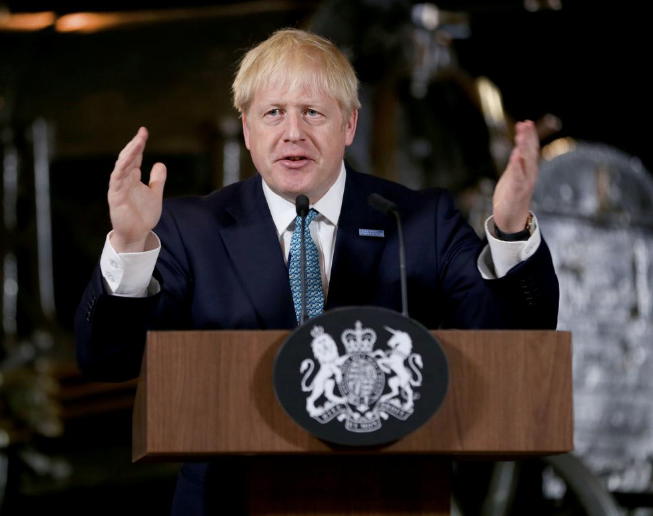
PM Johnson holds Belfast talks on Brexit backstop riddle

Ian Graham

BELFAST(Reuters) – Britain’s new Prime Minister Boris Johnson held talks in Northern Ireland on Wednesday in a bid to untangle an impasse over the Irish border “backstop” that has scuppered all efforts to secure an orderly withdrawal from the European Union.

Plans for the border have become the most contentious issue in negotiations with the EU, and the British pound has tumbled in recent days as Johnson said Britain would leave without a deal on Oct. 31 unless the backstop was scrapped.

The head of Irish nationalist party Sinn Fein, Mary Lou McDonald, said she warned Johnson that leaving without a deal would be catastrophic for the economy and the 1998 peace deal that ended three decades of violence in the region.

Some 3,600 people died in sectarian violence commonly known as The Troubles.

Johnson began his trip with talks on Tuesday evening with the leadership of the Democratic Unionist Party, the largest pro-British party in the region whose 10 members in the Westminster parliament prop up the Conservative government.

After the meeting DUP leader Arlene Foster repeated Johnson’s demand that the backstop, designed as an insurance policy to prevent border controls between Ireland and Northern Ireland, be scrapped. “It is very important that the backstop goes,” she said.

But a senior DUP lawmaker also at the meeting said possible compromises were discussed – specifically the possibility of putting a time limit on the backstop and other “pragmatic solutions.”

Asked if Johnson’s was responsive to the suggestion, Donaldson told Irish radio RTE that he would not “negotiate in public on this.”

Speaking to journalists ahead of the talks, Johnson’s said Brexit would be on the agenda, but said he wanted a quick restoration of Northern Ireland’s suspended power-sharing executive. It is a critical part of the 1998 Good Friday peace agreement that ended 30 years of conflict.

The power-sharing administration was suspended two-and-a-half years ago because of differences between the parties representing mainly Protestant pro-British unionists and mainly Catholic nationalists who favour a united Ireland.

“The people of Northern Ireland have been without a government, without Stormont for two years and six months so my prime focus this morning is to do everything I can to help that get up and running again,” Johnson told journalists.

A couple of dozen protesters held a rally against Brexit while the talks continued.

Writing by Conor Humphries and Michael Holden; Editing by Jon Boyle

Source: Reuters

Friedman says U.S. peace plan will support ‘Palestinian autonomy’

0

U.S. ambassador to Israel says the Trump administration does not use the term “two-state solution” in crafting its Mideast peace plan, but is not promoting a one-state solution, either.

(July 31, 2019 / JNS) U.S. Ambassador to Israel David Friedman said on Tuesday that the Trump administration supports “Palestinian autonomy,” but does not use the phrase “two-state solution” as it works to develop a solution to the Israeli-Palestinian conflict.

“We believe in Palestinian autonomy,” Friedman told CNN’s Christiane Amanpour. “We believe in Palestinian self-governance. We believe that the autonomy should be extended up until the point where it interferes with Israeli security.”

Asked if the as-yet-unveiled American peace plan is based on the two-state concept, Friedman responded “We haven’t used that phrase, but it’s not because we are trying to drive toward a one-state solution … The issue we have is agreeing in advance to a state because the word ‘state’ conjures up with it so many potential issues that we think it does a disservice to us to use that phrase until we can have a complete exposition of all the rights and limitations that would go into Palestinian autonomy.”

According to Friedman, the Bahrain “Peace to Prosperity” conference in June was intended to “help the Palestinians create some of the institutions necessary for statehood,” but warned: “Let’s be clear, the last thing the world needs is a failed Palestinian state in between Jordan and Israel.”

He noted that even former prime minister Yitzhak Rabin, who gained notoriety as a strong proponent of making concessions for peace, was unwilling to use the term “Palestinian state,” preferring to use words “like autonomy and self-governance.”

Friedman emphasized that the administration is not pushing for a one-state solution.

“I don’t think anyone responsible in Israel is pushing for a one-state solution,” he said. “I don’t think there is a serious political movement in Israel for a one-state solution, and I don’t think any of the acts Israel has taken or we’ve taken over the past two years is driving us to that point.”

In the interview, Friedman also minimized comments he made in The New York Times in June about the legitimacy of Israeli annexation in parts of Judea and Samaria, saying the Israeli government has not raised the issue with the administration, which renders the matter “hypothetical.”

Friedman told CNN that “it’s good for Israel and good for the Palestinians” that the Israeli Security Cabinet approved construction of 700 Palestinian housing units in Israeli-controlled Area C, saying the U.S. administration has been encouraging Israel to improve conditions for Palestinians in the area.


Montpellier, France – French City Official Received A Swastika Birthday Cake

0

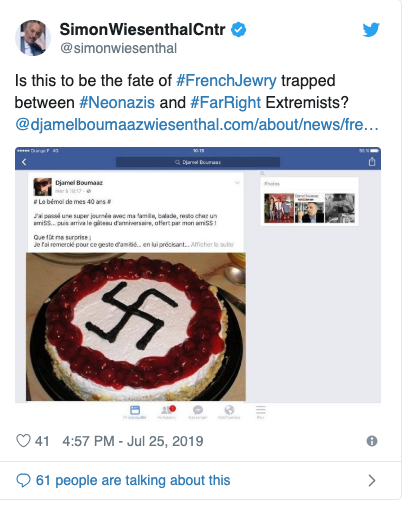
Montpellier, France – The Simon Wiesenthal Center has called for the firing of a city councilman from the French city of Montpellier over a birthday cake decorated with a swastika.

Montpellier councillor Djamel Boumaaz, a former member of France’s far-right National Front party, received the cake with a black swastika on a white background surrounded by cherry filling for his 40th birthday and posted a photo of it on social media. The tweet has since been removed.

The Wiesenthal Center posted a screenshot of the tweet on its Twitter page and in a statement dated July 25 called on the European Coalition of Cities Against Racism “to condemn Boumaaz and to urge the Mayor of Montpellier to take measures to remove him from his municipal functions.” The center is affiliated with the coalition.

Boumaaz has been fined in the past for performing numerous “quenelles” – an inverted Hitler salute created by anti-Semitic French comedian Dieudonne – including in the Montpelier city hall. It is an action banned by law in France.Advertisement:

His Twitter feed includes many references to the quenelle and a tweet in which he doctors a photo of the Gaza border to look like a concentration camp. In 2016, he wrote that his Twitter account was “forbidden to dogs and Jews.”

He told the French newspaper Le Parisien that he received the cake two years ago from a supporter and that the message that accompanied the cake noted that he turned it down. He said there was a police investigation of it at the time, following complaints from social media users, and that the case was ultimately closed.

Source: VosIzNeias

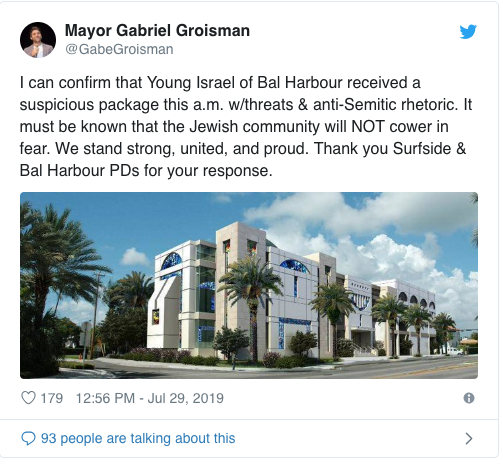
Florida synagogue receives package with anti-Semitic and threatening content

0

Delivered to the Young Israel of Bal Harbour, according to reports, was a DVD, a photo of someone pointing a gun and anti-Semitic writing.

(July 30, 2019 / JNS) A package containing anti-Semitic and threatening content was received at the Young Israel of Bal Harbour in Southeast Florida on Monday.

Inside the package was a DVD, a photo of someone pointing a gun and anti-Semitic writing, sources told COLLIVE.

Police are investigating the incident.

“It must be known that the Jewish community will NOT cower in fear. We stand strong, united and proud,” Bal Harbour Mayor Gabriel Groisman tweeted.

Just a day earlier, an 68-year-old Jewish man was shot multiple times in front of the Young Israel of Greater Miami.

WP Twitter Auto Publish Powered By : XYZScripts.com