
Gad Elbaz Sings Acapella “Abbale”

Superstar singer Gad Elbaz has released an Acapella version of his hit song Abbale, with a message of “longing and power.”
“When people go through changes and start new chapters in their life, might feel completely alone!” Elbaz says. “The song ABBALE is here to remind us that we are never alone, there is always Someone up above who loves us and is watching over us.”


Russian spaceship brings 3 tons of supplies to space station

MOSCOW (AP) — An unmanned Russian spaceship carrying tons of supplies to the International Space Station has docked with the orbiting laboratory.
The Progress 73 cargo ship blasted off atop a Soyuz rocket at 1210 GMT Wednesday from the Russian space complex in Baikonur, Kazakhstan, and docked with the ISS about 3 ½ hours later after two orbits.
The Progress is carrying about 3 tons (2.7 metric tons) of food, fuel and supplies to the space station, which currently has six astronauts aboard.
Those on the space station now include Nick Hague, Christina Koch and Andrew Morgan of the United States, Russians Alexander Skvortsov and Alexey Ovchinin and Luca Parmitano of Italy.
Iraqi journalist praises ‘heroic Israeli army’ for strikes on Iranian targets

As Iranian targets are attacked in Iraq, liberal Iraqi journalist writes: “Many Iraqis love Israel and view it as an ally.”
(July 31, 2019 / MEMRI) Over the past month, there have been various media reports about Israeli strikes against Iranian weapons and missile storehouses in Iraq.
Following one such strike, on July 19, which according to Arab media reports targeted a missile storehouse in a base in the Amerli area north of Baghdad, Iraqi journalist Khudayr Taher, who lives in the United States, published an article in the Iraqi daily Sot Al-Iraq.
Under the headline, “The Courageous Israeli Army Bombed the Nest of Iran’s Collaborators in Iraq,” he praised the attack on “the Iranian forces of evil” and the “terrorist devils” among the collaborators with Iran, adding that Iran aspires to take over and destroy the Arab lands while Israel is revealed as a friend and potential ally of the Arabs.
The following are translated excerpts from Taher’s article:
“The courageous and heroic Israeli army is now playing a noble role in service of security, peace, and stability in the region, by means of war against the Iranian forces of evil that aspire to attain hegemony in the region, sow sectarian conflict, sow terrorism and plunder the resources of the [Arab] lands.
“Note how Israel withdrew from Egyptian, Jordanian and Lebanese lands and proposed peace and withdrawal to the Syrians and Palestinians. This is while Iran spreads [its influence] and openly interferes in the affairs of Lebanon, Yemen, Bahrain, Syria and Iraq and conducts secret interventions in various countries around the world. So which is the peace-seeking country, Iran or Israel?
“The heroic Israeli air force destroyed the nests of Iran’s agents at Amerli base in Iraq and killed the Iranian agents, the evil terrorist devils, who plot to carry out terror attacks against the neighboring countries. This was an amazing message, conveying that all Iran’s activity in the region is exposed and is being monitored, and is not immune to Israeli attack and punishment.
“The move [against Iran and its supporters] began on two fronts: The first is the sanctions on corrupt actors, and on the civilian collaborators with Iran, by means of the American Treasury lists—and the names of the members of the mafia of corruption and crime will thus be exposed, preparing the way for pursuing and arresting them. The second is the joint U.S.-Israel military attacks and hunting for and harshly punishing the remaining Iranian agents.
“Perhaps Israel doesn’t understand the extent of the love which large sectors of the Iraqi people have for it because of its respectable and valiant actions in the war against [the spread of] the Iranian influence in the region. A pragmatic perspective has led many among the Iraqis and the Arabs to view Israel as an awe-inspiring friend and ally, in the framework of the axis of the war against the Iranian evil.”
Iran continues efforts to surround Israel with missiles and hostile forces

Despite U.S. sanctions cracking down on its economy, Iran isn’t giving up its hegemonic aspirations, and is now focused on using Iraq for its purposes.
BY YAAKOV LAPPIN
(July 31, 2019 / JNS) Iran is facing severe economic pressure due to U.S. sanctions, yet recent reports indicate that the Islamic Republic is still investing significant resources in building up attack capabilities throughout the Middle East, with a new focus on Iraq.
According to the London-based Arabic daily Asharq Al-Awsat, Israel struck two Iranian military sites this month in Iraq. The report, citing Western diplomatic sources, said Israeli stealth F-35 jets hit an Iranian rocket depot northeast of Baghdad on July 19, and on July 28, a base in Iraq that lies just 80 kilometers from the Iranian border in an airstrike. That base reportedly contained a shipment of Iranian ballistic missiles, as well as Iranian “advisers,” the report stated.
Iran’s apparent shift to Iraq comes after an intensive Iranian push in recent years to turn Syria into a missile, drone and terrorist launchpad against Israel. That attempt ran into a brick wall, in the form of hundreds of Israeli airstrikes that largely prevented the rise of an Iranian war machine in Syria. Iran already established a forward division in Lebanon in the form of Hezbollah, and Israel has no intention of allowing Iran to replicate that success in Syria.
Iran appears to have responded to Israel’s intelligence superiority by repositioning itself in Iraq. If the latest reports are true, Israel is signaling that it is prepared to use the same effective combination of intelligence and precision firepower to thwart Iranian threats as they form in Iraq, just like it did in Syria.
In addition, it seems that the shadow war between Tehran and Jerusalem in Syria is far from over. Last week, Israeli jets reportedly struck a target in southern Syria’s Tel al-Hara, apparently to stop Iranian-backed forces from seizing control of a strategically important hill that can be used to gather intelligence on Israel.
Reports also surfaced last week of a Hezbollah operative—a Syrian-Druze resident of the village of Khadr, near the Israeli border—being killed after his car exploded as it drove in south Syria.
And on Sunday, rebel media sources in Syria released images of smoke rising from a Hezbollah headquarters building north of Damascus in what could be an additional strike.
Israel’s “War Between Wars”—the low–profile campaign designed to stop Iran from setting up attack and weapons bases in Syria and beyond—seems to remain highly active. It is a direct response to Iran’s own intensive attempts to build up threats against Israel, including the attempt to flood Syria with missile factories, rocket launchers, drone bases and terror cells.
Iran has failed to achieve many of its central goals in Syria, so the Iranian Quds Force, led by the notorious Qassem Soleimani, looks determined to set up some of the missile bases on Iraqi soil instead.
From a practical perspective, Iran’s commitment to expanding its forces around the region while its economy crumbles makes little sense. But Iran’s fundamentalist Shi’ite ideology and hegemonic ambitions have fused to keep this effort going.
Iran working to construct land bridge to Mediterranean
In this context, reports that a new border crossing that links Syria to Iraq is set to open deserves special attention.
According to a July 25 report published by the Meir Amit Intelligence and Terrorism Information Center, preparations are underway to open the Albukamal border crossing in the coming two months.
The Meir Amit Center identified why this crossing is critical to Iran’s ambitions, noting that it is “vital for the land bridge Iran seeks to construct between its territory and the Mediterranean Sea. The route allows Iran to send forces, supplies and weapons through Iraq to Syria and from there to Lebanon. It can be assumed that Iran is of the opinion that the land bridge will enable it to reduce its dependence on risky aerial and naval routes. The new crossing, when it opens, will enable larger numbers of vehicles to enter Syria and make it easier to preserve secrecy.”
In June 2018, reports surfaced of unidentified planes striking Iranian-backed militias in the Syrian border town of Albukamal, resulting in many casualties.
With the new border crossing under construction, it seems difficult to believe that Israel would allow Iran to create its long-desired land bridge.
The Meir Amit Center assessed that “it is likely that the new crossing is being constructed with Iranian aid, and possibly with Iranian involvement. In addition, Iran participates in securing the area between Albukamal in Syria and al-Qa’im in Iraq by using Shi’ite militias deployed permanently in the region.”
Hezbollah and Shi’ite militias backed by Iran seized Albukamal in November 2018, remaining active on both sides of the Syrian-Iraqi border.
It seems unreasonable to believe that after putting a dent in Iran’s scheme to flood Syria and Lebanon with arms by trafficking them in planes, Israel would simply agree to those same arms entering the area by road.
Ultimately, it is the Israeli Air Force that acts as Israel’s “police force” in the skies of the Middle East, enforcing Jerusalem’s red lines against Iranian entrenchment.
To be able to achieve this, its personnel must function in a very high operational tempo and remain with a finger on the pulse of the rapidly changing geopolitical reality. The challenge is enormous.
Nevertheless, the IAF has been highly successful in waging Israel’s active defense campaign as it maneuvers in the most dangerous and sensitive regions in the world. Syria alone has the most densely crowded air-defense network on the globe, and is also the scene of intense Russian military activity.
Operating largely behind the scenes, the IAF has been able to protect Israel’s vital security interests, roll back Iran’s presence, and so far, delay the outbreak of the next major war.
Shanghai – Latest U.S.-China Trade Talks Called ‘Constructive’ By Both Sides
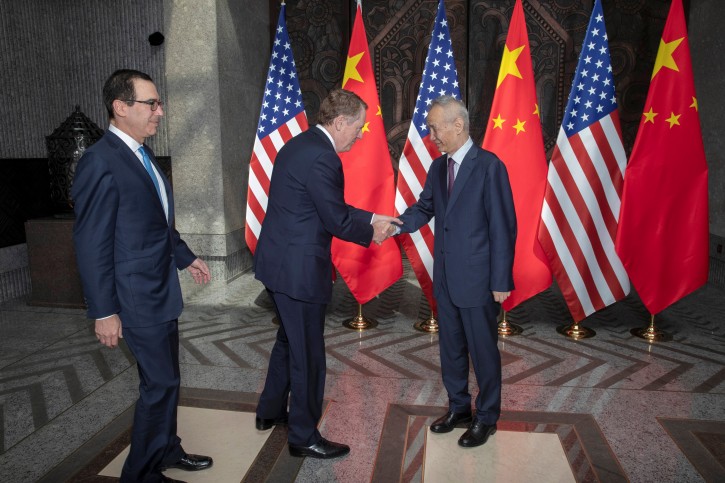
Shanghai – U.S. and Chinese negotiators wrapped up a brief round of trade talks on Wednesday that both sides described as “constructive,” including discussions over further Chinese purchases of American farm goods and an agreement to reconvene in September.
The first face-to-face talks since a ceasefire was agreed to last month in the trade war between the world’s two largest economies amounted to a working dinner on Tuesday at Shanghai’s historic Fairmont Peace Hotel and a half-day meeting on Wednesday, before U.S. Trade Representative Robert Lighthizer and Treasury Secretary Steven Mnuchin flew out.
“The meetings were constructive, and we expect negotiations on an enforceable trade deal to continue in Washington … in early September,” White House spokeswoman Stephanie Grisham said in a statement.
“Both sides, according to the consensus reached by the two leaders in Osaka, had a candid, highly effective, constructive and deep exchange on major trade and economic issues of mutual interest,” China’s Commerce Ministry said in a statement shortly after the U.S. team left Shanghai.
It was not immediately clear what, if any, further agricultural products China agreed to buy from the United States and when – an issue that had become a bone of contention after U.S. President Donald Trump said China had not made good on promised purchases.
“The Chinese side confirmed their commitment to increase purchases of United States agricultural exports,” the White House’s Grisham said, offering no other details.
Representatives for the U.S. Trade Representative’s office did not immediately respond to a request for comment.
The Chinese statement said negotiators discussed more Chinese purchases of agricultural products from the United States, but did not say there was any agreement to buy more.
The talks began amid low expectations. Trump on Tuesday warned China against waiting out his first term to finalize any trade deal, saying if he wins re-election in the November 2020 U.S. presidential contest, the outcome will be worse for China.
Fresh fears over the trade war and concerns about a protracted fight with little near-term progress weighed on global markets on Wednesday.
Chinese Foreign Ministry spokeswoman Hua Chunying said on Wednesday that she was not aware of the latest developments during the talks, but that it was clear it was the United States that continued to “flip flop”.
“I believe it doesn’t make any sense for the U.S. to exercise its campaign of maximum pressure at this time,” Hua told a news briefing in response to a question about the tweets.
“It’s pointless to tell others to take medication when you’re the one who is sick,” she said.
EARLY FINISH
The U.S.-China trade war has disrupted global supply chains and shaken financial markets as each side has slapped tariffs on billions of dollars of each other’s goods.
An official Chinese government survey released on Wednesday showed factory activity shrank for the third month in a row in July, underlining the growing strains the dispute has placed on the No. 2 economy.
The Shanghai talks were expected to center on “goodwill” gestures, such as Chinese commitments to purchase U.S. agricultural commodities and steps by the United States to ease some sanctions on Chinese telecoms equipment giant Huawei Technologies Co Ltd, a person familiar with the discussions told Reuters earlier.
Those issues are somewhat removed from the primary U.S. complaints in the trade dispute such as Chinese state subsidies, forced technology transfers and intellectual property violations – all topics the White House in its statement said were discussed. China’s account of the discussions did not mention any of the non-agricultural issues.
Trump and Chinese President Xi Jinping agreed in June at the G20 summit in Osaka, Japan, to restart trade talks that stalled in May, after Washington accused Beijing of reneging on major portions of a draft agreement. The collapse in talks prompted a steep U.S. tariff hike on $200 billion of Chinese goods.
The U.S. Commerce Department put Huawei on a national security blacklist in May, effectively banning U.S. firms from selling to Huawei, a move that enraged Chinese officials.
Trump said after the Osaka meeting that he would not impose new tariffs on a final $300 billion of Chinese imports and would ease some U.S. restrictions on Huawei if China agreed to make purchases of U.S. agricultural products.
But so far, U.S. semiconductor and software makers are still mostly in the dark about the administration’s plans.
In Sao Paulo on Tuesday, U.S. Commerce Secretary Wilbur Ross said decisions on license applications by U.S. firms to resume some sales to Huawei could come as early as next week.
Hu Xijin, editor-in-chief of China’s nationalistic Global Times tabloid, run by the ruling Communist Party’s People’s Daily newspaper, wrote on Twitter that the negotiators had “efficient and constructive” exchanges.
“The two sides discussed increasing purchase of U.S. farm products and the U.S. side agreed to create favorable conditions for it. They will hold future talks,” Hu said, without elaborating.
Source: VosIzNeias
Israeli Pediatricians Association Oppose E-Cigarettes

July 31, 2019 10:30 am
The Israeli Association of Pediatricians is calling for stricter measures to limit e-cigarettes in Israel. Following the decision by the parallel organization in the United States, and the World Health Organization (WHO), as it has been established the flavored e-cigarettes may endanger the health of teenagers and young people who use them, association leaders Prof. Shai Ashkenazi and Dr. Tzachi Grossman stated, adding “it is the same lady without glorifying change: the addiction problems, pulmonary damage and one becoming a ‘regular’ smoker, these problems will only worsen”.
“If we want teenagers to aspire to life and not endanger their lungs, we must oppose marketing and distribution of e-cigarettes among young people.”
(YWN Israel Desk – Jerusalem)
US To Set Up Plan Allowing Prescription Drugs From Canada

July 31, 2019 4:00 pm
The Trump administration said Wednesday it will set up a system to allow Americans to legally import lower-cost prescription drugs from Canada, weakening a longstanding ban that had stood as a top priority for the politically powerful pharmaceutical industry.
Health and Human Services Secretary Alex Azar made the announcement Wednesday morning. Previous administrations had sided with the industry on importation, echoing its concerns that it could expose patients to risks from counterfeit or substandard medications.
Azar, a former drug industry executive, said U.S. patients will be able to import medications safely and effectively, with oversight from the Food and Drug Administration. The administration’s proposal would allow states, wholesalers and pharmacists to get FDA approval to import certain medications that are also available here.
It’s unclear how soon consumers will see results.
Most patients take affordable generic drugs to manage conditions such as high blood pressure or elevated blood sugars. But polls show concern about the prices of breakthrough medications for intractable illnesses like cancer or hepatitis C infection, whose costs can run to $100,000 or more. And long-available drugs like insulin have also seen price increases that have forced some people with diabetes to ration their own doses.
“For too long American patients have been paying exorbitantly high prices for prescription drugs that are made available to other countries at lower prices,” Azar said in a statement that credited President Donald Trump for pushing the idea.
The administration’s move comes as the industry is facing a crescendo of consumer complaints over prices, as well as legislation from both parties in Congress to rein in costs.
Trump is supporting a Senate bill to cap medication costs for Medicare recipients and require drugmakers to pay rebates to the program if price hikes exceed inflation. Democrats in the House are pressing for a vote on a bill allowing Medicare to directly negotiate prices on behalf of millions of seniors enrolled in its prescription drug plan. Separately, the Trump administration is pursuing a regulation that would tie what Medicare pays for drugs administered in doctors’ offices to lower international prices.
The importation idea won praise from a key lawmaker, Sen. Chuck Grassley, R-Iowa, chairman of the panel that oversees Medicare. Grassley said on Twitter that importation would lower prescription drug costs, and all drugs from abroad must be verified as safe by the FDA. He and Democratic presidential candidate Sen. Amy Klobuchar of Minnesota have a bill to facilitate importation.
Eyeing his reelection campaign, Trump has made lowering prescription drug prices one of his top goals. As a candidate, he called for allowing Americans to import prescription drugs, and recently he’s backed a Florida law allowing state residents to gain access to medications from Canada
Drug prices are lower in other economically advanced countries because governments take a leading role in setting prices. But in the U.S., Medicare is not permitted to negotiate with drug companies.
Some experts have been skeptical of allowing imports from Canada, partly from concerns about whether Canadian suppliers have the capacity to meet the demands of the much larger U.S. market.
But consumer groups have strongly backed the idea, arguing that it will pressure U.S. drugmakers to reduce their prices. They also point out that the pharmaceutical industry is a global business and many of the ingredients in medications sold in the U.S. are manufactured abroad.
AARP had pushed hard for the Florida plan, saying it’s possible to safely import lower-priced, equally effective drugs and it would promote worldwide price competition.
The drug industry lobby, Pharmaceutical Research and Manufacturers of America, has successfully blocked past efforts in Washington to allow importation. It argues that patients would be at risk of receiving counterfeit or adulterated medications.
(AP)