Home Blog Page 1126

Shuvu School to be Dedicated in Memory of Rebbetzin Esther Jungreis a”h

0

Shuvu School to be Dedicated in Memory of Rebbetzin Esther Jungreis a”h

The newest school of the Shuvu Network in Eretz Yisroel, Shuvu Yavne, will be dedicated by Mr. and Mrs. Andrew Penson in memory of Rebbetzin Esther Jungreis a”h, founder of the Hineni Outreach organization.

The dedication ceremony will take place IY”H on Wednesday, Isru Chag of Succos, on the school’s campus in Yavne.

Several months ago at a Shuvu weekend in Manhattan, Shuvu’s Nasi Dayan Yonason Abraham Shlita made a plea to allow the opening of this school, calling out “Tnu Li Yavne, and we will give you Chacham’eha”. Mr. and Mrs. Penson heeded the Dayan’s call, and B”H the Shuvu Yavne school opened its doors with over one hundred Yiddische Kinder, the only Kiruv school in the city.

“It is only fitting that a Shuvu School that is dedicated to being Mekarev Jewish Children to Aveinu Shebashamyim be named after Rebbetzin Jungreis who was a giant in kiruv in our generation.” Said co-chairmen, Mr. Avrohom Biderman and Mr. Yossi Hoch.

For further information please call 052-345-3007.

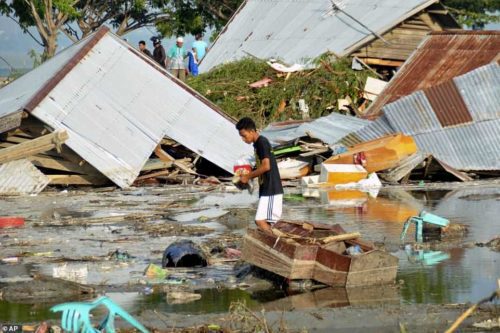
Indonesia tsunami devastation after 10ft wave wipes out a beach festival – sweeping away partygoers, obliterating two towns killing 832

0

Drone footage shows Indonesia tsunami devastation after 10ft wave wipes out a beach festival – sweeping away partygoers, obliterating two towns killing 832

  • 832 people have been killed after a 6.1 magnitude tremor hit the central Indonesian island of Sulawesi on Friday followed by a massive 7.5 magnitude earthquake 
  • Indonesia’s disaster agency’s Sutopo Purwo Nugroho withdrew an earlier warning to residents of a tsunami
  • But three hours later Indonesia’s geophysics agency said there had been one, and hundreds have now died 
  • The cities of Palu and Donggala were struck by 10ft waves which demolished houses and swept away cars


The devastating impact of a huge tsunami in the Indonesian city of Palu has been revealed in chilling aerial photographs – in a natural disaster estimated to have killed 832 people.

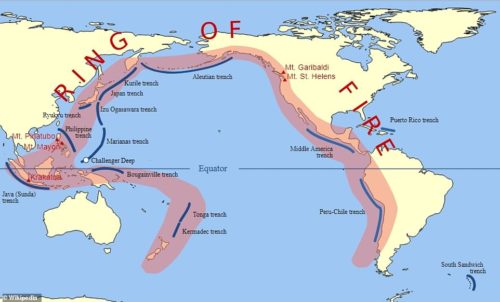
The tsunami, which was triggered after a magnitude-7.5 earthquake, ripped through the Pacific Ring of Fire and crashed into the Palu at 500mph, causing widespread destruction.

Indonesian media, citing the national disaster agency, said Saturday that a further 540 people were injured in Palu City alone, on the the Indonesian island of Sulawesi.

Fears are mounting for the the fishing town of Donggala, which was closer to the epicentre of the quake, but which rescuers have not been able to reach. The town of Mamuju was also severely affected but currently impossible to access due to damaged roads and disrupted telecommunications.

Meanwhile criticisms have been levelled at the counry’s geophysics agency for lifting the tsunami warning 34 minutes after it was first issued, which may have led to confusion and exacerbated the death toll.

Many of those killed in Palu were swept away by giant waves more than 10ft high as they played on the beach in the scenic tourist town.

The number of casualties was no doubt increased by the fact that hundreds of people had descended on Palu’s beach for a festival to celebrate the city’s anniversary, due to start Friday night.

‘When the (tsunami) threat arose yesterday, people were still doing their activities on the beach and did not immediately run and they became victims,’ Sutopo Purwo Nugroho, spokesman of Indonesia’s disaster mitigation agency BNPB said in news briefing in Jakarta.

Some people climbed trees to escape the tsunami and survived, Nugroho said.

The first earthquake was of 6.1 magnitude and hit Indonesia’s densely populated region on Friday morning, quickly followed by even fiercer 7.5 magnitude tremors which caused the terrifying waves.

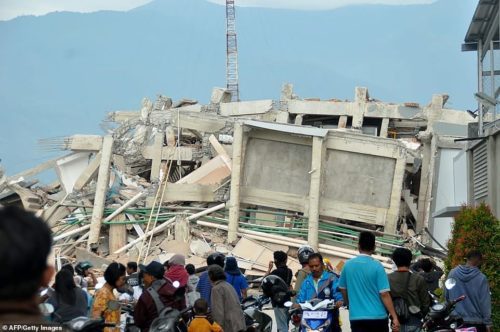
The National Disaster Mitigation Agency warned early on of reports showing that ‘victims died in the rubble of a collapsed building’.

It is thought thousands of buildings have been damaged, with some entirely swept away or demolished, leaving scores of families still missing among the debris.

Strong aftershocks continued to rock Palu on Saturday morning.

Photographs from the city on the coast of Sulawesi island showed bodies being lined up along the street, some in bags and others with their faces covered with clothes.

Bodies of some victims were found trapped under the rubble of collapsed buildings, Nugroho said.

Injured people were being treated in makeshift medical tents set up outdoors and in the hallways of hospitals.


Indonesia sits on the Pacific Ring of Fire and is regularly hit by earthquakes. Roughly 450 volcanoes make up this horseshoe-shaped belt which follows the coasts of South America, North America, eastern Asia, Australia and New Zealand. It’s known for frequent volcanic and seismic activity caused by the colliding of crustal plates.


Source: Daily Mail

From Benedictine Monk to Rebbe’s Assistant by Michael Freund

0

From Benedictine Monk to Rebbe’s Assistant

by Michael Freund


For three years, Aharon Calderon was a monk at a Catholic monastery in South America, living an austere existence of contemplation and introspection. But amid all the silence, he heard the call of eternity, leading him to embrace Judaism. This is his story.

Aharon Calderon was born 36 years ago, in the city of Parana, capital of Argentina’s Entre Rios province. “I was born into a Catholic family, though it was not a very religious one,” Calderon says. “But my parents did send me to a Catholic high school.”

The ideal of helping people greatly appealed to him. At school, Calderon found himself taking a growing interest in religion, confident that it would offer him a framework in which he could give to others while also achieving his own sense of spiritual satisfaction.

After high school, he attended a Catholic seminary for two years, where he had his first experience with missionary activity. Along with his fellow students, Calderon was charged with assisting a group of Indians from a less affluent part of Argentina. At the time, he enjoyed it immensely. It seemed to embody the idea of universal love that he was always hearing about in school.

In retrospect, however, Calderon says it proved to be an important moment, one in which the first seeds of doubt regarding the Church were planted in his mind, albeit subtly. “The work gave me a great deal of satisfaction because I was helping people. However, it also created a spiritual vacuum within me, because it was to a certain extent superficial.”

Continuing, Calderon asserts that, “To give can also be a form of falsehood. And this, by the way, was the first intuitive criticism that I had regarding the Church: we would help the poor, give them second-rate food and drink, and then go back to our comfortable institution, where we would take a warm bath, relax and eat expensive delicacies.”

At the age of 19, Calderon sought out what he terms “a more archaic, more ancient order, one more connected with Catholicism’s roots.” He found and joined a Benedictine monastery.

“It was a contemplative order, where the monks were forbidden to speak most of the day,” Calderon says. The enforced silence, he says, was a powerful experience, and it gave him an opportunity for self-exploration and discovery.

Among other things, Calderon spent a lot of time engaged in inner reflection and in reading the Bible. “When a person connects to their true self,” he says, “they can then discern the existence of the Creator, of a solitary being Who protects, creates and sustains the universe.”

It was during this period that Calderon began to develop a sense of unease with basic Catholic doctrine. One evening, Calderon was reading the Bible when he came to the verse, “Hear O Israel, the L-rd our G-d the L-rd is One.” As he thought about the text, he wondered why his own faith contradicted this most fundamental of principles.

Calderon’s doubts persisted. Eventually, he decided to leave the monastery. But he remained intrigued by the world of the spirit and went to study theology at a Catholic university. While there, he decided to learn Hebrew. He found an adult-education institute where Hebrew was taught, and through the classes Calderon first met Jews.

The turning point came one day when, “I said to my friend, ‘The Jews say every Friday, “The Children of Israel shall observe the Sabbath, to make the Sabbath an eternal covenant for their generations.” If it is an eternal covenant, then G-d would not go back on it. So if we move it to Sunday, then we are making a mistake!’

“I understood then that there was no turning back. This was the spiritual point at which I decided to join the Jewish people.”

Calderon had heard that an Orthodox rabbi had recently arrived in the city. One day, Calderon saw the rabbi walking in the street, so he introduced himself, and said that he wished to convert.

They later arranged a meeting, where Rabbi Moshe Blumenfeld, a Chabad-Lubavitch emissary in Argentina, said something that made a deep impression on Calderon. “He explained to me that I did not need to convert to achieve redemption… it was sufficient for me to keep the seven basic commandments required of a gentile.”

“This,” Calderon explains, “led me to understand that the G-d of Israel is a G-d of love Who accepts all of mankind. By contrast, according to Christianity, anyone who does not accept their way of thinking is condemned to hell.”

Calderon found Rabbi Blumenfeld to be warm and hospitable, and for the next two years, he spent a great deal of time with him studying Judaism. “I wanted to learn how Jews live. In the process, I watched, internalized and then connected to it.”

Calderon decided that he wanted to go to Israel to convert.

“From the moment I arrived in Israel, I felt a connection with the Land and with the Jewish people.” He began to study at a yeshiva in Jerusalem.

A few months later, a friend of Calderon’s took him to see the Rebbe of Stropkov, of the Sanz dynasty. Calderon was immediately captivated by the Rebbe and by his personality. He found himself drawn to the Chassidic lifestyle.

Eventually, he went before a rabbinical court in Jerusalem and converted. After his conversion, Calderon continued to study while working. He married, and he and his wife Anya have three children. Calderon remains close to the Rebbe of Stropkov, serving as his assistant in Jerusalem’s Meah Shearim neighborhood.Looking back, Calderon remembers something that Rabbi Blumenfeld told him. “He explained to me that the conversion must be like a fruit that ripens and falls by itself from the tree when it is ready. That is how I view my Judaism, as something natural and integral to me.”

Calderon is proud of his spiritual journey, and he hopes that it will inspire more Jews to cherish their heritage. “Generally speaking, once people know that you have converted for no reason other than love for G-d and for the Torah, it causes them to feel proud and gives them yet another reason to appreciate their Judaism.”
~~~~~~~~~~~~~~~
Source: Reprinted from //lchaimweekly.org (#979), with permission.
Michael Freund is the founder and Chairman of Shavei Israel (//shavei.org), a Jerusalem-based group that assists “lost Jews” seeking to return to the Jewish people.


SOURCE: ASCENT

New musical art video in memory of Ari Fuld Tribes

0

The Sons of Israel musical video is presented from Outreach of Humanity series.


Danish committee OKs draft resolution calling to ban circumcision

0

Danish committee OKs draft resolution calling to ban circumcision

(JTA) — A parliamentary committee in Denmark cleared the path for a nonbinding vote on a petition that calls for banning nonmedical circumcision of boys for humanitarian reasons.

The Folketingets Administration said Thursday that the text of the petition presented no constitutional obstacles.

A vote could be held before November, according to Lena Nyhus, an activist for the ban and an initiator of the petition.

The petition by the group Denmark Intact crossed the 50,000 mark in June, four months after its launch, Danmarks Radio reported. According to regulations passed in January, petitions approved for posting on the Danish parliament’s website are brought to a vote as nonbinding motions if they receive that level of support within six months and unless they are deemed unconstitutional.

Petitions that make the signature threshold are read out as resolutions, requiring the government to take no actions whether they pass or fail. Still, a vote in a major European parliament on whether circumcision should be banned would be a precedent in Europe after World War II, when the Nazis imposed and introduced anti-Semitic legislation and practices in many countries they occupied.

Jews circumcise males when they are 8 days old. Muslims perform the practice at a later age, but rarely after the boy turns 13.

The petition describes circumcision as a form of abuse and corporal punishment, equating it with female genital mutilation. The petition states that parents who have their children circumcised outside Denmark should be exposed to legal action in Denmark, which has 8,000 Jews and tens of thousands of Muslims.

But last week, when spokespeople for most of the parties in the Danish parliament provided their faction’s positions on the issue, a tally showed that a majority of lawmakers would vote against supporting a ban if the issue is brought to a vote, the Kristeligt Dagblad daily newspaper reported.

The Socialist People’s Party and the far-left Red-Green Alliance are the only parties in favor of a ban, according to Danmarks Radio. Between them, they have 21 seats out of the parliament’s 179.

However, it is not yet clear if the other parties will require their representatives in parliament to vote against the nonbinding motion calling for a ban.


Source: JTA

Palestinian in Germany caught planning chemical terror attack in Israel

0

Palestinian in Germany caught planning chemical terror attack in Israel

Syrian-born 21-year-old arrested by armed forces on suspicion of plotting attack, recruiting fighters for Islamic State


A 21-year-old Syrian-born Palestinian man has been arrested in Germany on suspicion of planning to carry out a terror attack in Israel using chemical weapons, according to German media reports.

Security forces armed with automatic weapons arrested the man last week outside a restaurant in Berlin’s Neukölln neighborhood, Bild reported Thursday.


The German Federal Intelligence Service (BND) reportedly received a tip from a foreign security service about the man, who arrived some time ago from Libya using a false passport.

The German newspaper Welt reported that the man intended to use chemical weapons for his planned terror attack in Israel, and in a phone call intercepted by security officials stated that he had already acquired the necessary materials.

However, police had not yet found the materials, the reports stated, and the investigation was ongoing.

According to police, the man was arrested several months ago for assault during a brawl.

Welt reported that the man was already known to law enforcement officials for his aggressive behavior and extremist views.

He was reportedly arrested by SEK Special Deployment Commando forces while riot police secured the area.

Source: The Times of Israel

Wellington, New Zealand – Everybody On Plane Survives Crash Landing In Pacific Lagoon

0


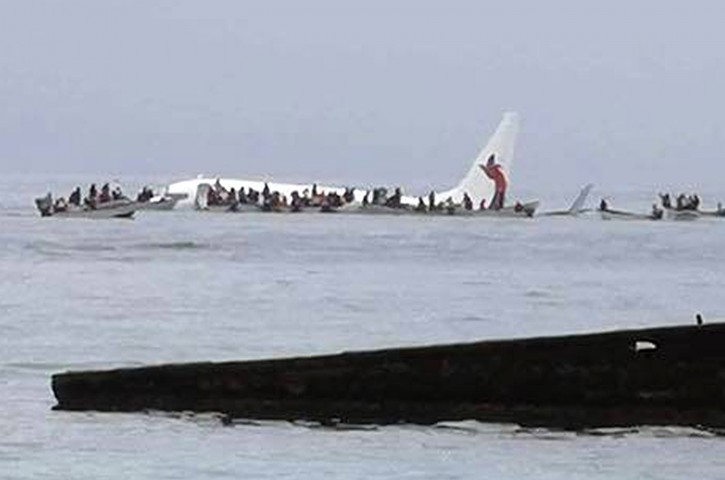
Wellington, New Zealand – All 47 passengers and crew survived a plane’s crash landing in a Pacific lagoon Friday morning, wading through waist-deep water to the emergency exits and escaping on local boats that came to the rescue in the Micronesia archipelago.

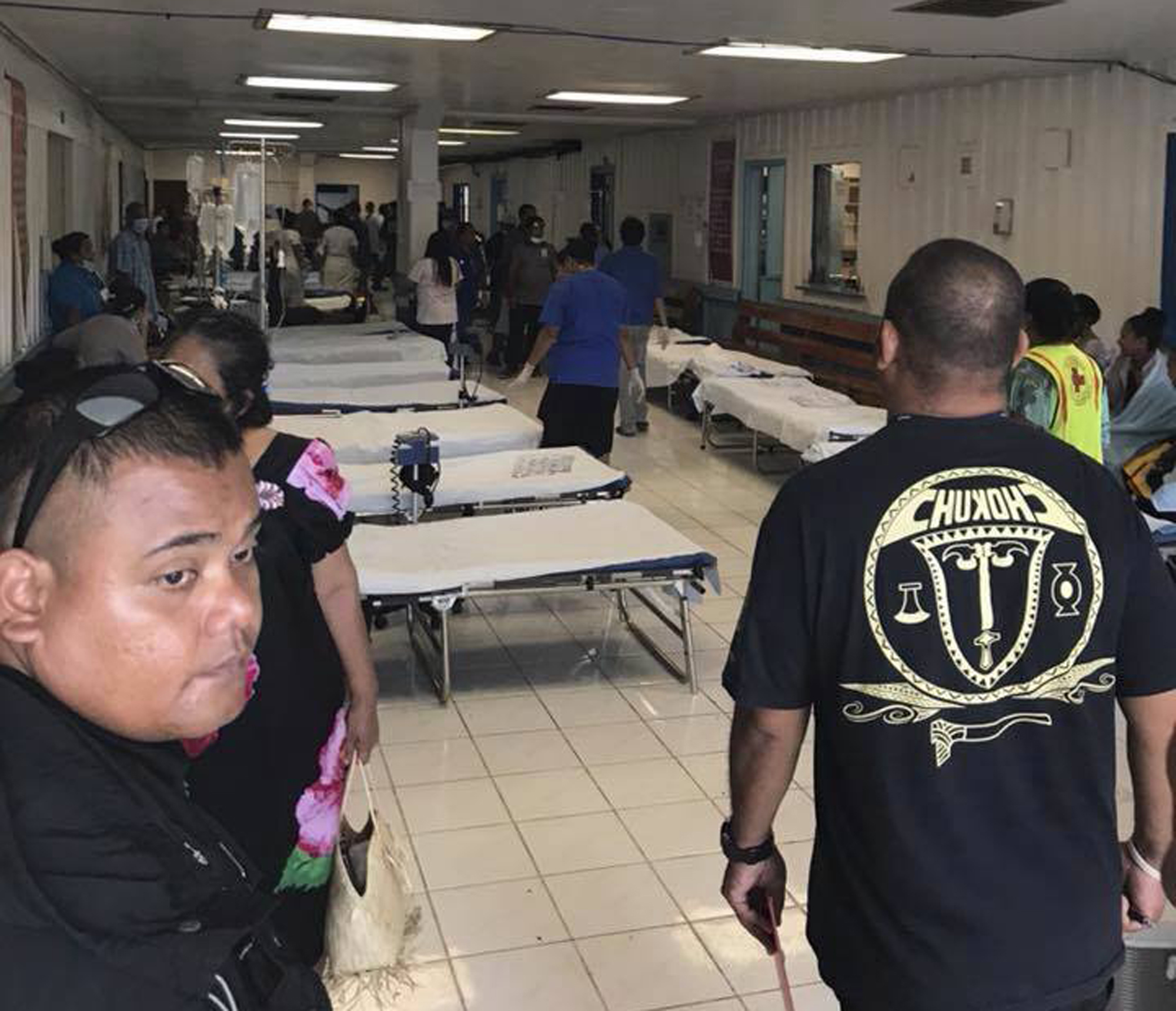
Seven people were taken to a hospital, according to officials, including one described as being in critical but stable condition.

Passenger Bill Jaynes said the Air Niugini plane came in very low as it was attempting to land at the Chuuk Island airport.

“I thought we landed hard,” he said. “Until I looked over and saw a hole in the side of the plane and water was coming in. And I thought, well, this is not the way it’s supposed to happen.”

Jaynes said the flight attendants were panicking and yelling, and that he suffered a minor head injury. He said he called his wife, who started crying.

“I was really impressed with the locals who immediately started coming out in boats,” he said in an interview with a missionary in Chuuk, Matthew Colson, that was posted online and shared with the AP. “One would think that they might be afraid to approach a plane that’s just crashed.”

The sequence of events remains unclear. The airline said the plane landed short of the runway. However, Jaynes said the only scenario he can imagine is that it hit the end of the runway and continued into the water.

The U.S. Navy said sailors working nearby on improving a wharf also helped in the rescue by using an inflatable boat to shuttle people ashore before the plane sank in about 30 meters (100 feet) of water.

The striking images of people being rescued from the half-submerged plane were reminiscent of the 2009 crash landing in New York City known as the “Miracle on the Hudson.”

Louie Mallari, who was working at a hotel near the airport, said he could hear the whole thing happen.

“As the plane approaches, the sound of the engine is getting stronger, then suddenly a splash of water,” he said, adding that he then heard screaming.

180928-N-WR252-001 CHUUK, Federated States of Micronesia (Sept. 28, 2018) U.S. Navy Sailors from Underwater Construction Team (UCT) 2 assist local authorities in shuttling the passengers and crew of Air Niugini flight PX56 to shore following the plane crashing into the sea on its approach to Chuuk International Airport in the Federated States of Micronesia. (U.S. Navy photo by Lt. Zach Niezgodski /released)
180928-N-WR252-001 CHUUK, Federated States of Micronesia (Sept. 28, 2018) U.S. Navy Sailors from Underwater Construction Team (UCT) 2 assist local authorities in shuttling the passengers and crew of Air Niugini flight PX56 to shore following the plane crashing into the sea on its approach to Chuuk International Airport in the Federated States of Micronesia.  (U.S. Navy photo by Lt. Zach Niezgodski /released)
He said it’s a good thing that so many people use boats to travel and were able to quickly help with the rescue.

“It’s really fortunate that we didn’t have any fatalities,” said Glenn Harris, a government aviation security inspector for the Federated States of Micronesia.

Harris said the plane left from the Micronesian island of Pohnpei about 700 kilometers (435 miles) to the east before ending up in the water at about 10 a.m.

He said he has yet to see a passenger manifest, but typical passengers would include businesspeople from Micronesia, Papua New Guinea and Australia, as well as some tourists. Chuuk is known for its world-class diving, with dozens of World War II shipwrecks visible in the clear waters.

Harris said he doesn’t know what caused the crash landing or whether the pilots had alerted air traffic control of any problems. He said an investigative team would be on the ground in Chuuk by Saturday to figure out what went wrong.

The airline said in a statement that the 35 passengers and 12 crew members aboard the Boeing 737 were all able to safely evacuate. It said the weather was poor at the time, with heavy rain and reduced visibility.

The airline said it was making all efforts to ensure the ongoing safety of the passengers and meet their immediate needs. It said it was in touch with embassies, passenger representatives, stakeholders and families of the crew.

Air Niugini is the national airline of Papua New Guinea and has operated since 1973. The airline identified the flight as PX 073 with the registration number P2-PXE. Flight histories show the aircraft has made recent flights to Manila, Sydney and Singapore.

This image provided by Matthew Colson shows beds at a hospital after an Air Niugini plane has crash landed in a Pacific lagoon, near Chuuk Airport in Chuuk Island, Federated States of Micronesia, Friday, Sept. 28, 2018. All of the passengers and crew survived the crash landing. The Air Niugini plane hit the water short of the runway while trying to land at the island, according to the airline. (Matthew Colson via AP) Air Niugini’s network is concentrated on domestic routes linking the capital, Port Moresby, with isolated points across the Papua New Guinea archipelago, but it flies as far as Tokyo and Hong Kong.

The fleet includes Boeing 767 and 737 jets for international routes, according to the airline, as well as Fokker F-100 aircraft, Q400 and Dash 8 aircraft for challenging local terrain.

Micronesia, located north of Australia and east of the Philippines, is home to just over 100,000 people. It has close ties with the U.S. under an agreement known as a compact of free association.

The crash landing comes less than two months before Papua New Guinea hosts the Asia-Pacific Economic Cooperation summit, expected to draw world leaders beginning on Nov. 17.

In the “Miracle on the Hudson,” both engines on a U.S. Airways jet failed after it struck a flock of geese during takeoff from New York’s LaGuardia Airport. Pilots Chesley Sullenberger and Jeffrey Skiles safely landed their powerless plane on the Hudson River and passengers and crew walked on the wings to be rescued.

In both crashes, everyone survived.

“I’m alive,” said Jaynes, the passenger. “That’s an extremely good thing.”


Source: VozIsNeias

U.S.: IAEA Must Investigate New Netanyahu Allegations About Iran

0

U.S.: IAEA Must Investigate New Netanyahu Allegations About Iran


The State Department Thursday night called on the International Atomic Energy Agency to investigate allegations made by Prime Minister Binyamin Netanyahu in his speech to the U.N. General Assembly earlier Thursday. In a statement quoted by Reuters, a State Department official said that it was “absolutely imperative that the IAEA fully exercise its authorities in order to provide confidence to the international community that there are no undeclared nuclear materials or activities in Iran.”

Iran itself denied the allegations that it had lied about ending its nuclear weapon development program, and that it had established a second, secret nuclear development facility in Tehran. “The world will only laugh loudly at this type of false, meaningless and unnecessary speech and false shows,” Iranian foreign ministry spokesman Bahram Qassemi said to Iran’s Fars news agency. In a social media post, Iranian Foreign Minister Mohammad Javad Zarif said that “No arts & craft show will ever obfuscate that Israel is only regime in our region with a *secret* and *undeclared* nuclear weapons program – including an *actual atomic arsenal*. Time for Israel to fess up and open its illegal nuclear weapons program to international inspectors.”

In his speech, Netanyahu said that he was “disclosing for the first time that Iran has another secret facility in Tehran, a secret atomic warehouse for storing massive amounts of equipment and materiel from Iran’s secret nuclear program.” Last year, Israel obtained and publicized thousands of documents about the program, forcing Iran to revamp it. “Since we raided the atomic archive, they’ve been busy cleaning out the atomic warehouse. Just last month they removed 15 kilograms of radioactive material. You know what they did with it? They took it out and they spread it around Tehran in an effort to hide the evidence,” Netanyahu said, displaying a map that showed what he said was the exact location of the site.

“I also have a message today for the tyrants of Tehran. Israel knows what you’re doing and Israel where you’re doing it. Israel will never let a regime that calls for our destruction to develop nuclear weapons. Not now, not in ten years, not ever,” Netanyahu said. “And Israel will do whatever it must do to defend itself against Iran’s aggression. We will continue to act against you in Syria. We will act against you in Lebanon. We will act against you in Iraq. We will act against you whenever, and wherever. We must act to defend our state and to defend our people.”

Netanyahu also discussed Iran’s activities in Lebanon. “In Lebanon, Iran is directing Hezbollah to build secret sites to convert inaccurate projectiles into precision-guided missiles. Missiles that can target deep inside Israel within an accuracy of ten meters. So I have a message for Hezbollah today: Israel knows, Israel also knows what you’re doing. Israel knows where you’re doing it. And Israel will not let you get away with it.”

Reaction in Israel to the speech fell along political lines, as would be expected. Education Minister and Jewish Home chairman Naftali Bennett called the speech “excellent,” with the Prime Minister “displaying the evil of the policy of appeasement of Iran, and the hypocrisy of international organizations against Israel.” Housing Minister Yoav Galant said that Netanyahu “held up a mirror to the world and revealed the Iranian terror machine that never stops working even as Iranian leader Rouhani tries to cover the eyes of the world.” Depurty Minister and Kulanu MK Michael Oren said “like Daniel in the lion’s den, Netanyahu walked into the U.N. building and fought for the truth. The truth is that Iran is murderous, the truth is that the Iranian deal is ruinous. Israel has to defend its truth and pursue peace.”

Former Prime Minister Ehud Barak said that Netanyahu’s speech was “eloquent but arrogant speech to a half-empty auditorium, with all the applause coming from the Israeli section. This speech was aimed at Israel. America is busy with congressional crises. Netanyahu uses too many secret documents and materials in these speeches. We have paid a price for this, and we will in the future.”


Source: Hamodia

On The Road With Israel’s Angels of Mercy

0

On The Road With Israel’s Angels of Mercy

By Ilanit Chernick • 27 September, 2018


The sirens wail. Adrenaline pumps through our veins as the call comes in. We rush to the scene, weaving in and out of traffic.

Some motorists heed the siren and move swiftly out of the way, others don’t, making it difficult to navigate through the long lanes of Jerusalem traffic.

Some drivers are not accommodating and make it difficult for the United Hatzalah ambulance to get through.

Eventually, the United Hatzalah ambulance partially mounts a pavement to beat the traffic and a race against time to get to a patient in need.

TPS recently spent a day with United Hatzalah discovering the ins and outs of how these angels of mercy respond to medical emergencies across Israel.

The organization has volunteers from all walks of life, Jews, Arabs and Christians working in harmony to save lives.

United Hatzalah spokesman Raphael Poch explains that the organization has 65 chapters across the country with volunteers from all religions and backgrounds.

“Each chapter is made up of the people who live there, so places like Umm al-Fahm [in northern Israel] or in East Jerusalem, which are more Muslim chapters, are not going to have the same makeup as a chapter in Gush Etzion or Tel Aviv.

“That’s an interesting thing for a national organization to have because you end up with a bunch of people with their own identity feeling proud of who they are – which is something unique and conceptualizes United Hatzalah,” Poch says. “We’re an organization that really brings people together – people work hand-in-hand…ultra-Orthodox, Muslim and Christian volunteers can be proud of their identities without stepping on each others toes. There’s a real comradery between members.”

Poch adds that in the dispatch center there is a break room “and there have been many times where we have a Muslim bowing down on a carpet and a Jew saying their Shemona Esrei [a central Jewish prayer], praying at the same time in different directions in the same room together.”

As we race on the highway, in minutes, the team makes it to the the first patient, an infant who was injured after a fall. Medics Poch, Nissim Yadzi and Yonaton Atkin jump out the vehicle as it grinds to a halt, ready to deal with their little patient.

They handle both baby and parents with empathy and tender care doing everything to keep everyone calm – a difficult fete for the devastated mom. A large bump is visible on the infant’s head and a decision is made to take the child to the Hadassah Ein Kerem Medical Center.

Poch and his crew succeed in keeping everyone calm as the ambulance heads to the hospital, keeping a close watch on the baby’s condition, movement and vitals.

As we make it to the hospital, which doesn’t have an ambulance lane, it’s met with a major traffic jam. A security officer signals to the ambulance to move through and as it tries to cross over, sirens blaring, a car filled with passengers cuts it off, refusing to move or let it through despite the fact that it’s an emergency.

Shock spreads throughout the medical crew and Yadzi tries to implore the car to move, to no avail.

Finally, the ambulance makes it to the ambulance bay and the patient is off-loaded and admitted to the hospital.

We leave the hospital and begin chatting about the role that women play in the organization.

“We have about 600 women in the organization. Certain chapters have women fully integrated and they do the exact same thing as the men, in some places there’s a lot more leniency to have women and men interact regularly and generally, but it depends on the makeup of the chapter,” he explains. “Chapters that have an ultra-Orthodox makeup will have only women to treat women and men to treat men.”

In Jerusalem, Gitty Beer – the wife of United Hatzalah’s founder and president Eli Beer- started a women’s unit specifically for the ultra-Orthodox community.

“Women from these communities were not volunteering because they didn’t feel it was appropriate… she created the unit where the women trained by themselves one night a week for a year, making it a lot more lenient for women who are working, taking care of children and running households, to take part. They will go to any call, but primarily attend to women’s needs as their are medical issues that they would prefer women to attend to instead of men,” Poch says.

During the shift, we head to a kindergarten where Yadzi’s son attends.

“We’re going to teach them about Rosh Hashanah and the shofar – we will blow the shofar for them,” he says, as we pull up to the colorful school.

The teachers and children greet us excitedly and Poch takes out a shofar and tells the children why we blow the shofar in the Jewish month of Elul, which comes just before Rosh Hashanah.

Poch blows the shofar and teaches them about each of the sounds. They watch fascinated and some imitate the sounds together with Poch as he blows the shofar.

There’s a realization that United Hatzalah doesn’t just focus on the medical well-being of Israel, but also the communal outreach aspects as well.

As we bid farewell to the children, a call comes in about a car accident. We respond, the adrenaline kicks in again and the sirens wail.

We attend to three more accident-related calls and a woman who collapsed near the Machane Yehuda market as the shift progresses – the teams incredible professionalism and genuine passion for the job becomes more and more apparent as the day wears on.

Taking care of large cuts, bruises, bumps, stemming serious bleeding and watching vitals closely are just some of the injuries the team faces throughout the day.

Asked about some of the more difficult aspects of being a volunteer, Atkin, who is originally from Chicago, says that everything they do is volunteer-based. “It’s all on our own time, so we can be at the Shabbat table in the middle of the Shabbat meal and if I get a call, I have to leave my wife and three kids, which can be hard… also for me, seeing deaths is difficult.”

What he loves most about his job – which is something we witnessed first hand – “is being able to calm the parent and patient down, and successfully treating the patient.”

He did the course with his father, which for him is inspiring. Together, three weeks ago, father treated a religious Muslim woman who had gone into cardiac arrest and managed to resuscitate her.

“I think it’s really important for us as Jews to be a light upon the nations and myself being a religious Jew, going to this call and being able to help this Muslim woman successfully shows this.”

For Yadzi, being able to save lives is what keeps him going as a volunteer. “Just knowing that we’re helping people and making a difference is worth it.

“The most difficult aspect on the job is taking care of children,” Yadzi says, alluding to the difficulty of seeing children in pain. “When we arrive to treat children, I feel helpless – it breaks my heart.”

As the shift comes to a close, we all take a deep breath as the ambulance pulls into the United Hatzalah parking area.

These brave men and women are a patients first port-to-call.

They are the angels of mercy, protecting the country’s beating heart one life at a time – without a second to spare.

Thousands Take to Jerusalem’s Streets to Celebrate Israel

0

Thousands Take to Jerusalem’s Streets to Celebrate Israel

By Mara Vigevani/TPS • 27 September, 2018

With flags from all over the globe waving high, a colorful march of some 80,000 Israelis and foreign friends of Israel descended on the streets of Jerusalem on Thursday afternoon for the annual Jerusalem March to celebrate Israel and pray for peace.

Hundreds of police officers deployed along the march route, which began at the Sacher Park and ended at the First Station compound,  to provide security and direct traffic, closing off major streets and intersections in the capital in the early afternoon to make way for the parade.

Over 6,000 pilgrims from over 100 nations joined the 3-kilometer popular parade, held annualy during the Succot holiday, including large groups waving flags and traditionally dressed from countries including Brazil, China, Switzerland, Malaysia, the United States, South Africa, and Peru and singing. The International Christian Embassy Jerusalem (ICEJ) is behind the event, now in its 39th year.

The Chinese speaking delegation, one of the biggest with 500 representants arrived in Israel for the march, walked holding six small sukkahs, the temporary hut constructed for use during the Jewish festival of Sukkot,  differently decorated.

Pilgrims from Brazil represented the biggest delegation with 900 people.Other large delegations arrived from Ivory Coast with 600, from the United States, 500,  and 250 people from the Philippines.

This year’s event centered on the 70th anniversary of the creation of the Jewish state.

“Every year the participants to the march rise, as tourism in Israel which is on rise 15% up as well,” ICEJ Vice President David Parsons told TPS.  “60% of the pilgrims who arrived in Israel are from Latin America and Africa, the developing countries, where evangelical churches  are growing the fastest”.

According to Parsons the interest of the pilgrims from developing countries doesn’t come only from religious reasons but also because they admire the spirit of the country

“Developing countries watch Israel from the last 70 years, from the time orphans from the Shoa arrived to the high tech nation and admire it, they want to take the spirit of Israel to their nations,” Parsons said.


WP Twitter Auto Publish Powered By : XYZScripts.com