December 20, 2013, 17 Tevet 5774
The ERUV is UP
The eruv is sponsored, anonymously.
For more information please visit laeruv.com

The ERUV is UP
For more information please visit laeruv.com

Mazel Tov on the engagement of Mushka Greene to Rabbi Isser Kluwgant of Melbourne, Australia!
Mazal Tov to the parents, Rabbi Mayer and Debbie Greene and Rabbi Meir Shlomo and Yehudis Kluwgant and their entire families upon this great occasion.
May the young couple build an eternal and everlasting edifice, a Binyan Adei Ad and may the community continue to share many simchas in the near future.


On Sunday 12/29/13 Bikur Cholim will hold an urgent Blood Drive at Bais Yaakov, 7353 Beverly Blvd, Los Angeles, CA, 90036 from 9:00 AM – 2:30 PM to benefit the patients at Cedars-Sinai Medical Center. This is a critical time of year due to the increased need for blood and extreme shortages. Please make your appointment at www.bikurcholim.net or call (323) 852-1900.

With the launching of their state of the art multimedia lending library in Los Angeles, Misameach reached a new milestone in caring and bringing joy to the life of patients across the country. The West Coast library, servicing the hospitalized and homebound of the Los Angeles community is the fourth branch of Misameach’s legendary DVD library, joining its existing counterparts in Boston, Lakewood and North Carolina. The new kosher library features hundreds of titles, from the entertaining to the educational, from informative to inspirational. Jewish hits such as Uncle Moishy, HASC concerts, Leah Forster, Machon plays and more provide hours and hours of viewing time for children and adults, men and women.
Misameach is an organization comprised of a devoted core of volunteers who have made it their mission to alleviate the suffering of seriously ill children and their families in whatever way they can. Misameach stops at nothing to bring a smile to a patient’s face with their myriad programs, events and activities.
With a song, a dance, and sometimes nothing more than a caring heart, Misameach has succeeded in changing lives and spreading joy wherever they go. Misameach has grown in scope, from a group of volunteers making the rounds of local hospitals and cheering up patients with song and dance, to a well rounded organization with a veritable treasure house of options available for the ill and their family. Aside for the expansive libraries, some of the unique programs and resources that Misameach offers are:
Short of actually curing a child of his illness, Misameach spares no effort in ensuring the greatest quality of life for every patient in its care. Working professionally with community leaders and medical personnel, Misameach remains wholly devoted to it selfless mission of bringing a smile to ailing lips and hope to suffering hearts.
“Nothing gives us greater pleasure than that of seeing a sick child smile,” says Mr. Lipa Schwartz, founder and director of Misameach.
For countless children and their families, Misameach is a miracle. Misameach gives them a reason to wake up in the morning, lending a spring to thier step and a relief from the all-pervasive pain. Misameach gives its patients a reason to smile when they’ve lost all will to muster up any semblance of joy. For so many suffering children, Misameach is more than just an organization. They are a lifesaver.
To contribute to this worthy organization contact (732) 905-9191, (877) 905-8181 or misameach@misameach.org. Visit their website at www.misameach.org









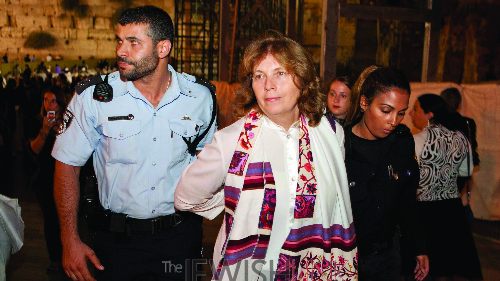
You’ve read about it in the news. Rosh Chodesh services by women, for women at the Kotel, the Western Wall of the Old Temple. Women are conducting large religious services every Rosh Chodesh at the Kotel, with many of them donned in Tallis and Tefillin. To counter this breach of traditional protocol, Orthodox seminaries are bussing in hundreds, if not thousands of seminary girls to crowd these Reform and Conservative women out and preserve the traditional aspects of the Kotel. There have been skirmishes between the two groups.
Responding to the pressure from outside and inside Israel, Prime Minister Netanyahu has appointed Natan Sharansky, Head of the Jewish Agency, to try to come up with a solution. Sharansky is faced with a Solomonic decision. How can he satisfy both sides?
Sharansky has proposed that an archaeological site just off the present Kotel site but seen as a continuation of the actual wall could be used by the Women of the Wall, the group pushing for women’s rights at the wall. This site has been opened in the recent past to Reform and Conservative groups for Bar and Bat Mitzvah and other services featuring egalitarian minyanim with equal participation by men and women. The Orthodox have tentatively accepted this proposal. The Women of the Wall have opposed the proposed solution, but may accept it with the proviso that the geographically much lower site be raised to the same level as the current Kotel site. They know that any such structural change in the area will require the approval of the Moslem group which oversees the mosques atop the Kotel area. This approval is unlikely. And the debate over woman’s participation at the Kotel continues.
I have separately written in the pages of Community Links before regarding the quest for an increasing role of women in Judaism. Women from the more liberal segments of the Jewish community have sought to express themselves in the attire traditionally associated with men. They have sported Kipot, Talesim, and Tefillin. They have sought egalitarian minyanim where women are called to the Torah, even read from the Torah, and chant the services. They have sought rabbinic and cantorial roles in synagogues. They claim that Orthodoxy puts down women and places them in an “inferior” status where women are relegated to secondary roles behind the Mechitza, the dividers that separate men and women in the traditional shul. In an effort to claim expanded roles, they seek to break down the barriers and enter the previously men’s only world.
Throughout the Twentieth Century, some of these barriers were broken down by Reform and Conservative Jews. Mixed seating of males and females became common in most synagogues throughout the United States. In the last quarter of that century, women Rabbis were ordained at first the Reform seminary and then at the Conservative. Women cantors followed. The Bat Mitzvah celebration became identical with the Bar Mitzvah in these synagogues.
But with the Twenty-First Century, there were to be more changes. Women rabbis took on increasing roles in the communities, with a woman rabbi, for example, at the top of the largest Reform congregation in Beverly Hills. Women were not content to just lead Reform and Conservative communities. They wanted equal rights to participate as Jews in all sites, including the Kotel HaMaravi, the Western Wall of the ancient Temple site, the holiest site in the Jewish world. Not only did they want to participate equally in services there, but they wanted to do it their way, complete with Talis and Tefillin and the chanting of communal services. This was the way in which they would assert themselves. Women would take on increasing roles in Judaism by assuming men’s roles. They have assumed that for women to take on expanded roles in Judaism, they must in a sense become like men and do as men traditionally have done.
This quest to become like men does not acknowledge the roles women have played in Judaism through the centuries. Women have occupied roles within traditional Judaism that have been forgotten in the focus and quest for women to become like men.
As many of you may know, my family comes from the Island of Rhodes. Jews lived on this Mediterranean island since Before the Common Era. They survived Greek civilization, the Roman Empire, and in more modern times, the Ottoman Empire. There has been a Jewish Quarter on this island for many centuries, with Jews, Christians, and Moslems integrated in the marketplace. That is, until the Nazis, may their memories be blotted out, occupied Rhodes in 1944 and forcibly captured the Jews on the island and shipped them to Auschwitz.
There were many traditions on Rhodes. There was the position of La Hermana, a unique leadership position for women. Actually, two kinds of women held this lofty position. The first women who held this position inherited from their mothers the medicinal remedies passed down through the ages. These “medicine women” helped to cure the island’s inhabitants with the tried but true remedies. But, from my perspective, far more interesting was the second type of women who held the position of La Hermana.
These women held leadership roles in the community at large. While the men supervised the ritual of the community, these women took the leadership over the social welfare components of the community, sort of like the current Jewish Federations. There were no asylums for the mentally ill, no nursing homes for the elderly in Rhodes. These women, in their roles of La Hermana, assigned some families the responsibilities of taking care of the ill and elderly. The families would house the ill and elderly and provide for them and take care of them. Other families would be taxed to help pay for these services. These women would also tax businesses in the community to help pay for these social welfare efforts. These businesses were primarily owned by men. Those who did not pay the taxes charged would be ex-communicated from the community, so powerful were these women. Women taxing men to provide for the social welfare of the community!
In this separate but equal form of governance, women were “more equal.”
The women of Rhodes did not lead with Talis and Tefillin on. They had more important things to do. They had to tend to the welfare of the entire community. With their leadership and guidance, no ill, mentally ill, or elderly individuals were without care and assistance. They mobilized the community to ensure that no one went without the needed care. They did not “ship out” their needy. They kept those who needed care within the community. These individuals kept their dignity. This was all done by the La Hermana.
Reform and Conservative women, lacking an understanding of the historic roles occupied by women, seek to achieve equal status in the narrowest of roles, in the ritual aspects of the community. They lose sight of the traditional leadership roles occupied by women. They see women relegated to an “inferior” role in the ritual and forget to see the leadership over the entire community shown by women traditionally and historically.
The ritual role in the community is but one role, and not that important when you contrast the larger purposes of the community. Yes, there are traditional roles in the community for men and traditional roles for women. To see the roles for women as somehow inferior is a misreading of history. That women taxed men and that men were excommunicated from the communities if they did not pay showed the power women held.
Psychologically, and in Jewish thinking, the feminine characteristics seen in women are not a negative. Caring, compassionate, deferential: These are just some of the “feminine” characteristics seen. When women forego these characteristics, is society better off? Rather than seeking ways for women to be more masculine, can’t we pursue a Judaism in which men assert more of their feminine side? Is not the community welfare as important, or even more important than narrow ritualism?
The Lubavitcher Rebbe would say that there is a time when one should even forego faith in G-d. When individuals come to your door and say that they are in need, that they are hungry, you should not say, “G-d will take care of you” and do nothing. You should provide for the needs of the person. You must feed them. Tending to the welfare of the Jewish people is that important.
The Women of the Kotel are misguided. Rather than seeking to emulate men in terms of ritual, they should be engaged in finding more ways to traditionally fulfill their femininity. There is much to be done in terms of the social welfare of the people. Reasserting traditional roles in this regard, for the betterment of the people, should be the top priority.
We have much to learn from Jewish history and tradition.
Robert J. Rome, Ph.D., is a licensed psychologist in clinical practice in Encino, California. He can be reached at RJRome@aol.com.

Recently I had the chance to visit San Francisco with my husband and during our trip we, thankfully, had many great adventures. Something that I saw, what seems like the silliest thing, has stuck in my mind and I feel compelled to write about it. One of the things we did on our trip was to visit Alcatraz Island, the retired United States Penitentiary that is now a national park. The prison is completely intact and the audio tour provided a wealth of history and intrigue about this notorious location. While we were exploring “The Rock” as it is called, I came across a photo of the Alcatraz Warden checking his line-up of prison guards (see photo). At first blush there might not seem anything extraordinary about this photo. However, what caught my eye immediately were the warden’s three-piece suit, tie, and dress hat. Then, as I looked a bit closer, I noticed that even the prison guards were wearing suits. Imagine this: a prison house full of the worst behaved criminals in all of the U.S. prison system and yet the head of the place is dressed daily like he is going to a formal event. The guards, whose jobs were to keep these inmates in line every day, were also dressed in a uniform of a single or double-breasted suit and tie with dress shoes and military-style caps. This is a far cry from what we see today not only in the prison system, but in life in general, and it started me thinking.
It is widely and primarily sub-consciously understood that a person’s choice of personal expression through the clothing they wear (or don’t wear) is an external voice representing the internal character—or the character in which one wants you to believe exists. For the purposes of this article, let’s put aside those who are the “wolf in sheep’s clothing” and talk about the majority of people who chose their clothing according to their inner feelings and sense of “self.” The garb shown in the prison photos demonstrated to me a certain respect for the positions of warden and prison guard. In the days when I was a little girl, I remember my father going to work and he was always—and I mean always—in a suit and tie. There was no such thing as “casual Friday” which has now turned into “casual work environment” that welcomes a relaxed dress code on all days. Some schools today maintain a uniform as required dress, while others maintain a dress code. It is customary that one would “dress up” for synagogue or a special event, yet today I have been to several weddings where men have shown up in jeans. What does it all mean? I’m not entirely sure, but unofficially speaking I can’t help but think there is a direct correlation to our dress and our general internal sense of respect and sensibility for the world around us. Does it mean that all those who dress a certain way have a certain quality of character that is better than another? Certainly not—we’ve seen this clearly. However, studies have shown that a person who takes the time to dress and present themselves to the world in way that demonstrates self-respect and respect for others experiences an elevation in mood and a greater level of productivity. All of this secondary to simply feeling good about one’s self.
One of the most moving examples of this is a YouTube video clip of a homeless United States Veteran who has battled alcoholism for years of his life. In September of this year he was given a complete make-over and the results are astounding. As a result of seeing himself for the first time in years clean-shaven and dressed in a suit, he began to attend Alcoholics Anonymous meetings and arranged for housing for himself. I highly encourage you towatch this video below. This video in and of itself demonstrates the power of dress and how it impacts the human psyche. All of this is meaningful, but let’s take the subject matter a bit deeper: What does the Torah say about dress?
Probably the easier question is, what does it not say? The Torah and its many accompanying texts explore the dress code of a Jewish person in great depth. It gives laws and suggestions for what is permissible, what is expected, what is appropriate at certain times of the year and certain holidays, and even what is required for burial. It discusses how a community leader should dress, how men and women should or should not dress. It goes into details about threads, thread counts, colors, fabrics, styles, gemstones, and more. Given the sheer amount of writings and commentary on the subject of Jewish dress it inherently seems to be important to the well-being of a person’s persona as well as his or her relationship to G-d. If it wasn’t so important, we would have to assume the Torah and its scholars would not waste the words, paper, or ink to express it. When one looks just a bit deeper, the meaning of clothing takes us to an entirely different realm, and one that gives a new perspective of the things we value in the physical world vs. the spiritual realm.
My husband, who is a Talmid Hacham (Torah scholar), shared with me that Rabbi Yosef Chaim in his book Sefer Sod Yesharim, discusses the process a soul goes through once it passes on from this physical world and its body. The soul travels to the higher courts to have his or her life reviewed, after which a determination will be made as to where that soul will ultimately reside in spiritual realms. When I first learned about this conceptI was shaken a bit. It discusses a man who arrives to the courts upon his passing and he is standing “naked before the courts” which includes the judges and tzadikim whose role it is to issue judgment. I asked myself, how could it be that someone would show up on one of the most important day of one’s life (ironically the day of his death) to meet G-d and his court with no clothing?? How humiliating! Can you imagine? “Why would anyone possibly do that?” I asked myself repeatedly. Then the book goes on to reveal the truth of this embarrassing situation as this: In the spiritual realm, a man’s “clothing” are his mitzvoth. When a man or woman passes away, his mitzvoth done in this lifetime travel with him or her and wrap themselves around the soul to become the clothing he or she wears in the courts. This “clothing” actually “speaks” on behalf of the soul, defending his or her actions and testifying to the good deeds done during the soul’s immediate past life. I don’t know about you, but the second I internalized that concept I started running—not walking—to do more mitzvoth. If that’s not enough motivation to do more mitzvoth then I don’t know what would be.
The important point to grab from this idea of our dress—physically and spiritually—is that what we wear does matter as much as our actions matter. When a bride and groom are being united by the power of G-d under the chuppah, forgive me but jeans are not appropriate. The holiness of the event demands more respect than denim has the capacity to provide. Perhaps it is a statement about us that as a society and a culture we have become much more casual in our dress. If every day when we awoke we would remember that the body we are dressing is a holy instrument given to us by G-d to perform our purpose in life, might we choose to “dress up” for the occasion of being given another day? Certainly the impending nakedness of our souls in front of the Holy of Holys provides thought towards fulfilling more mitzvoth. Once again, it all comes down to simply showing up with appreciation for what is. Remember the warden at Alcatraz in his three-piece suit the next time you are getting ready for a new day and perhaps it may spark some inspiration to dress it up a notch while you are planning all of the mitzvoth you will be doing that day. In the end, you will feel great about yourself and will have most likely inspired others in the process.
Mia Adler Ozair, MA, LPCC, NCC is a licensed clinical psychotherapist and educator with a private practice in Beverly Hills, California. Mia is licensed in both California and Illinois and she can be reached through her website at www.bhcounselingcenter.com or followed on Twitter @MiaAdlerOzair.

The second film from the Twins From France has them chasing after a bike thief while doing their routine shtick and tricks.
This is their second DVD of their acrobatic stunts. It should be for sales in stores by the end of the month.