Home Blog Page 1565

Touro College Los Angeles Crisis Intervention Helpline

0

Touro College Los Angeles (TCLA), the only Orthodox Jewish WASC accredited college on the West coast, is drawing attention with their newest addition to their psychology department; an evening crisis helpline. Under the supervision and direction of Psychology Department co-chair, Dr. Lucien Chocron Psy.D., the Helpline is already in its third batch of trainees with a waiting list for fall semester. Participating students must complete a 10 week course training them in the fundamentals of crisis intervention. Students are introduced to a broad range of crises including but not limited to, depression, anxiety, marital discord, parental issues as well as physical and substance abuse. This is not a routine lecture but an intense training where students are stepping into a sphere of accountability and responsibility. Dr. Chocron is developing the students’ active listening skills and encouraging open expression to gain deeper understanding of a crisis through participating in role play. The purpose of the helpline is to provide the students with the opportunity to be active participants in the field of psychology and provide the community with an additional outlet to reach out for help in a safe and confidential manner. Students manning the phone lines will assist callers to grasp reality and offer them alternatives to dealing with their crisis by connecting them to networks that specialize in their specific crisis.

The launching of this helpline is providing Touro LA psychology majors with the opportunity to begin taking initiative in their field of study and gain real experience under the direction of the department co-chair. “What the students are getting is a strong extracurricular activity that will help enhance their qualifications for admission for any master’s degree program. This is a skill students can take with them anytime, anywhere. The training is boosting the sense of pride and self esteem of our students and this idea of serving and giving back to the community is really in the spirit of Touro’s mission statement,” says Dr. Chocron. Students are eager and excited to put to use the training they have undergone. “What makes this different from other classes is the large variety of crises that we are exposed to and the opportunity for intense critical thinking. The role play provides us with a deep sense of emotional responsibility. You don’t get this in a regular psychology class, this is an opportunity to get hands on experience,” says one student. It’s clear that this helpline is doing as much for the volunteers as they hope it will do for the callers.

Touro LA’s mission has always been inclusive of “serving the general community in keeping with the Judaic commitment to intellectual inquiry and social justice”. In initiating a crisis helpline on the Touro campus, Dr. Chocron, and the participating students are taking the college’s mission and putting it into practice. This offers the larger Jewish community an opportunity to connect in a hugely significant way to TCLA.

 The helpline has just been officially launched as of February 18th. Hours are Monday through Thursday 6 pm – 9 pm. The Helpline phone number is 323-822-9700 ext 85151. All calls are kept confidential.
Chaverim to the Rescue

0

Chaverim of Los Angeles Safety Fair and Disaster Preparedness.

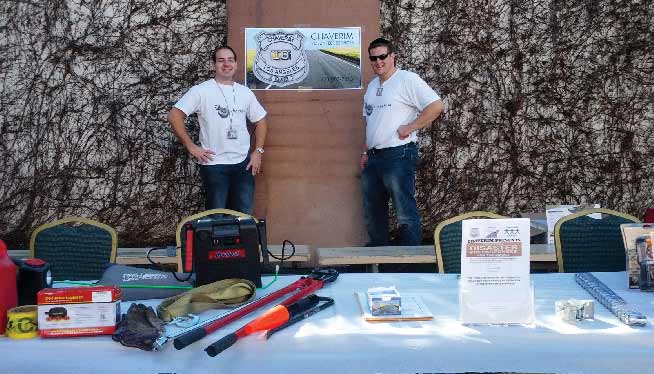
On Sunday January 13, 2013 Chaverim of Los Angeles joined Congregation Shaarey Tzedek of Valley Village in their  “Community Safety Fair”. The fair also featured CPR classes, a Bikur Cholim blood drive, and a Hatzolah information booth with their vehicles on display. In addition to Chaverim displaying their day-to-day equipment and performing live demonstrations, Chaverim showcased a novel concept to the Los Angeles community; Disaster Preparedness Kits.

Although Chaverim started as an organization primarily focused on emergency auto roadside assistance, recent global events has changed the way Chaverim approaches disaster preparedness. It is Chaverim’s goal to bring disaster awareness and preparedness to the entire Los Angeles community.

In addition to informing visitors on the need to prepare, Chaverim’s booth offered two levels of disaster kits for sale. The kits included: enough water and food for two people (for two days), a large first aid kit, a hand cranked flashlight-radio, rain ponchos and blankets, emergency lighting, waterproof matches, an axe, ponchos and blankets, a crowbar, a multi-tool and other essential items. Also for sale were power inverters, emergency lanterns, blackout lamps for the home, and portable gas generators.

The community members who stopped by at the booth were educated as to what should be done to prepare for a disaster, including how to make a plan and how to prepare for unpredictable events. The purpose of the display was to inspire them to build a kit, be prepared, and spread the word to others.

Our demonstrations: Chaverim volunteers changed tires, provided jump-starts, and opened a locked car door with a child stuck inside the vehicle in less than 30 seconds. All Chaverim equipment was on display as well, including home lockout equipment, large bolt cutters capable of breaking locks, flashlights, tool kits, safety flares, fire extinguishers, tow straps, socket wrenches, and much more.

Chaverim will continue to educate the public about the importance of preparedness and spread awareness throughout the communities. To help support Chaverim in it’s day-to-day operations or to sponsor disaster supplies, please visit them on the web at www.chaverimla.org and click the donate button.

 Chaverim can be reached on their 24/6 hotline: 323-903-7613


Tashbar Torat Hayim-LA’s Only Sephardic Yeshiva

0

Tashbar Torat Hayim, now in its 26th year, is the only Sephardic yeshiva in Los Angeles serving students from preschool through 8th Grade. The student body is made up of children from a variety of family backgrounds including Moroccan, Yemenite, French, Israeli, Persian and Ashkenazi. At Tashbar, the children gain a broad education, rich in Sefardic tradition.

Tashbar’s preschool program for children ages 2-5 integrates Judaic and secular subjects. Sparks of Torah and Judaism are ignited daily through a variety of creative and stimulating activities.  The curriculum emphasizes Tefilah, Mitzvot, Midot Tovot, and Sephardic Minhagim. Shabbat and the Chagim come alive through songs, stories, arts and crafts, and interactive activities. Experiences in science, cooking, art, language and math concepts, experimenting and risk- taking, all contribute to a young child’s feeling of success.  The preschool classrooms are buzzing with meaningful activities, purposeful play, language opportunities, stories, and the activities needed to build skills for higher learning.  Each child is encouraged to discover his or her own strengths and interests, with the guidance of the professionally trained Morot. Tashbar’s staff proudly includes the 2012 recipient of the BJE’s Judaic Curriculum award.

Classes from Pre-1 and up are separated by gender. The General Studies curriculum is based on California State Common Core Content Standards. Tashbar’s credentialed teachers create a learning environment which encourages students to maximize their potential in all subject areas. The Torah Studies curriculum is taught by dynamic Rabbanim and Morot who teach a love of Torah along with the skills necessary to be life-long learners. The boys learn to chant the Torah with Ta’amim and begin reading the Maftir in the Synagogue when they are in 1st grade.

The school boasts a vibrant PTA and many family events such as Father-Son Learning, Mother -Daughter Programs, parenting classes, and more.

Tashbar plans to open a brand new Mommy and Me Program after Pesach. Tashbar encourages students to love Torah, to live Torah, and to make Torah a part of their daily lives.

For more information call Tashbar Torat Hayim 310-652-2626

It’s Time to Press Your Luck

0

Yes, folks, despite conventional wisdom, I think you absolutely SHOULD press your luck.  Now, I don’t mean you should go running through traffic on a busy street during a blackout wearing a scuba suit, or that you should pick a fight with some angry bikers at a highway rest stop because you didn’t like how one of them was looking at you, or that you should ask for seconds of Cousin Rosie’s world-famous gefilte fish blintzes.  I said press your luck – not do something crazy.

Judaism doesn’t believe in luck.  We have Mazel.  Mazel, for the uninitiated, is not Hebrew for luck.  Mazel means planet, and refers to the effect the placement of various planets and stars in the Heavens at the time of one’s birth have on each of us.  I know; you figured that astrology was all hocus pocus and was just made up by the tabloids to give us something to read next to the comics, but it’s not.

True astrology has its roots in the fact that everything in the Universe was created by HaShem, so it all works together.  The Creator instilled in His great machine the fact that certain things cause other things to happen.  I can’t tell you why someone’s sign or natal chart affects them, but the really good astrologers can tell you how.

To me, it makes no difference if someone is a Leprechaun with a Son on Jupiter, or if they’re a Cancer with a Bad Moon rising.  The bottom line is, the Universe was created with interconnecting aspects, and Mazel is one way G-d affects people’s lives.

Everyone knows “Mazel Adar Dagim,” the Zodiacal sign for the Hebrew month Adar is Pisces, the fish.  The Jewish People are compared to fish, and Adar is known to be “our month,” when we believe we will be more successful in court battles, business dealings, and other undertakings. You know who else knew that?  Pharaoh.  Yes, when Moshe went to Pharaoh all those thousands of years ago, Pharaoh thought that his time was about to come because Chodesh Nisan was just around the corner.

According to the Aruch HaShulchan (OC 429) He figured Moshe had been able to subdue him with Makkos because the Egyptian’s god, the sheep, wasn’t at full power.  When Nisan arrived though, the month of the Zodiacal sign t’leh, or sheep (Aries for those who understand it), Pharaoh was sure he would be victorious.  He had to be; it was time for his Mazel!

HaShem turned the tables on Pharaoh by saying, “HaChodesh HaZeh Lachem,” this is your month, and telling Moshe and Aharon that the Mazel of Nisan would work for the Jews just like Mazel Adar.  In fact, this wasn’t the first time HaShem had done something like that.

Avraham Avinu told HaShem that he had seen in the stars that he was not destined to bear children.  HaShem told him, “Don’t believe everything you read,” then manipulated Jupiter, moved things around, and presto! Avram becomes Avraham and fathers the Jewish People.  Though the basic structure and rules are there, nothing is set in stone when it comes to Klal Yisrael.

The Midrash says, “Everyone and everything needs mazel, even the Sefer Torah in the Ark.”  The simple understanding of this is that there are often numerous Sifrei Torah in a shul, but not all of them are “lucky” enough to be read from regularly.  It was that phrase that struck me as I reached for a chumash one day in shul.

As I stretched my hand out to the neatly arranged row of seforim, deciding which one I would take, I thought about the mazel they each needed to be the chosen one.  I ended up picking the one that was slightly forward of the rest of the row, noting it would be the easiest one to take off the shelf.  And that’s when it hit me.

Yes, you may need Mazel to find success, but you can “press your luck,” meaning to shove it aside or otherwise move or nudge it, and find ways to help your mazel.  This chumash was easily accessible so I chose it.  When we want to be picked for a promotion at work, invited for a meal on Shabbos, or chosen as a partner for a project, we have to make sure we’re visible and that we’re the easiest choice to make, one that the decider will find gratifying.

It’s been said that MaZeL is an acronym for Makom – place, Zman – time, and Lashon – speech.  If you can be in the right place at the right time and say the right thing, that’s mazel.  Well, you may not know what the right time is, but if you put yourself in the right place, when the time comes you’ll already be there!

If you want to become wise, the place to be is surrounded by wise people, Talmidei Chachomim who usually know what to say, and what not to say.  That will help your mazel because you’ll learn the power of the tongue, the L of mazel, the final piece of the puzzle.

And, my friends, the time has come.  We’re in the month of Nisan now, when HaShem told us that we’d overcome the standard-issue mazel by following His rules.  When we make ourselves more accessible, put ourselves in the right environment, and open ourselves to the possibilities of the Universe like the chumash or the sefer Torah in the Aron, we may find ourselves being picked for greatness we had no idea about.  We may find goodness and “mazel” chasing after us.  Yes, by manipulating our place in space, we can cheat destiny in a way that no one else can.

So go ahead and press your luck, but please, take my advice on the blintzes.

By: Rabbi Jonathan Gewirtz

Jonathan Gewirtz is a freelance writer whose work has appeared in publications around the world.  He also operates JewishSpeechWriter.com, where you can order a custom-made speech for your next special occasion.

For more information, or to sign up for his weekly Dvar Torah in English, e-mail info@JewishSpeechWriter.com and put Subscribe in the subject.

© 2013 by Jonathan Gewirtz. All rights reserved.


A Visit from Rabbi Noach Orlowek

0

Rabbi Noach Orlowek, Shlita visits Yeshiva Aharon Yaakov/Ohr Eliyahu, Los Angeles.

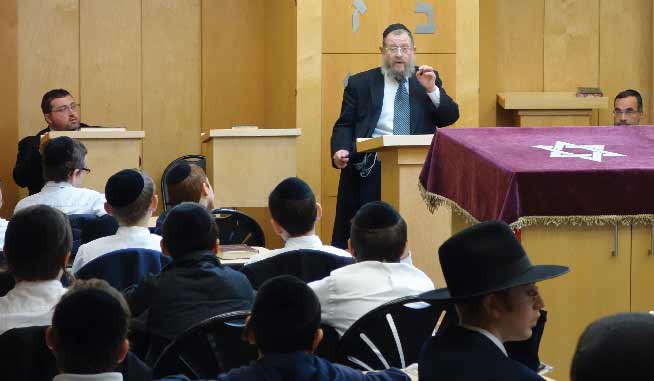
Rabbi Noach Orlowek, shlita, Mashgiach of Yeshiva Torah Ore, Jerusalem, and world renown mechanech and counselor, visited Yeshiva Aharon Yaakov/Ohr Eliyahu in Los Angeles, as he does yearly, to mechazaek the talmidim, administration and parents of the Yeshiva.  RavOrlowek, spoke to groups of elementary and middle school children on the subjects of Achdus, Hakaras HaTov, Being and Keeping a Good Friend, and How to Change.  All of the topics were connected with Parashas HaChodesh and Pesach.  Rav Orlowek was particularly impressed with the zest and comfort that the talmidim and talmidos had in interacting with the Rav and asking questions.
In addition to his talks with the students, Rav Orlowek taught the weekly Shiur for Women on Sefer Tomer Devora as the shiur completed the first chapter of this important sefer, an accomplishment that required two years and over 40 shiurim to complete, taught by the Yeshiva’s Menahel, Rabbi Shlomo Goldberg, himself a talmid of Rav Orlowek.  Finally, the school administrators were able to bring their questions to RavOrlowek, most notably on the subject of how to give children the inner strength in their early years to combat the onslaught of challenges that they are likely to face in later life.  The Yeshiva is already putting Rav Orlowek’s advice into practice and looking forward to next year’s visit.

Pesach In-Style With Meir Panim

0

Meir Panim’s Innovations Enables Indigent Israeli Families to Celebrate Pesach In-Style

While the ancient Israelites were miraculously able to rid themselves of back-breaking bondage and enter the Promised Land with the riches taken from their Egyptian taskmasters, hundreds of thousands of less fortunate Jews in modern day Israel, have had to rely upon the every-day miracles performed by Meir Panim’s angelic volunteers in order to celebrate Pesach without being enslaved by the soaring prices in the consumer marketplace.

Statistics don’t lie. Though Israel never officially fell into the economic muck, which has enveloped the USA, UK and the EU during the past five years, the number of individuals and families with children seeking economic and social welfare assistance from the government, as well as outreach organizations continues to climb in an unabated fashion. Over a quarter of Israel’s population currently lives below the poverty line!

To make matters worse, many Israeli outreach organizations such as Meir Panim, which are reliant on donations from the USA, UK and EU have been forced to do more with less based on global economic realities. However, Meir Panim, which has been lauded for their innovative social welfare programs, is blessed with a phalanx of talented individuals in the Holy Land. Meir Panim’s professional staff have been able to meet the herculean task of providing Pesach food baskets and personalized shopping cards to individuals and families in need, as well as creating “shidduchim” (matches) for nearly 3,000 other needy individuals and “lone soldiers” seeking a communal seder or with individual families who wish to perform the mitzvah of “hachnasat orchim”, by hosting someone.

“The unemployment rates are deceiving. We have become acquainted with a new type of poor: the working poor. Many families who are receiving our assistance have at least one head of family working. For instance, in Kiryat Malachi we have a family whose children attend our after school hours club. The father is gainfully employed at a nearby factory but only earns about 4000 shekels ($1000) per month, and is trying to pay bills and feed a family with five children, “revealed Goldie Sternbuch, Meir Panim’s, Assistant Director of Overseas Relations.

In order to understand the scope and breadth of Meir Panim’s unique pre-Pesach outreach, last year’s program highlighted:

•1,500 bountiful Pesach food baskets valued at $40-50 per basket were distributed in cities such as Jerusalem, Netanya, Haifa, Akko (Acre), Safed (Tzfat), Dimona etc.

•2,000 food shopping cards, with card values ranging from $75-80 dollars were personally delivered to needy families across the country by organizational volunteers

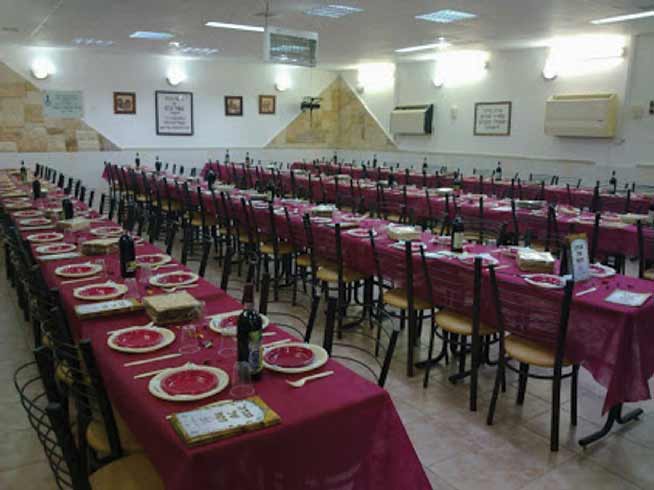
•Meir Panim’s “Kulam B’Seder” ( everyone at a Seder- a play on a popular Hebrew expression that means ‘everyone is OK’) campaign hotline received over 9,500 requests from needy individuals, lone soldiers and families looking to be “matched” for a festive seder; Families in 90 Israeli cities and towns hosted 2,989 needy people (average of 3 people hosted per family). According to Meir Panim over 3,000 people will be hosted this coming Pesach. “It is especially meaningful for us as individuals and as an organization to be able to assist people in need during one of the most important holiday seasons, by inviting them to our seder table,” added David Roth, President of American Friends of Meir Panim.

The “Kulam B’Seder” campaign in particular has become a fascinating challenge for both Meir Panim’s volunteer program managers, as well as the families. “It’s not just a matter of picking up the phone to a family and saying ‘so and so’ is coming. Remember, this is Israel where there are so many different types of Jews with different traditions, so it becomes a fascinating task for us to create a ‘shidduch’ for instance between an older Moroccan man with a Moroccan family that will have a seder in the North African tradition. This will also enable the hosts to make their guest (s) feel comfortable and create a long-term bond, which is the essence of this mission,” said one of Meir Panim’s hard-working volunteers. “The word-of-mouth about the Kulam B’Seder program is so positive that there is a real dynamism in play. There are hundreds of families across Israel who literally beg us to let them host people in need. Lone soldiers, who have left their families behind in a number of countries, in order to serve in the Israel Defense Forces and have nowhere to go for the seder, are especially popular with families who wish to provide them with a welcoming atmosphere and a festive meal. There are also families who every year celebrate Pesach in a local hotel. Some of them actually order an extra room so they can host guests and call us to make sure we send someone.”

Unfortunately, there are so many people who are in need of accommodations for Pesach that it’s difficult for a Meir Panim staff member to say ‘no’ to someone. “Because we don’t want to leave anyone behind without a seder, we’ll work right up until the last moment to make sure someone has a place to celebrate, whether it’s a public seder or someone’s home,” a Meir Panim volunteer added.

By Shlomo Stephens

For more information on how you can contribute to Meir Panim’s Pesach programs visit www.meirpanim.org.


The Pesach Connection

0

We of course know that our redemption from the bondage of Egypt occurred in the month of Nisan, but we also have been told by the Midrash that our future redemption will also come in the month of Nisan. So whenever Nisan comes along, we wait in breathless anticipation for our redemption, for the coming of Moshi’ach. It seems only fitting, then, that we should study about the future redemption, hoping that this will be the year when we will be redeemed and see the gathering of the Jewish people in Eretz Yisrael.

In fact, the Great Maharal of Prague likened the history of the Jewish People—itself reflected by the days of the holiday of Pesach—to a tunnel that leads from a light at one end—the brilliant age that began with the Exodus from Egypt and the Giving of the Torah, to the conquest of Eretz Yisrael and the building of the Temples in Jerusalem, ending with the destruction of the Second Temple—to a light at the other end, the light of the future redemption shines. This is the Messianic Age and the great era of Revelation of the coming period, when all of humankind will be redeemed along with the Jewish People, who will lead them.

That tunnel in between—a tunnel in which we have been living in for some 2000 years—could be divided into three areas, three periods: the first is the area of the tunnel just after the Destruction of the Second Temple. There was still light coming in from Am Yisrael’s earlier glorious period, some 1500 years long, during which the Jewish People created a great civilization based on Spirituality, Humanity and Law. Then the tunnel becomes dark, as the Jewish people was besieged and persecuted across the civilized world. In spite of its great thinkers and leaders of spirit, the Jewish nation suffered and endured a precarious existence. But now we come to the third part of the tunnel: a part in which we sense the light ahead of us, coming from a future period that will be filled with greater light and greater spirituality and G-dliness than we or the world has ever known.

Thinking about and studying that future Redemption is useful for two reasons: First, it prepares us for the great upheavals that will accompany the coming of Moshi’ach, so that we will not be overwhelmed and swept away by the great historical forces the coming of Moshi’ach will unleash. But second, the act of studying Torah and thinking about the future redemption in terms of Torah teachings and values actually hastens the coming redemption. We have been taught that G-d created the world in accordance with the “blueprint” that is contained in the Torah—more than that, the blueprint for all Creation is the substance of the Torah—and even that is only a small portion of the Divine mentality that is contained in the Torah. So is it any wonder that all of history unfolds in accordance with what is contained in the Torah.

Many people are hesitant to even think about Moshi’ach, because they are fearful of the great changes and upheavals that will characterize the Messianic Age, even if those changes will be positive and better. Some of that anxiety is due to the sorry examples we have had to endure in which a single monarch or a ruling class wields power over people’s and nations’ destinies. In our modern world, we have grown to become suspicious and anxious about great power being invested in a single individual or a single group—and who could blame us?

We have become more comfortable with authority being shared by the largest possible group of people, and that has given rise to the modern positive attitude toward democracy as a desirable—or, as Churchill put it, the least objectionable form of government. And even if authority would be invested in a single individual, we may wonder why that individual must be a monarch—why not a sage, a scholar, a teacher who will offer wisdom and advice that we can accept or not accept? Why must the future Redeemer be a solitary king?

Yet, that is how the Navi, the Prophet Yeshayahu describes the Moshi’ach, the future redeemer: a single individual who will rule by a sense of majesty and will be accepted as ruler by all of humanity. The last days of Pesach is a time filled with the light and energy of the future redeemer—we, in fact, read the section of Yeshayahu, Chapter 11, as the Haftorah portion in Shul on the last day of Pesach for this reason.

In the beginning of Chapter 11, the Yeshayahu Hanavi describes the Moshi’ach as a descendant of the House of Yishai, the House of David—a man of great wisdom and, more importantly, with a power of Prophecy that is nearly as great as Moshe Rabeinu’s—nearly, but not equal, for the Torah tells us that no prophet can exceed Moshe, and thus no one can change or revise the Torah that we received through Moshe at Sinai.

Yet the question remains, why does this require a king; why can’t this wonderful state of affairs be the work of a teacher, or a group of teachers and leaders, or of a representative government? But to understand this, we have to understand the Torah concept of a king. While a king is a teacher, lovingly guiding his people in the ways of righteousness and justice, he is a monarch who rules by virtue of the sense of the majesty he projects. That majesty comes from his unique connection to the highest reaches of understanding of the hidden aspects, the light concealed in the depths of the Torah.

In our world, leaders have become nothing more than managers who “open the store in the morning, close it at night, and watch the cash register.” But Moshi’ach will be much more than a manager, a clerk—even more than a rabbi or a teacher: he will also be a fount of inspired insight into the reality of G-d’s creation of the universe and how that reality heals and inspires the human spirit—how it gives rise to a world ruled by justice and compassion instead of greed and power.

The gap that will exist between the Moshi’ach’s understanding of the deepest secrets of Existence, Creation and the Divine Will is going to be so great, that it will be beyond the grasp of nearly everyone he touches and reaches. Make no mistake, the Melech HaMoshi’ach will have to pass the most rigorous test and meet the incredibly high standards of the greatest minds and the most sensitive and wise people of spirit—yet even they will fall short of matching his level of understanding. Even they will have to accept his teachings and his instruction—his rule—on faith. No one will be able to learn what he has discovered in the usual, plodding way we learn things from a textbook or a teacher. (Sorry, there’ll be no “For Dummies” title in this to help us.) Moshi’ach will inspire the world with his teachings and with his insighst into the deepest mysteries of creation. Yes, we will accept the teachings of Moshi’ach and be his loyal subjects as a matter of faith, because we will none of us be able to fathom every detail of what he has discovered in his explorations of the higher reaches of Existence and the majestic spheres of the Divine.

But this sort of soul does not happen by accident or come out of nothing. It arises out of the generations of people who have studied and observed Torah—and especially the ceremonies of the Seder on the first days of Pesach—for centuries and centuries. Whether we do it in the most correct way—mehadrin min ha’mehadrin: “to the most exacting standards of observance”—or in an approximate way only clumsily following the rules of Passover, millions of Jews all over the world will sit down and eat Matzah and dip herbs in salt water at the Seder, as they have done for centuries.

That’s the connection between the first days of Pesach and the last days. Jews for thousands of years have steadfastly and stubbornly observed the Passover Seder—in the dark cellars of Spain during the Inquisition; in corners of concentration camps during the Holocaust, and while ridiculed in America for our “quaint customs” by so-called sophisticated moderns. From that stubborn, persistent performance of the Seder on the first nights of Pesach, will arise the faith of the Jewish People to be loyal subjects of the Moshi’ach—and the special soul of the Moshi’ach that will, speedily in our day, redeem us all on the last days of Pesach.

 By: Rabbi Reuven Wolf

Rabbi Reuven Wolf is a world renown educator and lecturer who has
devoted his life to reaching out to Jews of all ages and circumstances and
rekindling their spirit of Judaism. Raised in the Ropschitzer Chassidic dynasty, he was educated in the Belz and Bluzhev Yeshivos, and later in the
celebrated Yeshivos of Slabodka and Mir. He is profoundly influenced by
Kabbalah and the Jewish Mystical teachings of Chabad Chassidic philosophy. Since 1995, Rabbi Wolf has taught Jews of all ages, all across North
America. In 2006, Rabbi Wolf and Haki Abhesera founded Maayon
Yisroel as a center dedicated to spreading the profound mystical teachings
of Chassidic Judaism and to fostering the love of Jewish tradition among all
Jews, particularly the young Jewish population of Southern California.

Deep Cleaning

0

Believe it or not, I have always found Passover to be one of the most inspired holidays when it comes to making connections between Jewish living and mental and spiritual well-being.  Although we all know that Rosh Hashanah is considered the Jewish New Year, the truth is that Nissan, and for that matter Passover, are truly the start of the spiritual new year.  On Rosh Hashanah we celebrate our physical creation and existence, and on Passover we are given the opportunity to reflect upon and celebrate our spiritual creation and existence.  This concept is particularly deep and meaningful, yet subtle.

At first glance, it would seem Passover is very much about the physical—deep cleaning, so much food to purchase and prepare, table to set, clothes to buy, business to get in order.  Yet underneath it all what it is really all about?  From the standpoint of cleansing, re-birthing  and nourishing our souls, there are some amazing opportunities waiting for us in the coming weeks that should simply not be missed.

Let’s take the cleaning for example.  We are commanded to remove “chametz” from our lives and our dwelling places.  We must scrutinize every corner of our homes by candlelight ensuring a thorough and detailed search for any last crumbs.  But what is chametz?  What does it represent?  We learn in the Jewish texts that chametz is much more than just the physical element of bread or wheat.  Chametz represents that within us that is darker—thoughts, emotions, behaviors—that hold us back from revealing our greatest Light.  The cleaning of our homes is more symbolic and a tool through which to find the strength and platform to explore ourselves on a more profound level.  We are not meant simply to physically clean, but to clean our psyche as well.  To review our nature and decide what stays and what is chametz to our soul.  As diligent as we are with scrubbing the oven, so must we be diligent in examining our intentions and our desire to improve as human beings.  Yes, it is hard work.  There is nothing easy about being an observant Jew.  However the rewards are great and usually surpass the investment of time and energy.

I’ll share with you a funny, personal story.  I was speaking on the phone one day with my husband’s ex-wife (yes, she is lovely, and yes, we get along well).  We were making plans for how to share the days of Passover with my husband’s children and we got to talking about the holiday of Passover itself.  At one point in the conversation we were laughing and she jokingly said, “Well, I got rid of my chametz a long time ago!” making a clear reference to my current husband . . . at which point I burst out laughing and replied, “You see??  One woman’s chametz is another woman’s matzah!”  We laughed hysterically for a couple minutes but the point of this story is important:  we each have our own spiritual chametz—what is bad for one person may be quite wonderful for the other—and this is why the work of Passover is so personal and so important.  No one can do this spiritual soul searching for you.  You may be able to hire someone to clean your home, but no one other than YOU can clean your heart and soul.  And, by the way, for all of those fortunate enough to do a Passover vacation experience, you can run from the cleaning but you can’t hide from yourself!  So, no matter what your plans are for this holiday, take advantage of the beautiful opportunity you have to create a new, shinier you.  Remove those blockages that hold you back.  Be real and honest with yourself.  Decide today that the status quo is never enough and that being a spiritual human being requires dedication to constant self-improvement.

So much of our happiness and personal fulfillment rests in our own hands.  Wishing everyone a blessed Passover holiday, chag sameach v’kasher

 By: Mia adler Ozair, Ma, lPCC, NCC


Forgetting the South

0

This Pesach, as we celebrate the Jewish People’s redemption from the depth of slavery, let us not forget Southern Israel which is still suffering from the after effects of years of terror, economic instability and the recent army operation, Pillar of Defense”. Despite the cessation of headlines from the South, the economic strains of this tumultuous region are still being felt.

On the 14th of November, 2012, Israel was yet again engulfed in fighting on its Southern border. Operation Pillar of Defense was launched by the Israel Defense Forces (IDF) in response to the barrage of rockets emanating from the Gaza strip. Israel looked on as the IDF began its widespread campaign targeting military structures and operatives throughout Gaza. In response, Hamas shot over 1,400 rockets into Israel reaching as far as Tel Aviv and the outskirts of Jerusalem.

The South of Israel was under attack. The sirens wailed day and night and the south shut down. Residents of cities such as Ashkelon, Kiryat Gat, Kiryat Melachi and Beer Sheva fled to their shelters. Sderot residents on Gaza’s border had long become familiar with the “Red Alert” warning them of imminent attack but for those cities located up to thirty miles from Gaza, the operation came as a shock.

Factories closed, transport ceased and citizens took cover. Six Israelis were killed, 269 Israelis were injured and houses, cars and businesses were damaged. For the South, which contains some of the most economically disadvantaged areas in Israel, the operation was yet another blow for their fragile economy.

But as the shelters once again gather dust, the south of Israel is still struggling to pick its feet up economically after years of poverty, distress and neglect.

Picking up the pieces economically: According to the central bureau of statistics, in 2001 31% of the South was classified to be ‘poor’. The research used a new indicator to measure poverty and defined a person as poor when his “physical existence and needs distract him every minute of the day and therefore most of his economic resources are allocated to food consumption and residence.”

Just fifteen miles from the Gaza strip lies Kiryat Gat. During Operation Pillar of Defense rockets sent residents running for shelter and this already poverty stricken city was plunged further into darkness. “The economic situation in Kiryat Gat is unstable. The operation made it worse; people didn’t leave their houses,” said Maya Naim whose house in Kiryat Gat was hit by one of the rockets coming from Gaza. “My business suffered, my house was damaged and my disabled son’s car was destroyed.” Naim has received compensation for the damage to her house but the car was not included in this. She is now spending hundreds of shekels each month on taxis to enable her son to get to work.

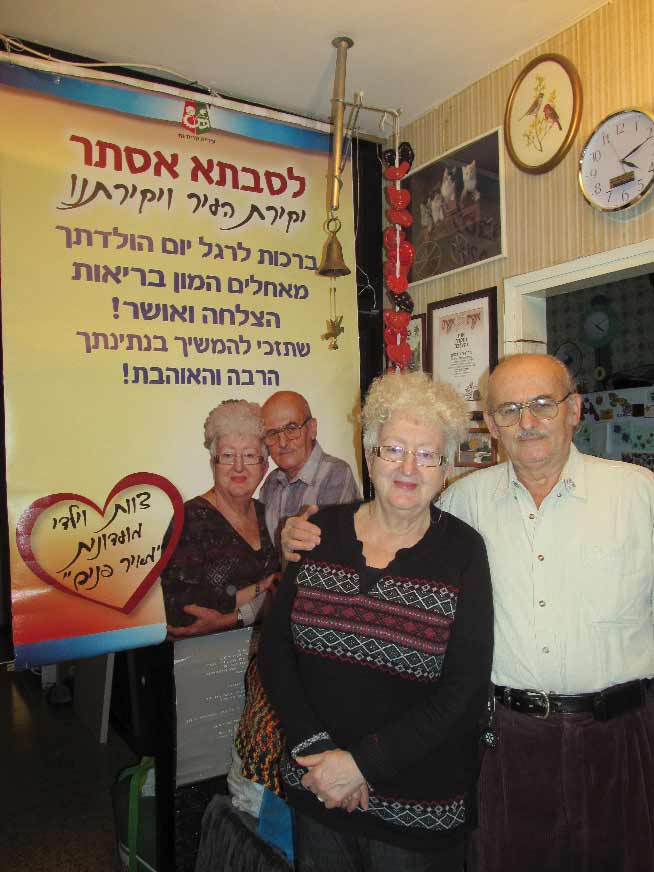
Kiryat Gat’s residents struggle to provide for their families’ basic needs with the average wage being around 50% lower than the national average. Though the situation is dramatic and unemployment rates run high, there are organizations and individuals making a real difference to this troubled community. Esther Richtman is one such shining beacon and she was recently honored with the “Citizen of the City” award at a ceremony in the city center.

Savta Esther, the city’s Grandmother: Richtman arrived in Kiryat Gat in 1964 from Romania with her husband Abraham and their first child on the way. Following a long career in the textile industry the couple decided to spend their retirement giving back to the people of Kiryat Gat. Richtman, who is locally known as Savta Esther (Grandma Esther), has now become somewhat of a local celebrity thanks to her work with Meir Panim.

Leading Israeli relief organization, Meir Panim, operates two Power of Giving warehouses in Southern Israel to distribute furniture, clothes and other necessary household equipment for those who cannot afford to purchase them at regular prices. Richtman began volunteering at the Kiryat Gat warehouse sorting items and mending donated clothes. “I saw the good that Meir Panim was doing by supporting the poor but more importantly, how they did it with dignity” (customers pay a nominal fee for each item so that it does not feel like receiving a hand-out). Eight years ago, when volunteering in the warehouse, she overheard that Meir Panim was looking for someone to run their after school facility for some of the poorest children in Kiryat Gat and she jumped at the chance. “Within a week Meir Panim had located premises for me, provided me with National Service volunteers and we had decorated the club to feel like a home,” Richtman explains. “We are dealing with children whose parents cannot afford to feed them healthy meals each day, who are left to their own devices and who simply continue their parents’ cycle of poverty.”

Breaking the cycle of poverty: Together with Meir Panim, Savta Esther is working to break this cycle of poverty. The children turn up to school prepared because she delivers school supplies at the beginning of the school year. The children are able to study because they receive two hot meals a day and studying at school is complemented with homework help from the National Service Volunteers. “I’m so grateful that Savta Esther came into our lives eight years ago,” said Chagit Hazan mother of two participants in the after school club. “I work long hours in an old age home and try to support my children on my own but without Savta Esther and Meir Panim I don’t know what we’d do.” Hazan says that there are parents and children queuing up to be admitted to the after school club.

Kiryat Gat is just one example of a city trying to get back on its feet now that peace has returned to the area but it is not easy. “When the rockets stopped falling, Southern Israel slipped off the media radar,” explains Goldie Sternbuch, Assistant Director of Overseas relations at Meir Panim. “But for those of us who witness this poverty daily, it is clear that help is needed now, as much as ever before.” Meir Panim is currently building a Nutrition Center located in Kiryat Gat which will not only produce the thousands of hot meals that Meir Panim need to feed Israel’s poor each day but it will provide a much needed boost to Kiryat Gat’s dwindling economy.

Getting the South back on its feet after years of trauma caused by rocket fire and economic distress is no easy feat but slowly but surely the future looks more positive. “This Pesach we will be yet again distributing food cards to enable residents stock their cupboards with the special foods needed at this time of year,” Sternbuch said. “We will be hosting hundreds of adults and children for communal Seders and hoping to bring a little joy to those in the midst of economic distress.” Like in previous years, Savta Esther also has a few tricks up her sleeves for the children of Kiryat Gat and she looks forward to truly celebrating Pesach both with the children and also with their extended families.

By Anna Harwood 


Israeli Hospital Receives Prestigious Computing Prize

0

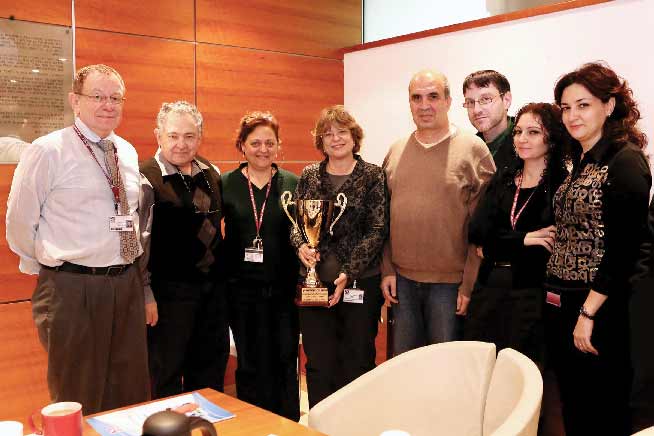
Rambam Hospital in Haifa has won the ‘Oscar’ of the Israeli computing world for a program it has developed that can manage hospitals during a time of emergency. The “e-mergency” advanced information and control system, which won the 2012 Outstanding Project Award at the highly acclaimed ‘IT Awards’ competition in Israel, enables hospital staff to move from a ‘routine’ to ‘emergency’ state as quickly and as efficiently as possible.

As the first system of its kind in Israel, the “e-mergency” program’s purpose is to enable the hospital’s leadership to make intelligent decisions based on an integrated flow of information received in real time. The system automatically reports on crucial aspects of hospital functioning such as excess demand and bottlenecks, indicating the number of blood portions on hand or the number of available operating theaters. Simultaneously, it controls security cameras, disseminates e-mail and SMS notifications, and runs the public address system. It also automatically documents all developments and decisions in a computerized events journal that will enable production of an investigative report and the drawing of conclusions after the event.

With the capability of leading decision makers through pre-designed processes for every possible scenario, the system has the potential to revolutionize emergency medical care, Since this is unfortunately becoming an increasingly important consideration in Israel, the program has awakened widespread interest. In fact, the Emergency Branch of Israel’s Ministry of Health, has already expressed the intention of purchasing it.

“Our aim is to facilitate Rambam Hospital’s work during a real emergency and to enable decision-making on the basis of changing data, under optimal conditions,” explains Ms. Sara Tzafrir, of the Division of Information Technology & Communication Services at Rambam Hospital. “This system can certainly help the hospital staff to cope with tough scenarios and enable the best care possible under these circumstances. It may even save lives.”


WP Twitter Auto Publish Powered By : XYZScripts.com